DD
MM
YYYY

PAGES

DD
MM
YYYY

spot_img

PAGES

Home Blog Page 167

Implications of France Lifting the Travel Ban on Telegram CEO Pavel Durov

0

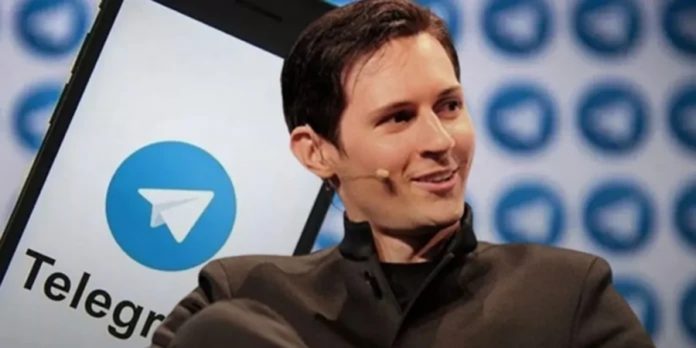
French authorities fully lifted the travel restrictions imposed on Pavel Durov, the CEO and founder of the encrypted messaging app Telegram.

This decision ends a year-long period of judicial supervision that had barred him from leaving the country without authorization, following his high-profile arrest in August 2024 at Paris’s Le Bourget Airport.

Durov, a French-Russian dual national, was detained on charges related to Telegram’s alleged failure to cooperate with law enforcement in combating illegal activities on the platform, including the distribution of child sexual abuse material, drug trafficking, and other crimes.

Prosecutors accused him of complicity in these offenses, with potential penalties of up to 10 years in prison and fines exceeding $500,000. Post-arrest, Durov was placed under strict judicial control, requiring him to remain in France and report regularly to police in Nice.

This effectively grounded him, limiting his ability to travel to Telegram’s headquarters in Dubai. In July, restrictions were relaxed, allowing limited stays in the United Arab Emirates up to two weeks at a time.

In November 13, 2025, courts removed all remaining measures, including the travel ban and mandatory police check-ins. Durov is now free to travel internationally without oversight. The move was confirmed by judicial sources and reported by multiple outlets, though the underlying criminal investigation into Telegram remains active.

Durov has consistently denied the allegations, framing his arrest as an attack on free speech and privacy. In statements, he argued that Telegram operates as a neutral platform compliant with EU laws and that the case damaged France’s reputation as a hub for innovation.

Supporters, particularly in crypto and privacy communities, hailed the decision as a win for digital rights, with social media buzz linking it to optimism around Telegram’s TON blockchain ecosystem.

Critics, including French prosecutors, maintain that the platform’s end-to-end encryption has hindered efforts to moderate illicit content, sparking ongoing debates about tech accountability versus user privacy in Europe.

This development could signal de-escalation in the case, but no trial date has been set, and Durov’s legal team continues to push for dismissal. Telegram, with over 900 million users, has emphasized its cooperation with authorities while prioritizing user protections.

The decision by French authorities on to fully lift judicial supervision on Pavel Durov—including the ban on leaving France and mandatory police check-ins—marks a significant de-escalation in a high-stakes legal saga.

While the underlying criminal investigation into Telegram’s alleged complicity in facilitating illegal activities such as child exploitation material, drug trafficking, and fraud remains active, this move carries broad ramifications across legal, business, technological, and geopolitical domains.

Durov, can now travel freely without restrictions or bi-weekly police reporting in Nice. This ends a 15-month ordeal that began with his August 2024 arrest at Paris-Le Bourget Airport.

Judicial sources cited his full compliance with supervision as a factor in the decision. No trial date is set, and Durov remains under formal investigation. His legal team continues pushing for dismissal or reduced charges, arguing procedural flaws and that holding CEOs personally liable for user actions sets a “dangerous precedent.”

A conviction could still mean up to 10 years in prison and €750,000+ fines, but this lift signals potential weakening of the case. During the probe, Durov acknowledged rising criminal abuse on the platform and committed to improvements.

Telegram rolled out AI-powered tools in early 2024 and blocked over 34 million groups/channels in 2025 alone—demonstrating proactive enforcement. This could help fend off further regulatory pressure, positioning Telegram as a more “responsible” privacy-focused app.

Freed from constraints, Durov can more actively lead from Dubai HQ, potentially accelerating features like mini-apps and payments. Social media reactions highlight optimism for user growth in Europe, where Telegram competes with WhatsApp amid privacy concerns.

If the probe uncovers more evidence, it could lead to asset freezes or platform-wide blocks in France/EU, echoing past U.S. pressures Durov has cited. Telegram’s native blockchain, TON, surged ~4% immediately after the news, with community hype around Durov’s renewed ability to promote projects like the decentralized AI network Cocoon.

Posts frame this as “TON season” intensifying, linking Durov’s freedom to innovation in DeFi, NFTs, and Web3 integrations. The case underscores tensions between privacy tech and regulation, potentially influencing EU crypto policies. Durov’s recent meetings suggest expanded global partnerships.

This could shape EU enforcement of the Digital Services Act (DSA), balancing end-to-end encryption with moderation demands. Critics like French prosecutors see Telegram as a “safe haven” for crime; supporters view the lift as a rebuke to overreach.

Durov has called it an attack on free speech, damaging France’s innovation image. Similar probes (e.g., in Brazil or India) may pause or adapt, signaling that compliance yields concessions. It reinforces Durov’s narrative of governments targeting “tech leaders who defend privacy.”

Durov accused Paris of censorship and weakness; the lift may mitigate backlash but highlights EU-U.S. alignment on tech ccrackdowns. This is a partial victory for Durov and Telegram—easing immediate pressures while amplifying their privacy ethos—but the open investigation keeps the stakes high.

It could catalyze Telegram’s expansion and TON’s rally, but also fuel stricter EU rules if unresolved. Watch for Durov’s next moves, like Cocoon updates, as indicators of momentum.

Why Zero Knowledge Proof (ZKP) Is Surpassing ASTER & TON as the Top Trending Crypto for 2025

0

Aster and Toncoin continue showing technical activity, yet these patterns alone do not define which project becomes the top trending crypto for 2025. This distinction emerges when comparing structural readiness rather than surface-level chart reactions. ASTER may be forming familiar bullish setups, and TON is trying to stabilize above an important support zone, but neither reflects the depth of preparation shown by one competitor already shaping a clearer path ahead of its presale auction.

Zero Knowledge Proof (ZKP) enters that picture with unusually strong groundwork completed before launch. With more than $100 million already deployed toward development, plus $17 million of finished hardware placed in inventory for immediate delivery, the project has built much of its ecosystem before accepting presale participation. That shift from reactionary building to pre-launch completion is why Zero Knowledge Proof (ZKP) is increasingly referenced in early discussions about the top trending crypto for 2025.

ASTER: Technical Structure Still Looking for Confirmation

ASTER has drawn attention due to its developing “Power of 3” setup, known for a sequence involving accumulation, a shakeout phase, and ideally a later expansion. This structure reflects volatility followed by a potential upward move, and recent trading between $1.52 and $2.28 suggested some early steps toward that cycle. However, the drop toward $1.10 raised questions about the sustainability of the pattern, prompting a closer look at the thresholds that matter most.

Analysts are watching the $1.80 level, which aligns with the 100-hour moving average. A close above that area could open a path toward $2.28 and possibly $3.41 if overall momentum strengthens. But failing to maintain support around $1.52 risks weakening the broader setup. This leaves ASTER in a transitional state: strong potential, but incomplete confirmation. For that reason, its standing in conversations about the top trending crypto for 2025 remains limited until clearer signals appear.

TON: Maintaining Support While Awaiting Direction

Toncoin finds itself in a similar scenario. It briefly slipped below the familiar $2.00 support level before recovering, indicating that active buyers remain present. That recovery pushed the price to roughly $2.12, though the move lacked force, reflecting lingering weakness in several indicators. With the price sitting beneath important moving averages, TON still requires a more decisive shift to change its trajectory.

The immediate focal point is $2.35. A strong close above that level could create the momentum needed to establish a new upward trend. Failure to do so, however, and a renewed break of $2.00 could send the price toward $1.85 or even lower. Despite a committed user base and a functioning network, TON continues to wait for a catalyst that could reposition it among the top trending cryptos for 2025. Until that spark appears, its chart suggests more consolidation than expansion.

Zero Knowledge Proof (ZKP): Built Ahead of Demand

Zero Knowledge Proof (ZKP) offers a contrasting model. The project has not yet opened its presale auction, and the whitelist is live while the auction itself is only days away. Yet discussions about the top trending crypto for 2025 are increasingly placing Zero Knowledge Proof (ZKP) ahead of several active tokens. The reason is simple: the project is launching with most of the work already complete.

Its team funded more than $100 million of development independently, choosing to construct the full system before inviting presale participation. This includes finalizing its infrastructure plan, preparing its Initial Coin Auction system, and ensuring that every participant enters through the same rules. With no private allocations, no insiders, and no discounted early rounds, the structure is designed to create a balanced entry environment.

Alongside that, over $17 million worth of Proof Pods, the hardware powering its AI compute operations, is fully manufactured and scheduled for global shipment within five days once the presale begins. This means Zero Knowledge Proof (ZKP) will launch with functional technology available from the outset, a scenario rarely seen in early-stage crypto ecosystems. This emphasis on readiness rather than speculation explains why it is consistently referenced among analysts discussing the top trending crypto for 2025.

The absence of token-based hype has not slowed attention. In fact, the preparedness of the system has made Zero Knowledge Proof (ZKP) more visible than many assets already trading on exchanges. With infrastructure complete and distribution rules finalized, it shifts the conversation from anticipation to execution, positioning it as a project shaping its trajectory rather than reacting to the broader market.

The Broader Outlook

What stands out across these comparisons is the difference between waiting for momentum and establishing it. ASTER and TON both exhibit technical setups that could develop into stronger trends, but each still depends on external confirmation before gaining broader traction. That dependency limits their long-term narrative until new catalysts emerge.

Zero Knowledge Proof (ZKP) approaches the timeline differently. By entering the market with real infrastructure, transparent allocation rules, and ready-to-ship hardware, it begins its presale phase with most foundational challenges already resolved. That level of preparation supports its position in conversations about the top trending crypto for 2025 and reinforces its role as a project building deterministically rather than reactively.

As the market progresses, the projects that shape their conditions rather than chase them are likely to set the tone for the next cycle. Zero Knowledge Proof (ZKP) is already demonstrating that shift, and its growing momentum reflects how preparation can drive early recognition in a crowded field.

Find Out More about Zero Knowledge Proof:

Website: https://zkp.com/

MicroStrategy ($MSTR) Stock Dips Below $200 First Time Since 2024 

0

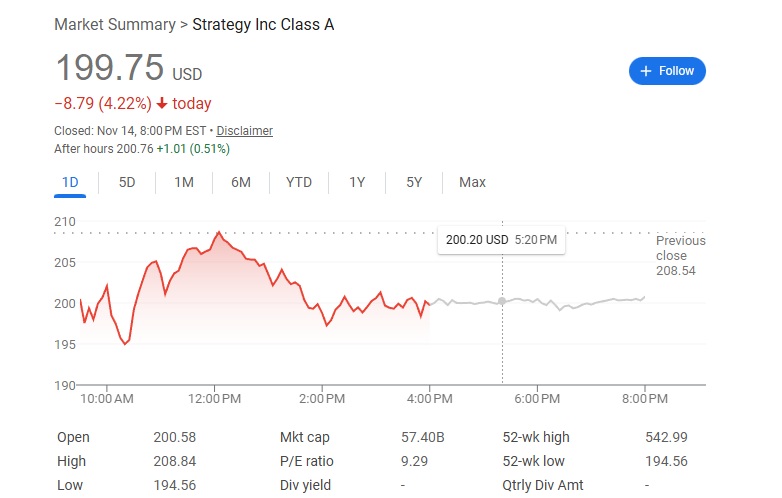
As of pre-market trading on November 14, 2025, MicroStrategy now rebranded as Strategy shares have fallen below $200 for the first time since early October 2024, when the stock traded around $180–$190 amid post-election volatility following Donald Trump’s victory.

The stock closed at $208.54 on November 13, down 7.15% for the day, and is extending losses today with pre-market bids around $195–$198. This marks a roughly 63% drawdown from its all-time high of $543 earlier in 2025, and a staggering 54% decline since mid-July.

MicroStrategy’s stock is essentially a leveraged bet on Bitcoin (BTC), holding over 397,000 BTC valued at approximately $70 billion (as of Q3 2025). The recent slide mirrors BTC’s pullback below $100,000—down 20% from its October peak—but MSTR has underperformed dramatically, decoupling from its crypto proxy role.

Historically correlated at 0.92 with BTC, MSTR has amplified downside due to its aggressive debt-fueled BTC acquisitions. BTC is only -20% YTD, while MSTR is -73% from its 2025 peak. The stock’s multiple-to-net-asset-value (mNAV) has collapsed to 1.06x from 2.7x last year, now trading near or briefly below the value of its BTC holdings per share adjusted for debt.

This erodes the “premium” investors once paid for CEO Michael Saylor’s strategy. The stock has experienced significant volatility in 2025, peaking at $543 in early November before a sharp correction. It is now trading about 62% below its all-time high, with the multiple-to-net-asset-value (mNAV) ratio—comparing stock price to Bitcoin holdings per share—compressing to around 1.22x, down from highs above 2.7x earlier in the year.

This narrowing premium has raised concerns about the sustainability of its “Bitcoin treasury” strategy, though CEO Michael Saylor has emphasized continued accumulation rather than sales. -29.22% underperforming the S&P 500’s ~20% gain.

These figures reflect a broader downtrend in crypto-related equities, with MSTR down over 10% in the past month alone as Bitcoin fell more than 10% from its recent peak.

MSTR’s stock has declined in tandem with Bitcoin’s drop to a six-month low, amplifying losses due to the company’s leveraged exposure via debt-financed BTC purchases. Despite this, Strategy recently added to its holdings, bringing total BTC to 641,692.

Analyst Sentiment: Of 15 analysts, 12 rate it “Strong Buy,” 1 “Moderate Buy,” 1 “Hold,” and 1 “Strong Sell.” The average price target is $523, implying over 155% upside potential from current levels.

RSI at 23.7 deeply bearish, price below the 200-day SMA ($342). Death cross confirmed: 50-day EMA crossed below 200-day EMA. Short interest up to 10% from 7% YTD low, with bears like Jim Chanos who recently closed his short warning of potential BTC liquidation if mNAV dips below 1x.

Inverse cup-and-handle pattern suggests further downside. Q3 earnings showed $2.8B net income from unrealized BTC gains, but core BI software revenue ~$480M TTM grows modestly at 5–7% YoY and remains unprofitable without crypto boosts.

High debt/equity (14%) creates negative carry but boosts ROE to 25.59%. Recent upsized stock offerings for BTC buys have sparked dilution fears, especially as passive funds post-2022 inclusion hold steady.

Further downside to $187–$190 next support, or even $180 if BTC tests $90K. Analysts see risk of BTC sales if mNAV <1x, potentially flooding the market. High-beta nature could drag it 80% from ATH as in 2022.

Oversold bounce if BTC reclaims $110K. Contrarians eye a 2023-like +1700% run if premium rebuilds to 2x+. Saylor’s playbook remains intact with $70B treasury, and passive inflows could stabilize.

Traders call it “brutal AF” and a “deep correction,” with some eyeing $180 targets, while others insist “$MSTR will never go below $200 again!” ironically, just before it did. If you’re holding or trading, watch BTC’s $100K level closely—it’s the linchpin.

Polymarket and UFC Announce Landmark Partnership

0

TKO Group Holdings – the parent company of the Ultimate Fighting Championship (UFC) and the upcoming Zuffa Boxing promotion—announced a multi-year partnership with Polymarket, designating it as the official and exclusive prediction market partner for both UFC and Zuffa Boxing.

This deal marks the first time major sports organizations have integrated prediction market technology directly into live events, aiming to enhance fan engagement by blending real-time crowd-sourced insights with traditional viewing experiences.

The multi-year deal between Polymarket and TKO Group Holdings UFC’s parent company positions prediction markets as a core element of combat sports entertainment. Announced on November 13, 2025, this first-of-its-kind integration blends blockchain-powered trading with live events, potentially reshaping fan interaction, market growth, and regulatory landscapes

Polymarket will introduce a real-time Fan Prediction Scoreboard during UFC broadcasts and live arenas, displaying evolving probabilities of fight outcomes based on user trades. This allows fans to track sentiment shifts round-by-round, treating predictions like tradable stocks for dynamic interaction.

Zuffa Boxing Tie-In: As the inaugural brand partner for Zuffa Boxing launching January 2026, Polymarket will feature similar activations, including in-arena experiences and custom social/digital content.

Starting in 2026, all U.S. UFC and Zuffa Boxing events will stream exclusively on Paramount+, with Polymarket data woven into commentary. A new digital series, Matchup Predictions – will launch on UFC’s social channels (Facebook, Instagram, Threads, X) to spark debates on future fights and drive new markets on Polymarket.

The partnership spans UFC’s premium assets, including events, broadcasts, and social media, positioning prediction markets as a complementary layer to regulated sports betting.

Ariel Emanuel, Executive Chair and CEO of TKO: “By partnering with Shayne and his team at Polymarket, we’re unlocking a new dimension of fan engagement. Integrating Polymarket with the UFC and Zuffa Boxing live experience will help fans interact with these events in real time, transforming passive viewership into active participation.”

Shayne Coplan, Founder and CEO of Polymarket: “Few sports generate emotion and debate like the UFC. By bringing prediction markets to the broadcast and arena, we’re giving fans a new way to be part of the action—not just watching outcomes but watching the world’s expectations evolve with every round.

What’s exciting is you can buy, sell, and trade just like a stock throughout the fight.” The announcement coincided with Polymarket’s team, alongside UFC’s Dana White and TKO executives, ringing the NYSE opening bell to celebrate TKO’s trading milestone and the partnership.

This follows Polymarket’s recent U.S. relaunch and partnerships with the NHL, PrizePicks, Google, Yahoo Finance, and DraftKings, signaling its push into mainstream sports and entertainment. For UFC, it taps into Polymarket’s blockchain-powered platform built on Polygon to reach hundreds of millions of global fans, potentially onboarding new users to crypto-adjacent tools.

On X, the news sparked excitement about mainstream adoption, with users highlighting how it could “put on-chain markets right in front of the mainstream world” and drive “massive influx of new users.”

This collaboration positions prediction markets as a novel engagement tool, distinct from betting, by emphasizing real-time, data-driven narratives around fan momentum.

The S&P Loses 1.6% as it is on Pace for its Worst November Since 2008

0

The S&P 500 closed sharply lower, dropping 1.66% to 6,737.49, extending a turbulent stretch for the benchmark index.

This marks the latest leg down in a broader market pullback that has the S&P on pace for its worst November performance since the 2008 financial crisis, when it plunged 7.5% amid the global meltdown.

The S&P 500’s 1.66% drop on November 14, 2025, capping a month-to-date decline of ~2.8% projected full-month loss of 4-5%, signals more than just a seasonal hiccup. This trajectory—the worst November since 2008’s -7.5% plunge—carries ripple effects across markets, the economy, and investor behavior.

Drawing from historical precedents, current data, and real-time sentiment, here’s a breakdown of the key implications. While earnings resilience offers a buffer, intertwined pressures like the government shutdown, Fed hawkishness, and tech valuation resets amplify risks, potentially extending volatility into Q4 and beyond.

Through the first 10 trading days of the month up to November 14, the index is down approximately 2.8% from its October 31 close of around 6,925, based on recent data showing a slide from highs near 6,850 earlier in the week. If the current trajectory holds—factoring in lighter holiday volume and lingering uncertainties—the full-month loss could approach 4-5%, the deepest since 2008’s rout.

The selloff reflects a confluence of factors weighing on investor sentiment. Technology stocks, which comprise over 30% of the S&P 500, led the decline, with the Nasdaq Composite falling 2.29% to 22,870.36.

Heavyweights like Nvidia (NVDA) shed 3.58%, Tesla (TSLA) tumbled 6.64% after breaking key support levels, and Disney (DIS) dropped 7.75%. Posts on X highlight this as a “tech tantrum,” with AI hype deflating and investors shifting to defensive sectors like energy (e.g., Exxon Mobil up 0.57%) and consumer staples.

Hawkish comments from Federal Reserve officials have slashed December rate-cut odds to just 49-53%, per market pricing. This comes as inflation concerns persist amid the U.S. government shutdown, now in its 45th day since October 1.

The shutdown—triggered by disputes over Affordable Care Act subsidies and budget extensions—has disrupted economic data releases and fueled fears of labor market strain. The VIX fear gauge surged 11.45% to 22.29, up 26% over five days, signaling heightened uncertainty.

Treasuries rallied as a safe haven, with the 10-year yield dipping 4 basis points to 4.08%. Crude oil bucked the trend, rising 1.60% to $59.63 on supply worries.

Historically, November has been a strong month for the S&P 500, averaging +1.4% gains since 1950. But downturns tied to macro shocks—like 2008’s credit freeze—can turn it brutal.

Despite the pain, some analysts see this as a “Black Friday sale” for long-term buyers, with support eyed around 6,630 the 50-day moving average. Earnings remain a bright spot: Q3 blended growth hit 10.7% year-over-year, led by the “Magnificent 7,” though Tesla and Meta disappointed.

FOMC minutes could clarify the Fed’s stance, while next week’s Nvidia earnings may either stem or exacerbate the tech bleed. Jobless claims and consumer confidence data will gauge shutdown impacts. Traders are split—some call it an “AI bubble burst,” others a “buying opportunity” in oversold names like TSLA near $400. High-volume distribution days suggest caution for bulls.

Markets are closed for Veterans Day on Monday, so watch for gap moves Tuesday. If you’re trading this volatility, consider protective puts or sector rotation into energy/defensives.