DD
MM
YYYY

PAGES

DD
MM
YYYY

spot_img

PAGES

Home Blog Page 169

Top Crypto to Buy: 4 Best Coins Primed for Life-Changing Profits

0

Next year, 2026, will likely see a crypto environment full of opportunities, with a few coins standing out as having the potential to bring huge, possibly life-changing profits. Those coins are Little Pepe, Dogecoin, Cardano, and Sui. Each of them features a distinct combination of strong fundamentals, innovative technology, and real-world applications that, in turn, attract more people. Whether you are a seasoned crypto investor or just thinking of a small investment, these are the ones you cannot afford to ignore. So, let’s go through them to see which ones might give us that big payoff in the future.

Little Pepe: Meme Vibes with Legit Features

Little Pepe (LILPEPE) is rising fast in the meme coin crowd, but it’s not all jokes; it’s got some real substance under the hood. Running on a Layer-2 chain that integrates seamlessly with EVM, it tackles those annoying high fees head-on, allowing you to zip through transactions quickly and essentially for free. That kind of setup makes it extremely approachable and ready to scale as things intensify. It’s not stopping at memes, either; Little Pepe’s crafting a whole ecosystem that’ll stick around. They’ve already raised over $27.4 million from the presale, with a community that has ballooned to 44,000 holders and more than 39,000 people chatting away on Telegram. People are hooked on the staking perks, where you could see up to 782% APY if you hold tight. Plus, no taxes on buys or sells means trading’s a breeze. They’re even rolling out PEPE’s Pump Pad, a spot to kick off new meme ventures, which amps up Little Pepe’s role in the bigger picture. With low fees, a fair start, and tons of buzz, this one’s poised for significant growth, with a 15x increase by 2026 not out of the question.

Dogecoin: Still Ruling the Meme World with Big Backers

Dogecoin (DOGE) has been the ultimate meme boss for years, and it’s not fading anytime soon. In November 2025, it is valued at approximately $0.18, with a market capitalisation soaring past $27.5 billion. That endless supply and die-hard fans keep it as a go-to for wild rides in the meme space. Daily trading? Often exceeding $2 billion, making it one of the busiest in the industry. On top of that, talk from President Trump about a $2,000 stimulus sparked a frenzy, bumping the price 6% and cranking up the trading vibe. Between that institutional pull and the ongoing hype, Dogecoin’s got the wind at its back for more climbs, potentially the kind that change portfolios by 2026.

Cardano (ADA): Planning to Be Used in Daily Life

At the moment, ADA is trading around $0.59, and its market cap is nearly $21.73 billion. One of the major highlights on the radar is the introduction of the Cardano Card, which allows users to use Apple Pay or Google Pay with ADA, Bitcoin, or stablecoins for fast and easy transactions, as well as earning rewards for staking. It is an important move to use crypto for daily spending and hence, linking Web3 to traditional banking. As Cardano continues to build bridges to real life and secure those partnerships, it’s shaping up to outpace many rivals, possibly delivering those massive wins by 2026 as more people join in.

Sui: The DeFi Up-and-Comer Shining Bright

Sui (SUI) is carving out a spot as a fresh DeFi powerhouse, with recent deals and tweaks putting it on a fast track for growth. We don’t have every detail on its market cap or exact price, but Sui’s focus on big-scale, enterprise-ready blockchain is turning heads. The November 2025 Mysticeti v2 update has accelerated transaction checks, reducing wait times and enhancing overall efficiency. It’s built for handling huge loads securely, which is crucial for DeFi to take off at scale. With that big-money appeal, top-tier scaling, and DeFi edge, Sui’s poised for some major leaps, making it a prime pick for those chasing transformative returns by 2026.

Conclusion: These 4 Coins Could Light Up Crypto’s Future

Hunting for cryptos that might just flip your finances? Little Pepe, Dogecoin, Cardano, and Sui are strong contenders. They’re each claiming their space with killer fundamentals, rising popularity, and fresh ideas that stand out in the crowd.


For more information about Little Pepe (LILPEPE) visit the links below:

Website: https://littlepepe.com

Whitepaper: https://littlepepe.com/whitepaper.pdf

Telegram: https://t.me/littlepepetoken

Twitter/X: https://x.com/littlepepetoken

$777k Giveaway: https://littlepepe.com/777k-giveaway/

Tekedia Capital is excited to announce our investment in Scalar Field

0

Tekedia Capital is excited to announce our investment in Scalar Field. The company is creating a new trading terminal (a modern Bloomberg terminal) from scratch with integrated datasets and the ability to backtest strategies, benchmark portfolios, and do event-driven trading research. With this, users can test any market hypothesis instantly and intelligently.

Remember: that whenever an analyst, trader, or quant looks at a Bloomberg terminal, they are consciously or subconsciously trying to verify a hypothesis, and that process is cumbersome, requiring users to sift through endless screens of data.

Scalar Field is reimagining the trading terminal from the ground up using intelligent agents, enabling users to directly test their hypotheses in real time, cutting through the noise and accelerating decision-making. They’re building a terminal that can run compute-heavy backtests, react to live market shifts, and trigger trades when your signals align. Agents reorganize dashboards, remember your research trail, and chain multi-hop logic, like surfacing trade ideas when ETF flows spike and earnings drop.

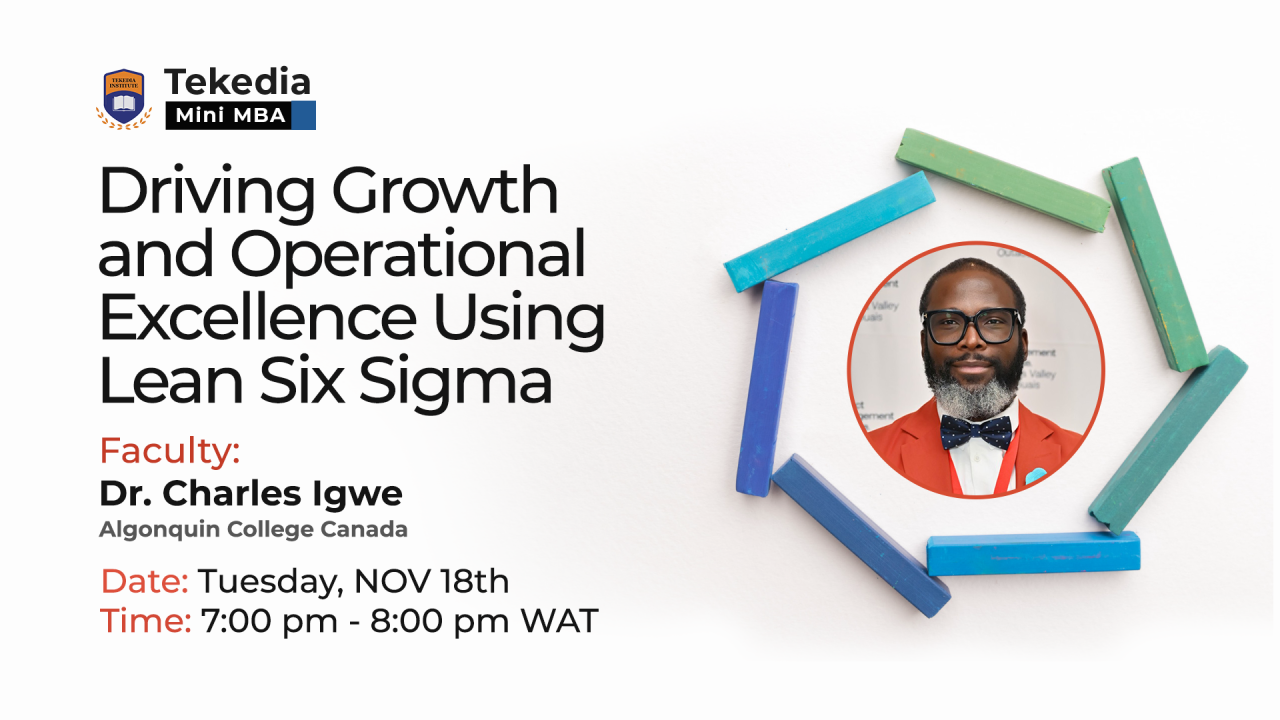
Driving Growth and Operational Excellence Using Lean Six Sigma –Dr. Charles Igwe

0

Come with your calculator and log book because you may need them. Indeed, you will understand the “Measure of Central Tendency” and how you can use lean six sigma to drive business growth and accelerate productivity. Join Dr Charles Igwe as he teaches on the topic – “Driving Growth and Operational Excellence Using Lean Six Sigma” – at Tekedia Mini-MBA Live at 7pm WAT today. Zoom link in the class board.

This is one of the leading courses which our university partners have used extensively (we allow that provided it is for the good of the students). Dr Igwe, a zen-master, created about 160 slide-courseware to explain this zen-stuff.

We are Tekedia Institute, the winner of University of Ilorin U-Inspire Award, the winner of Velocity Mhagic Award, and the winner in the knowledge systems of thousands of young people. We have one product and that is KNOWLEDGE.

Pick your seat and let’s fulfil the cardinal mission encapsulated by University of Nigeria Nsukka: “to restore the dignity of man (and woman)”. Now, it is Lean Six Sigma time from the best school.

Tue, Nov 18| 7pm-8pm WAT | Driving Growth and Operational Excellence Using Lean Six Sigma –Dr. Charles Igwe, Algonquin College Canada | Zoom link

Global AI Funding Holds Above $45B in Q3 2025 as Africa Records the Lowest Regional Share

0

Global AI startup activity slowed in the third quarter (Q3) of 2025, with deal volume dropping to 1,295, yet, funding remained robust, surpassing $45 billion for the fourth consecutive quarter.

According to CB Insights’ “State of AI Q3’25 report, despite fewer deals, the average AI investment size continued to rise sharply, reaching $49.3 million year-to-date, an 86% increase compared to last year. Investors are placing larger and more concentrated bets as they pursue long-term AI winners amid escalating infrastructure costs and intense competition in model development.

M&A activity in the AI sector remained near record highs. Q3 2025 recorded 172 acquisition deals, just behind Q2’s all-time high of 181. Notably, three of the five largest acquisitions involved AI agent companies, highlighting the race among legacy enterprise software firms to accelerate their AI product roadmaps through strategic purchases.

The quarter also featured six rounds valued at over $1 billion. The three largest went to leading LLM developers Anthropic ($13B Series F), OpenAI ($8.3B in private equity), and Mistral AI ($1.5B in Series C), reflecting the massive capital requirements associated with developing frontier models. Although OpenAI reached $12 billion in annualized revenue as of July 2025, the company is still projected to burn approximately $8 billion in cash this year.

Other major deals included infrastructure providers such as Nscale (AI data centers, $1.1B Series B) and Groq (AI inference processors, $750M Series E). These investments mirror the growing importance of technologies enabling AI scale, with references to data centers hitting record highs on Q3 earnings calls and chip development trending toward record funding activity for both training and inference hardware.

M&A remains a major force in the AI industry. Q3 2025 was the second-highest quarter ever for AI startup acquisitions. The U.S. strengthened its dominance, accounting for 59% of all exits its highest share since Q2 2021.

AI Funding by Region

Europe is the most-preferred destination for AI funding. AI startups across the continent raised $5.4 billion across 279 deals and representing 11.3 per cent of the quarterly total. This stands as an impressive 22.7 per cent improvement from the previous quarter, when $4.4 billion was raised.

The Asian region proved to be another powerhouse and one of three regions that recorded a billion dollars or more in quarterly funding. The region recorded $2.9 billion across 297 deals, an impressive 38 per cent increase from the $2.1 billion raised across 300 deals in the last quarter.

Africa remained the least in terms of funding as AI startups across the continent raised $14 million, representing only 0.03 per cent of the total $47.8 billion raised by AI startups globally.

Where AI Deals Are Concentrated

Across more than 1,500 technology sectors tracked by CB Insights, the markets with the highest AI deal activity in Q3 2025 included:Industrial, humanoid robotics, Coding AI agents & copilots LLM developers.

Generative Engine Optimization (GEO) also emerged as a fast-rising segment. GEO tools focus on improving brand visibility across AI-powered search platforms such as ChatGPT and Perplexity, an increasingly relevant area following OpenAI’s September 2025 launch of in-platform shopping features, which signals a shift toward AI-driven commerce and discovery.

AI startups with small headcounts and high potential continued attracting extraordinary valuations. Humanoid robotics company Figure led the quarter with a valuation of $104.3 million per employee, backed by a $39 billion valuation despite having no reported revenue last year (and projecting $9B annually by 2029).

Cognition followed with $98.1 million per employee on a $10.2B valuation, supported by more than $150M in ARR, equating to an exceptionally high revenue multiple of roughly 68x. Other companies at the top of the valuation-per-employee rankings spanned the model layer (Anthropic, Mistral AI, Decart, Harmonic), the infrastructure layer (Baseten), and the application layer (OpenEvidence, Sierra, Irregular).

Whether these valuations prove visionary or overinflated will depend on the companies’ ability to deliver on ambitious revenue projections in the years ahead.

For now, Q3 2025 underscores a clear trend, fewer deals, bigger bets, and an AI market rapidly consolidating as competition for technological leadership intensifies.

African Startups Face Longer Fundraising Cycles as Global Market Conditions Shift

0

A new analysis shows that start-ups across Africa are now waiting nearly twice as long to raise their next round of funding, reflecting a broader global slowdown in venture capital deployment. This comes as a shifting investor appetite prolongs fundraising for these startups.

The slowdown in funding began with the withdrawal of global venture capitalists as interest rates began rising a few years ago. Investors who have remained active in Africa have been inclined to fund startups at an early stage, where the ticket sizes are smaller.

According to data reviewed by Africa: The Big Deal, analyst Maxime examined how quickly African start-ups were raising capital during the peak funding period. The numbers from that time show a significantly accelerated pace. On average, start-ups moved from launch to pre-seed in 16 months, from Pre-Seed to Seed in just 11 months, and from Seed to Series A in around 15 months. Between Series A and Series B, the typical 18–24-month rule largely held.

This rapid cycle occurred because the market was overheated. Investors were eager and sometimes even pressured to deploy capital quickly for fear of missing out on strong opportunities. As a result, start-ups enjoyed higher valuations and greater bargaining power.

However, with the market slowdown that followed, the timelines have shifted dramatically. Since 2023, African start-ups have faced fundraising cycles that are 1.5 to 2 times longer than before. The journey from launch to Pre-Seed typically takes around two years, the same applies from pre-seed to seed. The Seed-to-Series A interval has stretched to about 2 years and 4 months, while raising a Series B now takes over three years from Series A.

Several factors contribute to this slowdown which include reduced capital availability, increased investor caution especially from those who were only casually investing in African markets, and the elevated valuations from the heatwave, which make follow-on conversations more difficult and often raise the specter of down rounds.

Partech General Partner Tidjane Deme in an interview with Semafor earlier this year, said that fewer investors are active in the current market, and the terms being offered have become far less attractive, resulting in longer negotiation periods. In his words, “There are less investors active in the market, the terms you find are much less attractive so negotiations take longer. Investors right now are trying to protect their downside, and founders are finding it difficult to take the more expensive and constraining terms.”

Crucially, this trend is not specific to Africa. Global comparisons confirm that extended fundraising timelines are a worldwide reality. A late-2024 analysis by Carta reported that the median interval between Seed and Series A had grown to 25 months—1.8 times longer than three years earlier. This aligns closely with Africa’s median of 28 months. Carta reported a 24-month gap between Series A and Series B, while Crunchbase estimates for a similar period reached 31 months, still in the same range, though slightly shorter than the 39-month interval observed in Africa.

The takeaway for founders is clear, extended fundraising cycles are now the global norm. Where “18–24 months” once guided planning, “2–3 years” has become the new reality. Understanding this shift is essential for strategic preparation, runway planning, and navigating the steadily evolving investment landscape.