DD
MM
YYYY

PAGES

DD
MM
YYYY

spot_img

PAGES

Home Blog Page 17

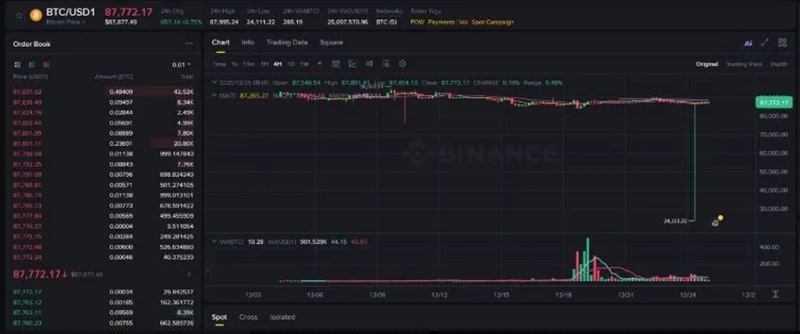
BTC Flashed Down to $24k on Binance’s BTC/USD1 Pair Due to Thin Liquidity During Christmas

0

On Christmas Day, Bitcoin briefly flashed down to around $24,000–$24,111 on Binance’s BTC/USD1 spot trading pair.

This was a classic flash crash caused by extremely thin liquidity in that specific pair during holiday trading hours. USD1 is a relatively new stablecoin issued by World Liberty Financial backed by the Trump family, with much lower trading volume and order book depth compared to major pairs like BTC/USDT.

A large sell order or cascade of orders swept through the thin buy-side liquidity, causing a sharp downward wick on the chart. The price recovered almost instantly within seconds as arbitrage bots bought the dip and normalized it back to the global market price ~$87,000–$88,000.

This event was isolated to the BTC/USD1 pair and did not affect broader Bitcoin markets or major pairs e.g., BTC/USDT on Binance or other exchanges remained stable above $86,000. CoinDesk confirm It was due to low holiday volumes and order book mechanics.

No significant liquidations were triggered from this wick, as it didn’t impact leveraged futures pricing broadly. Similar incidents have occurred before on illiquid pairs.

Recent daily liquidations have been in the hundreds of millions at most, not billions from this flash wick, with no ongoing exploit or massive liquidation cascade. Flash crashes on illiquid pairs highlight risks in newer/low-volume markets, but this was not an exploit or systemic issue affecting BTC overall.

The flash wick to ~$24,000 was confined to Binance’s low-volume BTC/USD1 spot pair. Major pairs (e.g., BTC/USDT) remained stable above $86,000–$88,000. No significant liquidations occurred—unlike larger 2025 events (e.g., October’s $16–19B cascade).

CoinGlass data shows typical daily liquidations in the hundreds of millions, not billions tied to this. Arbitrage bots normalized the price in seconds. As of December 27, 2025, Bitcoin trades steadily around $87,400–$87,600, with no lingering sell-off.

Holiday Amplification: Thin liquidity during Christmas low trading volumes exaggerated the wick from a single large sell order or cascade. Newer/illiquid pairs like BTC/USD1 are prone to extreme volatility. A Binance 20% APY promo on USD1 deposits surged demand, draining order book depth and creating a premium—then a market sell order swept bids.

Stick to high-volume pairs (USDT/USDC) for execution. Use limit orders over market orders in thin markets to avoid slippage. Similar wicks happened before (e.g., December 10, 2025, on the same pair). Binance (via CZ) noted no involvement in trades and no index-linked liquidations.

Events like this may prompt better price protection mechanisms or warnings for new pairs to reduce “fat finger” errors and FUD. USD1 hit $3B+ market cap shortly after, showing strong adoption. Promotions and integrations like replacing BUSD collateral drive inflows, but expose growing pains in liquidity.

Ties to the Trump ecosystem amplify visibility—and conspiracy claims e.g., manipulation theories on X/Reddit. Most evidence points to organic liquidity issues, not coordinated dumps. Could fuel regulatory debates on stablecoin oversight.

Its reinforces need for deeper order books in emerging assets. As stablecoin market caps swell ($310B+ total), similar events may recur until infrastructure matures. Positive spin: Quick arb recovery shows market efficiency.

Overall, this was a non-event for Bitcoin’s fundamentals—more a reminder of microstructure risks in niche pairs than any systemic threat. Bitcoin remains resilient in a consolidating market post-2025 highs. Trade cautiously in illiquid environments.


Why Bitcoin is Likely to Outperform Gold and Silver in 2026

2

Bitcoin is likely to outperform both gold and silver in 2026 percentage returns. Bitcoin is trading around $87,000–$88,000 after a disappointing 2025 down ~7% YTD from earlier highs near $125,000 in October. This followed the April 2024 halving, but Q4 saw ETF outflows, options volatility, and risk-off sentiment.

Gold: Near record highs at ~$4,530–$4,540/oz, up ~70–74% YTD—its best year since 1979, driven by central bank buying, geopolitical tensions, and de-dollarization. Silver’s explosive rally to ~$75–$79/oz, up ~150–170% YTD, fueled by industrial demand due to solar, EVs, AI and safe-haven flows.

Precious metals have dominated 2025 performance, while Bitcoin has lagged. 2026  Analyst consensus points to strong rebound potential: Bullish targets: $150,000–$250,000 from Bernstein, Standard Chartered, Fundstrat, J.P. Morgan ~$170,000.

Moderate: $110,000–$160,000 average ~$135,000. Potential returns: +70% to +180% from ~$87,000 base case ~+100–150%. Post-halving bull phase— historical cycles show major gains 12–18 months after halving; current cycle peaked early but could extend, ETF/institutional inflows resumption, regulatory clarity, and risk-on recovery.

Gold continued upside but moderating gains: Targets: $4,500–$5,000 major banks average, up to $6,000. Potential returns: +0% to +30% from ~$4,530 base case ~+10–20%.

Central bank demand, lower rates, geopolitics—but already at extremes, overbought RSI, massive 2025 run. Silver rally is trong but likely less explosive after 2025’s surge: Targets: $56–$80 bank averages ~$60–70. Potential returns: -20% to +5% or up to +30% in bullish scenarios from ~$77.

Industrial demand persists, but parabolic 2025 gains suggest consolidation and pullback risk. Bitcoin typically delivers its strongest gains in the year following halving; 2020–2021 cycle: massive run post-2020 halving. 2025 was anomalous, early peak, then correction; 2026 aligns with the “extended bull” phase many analysts now expect.

BTC is down YTD while metals are at ATHs—Bitcoin has more room for catch-up growth. If macro improves like rate cuts, institutional flows, BTC; correlated to equities and tech rebounds sharply; metals may consolidate after outsized 2025 gains.

Recent data shows gold/silver pulling safe-haven flows while BTC underperforms short-term, but forecasts flip this for 2026. Persistent recession or tighter policy could favor metals as pure safe-havens. However, evidence from cycles, analyst targets, and supply/demand dynamics supports Bitcoin delivering superior percentage gains in 2026.

Key Drivers for Bitcoin Outperformance in 2026

Bitcoin’s potential to outperform gold and silver in percentage gains stems from its position in the post-halving cycle, combined with maturing institutional adoption and a likely shift in macro conditions.

The April 2024 halving reduced daily supply issuance by 50%, historically triggering major rallies 12–18 months later. While 2025 saw an early peak ~$126,000 in October followed by a correction to ~$87,000–$88,000, many analysts view this as an anomaly.

The traditional 4-year cycle is evolving into a longer, liquidity-driven pattern due to institutional involvement. Forecasts suggest the bull peak extends into 2026, with new all-time highs possible in H1.

Spot Bitcoin ETFs hold over $100B+ in assets. After 2025 outflows during risk-off periods, renewed inflows are expected as regulatory clarity improves, like bipartisan support for crypto legislation and macro stabilizes. Corporate treasuries and nation-state adoption add structural demand.

Bitcoin correlates with equities and tech. If Fed cuts rates further markets price ~2 in 2026 amid softening growth, risk assets rebound. Lower opportunity costs favor non-yielding assets like BTC over consolidated precious metals.

Only ~1.5M BTC left to mine by late 2026; mining difficulty up 25%. This creates tighter scarcity than gold/silver, whose supplies grow annually. Analyst consensus targets: $135,000–$250,000, Fundstrat $200K–$250K, J.P. Morgan ~$170K, Bernstein/Standard Chartered $150K–$170K.

From ~$87,500 current, this implies +50% to +180% returns base ~+100%. Precious metals dominated 2025, gold +70–74%, silver +150–170%, reaching extremes that suggest consolidation. Central bank buying, geopolitics, de-dollarization, lower rates. But after record highs (~$4,530/oz), overbought conditions (e.g., highest monthly RSI since 1980) point to moderation.

2026 targets: $4,600–$5,000 average according to RBC, Goldman Sachs ~$4,900–$5,000. Returns: +2% to +10% base, up to +20–30% bullish. Silver; Industrial boom (solar/EVs/AI, 95M oz deficit), safe-haven flows. Parabolic 2025 run ($77–$79/oz) risks pullback. Targets: $56–$80 averages ~$60–75, some outliers higher. Returns: -10% to +10% base, potential +20–35% if demand persists.

Metals benefit from persistent uncertainty but lack Bitcoin’s asymmetric upside from cycle extension and risk recovery. Capital rotation from overextended metals to Bitcoin as risk appetite returns, boosting BTC while capping metals.

Market Sentiment Shift — Validates Bitcoin as “digital gold” in growth phases, accelerating adoption. BTC leadership could lift alts/ETH, contrasting metals’ more isolated safe-haven role. Strong BTC gains signal improving liquidity/risk-on environment; metals consolidation suggests easing extreme fear.

Persistent recession, tighter policy, or renewed geopolitics could favor metals as pure safe-havens. Some forecasts warn of BTC correction to $60K–$75K early 2026 before rebound.

Overall, cycle dynamics, valuation reset; BTC down YTD vs. metals at ATHs, and analyst distribution support Bitcoin delivering superior percentage returns in 2026 ~+80–150% base vs. +10–20% for metals.

What Does $1 Trillion in Interest Payments of US Public Debts Mean for Crypto?

0

The U.S. federal government’s net interest payments on the public debt crossed $1 trillion for the first time in fiscal year 2025 ending September 2025, up from about $970 billion in reported net interest figures and roughly triple the $345 billion paid in FY 2020.

This milestone reflects a national debt exceeding $38 trillion as of late 2025, combined with average interest rates around 3.4% on marketable debt—higher than the low-rate era of the 2010s.

Fiscal Strain and Broader Economic Effects

This level of interest expense consumes a growing share of federal revenue around 19% in FY 2025 and crowds out spending on other priorities like infrastructure, defense, or social programs. Persistent deficits—projected at $2 trillion annually—could push interest costs toward $1.8–$2.2 trillion by 2035, risking a “debt spiral” where borrowing costs compound.

In traditional markets, high debt servicing can pressure Treasury yields currently around 4.1–4.2% for the 10-year note as of late December 2025, potentially limiting the Fed’s ability to cut rates aggressively and contributing to tighter financial conditions.

Dollar-pegged stablecoins, like USDT, USDC are increasingly backed by short-term U.S. Treasuries. Regulations like the 2025 GENIUS Act mandate high-quality reserves, turning stablecoin issuers into major Treasury holders— Tether alone holds over $135 billion.

Analysts project stablecoin demand could absorb $1–$1.6 trillion in T-bills over the coming years, helping finance U.S. debt as foreign buyers from China reduce holdings. This bolsters dollar dominance via crypto infrastructure and creates symbiotic growth: fiscal needs drive stablecoin adoption, which supports Treasury markets.

Bitcoin as a Hedge

Unsustainable debt raises long-term inflation or devaluation risks, strengthening Bitcoin’s “digital gold” narrative. With fixed supply— 21 million cap, BTC appeals as a non-sovereign store of value amid fiat debasement concerns. Institutional inflows via spot ETFs and corporate holdings continue despite volatility.

Crypto correlates with equities during “risk-off” periods. High interest costs signal fiscal weakness, potentially leading to higher yields, reduced liquidity, or recession fears—all bearish for speculative assets like Bitcoin currently trading around $87,000–$88,000 after pulling back from October highs near $126,000.

Recent market weakness, crypto cap down over $1 trillion since peaks ties partly to funding costs and outflows, amplified by debt-related uncertainty. Overall, $1 trillion in annual interest payments highlights U.S. fiscal challenges but paradoxically creates opportunities for crypto.

Stablecoins help fund the debt, while Bitcoin benefits from hedge demand. Long-term bullish for adoption and dollar-linked crypto; short-term volatile as a risk asset. This dynamic explains why policymakers under the current administration have embraced pro-crypto policies to leverage digital assets for Treasury demand.

Higher Treasury yields; 10-year currently ~4.13–4.15% limit Fed rate cuts and increase funding costs. Crypto, as a risk asset, has shown sensitivity: Bitcoin trades around $87,000–$88,000, down from October highs near $126,000, amid ETF outflows, thin holiday liquidity, and broader market weakness.

Recent volatility includes flash crashes on thin pairs and correlation with “risk-off” moves, where debt uncertainty amplifies sell-offs in speculative assets. This creates downward pressure on crypto prices in risk-averse environments, as seen in recent pullbacks tied to macro fears.

Paradoxically, unsustainable debt levels ~124% of GDP and rising interest costs projected $1.5–$2.2 trillion annually by 2035 bolster crypto’s role in the financial system.

Stablecoins as Treasury Demand Engine

Major issuers like Tether ~$120–$135 billion in Treasuries and Circle are already significant buyers of short-term U.S. debt. With regulations e.g., advancing frameworks like the GENIUS Act mandating high-quality reserves, stablecoin growth could drive $1–$1.6 trillion in T-bill demand over the next few years—potentially absorbing much of new issuance and replacing retreating foreign buyers.

This symbiotic relationship: U.S. fiscal needs fuel stablecoin adoption, reinforcing dollar dominance via on-chain infrastructure. Bitcoin fixed supply (21M cap) positions BTC as “digital gold” against potential inflation, currency weakening, or debt monetization risks. Institutional narratives strengthen amid $2 trillion annual deficits, with spot ETFs and corporate treasuries providing inflows despite volatility.

Pro-crypto policies under the current administration leverage digital assets to sustain Treasury markets, potentially accelerating mainstream integration. Hedge narrative strengthens; institutional inflows. Overall Crypto is bearish in recessions/funding squeezes. Bullish for adoption, utility in payments/debt financing.

$1 trillion+ interest burdens highlight U.S. fiscal challenges, creating short-term headwinds for crypto as a risk asset but long-term tailwinds via stablecoin Treasury absorption and Bitcoin’s store-of-value appeal. This dynamic supports growing crypto integration into global finance.

U.S. GDP Growth of 4.3% Surprise Signals Trouble for Altcoins, Not Bitcoin

0

The U.S. Bureau of Economic Analysis released a delayed initial estimate for Q3 2025 GDP (July–September), showing annualized growth of 4.3%—significantly beating expectations of ~3.3% and marking the fastest pace in two years.

This was driven by strong consumer spending, exports, and government outlays. A strong GDP print like this typically signals a robust economy, reducing the urgency for Federal Reserve rate cuts in 2026. Combined with persistent inflation signals like the recent CPI and University of Michigan data it supports a “higher-for-longer” interest rate environment.

Higher rates make safe assets like cash and bonds more attractive, tightening liquidity for speculative investments. In crypto, capital often flows to the most liquid, “safe” asset: Bitcoin, viewed as digital gold.

Altcoins (everything else) are more speculative, relying on retail inflows, cheap money, and risk-on sentiment—which weaken in this scenario. During macro tightening or momentum slowdowns, money rotates out of altcoins into Bitcoin or out of crypto entirely.

Bitcoin showed relative resilience ranging rather than crashing. Altcoins flashed weakness, with bearish technicals and declining MACD breadth. No immediate crash expected, but prolonged consolidation or downside more likely for altcoins into early 2026.

Crypto markets were already soft heading into the data with holiday-thin liquidity, year-end positioning. Post-release, reports indicate downward pressure: Total crypto market cap dipped ~1-2%. Bitcoin held better briefly testing ~$88K levels. Broader altcoins and total market excl. BTC— TOTAL2 index showed clearer weakness.

Strong U.S. economic data acts as a liquidity warning—no longer purely bullish for risk-on assets like crypto, and disproportionately harmful to higher-beta altcoins. The “surprise” upside in GDP reinforces tighter monetary conditions, favoring Bitcoin’s dominance while pressuring altcoins’ recovery. This dynamic has played out in similar macro setups historically.

Current Federal Reserve Rate and Recent Actions

The federal funds rate target range stands at 3.50%–3.75%. The FOMC delivered a 25 basis point cut on December 10, 2025—the third consecutive quarterly cut of 2025—amid a divided committee three dissents: one favoring a larger cut, two preferring no change.

FOMC Projections

The latest summary of economic projections released December 10 shows: Median expectation: One 25 bps rate cut in 2026, end-2026 rate at 3.25%–3.50%. Another 25 bps cut projected for 2027, with longer-run neutral rate around 3.0%.

Projections were unchanged from September despite stronger growth data; wide dispersion among officials some dots implied no cuts or even higher rates, others more easing. Higher GDP growth for 2026, 2.3%, up from 1.8% prior, slightly lower inflation, unemployment steady at ~4.4%.

This hawkish tilt reflects persistent inflation above 2% and robust activity, reducing near-term easing urgency. The strong Q3 2025 GDP print released December 23: +4.3% annualized, beating expectations of 3.3% and the fastest in two years reinforces a resilient economy, driven by consumer spending, exports, and government outlays.

This has further tempered rate cut bets: Markets price in roughly 1–2 cuts for 2026 total some sources indicate the first not until mid-year, e.g., June. Overall for 2026: Implied terminal rate around 3.00%–3.25%, slightly more dovish than the Fed’s median but aligned with potential data-dependent adjustments.

No January 2026 cut widely expected; focus on incoming labor/inflation data. In context of crypto markets, this “higher-for-longer” stance supports tighter liquidity, favoring Bitcoin’s relative strength while pressuring altcoins. Expectations could shift with new data, but current signals point to cautious, limited easing in 2026.

Trust Wallet’s Chrome Browser Extension Breach Underscores Crypto’s Need for Advanced Security Infrastructure 

0

A security incident affected Trust Wallet’s Chrome browser extension specifically version 2.68, leading to approximately $7 million in unauthorized cryptocurrency drains across hundreds of user wallets.

The issue began surfacing on December 25, 2025, shortly after a compromised update was released on December 24. Malicious JavaScript code was injected into the extension, disguised as analytics functionality using a library like posthog-js.

This code silently exfiltrated users’ mnemonic seed phrases (recovery phrases) when wallets were unlocked or imported, sending them to an attacker-controlled domain (api.metrics-trustwallet[.]com, registered on December 8, 2025).

Attackers then used these phrases to drain funds rapidly, primarily in Bitcoin, Ethereum, and Solana. Investigations suggest a sophisticated supply-chain attack, possibly involving compromised developer access or deployment processes prior to mid-December.

Some analysts including SlowMist describe it as potentially APT-level, though the exact method is still under review. Only the Chrome browser extension version 2.68 was affected. Mobile app users and other browser extension versions were not impacted. No core protocol or blockchain-level vulnerability was involved.

Trust Wallet quickly released a patched version (2.69) on December 25 and urged users to update immediately. Changpeng Zhao (CZ, Binance co-founder and Trust Wallet owner and the official Trust Wallet team confirmed that all affected users will be fully reimbursed.

Losses are estimated at ~$7 million, and the team is prioritizing refunds via a dedicated support process users should submit claims through official channels only. As of December 26, Trust Wallet posted:”We’ve confirmed that approximately $7M has been impacted and we will ensure all affected users are refunded.”

If you used the browser extension: Do not open version 2.68. Disable it in Chrome extensions. Update to version 2.69 via the official Chrome Web Store: Trust Wallet Extension. If affected, submit a claim via Trust Wallet’s official support form as announced on their X account.

Mobile-only users are safe and unaffected. This incident highlights risks with browser-based wallets and automatic updates. For maximum security, consider hardware wallets for significant holdings or sticking to verified mobile apps.

The Trust Wallet incident was a classic supply-chain attack targeting the official Chrome browser extension. On December 24, 2025, version 2.68 was released via the Chrome Web Store containing malicious code that exfiltrated users’ mnemonic seed phrases.

This led to rapid drains across multiple chains Bitcoin, Ethereum/EVM, Solana, totaling approximately $7 million in losses affecting hundreds of users. The attack was not due to phishing, user error, or a compromised third-party npm package. Instead, attackers directly tampered with Trust Wallet’s internal source code before deployment.

Security firm SlowMist provided the most detailed analysis by comparing versions 2.67 (clean) and 2.68 (compromised): Malicious Code Injection: Added code iterated through all stored wallets in the extension. It triggered internal requests to retrieve encrypted mnemonic phrases for each wallet.

Using the user’s password entered during wallet unlock, it decrypted the phrases locally. The decrypted seed phrases were sent to an attacker-controlled server. The code masqueraded as legitimate analytics using the open-source library posthog-js a real analytics tool Trust Wallet uses.

Attackers redirected PostHog traffic to their fake domain, making it blend in with normal analytics behavior. The primary malicious logic was in a bundled JavaScript file often referenced as 4482.js in analyses. Once attackers had the seed phrases, they could import wallets elsewhere and drain funds instantly—no transaction approvals or user interaction needed.

Domain metrics-trustwallet[.]com registered via NICENIC INTERNATIONAL registrar. December 21, 2025: First observed requests to the malicious API. December 24, 2025: Compromised version 2.68 released. December 25, 2025: Drains reported en masse; Trust Wallet issues warning and releases patched version 2.69.

The domain mimicked legitimate Trust Wallet infrastructure and is now offline. Investigations from SlowMist, PeckShield, and on-chain analysts like ZachXBT point to: Likely compromise of developer devices, code repositories, or deployment permissions prior to mid-December.

Attackers showed deep familiarity with Trust Wallet’s codebase. Some speculation including from Binance co-founder CZ of possible insider involvement or nation-state actor like APT-level sophistication, though no conclusive evidence yet. Trust Wallet is still investigating the exact breach vector.

Only Chrome extension version 2.68 affected mobile app and other versions safe. Trust Wallet patched with version 2.69 on December 25 and committed to full reimbursements for all victims ~$7M total. Stolen funds partially laundered via exchanges like ChangeNOW, FixedFloat, and KuCoin.

This incident underscores the risks of browser extensions with auto-updates and highlights the need for stricter supply-chain security in crypto tools. For high-value holdings, hardware wallets remain the safest option.