DD
MM
YYYY

PAGES

DD
MM
YYYY

spot_img

PAGES

Home Blog Page 173

How to Invest in Ethereum for Beginners? (Guide 2025)

0

First, sign up for a trustworthy exchange, and buy ETH. Then deposit it safely in a secure wallet and follow a simple plan (DCA + basic security). Ethereum remains one of the most popular cryptocurrencies in 2025. It is known for its smart contracts, staking, wide ecosystem, and accessibility. This guide is perfect for beginners new to crypto or beginner-friendly stuff. Follow these simple, detailed steps to purchase ETH and get answers to common investing questions about transaction fees and taxes.

Buying ETH in Action

To buy Ethereum, follow four basic steps: Create account ? Verify identity ? Choose ETH & payment ? Enter wallet and confirm. Let’s discuss each in detail.

1.   Create Your Account

Click “Sign Up” on the home page of the exchange — for example, Paybis. Fill in a valid email address and secure password, then check your email to verify. Most exchanges have a mobile app optimized for use on the go.
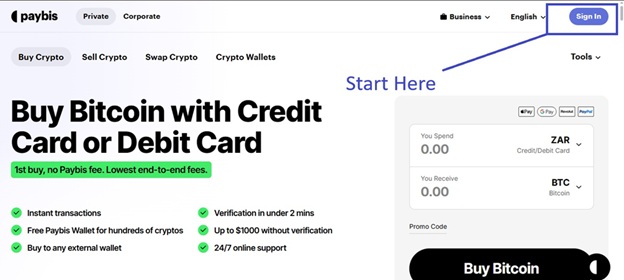
Tip: Use a unique password, manager-generated code for your account, and turn on two-factor authentication (2FA) immediately to be sure that you are protected from phishing and account attacks.

2.   Verify Your Identity

Upload a government-issued form of identification such as a passport, national ID card, or driving license. You may also be asked for proof of address, like a utility bill or bank statement. Verification usually takes only a few minutes but can take as long as 24 hours during peak times.
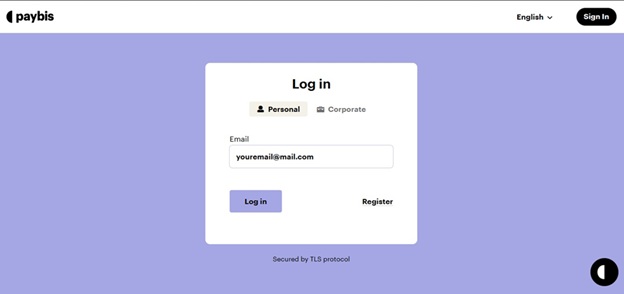
Tip: Make sure that the name and address you enter match your bank details. This will prevent delays in matching you to your account. It could also delay any payouts. Verified accounts may also qualify for higher deposit limits.

3.   Choose ETH and Payment Method

Choose Ethereum (ETH) from the list of cryptocurrencies available. Enter the fiat balance you want to spend. Some platforms even allow purchases from as low as $50.

Select how you are going to pay: some people use a credit or debit card, which allows for immediate purchases; others prefer SEPA/SWIFT transfers because of lower costs.
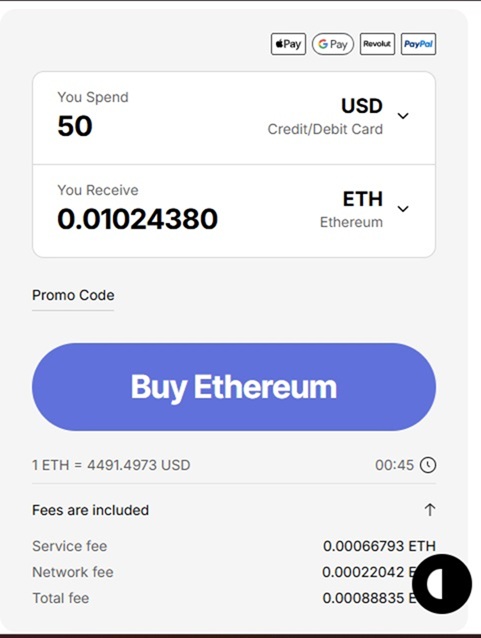
Tip: Don’t forget to check out both your final fees for the transaction and whether exchange rates apply. The breakdown typically includes bank/card transaction charges plus Ethereum network gas charges, which can vary depending on the blockchain activity level.

4.   Enter ETH Wallet Address and Finalize the Transaction

Paste your Ethereum wallet address into the required section. Make sure to check the Ethereum Mainnet box carefully. Review the breakdown and approve the purchase. ETH will be delivered when the blockchain is complete and confirms the process.

New to wallets? There are various ways to protect your ETH depending on your needs. Security starts with your storage option: take a look at some secure crypto wallets, from mobile apps to hardware devices for long-term storage.

Tip: Start a very small test transaction first. Once successful, scale up your order and remember to keep a note of your transaction receipt. You may need this for future tax returns.

Taxes for ETH Investors

ETH investors in the United States, and many other legal jurisdictions, consider sales taxable when they reach end users. Converting ETH into dollars or selling off some may be subject to capital gains tax. Having the right information is very important as more and more tax authorities are paying close attention to digital assets.

You’ll need to note:

  • Date of acquisition and disposal
  • Purchase cost (cost basis)
  • Market value at disposal
  • Transaction fees

Crypto tax software can automate these calculations, but always verify accuracy.

Table 1: Tax Scenarios for Ethereum Investors (Simplified)

Activity Taxable Event Tax Basis Notes
Buying & Holding No Only taxable when sold/disposed
Selling (short-term <1 yr) Yes Market price at sale Taxed as ordinary income rate
Selling (long-term >1 yr) Yes Market price at sale Lower long-term capital gains rates
Staking Rewards Yes Market price on receipt Reported as income (IRS Notice 2014-21)
Swapping ETH for another crypto Yes Market price at swap Each swap counts as a taxable disposal


Always consult a tax professional for your jurisdiction. U.S. readers can refer to the IRS Notice 2014-21 and guidance on staking taxation.


FAQ

What will 1 ETH be worth in 2030?
No one knows for sure. Some analysts predict growth with Ethereum’s role in DeFi and AI integrations, but this is speculative. 

What are Ethereum gas fees, and why do they matter?
Gas fees are payments to the network for processing transactions. They can spike during busy periods. Layer-2 solutions, for example, Arbitrum and Optimism, help lower these costs for regular users. 

What is the best crypto to buy?
Unfortunately, there is no set answer here, and it depends on the risk you are willing to take. Bitcoin is considered “digital gold,” while Ethereum powers a broader ecosystem of decentralized apps. 

Is it better to invest in Bitcoin or Ethereum?
Bitcoin offers scarcity; Ethereum offers utility. Many investors hold both for diversification. 

Will Ethereum hit $5,000 in 2025?
It’s possible if adoption accelerates, but equally possible for ETH to stay volatile below that level. Only invest what you can afford to lose. 

Should I sell or hold Ethereum?
This depends on your goals. Need short-term liquidity? Selling may make sense. For long-term investors, holding through market cycles has been rewarding. 

How much Ethereum should I buy as a starter?
Many new traders start with $50-$200 worth to test the process. 

Can I earn passive income with Ethereum?
By locking your ETH in the network, you earn rewards. Remember that the rewards you earn are taxable. 

What kind of wallet should I use for Ethereum?
Mobile wallets are easy and convenient, but hardware wallets, such as Ledger or Trezor, offer offline storage and robust protection.

Apple Hit With $634m Verdict in Long-Running Patent Battle With Masimo

0

Apple has been ordered to pay $634 million to Masimo after a federal jury in California found that the Apple Watch’s blood-oxygen-related features infringed one of Masimo’s patents, marking the most significant victory yet for the medical-technology company in its sprawling legal war with the iPhone maker.

The jury concluded on Friday that Apple violated Masimo’s patent rights through the Apple Watch’s workout mode and heart-rate notification features. Masimo confirmed the verdict in a statement, calling the decision “a significant win in our ongoing efforts to protect our innovations and intellectual property.”

Apple said it disagrees with the jury’s findings and will appeal. “Over the past six years (Masimo has) sued Apple in multiple courts and asserted over 25 patents, the majority of which have been found to be invalid,” an Apple spokesperson said. “The single patent in this case expired in 2022, and is specific to historic patient monitoring technology from decades ago.”

The ruling caps a major chapter in a contentious, years-long legal feud between the two California-based companies, one that has stretched across federal courts, the U.S. International Trade Commission (ITC), and now U.S. Customs and Border Protection.

A Multi-Front Fight Over Pulse-Oximetry Technology

Masimo, headquartered in Irvine, has accused Apple of hiring away its employees and using its proprietary pulse-oximetry technology—traditionally used in medical devices—for the Apple Watch. That claim has spawned multiple lawsuits and regulatory battles since 2018, turning the conflict into one of Apple’s most persistent patent fights.

The most dramatic escalation came in 2023 when the ITC blocked imports of Apple’s Series 9 and Ultra 2 watches after determining that Apple’s blood-oxygen technology infringed Masimo’s patents. Apple responded by stripping the blood-oxygen feature from certain watches in the U.S. market to avoid running afoul of the ban. The company later reintroduced an updated oxygen-sensing technology in August after receiving approval from U.S. Customs and Border Protection.

Even with the workaround, the regulatory tug-of-war remains in motion. The ITC said on Friday that it will hold a new proceeding to determine whether Apple’s updated watch models should still fall under the import ban. That decision could again disrupt Apple’s sales depending on the outcome.

Masimo has an ongoing lawsuit against Customs over the agency’s clearance of Apple’s revised watches. Apple, meanwhile, is challenging the original ITC import ban in the federal appeals court.

A Dispute With No Clean Ending in Sight

Friday’s $634 million verdict represents one of the largest single judgments Apple has faced in a patent case in recent years, though the company is already signaling a lengthy appeal process. Because the patent in question expired in 2022, the dispute centers on earlier Apple Watch models and historic technology, not the company’s newest devices.

The two sides have split earlier rounds of litigation. A California judge declared a mistrial in 2023 in Masimo’s trade-secret case against Apple after jurors could not reach a unanimous verdict. Apple scored a symbolic win in Delaware last year when a jury ordered Masimo to pay just $250 over allegations that Masimo’s smartwatches infringed two Apple design patents.

Still, the broader battle over pulse-oximetry technology remains unsettled. The stakes go beyond the two companies, because the Apple Watch is one of the world’s most widely used health-monitoring devices. Any ruling that affects its features or availability tends to ripple across the wearables industry, health-tech suppliers, and regulators.

Friday’s verdict adds to that uncertainty. Masimo, emboldened by its win, is continuing to pursue claims across multiple venues. Apple is preparing for another round at the appeals court. And the ITC could once again determine whether Apple’s flagship watches stay on U.S. shelves.

For now, the only clarity is that the fight is far from over.

How Hodlers Are Destroying Bitcoin, Making It What It Was Not Invented for

0

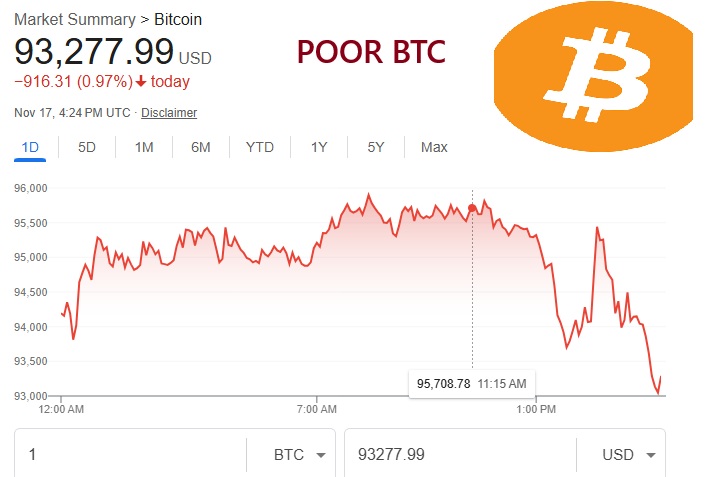
Who will rescue Bitcoin as it continues its gravitational drift toward the bears of the market? This is one of those moments when you wish Bitcoin had a date on the calendar to present revenue, profits, margins, an earnings call to defend its value. But since Bitcoin cannot show a balance sheet or an income statement, the only lifeline is hope: hope that new faithfuls will buy, creating another inflection point.

Good People, the invention of money transformed humanity. The history is rich, from barter to cowries, from precious metals to minted coins. Across kingdoms and civilizations, humans have always sought efficient ways to exchange value. Then came a breakthrough in 7th-century China when the Tang dynasty invented paper money. The Song dynasty popularized it in the 11th century, and the Mongol Empire and Yuan dynasty scaled it across territories. The pursuit of frictionless exchange has been a timeless human project. Hello, electronic fund transfer of the internet era!

But Bitcoin introduces a paradox. For hodlers, it is not money, it is an asset class. Yet it is spoken of as a currency. And because it behaves more like an asset than a medium of exchange, it suffers: it must appreciate simply because people believe it should appreciate.

Imagine if Bitcoin had an earnings call tomorrow, standing before the market to defend its valuation. That would change the game. As money, used to buy, exchange, transfer value, Bitcoin is a remarkable innovation. As an asset class expected to produce returns without a business engine behind it, the logic becomes fragile.

Use Bitcoin as money and it delivers. Ask it to behave like a company, and it collapses under expectations it was never designed to meet. I like stablecoins because they strip away the hodling spirit, removing the speculative pressure and leaving a powerful utility: the ability to cut transaction costs dramatically. That is transformative.

Let us scale that utility across Africa. Let us move away from the mindset of buying coins simply because we expect them to rise. Instead, let us deploy digital tools to improve operations, eliminate cross-border frictions, and unlock abundance across our economies.

Czech National Bank Purchases of First Digital Assets

0

The Czech National Bank (CNB)—the central bank of the Czech Republic—announced its first-ever purchase of digital assets, totaling approximately $1 million. This marks a historic step as the first central bank to publicly disclose acquiring Bitcoin (BTC).

The Czech National Bank’s (CNB) $1 million acquisition of Bitcoin and other digital assets is framed as a limited experimental pilot rather than a strategic investment. However, its significance extends far beyond the modest sum, representing a cautious yet pivotal entry by a Western central bank into blockchain-based assets.

The acquisition was approved by the CNB’s Bank Board on October 30, 2025, and executed through a regulated platform outside the bank’s international reserves. The purchase is not aimed at financial returns but to test operational processes for blockchain-based assets, including: Purchasing and custody.

Anti-money laundering (AML) compliance. Crisis response and tokenization workflows. The portfolio will be evaluated over 2–3 years, with the CNB planning to share insights publicly. It represents just 0.0006% of the CNB’s total assets, underscoring its limited, exploratory nature.

Governor Aleš Michl proposed the idea in January 2025 to prepare for a future where digital assets integrate with traditional finance, such as enabling seamless purchases of tokenized Czech bonds alongside everyday transactions.

The CNB noted that while it could invest in Bitcoin via exchange-traded funds (ETFs) under current laws, it opted for direct acquisition to gain hands-on experience. No immediate plans exist to add Bitcoin to official reserves due to its perceived immaturity.

This move positions the CNB as a pioneer among European central banks, leveraging the Czech Republic’s non-adoption of the euro for greater regulatory flexibility within the EU. It aligns with growing institutional interest in crypto, though the CNB emphasized compliance with Czech and EU regulations.

The announcement has sparked discussions on central bank digital asset adoption, with some viewing it as a signal for tokenized securities in public finance. As the first central bank to publicly disclose a direct Bitcoin purchase outside of seized assets or indirect ETFs, the CNB’s move normalizes crypto for sovereign institutions.

This could accelerate adoption, with analysts predicting it as a “turning point” for global Bitcoin integration into national strategies. Bitcoin’s price, already hovering above $100,000, saw a modest uptick post-announcement, reflecting heightened investor confidence in institutional inflows.

Governor Aleš Michl’s earlier proposal for up to 5% of reserves ~$7.3 billion in Bitcoin highlights potential for larger allocations. If the pilot succeeds, it could inspire similar tests elsewhere, echoing El Salvador’s full adoption but in a more measured EU context.

The portfolio—comprising Bitcoin for volatility/decentralization, a USD-pegged stablecoin and a tokenized deposit—focuses on practical workflows like custody, key management, AML compliance, and crisis simulations. Over 2–3 years, the CNB plans to share findings publicly, potentially establishing best practices for tokenizing assets like Czech bonds.

This could streamline future integrations, such as seamless koruna-based purchases of tokenized securities alongside everyday payments. By exploring blockchain’s role in payments, the CNB is preparing for a tokenized economy. Michl envisions “one-tap” transactions for everything from coffee to bonds, reducing barriers for retail investors and enhancing efficiency in a post-euro Czech system.

The Czech Republic’s non-euro status grants regulatory flexibility, allowing this pilot despite ECB President Christine Lagarde’s dismissal of Bitcoin as having “zero” value and warnings against reserve inclusion. Reactions on X describe it as “heroic,” potentially pressuring the ECB to revisit crypto policies and fostering debate on EU-wide standards.

Google Unveils $40bn Texas Data-Center Push as AI Infrastructure Race Heats Up

0

Alphabet’s Google on Friday announced a sweeping $40 billion investment to build three new data centers in Texas through 2027, marking one of the company’s largest-ever infrastructure commitments and intensifying the high-stakes battle among U.S. technology giants to secure the computing power needed for advanced artificial intelligence.

The investment underscores how fiercely competitive the AI arms race has become. Companies including OpenAI, Microsoft, Meta Platforms, and Amazon are pouring billions into AI-focused data centers across the country, driven by unprecedented demand for training and deploying frontier AI models.

Google’s latest move places Texas at the heart of this new infrastructure surge. According to the company, one of the new facilities will be located in Armstrong County in the Texas Panhandle, while the other two will rise in Haskell County, a stretch of West Texas near Abilene. The tech company will also pump fresh capital into its existing Midlothian campus and the Dallas cloud region, both of which anchor its global network of 42 cloud regions.

“This investment will create thousands of jobs, provide skills training to college students and electrical apprentices, and accelerate energy affordability initiatives throughout Texas,” Alphabet CEO Sundar Pichai said in a statement.

Texas Governor Greg Abbott welcomed the announcement, saying, “Google’s $40 billion investment makes Texas Google’s largest investment in any state in the country and supports energy efficiency and workforce development in our state.”

The company’s Texas plan lands during a period of rapid industrial expansion across the cloud and AI sectors. Big tech firms have announced massive new spending in 2024 and 2025, particularly within the U.S., as President Donald Trump pushes for major domestic investment to maintain the country’s advantage in the global AI contest. Google’s move aligns closely with that policy direction.

Earlier this month, Anthropic announced its own $50 billion plan to build data centers across the United States—including in Texas and New York—highlighting how capital expenditure is accelerating beyond long-established giants and into the broader AI startup ecosystem.

Google’s investment in Texas also complements its growing commitments in Europe. Just days earlier, the company said it would invest €5.5 billion ($6.41 billion) in Germany over the coming years, dedicated to expanding infrastructure and data-center capacity in Europe’s largest economy.

The latest Texas investment follows Google’s recent upgrade of its AI capabilities and expansion of cloud services, both of which depend heavily on computing infrastructure. As more enterprises migrate toward AI-driven processes—and as model sizes balloon—hyperscale data centers have become essential to meeting demand.

Still, analysts are warning that the current AI spending boom bears echoes of past tech cycles where capital outpaced returns. Some investors have cautioned that valuations and expenditure growth may prove difficult to sustain if AI adoption does not rise at the same explosive pace as infrastructure deployment.

Even so, with rivals racing to secure land, power, and long-term access to advanced chips, Google’s Texas expansion signals that the company is unwilling to lose ground in one of the most consequential technology competitions in modern history. The data centers—spanning workforce development, energy infrastructure, and regional economic gains—are both a strategic and symbolic marker of where the AI race is headed next.

Google says the investment will expand its cloud footprint, add significant capacity for AI workloads, and prepare the company for the next phase of rapid model development and deployment. The project is set to roll out through 2027.