DD
MM
YYYY

PAGES

DD
MM
YYYY

spot_img

PAGES

Home Blog Page 176

XRP ETF Launch is A Record-Breaking Debut in 2025, as Bitcoin ETF Outflows Rise

0

Canary Capital’s spot XRP ETF (ticker: XRPC) made its highly anticipated debut on Nasdaq, marking the first U.S.-listed ETF providing direct exposure to XRP.

The launch was nothing short of explosive, shattering expectations and setting a new benchmark for ETF debuts this year. Despite a broader crypto market downturn—with Bitcoin dipping 3% and the total market cap sliding 4% to $3.2 trillion—XRPC demonstrated robust institutional and retail demand.

XRPC clocked $58.6 million in first-day trading volume, the highest for any of the over 900 ETFs launched in 2025. This narrowly edged out Bitwise’s Solana Staking ETF (BSOL), which held the previous record with $57 million on its October 28 debut.

Earlier in the day, XRPC hit $26 million in just the first 30 minutes—more than double Bloomberg analyst Eric Balchunas’s initial estimate of $17 million—before climbing to $36 million by mid-morning and $46 million by afternoon.

The ETF attracted $245 million in net inflows on day one, pushing its assets under management (AUM) to around $115 million initially. This reflects strong pent-up interest in regulated XRP products, especially after years of regulatory hurdles for Ripple.

Trading began amid a risk-off environment, with XRP falling 5.2% to $2.30 from a pre-launch high near $2.52. The dip aligns with a “sell-the-news” pattern seen in prior crypto ETF launches, but on-chain metrics show resilience: unique XRP holders grew 15% post-approval, and exchange supply has been shrinking.

XRPC’s success underscores XRP’s evolution from a regulatory battleground to a mainstream asset. Ripple’s partial 2023 court win deeming retail XRP sales non-securities paved the way under a pro-crypto U.S. administration, accelerating approvals for altcoin ETFs.

The ETF offers 100% spot XRP exposure with audited reserves, no staking, and MiCA-compliant transparency—ideal for cross-border payments via the XRP Ledger (1,500 TPS). Analysts like Nate Geraci (ETF Store) called it a “significant” exceedance of traditional finance expectations, with potential for $10–20 billion in inflows over the next year.

This could boost XRP’s utility in remittances and DeFi, targeting $500 billion in annual flows. XRPC tops the 2025 leaderboard, outpacing even Bitcoin and Ethereum spot ETF debuts in relative terms. It pressures the SEC for faster altcoin approvals (e.g., SOL, DOGE, LTC), potentially expanding the altcoin ETF market to $50 billion by 2026 and diluting Bitcoin’s dominance.

The XRP “Army” is ecstatic, with posts celebrating the narrow win over BSOL and speculating on $5–$8 targets if support at $2.30 holds. Sentiment is 2:1 bullish despite short-term bearish technicals like a potential “death cross.”

While XRP’s price faces near-term volatility key support at $2.30; resistance at $2.84, the ETF’s organic volume—without heavy seeding—signals genuine demand. If daily volumes stabilize near $50 million, analysts project a rally to $3–$5 by year-end, fueled by ETF rebalancing and global adoption.

The Canary Capital Spot XRP ETF (XRPC)’s record-shattering $58.6 million in first-day volume and $245 million in inflows—transcends mere trading metrics. It’s a seismic shift signaling XRP’s maturation from a regulatory pariah to a Wall Street staple.

This isn’t just about XRP; it’s a blueprint for altcoin legitimacy, institutional integration, and real-world utility in a $3.2 trillion crypto market grappling with post-launch volatility XRP down 5.2% to $2.30 amid broader dips.

The ETF’s explosive start reflects pent-up demand from a decade of SEC-Ripple litigation, but expect turbulence as the market digests it:Price Pressure and Supply Shock: ETF issuers must acquire underlying XRP within 24-48 hours post-launch, often via OTC desks to minimize exchange impact.

However, with 11 XRP ETFs now DTCC-listed like Franklin Templeton on November 18, 21Shares/Bitwise by November 22, competition for XRP’s ~55 billion circulating supply intensifies. Whales offloaded 90-94 million XRP pre-launch, but shrinking exchange reserves down 15% YTD and a 31% volume surge signal impending compression.

Analysts warn of a “buy-the-rumor, sell-the-news” pullback to $2.00-$2.20, followed by a rebound to $3.00 if support holds at $2.27. This isn’t just a win for XRP; it’s proof that altcoins are graduating to Wall Street’s big leagues. Stay tuned—more launches could ignite a 20% altcoin rotation.

Bitcoin ETF Outflows Jitters As Crypto Markets Turbulence Persists

U.S. spot Bitcoin ETFs experienced their second-largest single-day outflow on record, with approximately $870 million in net redemptions across the 11 funds.

This marked a sharp escalation in selling pressure, contributing to Bitcoin’s intraday dip below $97,000—the lowest since May 2025—and amplifying a broader crypto market sell-off that liquidated over $1.1 billion in positions.

Ethereum ETFs fared similarly, bleeding $260 million, pushing total crypto ETF outflows for the day to well over $1 billion and the week past $1.5 billion. Second-highest daily outflow since launch; BlackRock’s IBIT led with -$248.94M. Year-to-date inflows still +$24B.

Largest daily outflow since Oct. 13; BlackRock’s ETHA: -$135.86M. Includes minor inflows to altcoin products like Solana (+$1.49M), but dominated by BTC/ETH exits. This event extends a three-week outflow streak totaling $2.64 billion from Bitcoin ETFs alone, the third-worst weekly run since their January 2024 debut.

For context, the all-time largest single-day Bitcoin ETF outflow was over $1 billion on February 25, 2025, during a prior correction. Bitcoin hit an all-time high above $126,000 in early October, fueling a 23% pullback.

Long-term holders and institutions are cashing in gains, with on-chain data showing elevated selling from wallets dormant for 6+ months. Fading expectations for aggressive Fed rate cuts now priced at ~50% chance of extension beyond November 16 have tightened liquidity.

Crypto’s correlation with tech stocks (e.g., Nasdaq down 1.65%) is at multi-year highs, dragging BTC as a “high-beta” asset. Despite Wall Street’s ongoing crypto push (e.g., Fidelity and VanEck expanding products), ETF flows reflect a “wait-and-see” stance.

BlackRock’s IBIT, the year’s inflow leader, still holds $75.8 billion in BTC but saw heavy redemptions. $969 million in long liquidations vs. $128 million shorts created a feedback loop, with $5 billion in BTC/ETH options expiring on Deribit adding volatility.

The Crypto Fear and Greed Index plunged to 22 (“Extreme Fear”), its lowest since March 2025, echoing sentiment from past bottoms—but analysts like those at Dragonfly Capital note this dip “is nothing like 2022’s collapses.”

Altcoin Bright Spots: Solana ETFs added $1.49M, Litecoin $698K, and Hedera $5.37M. XRP’s new Canary Capital fund debuted with $245 million in inflows—the top ETF launch of 2025—hinting at rotation toward utility-focused assets.

Bitcoin ETFs: -$1.2B third-worst week; Ethereum: -$508M; Solana: +$137M since October launch. Year-to-date, Bitcoin ETFs remain net positive at $24+ billion, underscoring that this is a correction within a bull cycle, not a reversal.

JPMorgan eyes $94K as key support; a break below could signal deeper trouble, but on-chain metrics (e.g., stablecoin inflows to Binance at $7.3B in 30 days) suggest accumulation is building quietly.

This outflow wave tests Bitcoin’s resilience as “digital gold,” but history shows ETF redemptions often precede bottoms such as the eight-day outflow streaks in 2024.

With U.S. equities stabilizing post-government shutdown and potential XRP/Solana ETF launches by month-end, sentiment could flip fast. Whales are nibbling— one scooped $55 million in BTC/ETH longs post-crash—positioning for a rebound toward $100K+ if macro eases.

The massive outflows from U.S. spot Bitcoin and Ethereum ETFs on November 13, 2025—totaling over $1.13 billion—aren’t just a blip; they’re a stark signal of shifting market dynamics amid heightened volatility.

While Bitcoin’s price has plunged below $97,000 its lowest in six months, erasing much of October’s rally to $126,000, this event underscores a classic crypto correction: institutional de-risking meets macro uncertainty.

But history suggests these outflows often precede rebounds, as seen in prior eight-day streaks that marked local bottoms. For now, it’s a classic shakeout: fear sells, but conviction buys. Keep an eye on weekend flows and Monday’s open.

Ark Invest’s Latest Crypto-Focused Trades

0

Cathie Wood’s Ark Invest continues its bullish stance on crypto infrastructure amid a market dip, announcing significant purchases on November 13, 2025.

The firm allocated funds across three key exchange-traded funds (ETFs): ARK Innovation ETF (ARKK), ARK Next Generation Internet ETF (ARKW), and ARK Fintech Innovation ETF (ARKF). These moves signal growing confidence in stablecoins, blockchain mining, and digital asset exchanges despite recent price volatility.

ARKK: 52,011 shares partial; full split across ETFs not detailed. Approximately $31.7 million in these crypto-linked assets. These buys followed a strong Q3 earnings report from Circle, which saw revenue surge 66% year-over-year to $740 million, net income rise 202% to $214 million, and USDC circulation more than double to $73.7 billion.

Despite this, shares dipped on the day of purchase. The trades occurred as the broader crypto market corrected, with total market cap falling over 6% to around $3.27 trillion in the 24 hours following. Closing prices on November 13 reflected the downturn: Circle (CRCL): Down 4.59% to $82.34.

BitMine (BMNR): Down 9.86% to $36.57 a Bitcoin mining firm holding over 3.5 million ETH, valued at ~$11 billion. Bullish (BLSH): Down 9.85% to $41.02 a Peter Thiel-backed digital asset trading platform.

This “buy the dip” strategy aligns with Ark’s recent pattern. Over the prior two days, the firm added another 353,328 Circle shares worth ~$30 million, bringing its two-day Circle total to ~$46 million. Earlier in November, Ark scooped up $12 million in Bullish shares.

Meanwhile, it trimmed non-crypto holdings, selling $15.6 million in Pinterest and $8.2 million in Regeneron. Ark’s ramp-up in crypto exposure underscores Cathie Wood’s view that stablecoins like USDC are reshaping global finance, potentially capping Bitcoin’s upside she recently adjusted her 2030 BTC price target from $1.5 million to $1.2 million due to stablecoin growth.

Analysts see these moves as bets on a “winner-take-most” stablecoin market, with Circle leading alongside services like tokenization and blockchain infrastructure.

CEO of ARK Invest, has been one of Bitcoin’s most vocal advocates since 2014, viewing it as “digital gold” and a hedge against both inflation and deflation. Her predictions have evolved with market developments like ETF approvals, institutional adoption, and the rise of stablecoins.

ARK’s models emphasize Bitcoin’s finite supply 21 million coins, network effects, and penetration into global portfolios. As of November 2025, Wood remains optimistic but has tempered her long-term targets due to stablecoins capturing some expected Bitcoin use cases in emerging markets.

Spot Bitcoin ETFs unlocking trillions in capital; 50% upside from prior $1M target. On-chain metrics like hashrate and holder supply; halving cycles. Institutional allocations rising to 6.5% of portfolios; Bitcoin as a new asset class.

72% CAGR in bull case; active supply reduction and ETF inflows; stablecoin growth noted as secondary factor. Doubled down on base case despite volatility; corporate and sovereign adoption.

Down from $1.5M; stablecoins processed $15.6T in 2024 surpassing Visa/Mastercard, reducing Bitcoin’s emerging-market role but boosting its “digital gold” status. With Bitcoin trading around $102,000, Wood’s base case implies ~1,076% upside by 2030.

She highlighted this at a Cantor Fitzgerald conference, noting stablecoins’ rapid growth (e.g., USDC circulation doubling to $73.7B) has “usurped” Bitcoin’s expected medium-of-exchange role in high-inflation regions like Venezuela 269% inflation in 2025.

Despite the adjustment, ARK sees Bitcoin’s store-of-value potential “soaring” via institutional demand. Wood’s models project Bitcoin capturing market share from gold ~$15T market cap and traditional assets.

ETFs could drive 5–6.5% portfolio allocations, adding $2.5T–$5T in inflows. Firms like MicroStrategy and nations (e.g., potential U.S. reserves) hoarding BTC. Higher hashrate, long-term holders, and non-zero addresses signal maturation.

Bitcoin as a “risk-off” asset during deflation (e.g., 2023 banking crisis saw +40% BTC surge) or inflation. While capping upside, they enhance crypto infrastructure, indirectly benefiting Bitcoin. Bitcoin’s history includes 80%+ drawdowns in 2018, 2022. U.S. pro-crypto shifts under Trump help, but global crackdowns (e.g., China) persist.

Stablecoins and altcoins could fragment demand. Some call Wood’s targets “financial astrology,” citing over-reliance on adoption FOMO vs. fundamentals. Wood’s track record is mixed—ARK nailed Tesla’s rise but underperformed on broader markets—yet her Bitcoin calls have aged well post-ETF launches.

Implications of France Lifting the Travel Ban on Telegram CEO Pavel Durov

0

French authorities fully lifted the travel restrictions imposed on Pavel Durov, the CEO and founder of the encrypted messaging app Telegram.

This decision ends a year-long period of judicial supervision that had barred him from leaving the country without authorization, following his high-profile arrest in August 2024 at Paris’s Le Bourget Airport.

Durov, a French-Russian dual national, was detained on charges related to Telegram’s alleged failure to cooperate with law enforcement in combating illegal activities on the platform, including the distribution of child sexual abuse material, drug trafficking, and other crimes.

Prosecutors accused him of complicity in these offenses, with potential penalties of up to 10 years in prison and fines exceeding $500,000. Post-arrest, Durov was placed under strict judicial control, requiring him to remain in France and report regularly to police in Nice.

This effectively grounded him, limiting his ability to travel to Telegram’s headquarters in Dubai. In July, restrictions were relaxed, allowing limited stays in the United Arab Emirates up to two weeks at a time.

In November 13, 2025, courts removed all remaining measures, including the travel ban and mandatory police check-ins. Durov is now free to travel internationally without oversight. The move was confirmed by judicial sources and reported by multiple outlets, though the underlying criminal investigation into Telegram remains active.

Durov has consistently denied the allegations, framing his arrest as an attack on free speech and privacy. In statements, he argued that Telegram operates as a neutral platform compliant with EU laws and that the case damaged France’s reputation as a hub for innovation.

Supporters, particularly in crypto and privacy communities, hailed the decision as a win for digital rights, with social media buzz linking it to optimism around Telegram’s TON blockchain ecosystem.

Critics, including French prosecutors, maintain that the platform’s end-to-end encryption has hindered efforts to moderate illicit content, sparking ongoing debates about tech accountability versus user privacy in Europe.

This development could signal de-escalation in the case, but no trial date has been set, and Durov’s legal team continues to push for dismissal. Telegram, with over 900 million users, has emphasized its cooperation with authorities while prioritizing user protections.

The decision by French authorities on to fully lift judicial supervision on Pavel Durov—including the ban on leaving France and mandatory police check-ins—marks a significant de-escalation in a high-stakes legal saga.

While the underlying criminal investigation into Telegram’s alleged complicity in facilitating illegal activities such as child exploitation material, drug trafficking, and fraud remains active, this move carries broad ramifications across legal, business, technological, and geopolitical domains.

Durov, can now travel freely without restrictions or bi-weekly police reporting in Nice. This ends a 15-month ordeal that began with his August 2024 arrest at Paris-Le Bourget Airport.

Judicial sources cited his full compliance with supervision as a factor in the decision. No trial date is set, and Durov remains under formal investigation. His legal team continues pushing for dismissal or reduced charges, arguing procedural flaws and that holding CEOs personally liable for user actions sets a “dangerous precedent.”

A conviction could still mean up to 10 years in prison and €750,000+ fines, but this lift signals potential weakening of the case. During the probe, Durov acknowledged rising criminal abuse on the platform and committed to improvements.

Telegram rolled out AI-powered tools in early 2024 and blocked over 34 million groups/channels in 2025 alone—demonstrating proactive enforcement. This could help fend off further regulatory pressure, positioning Telegram as a more “responsible” privacy-focused app.

Freed from constraints, Durov can more actively lead from Dubai HQ, potentially accelerating features like mini-apps and payments. Social media reactions highlight optimism for user growth in Europe, where Telegram competes with WhatsApp amid privacy concerns.

If the probe uncovers more evidence, it could lead to asset freezes or platform-wide blocks in France/EU, echoing past U.S. pressures Durov has cited. Telegram’s native blockchain, TON, surged ~4% immediately after the news, with community hype around Durov’s renewed ability to promote projects like the decentralized AI network Cocoon.

Posts frame this as “TON season” intensifying, linking Durov’s freedom to innovation in DeFi, NFTs, and Web3 integrations. The case underscores tensions between privacy tech and regulation, potentially influencing EU crypto policies. Durov’s recent meetings suggest expanded global partnerships.

This could shape EU enforcement of the Digital Services Act (DSA), balancing end-to-end encryption with moderation demands. Critics like French prosecutors see Telegram as a “safe haven” for crime; supporters view the lift as a rebuke to overreach.

Durov has called it an attack on free speech, damaging France’s innovation image. Similar probes (e.g., in Brazil or India) may pause or adapt, signaling that compliance yields concessions. It reinforces Durov’s narrative of governments targeting “tech leaders who defend privacy.”

Durov accused Paris of censorship and weakness; the lift may mitigate backlash but highlights EU-U.S. alignment on tech ccrackdowns. This is a partial victory for Durov and Telegram—easing immediate pressures while amplifying their privacy ethos—but the open investigation keeps the stakes high.

It could catalyze Telegram’s expansion and TON’s rally, but also fuel stricter EU rules if unresolved. Watch for Durov’s next moves, like Cocoon updates, as indicators of momentum.

Why Zero Knowledge Proof (ZKP) Is Surpassing ASTER & TON as the Top Trending Crypto for 2025

0

Aster and Toncoin continue showing technical activity, yet these patterns alone do not define which project becomes the top trending crypto for 2025. This distinction emerges when comparing structural readiness rather than surface-level chart reactions. ASTER may be forming familiar bullish setups, and TON is trying to stabilize above an important support zone, but neither reflects the depth of preparation shown by one competitor already shaping a clearer path ahead of its presale auction.

Zero Knowledge Proof (ZKP) enters that picture with unusually strong groundwork completed before launch. With more than $100 million already deployed toward development, plus $17 million of finished hardware placed in inventory for immediate delivery, the project has built much of its ecosystem before accepting presale participation. That shift from reactionary building to pre-launch completion is why Zero Knowledge Proof (ZKP) is increasingly referenced in early discussions about the top trending crypto for 2025.

ASTER: Technical Structure Still Looking for Confirmation

ASTER has drawn attention due to its developing “Power of 3” setup, known for a sequence involving accumulation, a shakeout phase, and ideally a later expansion. This structure reflects volatility followed by a potential upward move, and recent trading between $1.52 and $2.28 suggested some early steps toward that cycle. However, the drop toward $1.10 raised questions about the sustainability of the pattern, prompting a closer look at the thresholds that matter most.

Analysts are watching the $1.80 level, which aligns with the 100-hour moving average. A close above that area could open a path toward $2.28 and possibly $3.41 if overall momentum strengthens. But failing to maintain support around $1.52 risks weakening the broader setup. This leaves ASTER in a transitional state: strong potential, but incomplete confirmation. For that reason, its standing in conversations about the top trending crypto for 2025 remains limited until clearer signals appear.

TON: Maintaining Support While Awaiting Direction

Toncoin finds itself in a similar scenario. It briefly slipped below the familiar $2.00 support level before recovering, indicating that active buyers remain present. That recovery pushed the price to roughly $2.12, though the move lacked force, reflecting lingering weakness in several indicators. With the price sitting beneath important moving averages, TON still requires a more decisive shift to change its trajectory.

The immediate focal point is $2.35. A strong close above that level could create the momentum needed to establish a new upward trend. Failure to do so, however, and a renewed break of $2.00 could send the price toward $1.85 or even lower. Despite a committed user base and a functioning network, TON continues to wait for a catalyst that could reposition it among the top trending cryptos for 2025. Until that spark appears, its chart suggests more consolidation than expansion.

Zero Knowledge Proof (ZKP): Built Ahead of Demand

Zero Knowledge Proof (ZKP) offers a contrasting model. The project has not yet opened its presale auction, and the whitelist is live while the auction itself is only days away. Yet discussions about the top trending crypto for 2025 are increasingly placing Zero Knowledge Proof (ZKP) ahead of several active tokens. The reason is simple: the project is launching with most of the work already complete.

Its team funded more than $100 million of development independently, choosing to construct the full system before inviting presale participation. This includes finalizing its infrastructure plan, preparing its Initial Coin Auction system, and ensuring that every participant enters through the same rules. With no private allocations, no insiders, and no discounted early rounds, the structure is designed to create a balanced entry environment.

Alongside that, over $17 million worth of Proof Pods, the hardware powering its AI compute operations, is fully manufactured and scheduled for global shipment within five days once the presale begins. This means Zero Knowledge Proof (ZKP) will launch with functional technology available from the outset, a scenario rarely seen in early-stage crypto ecosystems. This emphasis on readiness rather than speculation explains why it is consistently referenced among analysts discussing the top trending crypto for 2025.

The absence of token-based hype has not slowed attention. In fact, the preparedness of the system has made Zero Knowledge Proof (ZKP) more visible than many assets already trading on exchanges. With infrastructure complete and distribution rules finalized, it shifts the conversation from anticipation to execution, positioning it as a project shaping its trajectory rather than reacting to the broader market.

The Broader Outlook

What stands out across these comparisons is the difference between waiting for momentum and establishing it. ASTER and TON both exhibit technical setups that could develop into stronger trends, but each still depends on external confirmation before gaining broader traction. That dependency limits their long-term narrative until new catalysts emerge.

Zero Knowledge Proof (ZKP) approaches the timeline differently. By entering the market with real infrastructure, transparent allocation rules, and ready-to-ship hardware, it begins its presale phase with most foundational challenges already resolved. That level of preparation supports its position in conversations about the top trending crypto for 2025 and reinforces its role as a project building deterministically rather than reactively.

As the market progresses, the projects that shape their conditions rather than chase them are likely to set the tone for the next cycle. Zero Knowledge Proof (ZKP) is already demonstrating that shift, and its growing momentum reflects how preparation can drive early recognition in a crowded field.

Find Out More about Zero Knowledge Proof:

Website: https://zkp.com/

MicroStrategy ($MSTR) Stock Dips Below $200 First Time Since 2024 

0

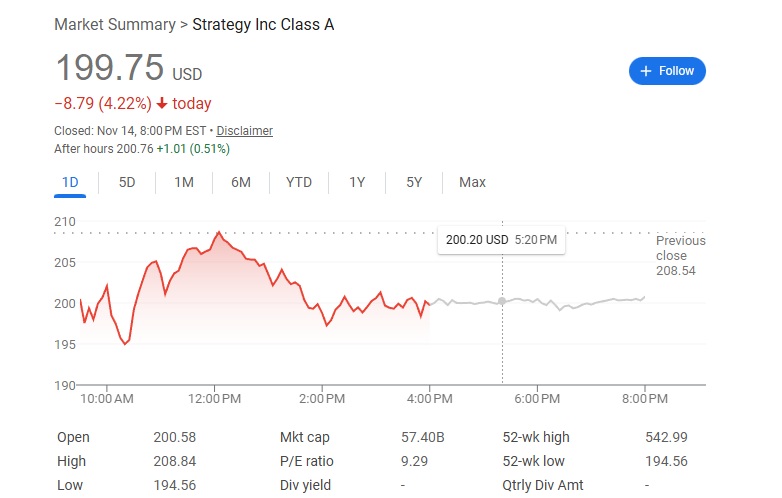
As of pre-market trading on November 14, 2025, MicroStrategy now rebranded as Strategy shares have fallen below $200 for the first time since early October 2024, when the stock traded around $180–$190 amid post-election volatility following Donald Trump’s victory.

The stock closed at $208.54 on November 13, down 7.15% for the day, and is extending losses today with pre-market bids around $195–$198. This marks a roughly 63% drawdown from its all-time high of $543 earlier in 2025, and a staggering 54% decline since mid-July.

MicroStrategy’s stock is essentially a leveraged bet on Bitcoin (BTC), holding over 397,000 BTC valued at approximately $70 billion (as of Q3 2025). The recent slide mirrors BTC’s pullback below $100,000—down 20% from its October peak—but MSTR has underperformed dramatically, decoupling from its crypto proxy role.

Historically correlated at 0.92 with BTC, MSTR has amplified downside due to its aggressive debt-fueled BTC acquisitions. BTC is only -20% YTD, while MSTR is -73% from its 2025 peak. The stock’s multiple-to-net-asset-value (mNAV) has collapsed to 1.06x from 2.7x last year, now trading near or briefly below the value of its BTC holdings per share adjusted for debt.

This erodes the “premium” investors once paid for CEO Michael Saylor’s strategy. The stock has experienced significant volatility in 2025, peaking at $543 in early November before a sharp correction. It is now trading about 62% below its all-time high, with the multiple-to-net-asset-value (mNAV) ratio—comparing stock price to Bitcoin holdings per share—compressing to around 1.22x, down from highs above 2.7x earlier in the year.

This narrowing premium has raised concerns about the sustainability of its “Bitcoin treasury” strategy, though CEO Michael Saylor has emphasized continued accumulation rather than sales. -29.22% underperforming the S&P 500’s ~20% gain.

These figures reflect a broader downtrend in crypto-related equities, with MSTR down over 10% in the past month alone as Bitcoin fell more than 10% from its recent peak.

MSTR’s stock has declined in tandem with Bitcoin’s drop to a six-month low, amplifying losses due to the company’s leveraged exposure via debt-financed BTC purchases. Despite this, Strategy recently added to its holdings, bringing total BTC to 641,692.

Analyst Sentiment: Of 15 analysts, 12 rate it “Strong Buy,” 1 “Moderate Buy,” 1 “Hold,” and 1 “Strong Sell.” The average price target is $523, implying over 155% upside potential from current levels.

RSI at 23.7 deeply bearish, price below the 200-day SMA ($342). Death cross confirmed: 50-day EMA crossed below 200-day EMA. Short interest up to 10% from 7% YTD low, with bears like Jim Chanos who recently closed his short warning of potential BTC liquidation if mNAV dips below 1x.

Inverse cup-and-handle pattern suggests further downside. Q3 earnings showed $2.8B net income from unrealized BTC gains, but core BI software revenue ~$480M TTM grows modestly at 5–7% YoY and remains unprofitable without crypto boosts.

High debt/equity (14%) creates negative carry but boosts ROE to 25.59%. Recent upsized stock offerings for BTC buys have sparked dilution fears, especially as passive funds post-2022 inclusion hold steady.

Further downside to $187–$190 next support, or even $180 if BTC tests $90K. Analysts see risk of BTC sales if mNAV <1x, potentially flooding the market. High-beta nature could drag it 80% from ATH as in 2022.

Oversold bounce if BTC reclaims $110K. Contrarians eye a 2023-like +1700% run if premium rebuilds to 2x+. Saylor’s playbook remains intact with $70B treasury, and passive inflows could stabilize.

Traders call it “brutal AF” and a “deep correction,” with some eyeing $180 targets, while others insist “$MSTR will never go below $200 again!” ironically, just before it did. If you’re holding or trading, watch BTC’s $100K level closely—it’s the linchpin.