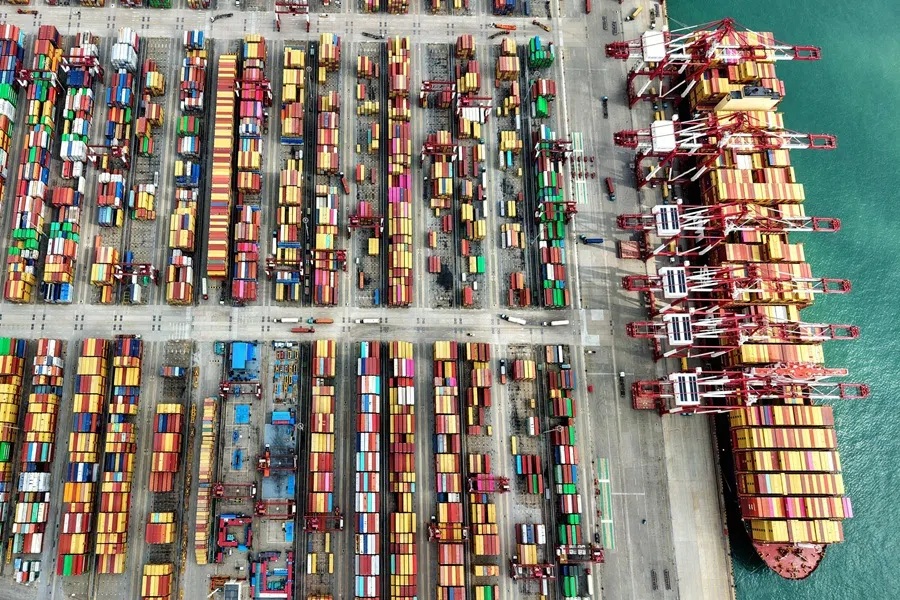
China’s exports grew faster than expected in July, extending a powerful run of external demand that is helping offset weak domestic consumption and giving the world’s second-largest economy an important source of growth amid persistent trade and geopolitical tensions.
Exports rose 23.9% in U.S. dollar terms from a year earlier, official customs data showed on Friday, exceeding the 22.2% increase expected by economists in a Reuters poll. Growth nevertheless slowed from June’s 27% surge, which was China’s strongest export expansion since October 2021.
Imports also expanded sharply, rising 27.5% year on year, just below the 27.9% forecast. The increase followed June’s 36% jump, the fastest growth in five years.
The figures point to continued strength in China’s manufacturing and technology sectors, even as domestic demand remains comparatively weak. A global investment boom in artificial intelligence infrastructure has become an increasingly important source of demand for Chinese-made components and industrial equipment.
China’s integrated circuit exports by value nearly doubled in the first seven months of the year from the same period in 2025, according to official data compiled by Wind Information. Chip exports alone jumped 117% in July from a year earlier.
That surge highlights a broader change in the composition of China’s export machine. Mechanical and electrical products accounted for more than 60% of total exports during the first seven months of the year, according to the customs authority. Electric vehicles, lithium batteries and wind-power equipment were among the products supporting shipments, while exports of 3D printers and industrial robots also recorded strong growth.
The data suggest that China is increasingly relying on higher-value manufactured goods and technology-related products to sustain export growth. That shift is important for Beijing as the property sector remains weak and household spending has failed to provide the same momentum as China’s industrial sector.
Tariffs Have Yet To Derail Exports
China’s trade performance has also been supported by exporters bringing forward shipments to the United States ahead of higher tariffs.
Shipments to the U.S. increased about 17% in July from a year earlier, accelerating from roughly 14% growth in June, according to Wind data. Imports from the U.S. rose 15%.
Washington imposed a new 12.5% levy on Chinese products in late July, replacing a temporary 10% tariff that had expired. The timing has encouraged some Chinese exporters to accelerate deliveries before higher trade barriers take effect.
The July increase in shipments therefore does not necessarily indicate that Chinese exports to the U.S. will maintain the same pace in coming months. Front-loading can pull future demand forward, creating a stronger near-term trade reading while potentially weakening subsequent shipments.
China’s exports to the European Union rose 16% year on year in July, while imports from the bloc declined 1%. The divergence could further complicate Beijing’s trade relationship with Europe, particularly as European policymakers continue to push China to address its large trade surplus.
China recorded a trade surplus of $112.5 billion in July, above the roughly $107 billion expected by economists, although the surplus narrowed from $125.6 billion in June.
Trade Surplus Exposes Domestic Weakness
China’s continued dependence on exports is becoming increasingly significant because domestic demand remains subdued. The country’s economy expanded 4.3% in the second quarter, its weakest quarterly growth since the fourth quarter of 2022. Retail sales increased just 1% in June after contracting 0.6% in May, while consumer inflation eased to 1% from 1.2%.
The contrast between strong exports and weak household demand underscores the imbalance that policymakers have struggled to address.
China’s trade surplus exceeded $1 trillion last year, drawing increasing criticism from the United States, the European Union and other trading partners. They have urged Beijing to shift its economic model toward stronger household consumption rather than relying so heavily on manufacturing investment and exports.
Zhiwei Zhang, president and chief economist at Pinpoint Asset Management, expects China’s export engine to remain strong through the third quarter.
“I expect intense negotiations between China and the major trading partners in the coming months on what can be done to make trade more balanced,” Zhang said, ahead of an expected U.S.-China summit in September and an EU-China meeting on economic relations in October.
Those discussions could become more consequential if China’s export growth remains concentrated in industries where domestic manufacturers are rapidly expanding global market share.
AI Boom Provides A New Export Engine
One of the most important developments in the July data is the strength of China’s technology-related exports. The rapid increase in chip shipments comes as global technology companies continue to spend heavily on data centers, AI computing infrastructure and related equipment. While U.S. restrictions limit China’s access to some advanced semiconductor technologies, Chinese manufacturers remain deeply integrated into broader technology supply chains.
The strength of exports of batteries, electric vehicles, industrial robots and renewable-energy equipment also underpins Beijing’s growing reliance on industries that it has spent years developing through industrial policy, subsidies and massive domestic investment.
That creates both an opportunity and a new source of tension.
China’s ability to export large volumes of sophisticated manufactured goods can support growth, employment and industrial utilization at home. But the same export surge risks prompting additional trade restrictions as governments in the U.S. and Europe seek to protect domestic manufacturers.
Beijing reaffirmed support for the economy at a policy-setting meeting in late July, signaling faster fiscal implementation and timely monetary adjustments. However, authorities stopped short of announcing major measures specifically aimed at boosting household consumption.
That leaves China’s economy heavily dependent on manufacturing and external demand at a time when trade relations are becoming more politically sensitive.
The July figures therefore present a mixed picture. China’s export sector remains remarkably resilient, powered by chips, electric vehicles, batteries, machinery and other technology-intensive goods. But the persistence of weak domestic consumption means that the country’s record trade surplus is also evidence of an unresolved economic imbalance.