DD
MM
YYYY

PAGES

DD
MM
YYYY

spot_img

PAGES

Home Blog Page 227

5 Cryptos to Buy as Elon’s Tesla Confirms None of Its $1.3B Bitcoin Was Sold in Q3

0

Tesla’s Q3 2025 earnings report confirmed that the electric car giant held tight to its $1.3 billion Bitcoin position, refusing to sell a single satoshi. With Bitcoin holding above $107,000, Tesla’s stance signals a bullish sentiment that could drive the next major altcoin surge. Investors now have their eyes set on the next wave of tokens that could follow Bitcoin’s momentum. Here are the five cryptos to buy right now, and leading the list is Little Pepe (LILPEPE), a meme coin sensation with serious market potential.

Little Pepe (LILPEPE): The Meme Coin About to Explode

Little Pepe (LILPEPE) is stealing the show as the top crypto to buy following Tesla’s decision to hold its $1.3 billion Bitcoin stake through Q3 2025. With a presale that has already raised over $27.35 million, this meme token is creating massive buzz across the DeFi space. Priced at $0.0022 in stage 13 after a complete sellout of earlier stages, investors are rushing to grab their share before the next price jump. This high level of engagement demonstrates that the community’s backing for Little Pepe is both broad and strong. Experts are already comparing LILPEPE’s potential to that of early-stage giants like PEPE and SHIB, predicting that its price could surge once the token launches on exchanges.

LILPEPE’s security credentials are equally impressive. It has been successfully audited by CertiK, achieving a security score of 95.49%, proving that investor protection is a top priority.

Its roadmap playfully describes the project as being in its “pregnancy stage,” preparing for a major market launch alongside “Mumma Pepe.” Once this meme coin hits major exchanges, analysts expect a massive price surge that could push Little Pepe into the top tier of cryptocurrencies. With Tesla showing faith in Bitcoin, meme coins with strong fundamentals and vibrant communities are next in line to benefit. Among them, Little Pepe (LILPEPE) stands out as a must-watch token for anyone seeking explosive gains.

Cardano (ADA): Smart Contract Growth Back in Focus

Following Tesla’s Bitcoin holdings, Cardano (ADA) is back on the radar of investors seeking a robust smart contract platform to add to their portfolios. ADA has reclaimed a 4.54% gain for the week. If the $0.84 resistance is breached, ADA could descend towards $0.97. A short-term dip could open up buying opportunities for traders anticipating a market recovery. As DeFi users and activity increase, Cardano’s potential for bullish performance looks promising.

Sui (SUI): Fast-Growth Token Ready for More Gains

Sui (SUI) has proven itself to be one of the fastest movers in the market since Tesla confirmed its Bitcoin holdings. After dropping to $0.56 in late October, SUI skyrocketed by over 380% to $2.71, breaking out from a symmetrical triangle with rising volume. As the crypto market gains more strength, SUI’s performance could extend further, making it a top pick for traders seeking short-term upside.

TRON (TRX): Stability Meets Steady Growth

Elon Musk’s steady Bitcoin strategy is giving extra fuel to reliable projects like TRON (TRX). Trading at $0.297, TRX remains one of the most consistent performers in the market. With low 4.5% volatility over the past month, TRON offers investors a stable accumulation zone.

Ripple (XRP): Whale Accumulation Signals Strength

Ripple (XRP) has crossed a major resistance level at $2.63, and with the current price at $2.68, it registers a 3% price growth. Weekly trading volume is up by 26%. With regulatory clarity improving and other countries’ interest piqued, XRP might finally garner some market excitement again now that Tesla has decided not to sell.

Conclusion

Tesla’s confidence in Bitcoin has reshaped the crypto sentiment, and savvy investors are moving quickly. Among the five cryptos to buy, Little Pepe (LILPEPE) is leading the charge with unmatched community engagement, verified security, and explosive presale growth. With excitement building, this meme token could soon be the next headline-making success story in the crypto space.


For more information about Little Pepe (LILPEPE) visit the links below:

Website: https://littlepepe.com

Whitepaper: https://littlepepe.com/whitepaper.pdf

Telegram: https://t.me/littlepepetoken

Twitter/X: https://x.com/littlepepetoken

$777k Giveaway: https://littlepepe.com/777k-giveaway/
Why Flipping Just $1,500 of Ethereum Into Ozak AI at $0.012 Could Outperform ETH Even at $10K by 2026

0

The year 2026 could see the Ozak AI token outperform Ethereum. This is primarily because the Ozak AI ecosystem has established a strong roadmap starting from the $OZ presale stage. Ozak AI has already generated a 12× ROI for Phase 1 investors and is estimated to deliver over an 83× ROI for Phase 6 investors. In comparison, ETH may only achieve around a 5× return in 2026.

Also, Ozak AI is backed by strong and modern technical specifications, like the fusion of AI tools and tokenized growth. These are in addition to the decentralized infrastructure, which still supports the overall structure for $OZ.

$OZ Outperforming ETH and Presale Progress

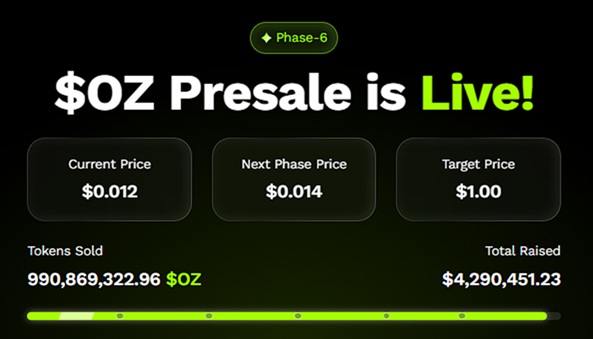
Ozak AI is currently in Phase 6 of its presale, with the $OZ token priced at $0.012. So far, the project has raised over $4.02 million by selling more than 969 million tokens, marking a 1,100% increase from the Phase 1 price of $0.001.

It is estimated that $OZ could outperform ETH even if ETH reaches $10,000 in 2026. For example, a $1,500 investment in ETH at today’s price would yield a 6.67× return if ETH hits $10,000. In comparison, investing the same $1,500 in $OZ at its current price of $0.012 could potentially grow to $75,000 if the token reaches its $1 target—a 50× return.

Even with more conservative growth, such as a 10× increase, the investment would still rise to $15,000, providing higher profits and a larger relative gain than the same investment in ETH.

Still, more presale phases will be lined up till all 3 billion tokens are sold out. This represents 30% of the total supply of 10 billion tokens. The remaining portion of the supply is allocated to Ecosystem & Community  (30%), Future Reserve (20%), Team (10%), and Liquidity & Listings (10%). The $OZ offer value will be revised to $0.014 from $0.012 after it commences Phase 7.

Technical Attractions of Ozak AI ($OZ)

Outperforming ETH in 2026 is also backed by the strong technicalities of the Ozak AI ecosystem. This includes DePIN design, cross-chain functionality, and token utility, to mention a few features. For starters, DePIN design works to lower the chances of data tampering and loss by leveraging blockchain and IPFS nodes. It essentially distributes data across a network of nodes.

Cross-chain functionality enables seamless operations for Ozak AI across multiple blockchains. This paves the way for $OZ to grow with stability. Token utility entails the power to participate in governance and contribute to the expansion of the ecosystem. Moreover, the holders of $OZ can engage in staking activities and exclusively access AI Agents & a real-time analytics feed.

The AI-powered infrastructure boosts automation, optimization, and smart analytics. Security and transparency are ensured by Certik and Sherlock through the deployment of advanced tools that frequently audit smart contracts to identify and address vulnerabilities.

Key Partnerships of Ozak AI

Ozak AI recently entered into a partnership with Meganet and Phala Network. A partnership with Meganet covers architecting an efficient and distributed computing capability that can fetch real-time financial insights. Ozak AI and Meganet have also agreed to work to save costs on AI processing.

A partnership with Phala Network is aimed at enabling secure and private AI prediction models specifically for financial markets. Ozak AI will contribute with Prediction Agents, and Phala Network will bring a stack of CPU-GPU-TEE to the table.

$OZ Over ETH in 2026

Suffice it to say, the Ozak AI token has the potential to generate a higher ROI compared to ETH in 2026. This is after considering that $OZ reaches just half of the target price. The technical specifications of the ecosystem, like the fusion of AI tools and decentralized infrastructure, are positioning it to dominate the next year.


For more information about Ozak AI, visit the links below:

Website: https://ozak.ai/

Twitter/X: https://x.com/OzakAGI

Telegram: https://t.me/OzakAGI

DOGE and SHIB Flips Created Millionaires—Ozak AI Could Be the Next Big Story

0

Crypto history is full of splendid memories of small investments becoming large fortunes. Dogecoin and Shiba Inu led that revolution, creating waves of millionaires at some stage in beyond bull markets. Their meteoric rises, pushed by means of network strength and viral strength, described the power of early positioning. But as the next bull run gathers steam in 2025, the focus is moving from memes to a significant era.

That’s where Ozak AI comes in—an AI-driven project blending real-world functionality with early-stage opportunity. With its presale price at just $0.012, Ozak AI could be the next big story that turns strategic investors into the next wave of crypto millionaires.

DOGE

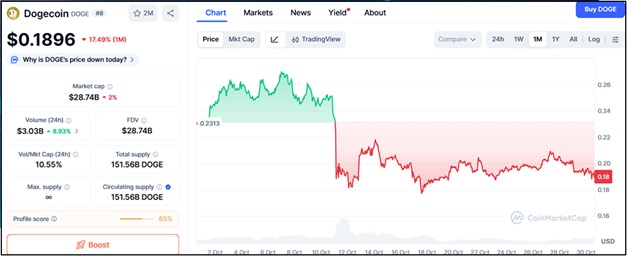
Dogecoin, currently trading around $0.1896, remains the most iconic meme coin in lifestyles. Its current technical setup indicates resistance at $0.215, $0.258, and $0.295, while support lies at $0.175, $0.160, and $0.142. These levels suggest that DOGE is still consolidating, but with developing social sentiment and market liquidity, a clean rally will be drawing close.

DOGE’s story is legendary—what began as a joke became a financial phenomenon. Early investors who bought DOGE under a cent saw life-changing gains as the token rocketed to over $0.70 during the 2021 bull run. However, with its massive market cap and reduced volatility, the probability of another 100x move is slim. It remains a cultural and historical pillar of crypto, but the next explosive growth will likely emerge from projects still in their infancy—projects like Ozak AI.

SHIB’s Community Strength and Ecosystem Growth

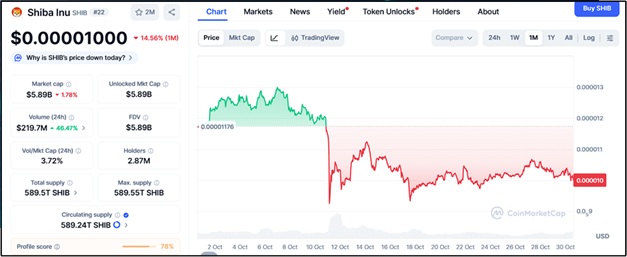
Shiba Inu, trading near $0.00001, continues to be one of the most lively altcoins within the market. Its resistance ranges are at $0.0000113, $0.0000126, and $0.0000142, whilst help sits around $0.0000093, $0.0000087, and $0.0000081.

Unlike most meme coins, SHIB has evolved beyond speculation. The introduction of Shibarium—its Layer-2 blockchain—has given SHIB real-world functionality, supporting DeFi packages, staking, and NFTs. Combined with regular token burns and a large community of over 1.3 million holders, Shiba Inu remains a top project for steady increase. But again, whilst SHIB may additionally nonetheless deliver 10x to 20x returns, it now does not give the once-in-a-lifetime access capacity that it did for the duration of its early days.

Ozak AI: The Next Big Crypto Breakout in the Making

Ozak AI is changing how investors perceive early-stage projects. Currently in its 6th OZ presale stage at $0.012, Ozak AI has already raised over $4.2 million and sold more than 980 million tokens, signaling strong investor confidence. The project focuses on AI-powered prediction agents—intelligent systems designed to deliver real-time market insights, predictive analytics, and automated trading strategies.


This unique utility sets Ozak AI apart from meme coins. It’s not driven by hype but by innovation—fusing artificial intelligence and blockchain technology to give traders smarter decision-making tools. As AI continues to dominate tech trends globally, Ozak AI is positioning itself as one of the most promising projects of 2025, capable of bridging crypto’s analytical and automation gap.

Partnerships Strengthen Ozak AI’s Foundations

Ozak AI’s credibility is further reinforced through key partnerships with Perceptron Network, HIVE, and SINT. These collaborations improve scalability, data accuracy, and integration across decentralized networks. Additionally, Ozak AI has undergone security audits from CertiK and Sherlock, ensuring transparency and investor protection—two elements crucial for long-term sustainability.

Dogecoin and Shiba Inu proved that timing, belief, and community can create unimaginable wealth in crypto. But Ozak AI is now evolving that narrative. It represents the next generation of high-upside tokens—combining early-stage entry with groundbreaking technology.

As the 2025 bull run intensifies, DOGE and SHIB may continue to deliver solid returns, but Ozak AI could be the one rewriting crypto’s next millionaire story. For traders ready to flip hype-driven gains into intelligent innovation, Ozak AI stands as the smartest bet of this cycle—and potentially, the next name whispered in every crypto success story.

About Ozak AI

Ozak AI is a blockchain-based crypto project that provides a technology platform that specializes in predictive AI and advanced facts analytics for monetary markets. Through machine learning algorithms and decentralized network technologies, Ozak AI enables real-time, correct, and actionable insights to help crypto fanatics and companies make appropriate decisions.


For more, visit:

Website: https://ozak.ai/

Telegram: https://t.me/OzakAGI

Twitter: https://x.com/ozakagi

U.S. Treasury Raises Series I Bond Rate to 4.03% as Inflation Adjustment Lifts Returns

0

The U.S. Department of the Treasury has announced a new composite interest rate of 4.03 percent for Series I savings bonds issued between November 1, 2025, and April 30, 2026.

The updated rate represents a modest increase from the previous 3.98 percent yield that was offered through October, marking another adjustment in response to inflation data and broader shifts in the bond market.

According to Treasury data, the new rate includes a variable portion of 3.12 percent, which reflects recent inflation figures, and a fixed rate of 0.90 percent that will remain constant for the life of the bond. The combined composite rate of 4.03 percent is the result of these two elements after rounding. The fixed rate is slightly lower than the 1.10 percent announced in May, but analysts note that it remains competitive given the current environment of easing inflation and declining yields across Treasury securities.

Series I bonds, introduced by the U.S. Treasury in 1998, are designed to protect investors from inflation while offering the security of a government-backed asset. The composite yield is recalculated every six months, in May and November, based on the Consumer Price Index for All Urban Consumers (CPI-U). Each bond’s variable portion adjusts in step with the rate of inflation, while the fixed rate — which represents the real yield above inflation — remains constant throughout the bond’s 30-year lifespan.

Under this structure, an investor who purchases an I bond in November 2025 will earn the current 4.03 percent annualized rate for the first six months. After that, the variable component will reset based on inflation at the time, while the fixed portion remains locked at 0.90 percent. For example, a buyer who purchased an I bond in March 2025 at a 1.2 percent fixed rate saw the variable portion adjust from 1.90 percent to 2.86 percent in September, yielding a new composite rate of roughly 4.06 percent. The mechanics are designed to ensure that I bond returns reflect inflation trends while offering some stability through the fixed-rate element.

Interest on I bonds compounds semiannually and can be earned for up to 30 years unless the holder redeems the bond earlier. The Treasury requires that I bonds be held for at least one year before redemption, and if an investor redeems before five years, they forfeit the last three months of interest as a penalty. Interest income is exempt from state and local taxes, though it is subject to federal income tax, which can be deferred until redemption or final maturity.

I bonds have a $10,000 annual purchase limit per individual when bought electronically via TreasuryDirect.gov. They are nonmarketable, meaning they cannot be traded on secondary markets and can only be redeemed by the original purchaser or a designated beneficiary.

The new 4.03 percent rate continues a period of moderation following the historic surge in I bond yields seen in 2022. In May of that year, the Treasury set the composite rate at a record 9.62 percent, prompting a rush of investors seeking a safe and inflation-protected return during a period of soaring consumer prices. Since then, inflation has cooled, and I bond rates have steadily declined in tandem. Still, the combination of a stable fixed rate and the inflation-linked variable component has continued to attract long-term savers seeking diversification and safety.

The fixed rate is often considered a key determinant of long-term appeal. At 0.90 percent, it remains significantly higher than the near-zero levels that prevailed between 2020 and 2022, when the Federal Reserve kept interest rates low to support the economy during the pandemic. Analysts note that the fixed portion has become more attractive as real yields in Treasury Inflation-Protected Securities (TIPS) have stabilized, offering investors a modest hedge against inflation over time.

Simulating Composite Returns Under Various Inflation Scenarios

If inflation remains moderate, averaging around 2 percent annually over the next year, the variable component of I bonds would likely stay close to 3 percent, producing a composite yield in the range of 3.8 to 4.2 percent. Should inflation rise to 3.5 percent, as some economists expect if oil prices remain elevated, the composite rate could move closer to 5 percent in the next adjustment cycle. In a high-inflation scenario, such as a 5 percent annual increase in the CPI, I bonds could again yield more than 6 percent, reflecting their direct link to inflation data.

Conversely, if inflation falls below 1.5 percent, the composite rate could decline to between 2.3 and 3 percent, which would make I bonds less attractive compared to other fixed-income instruments like short-term Treasury bills or high-yield savings accounts. However, even in such a case, the fixed portion would ensure some minimal return above zero — an advantage over many inflation-protected instruments that can yield negative real returns during periods of low inflation.

Compared to Treasury Inflation-Protected Securities (TIPS), I bonds have several advantages for small investors. I bonds are free from price volatility because they cannot be traded on secondary markets, whereas TIPS fluctuate in price as market yields change. I bonds also offer tax deferral until redemption, whereas TIPS generate taxable income annually. However, TIPS allow for larger investments and can provide liquidity for institutional investors seeking exposure to inflation hedges within diversified portfolios.

As of mid-October 2025, five-year TIPS are yielding about 1.75 percent above inflation, while the 10-year yield stands around 2 percent. That suggests that I bonds, with their 0.90 percent fixed rate plus inflation, remain a competitive alternative for long-term, low-risk investors — especially those who value simplicity and tax advantages over secondary market flexibility.

Financial analysts generally view I bonds as most suitable for conservative savers looking for guaranteed, inflation-adjusted returns rather than speculative capital gains.

Overall, the Treasury’s latest adjustment to the 4.03 percent composite rate underscores the stability of I bonds as a core instrument in the government’s savings program. While the days of near double-digit yields from 2022 are long gone, I-bonds continue to offer a balance between inflation protection and safety, standing out as one of the few investment products that directly ties returns to the real cost of living in the U.S. economy.

PayPal CEO Writes Merchants on Agentic Commerce Integration

0

Our business has been using PayPal for years. This week I received the first “email” from the CEO of the company. I mean for more than a decade, the CEO of PayPal has not directly written in any email our company has been included in this way. But this week, he made a case why merchants must plan for the future of agentic commerce. In other words, he considers the shift very important to sign that email. Read the note:

“Hello Ndubuisi Ekekwe,

The way people shop is changing fast. AI-powered agents are starting to help consumers discover and buy products in entirely new ways — and we want to make sure your business is ready to be part of it.

That’s why we are building PayPal’s new agentic commerce services — simple, powerful tools that make your products discoverable on leading AI platforms without extra setup or technical work. With just one PayPal connection, your store can appear across multiple AI shopping channels, while orders flow straight into your existing systems.

You’ll be able to accept payments instantly through PayPal, just like you do today — no new integrations or code required. Behind the scenes, our trusted and secure infrastructure takes care of everything from payment validation to routing, so you can focus on what matters most: your customers.

And through it all, your business stays your business.

You keep full ownership of your customer data — PayPal protects it.

You control your brand’s visibility and communication with every buyer.

You remain the merchant of record for every transaction.

We’re not here to replace your connection with customers — we’re here to help you reach more of them, faster.

This next chapter of digital commerce belongs to those who adapt quickly, and we’re making it simple for you to do just that. With PayPal as your partner, you can integrate once, reach everywhere, and grow confidently into the age of AI-driven commerce. Be the first to be a part of this exciting transformation and reach out to your PayPal account executives or visit our website today to sign up.

Thank you for choosing PayPal to power your business — we can’t wait to see what you do next.

Warm regards,

Alex Chriss

President and CEO, PayPal”

Tekedia Institute and our companies have joined the waitlist. With PayPal, you can register and pay for Tekedia Mini-MBA, AI Lab, etc while within ChatGPT, Google Gemini, and other ecosystems offered by Perplexity, Anthropic etc. Largely, the battle for conversational commerce and who will power the payment stack has started.