DD
MM
YYYY

PAGES

DD
MM
YYYY

spot_img

PAGES

Home Blog Page 23

Apple Reclaims World’s Most Valuable Company as Google Rejoins the $4 Trillion Club

0
An Apple logo is seen at the entrance of an Apple Store in downtown Brussels, Belgium March 10, 2016. REUTERS/Yves Herman/File Photo

Apple reclaimed its position as the world’s most valuable publicly traded company, closing Monday with an extraordinary market capitalization of $4.92 trillion.

The achievement pushed the iPhone maker ahead of Nvidia, which had recently dominated the rankings amid the explosive growth of artificial intelligence.

At the same time, Alphabet, Google’s parent company, crossed the $4 trillion market capitalization threshold once again, underscoring the sustained strength of Big Tech and investor confidence in the future of AI-driven innovation.

Apple’s return to the top reflects renewed optimism surrounding its long-term growth strategy. Although Nvidia has captured much of the spotlight over the past two years because of unprecedented demand for AI chips.

Investors have increasingly recognized Apple’s ability to integrate artificial intelligence into its massive ecosystem of devices and services. The company’s strength lies not only in hardware sales but also in its expanding software, subscription, and ecosystem revenues, which continue to generate consistent cash flow and reinforce customer loyalty.

The race between Apple and Nvidia has become one of the defining stories of modern financial markets. Nvidia’s meteoric rise was fueled by its dominance in supplying graphics processing units (GPUs) that power generative AI models, cloud computing infrastructure, and data centers worldwide.

Apple’s immense installed base of over two billion active devices gives it a unique opportunity to deploy AI features directly to consumers at an unprecedented scale. Investors appear to believe that this advantage could translate into significant revenue growth over the coming years.

Meanwhile, Google’s return above the $4 trillion market capitalization mark highlights the company’s resilience despite fierce competition in search, cloud computing, and artificial intelligence. Alphabet has aggressively expanded its AI offerings across Google Search, Workspace, Android, and Google Cloud.

Its Gemini family of AI models has become central to the company’s strategy, helping strengthen enterprise services while enhancing consumer experiences across its ecosystem.

Google Cloud has emerged as one of the company’s fastest-growing businesses, benefiting from rising demand for AI infrastructure and enterprise computing solutions.

At the same time, YouTube continues to deliver strong advertising and subscription revenue, while advances in AI-powered search are opening new opportunities for monetization. These developments have reassured investors that Alphabet remains one of the world’s premier technology innovators.

The simultaneous milestones achieved by Apple and Google illustrate a broader transformation taking place across global financial markets. Rather than viewing AI as a standalone industry, investors increasingly see artificial intelligence as a foundational technology capable of reshaping every aspect of the digital economy.

Companies with strong ecosystems, proprietary data, semiconductor capabilities, and cloud infrastructure are positioned to capture enormous value as AI adoption accelerates. The remarkable valuations of Apple, Nvidia, Microsoft, and Alphabet also reflect growing expectations that AI will drive productivity gains across industries ranging from healthcare and manufacturing to finance and education.

As businesses invest billions of dollars in AI infrastructure, software, and automation, technology giants are expected to remain among the biggest beneficiaries of this structural shift. While these record-breaking valuations demonstrate extraordinary investor confidence.

They raise expectations for continued innovation and revenue growth. Markets will closely watch upcoming earnings reports, product launches, and AI developments to determine whether these companies can justify their historic market capitalizations.

Apple’s return to the top and Google’s resurgence above $4 trillion reinforce the enduring dominance of Big Tech in shaping the future of the global economy.

AI Trade Shifts as Wall Street Bets on Companies Using Artificial Intelligence, Not Just Building It

0

The artificial intelligence-driven stock market rally is entering a new phase as investors shift away from the technology giants that have dominated gains over the past two years and toward companies using AI to improve efficiency, cut costs and drive earnings growth.

The rotation reflects a broader expansion of the bull market, with investors moving beyond the semiconductor makers and cloud computing companies that have been at the center of the AI boom into sectors that have lagged but are now expected to benefit from adopting the technology.

At the same time, some of the market’s biggest AI winners, including Nvidia and Microsoft, have faced increased volatility as investors assess whether massive spending on AI infrastructure will generate returns quickly enough to justify lofty valuations.

“The market is beginning to rotate toward quality, a classic mid-cycle transition as the business cycle matures,” Mike Wilson, Morgan Stanley’s chief U.S. equity strategist, wrote in a research note first quoted by Business Insider.

“From here, margin expansion is likely to depend less on early-cycle operating leverage and more on AI adoption, reinforcing our quality thesis.”

The changing market leadership comes after months of sharp swings in AI-related stocks. Semiconductor companies have experienced heightened volatility, with several of the sector’s biggest names giving up gains as investors reacted to concerns over competition from Chinese firms, questions about AI spending, and elevated valuations.

Analysts at Piper Sandler described the trend as a “mega-rotation” away from the technology sector and toward more defensive areas of the market. Analysts at Citigroup argued that the era of the “Magnificent Seven” dominating market performance has begun to fade.

Morgan Stanley believes the next stage of the AI investment cycle will increasingly reward companies that deploy artificial intelligence across their operations rather than those primarily supplying the underlying technology.

According to Wilson, businesses are already reporting measurable gains from AI implementation.

“Our systematic transcript analysis shows that 25% of S&P members cited measurable benefits from AI adoption in calendar 2Q, versus 14% a year ago,” he said.

The bank expects AI adoption to become a significant contributor to corporate profitability over the next several years.

“We continue to view AI adoption as an important source of earnings growth and operating leverage, with roughly 100 basis points of net margin expansion expected through 2027 related to adoption.”

Morgan Stanley’s “AI Adopter Screener” highlights companies that it believes are well positioned to benefit from integrating artificial intelligence into their businesses. The list includes Alphabet, Roblox, Dick’s Sporting Goods, CVS Health, Shopify, Apple, and Constellation Energy.

The bank said industries often viewed as vulnerable to disruption from AI, including transportation, software and services, and professional services, could instead emerge among the biggest beneficiaries as companies use the technology to improve productivity and reduce operating costs.

Investment manager Vanguard also sees investors broadening their exposure beyond the dominant AI infrastructure providers.

According to Vanguard senior economist Shaan Raithatha, investors are increasingly scrutinizing whether the enormous capital expenditures being made by AI “hyperscalers” such as Alphabet, Amazon, Meta Platforms, Microsoft, and Oracle will generate sufficient returns in an increasingly competitive environment.

“The dominant narrative is that investors are increasingly questioning whether the large investments committed by the AI hyperscalers will deliver sufficient returns amid elevated expectations and intensifying competition,” Raithatha said.

He added that investors are still expected to allocate capital across the broader AI ecosystem, including companies supplying critical semiconductors and memory chips. However, he warned that those areas are likely to remain volatile, particularly as Chinese competitors increase pressure on U.S. and South Korean chipmakers.

Vanguard said the next chapter of the AI investment story will be determined less by spending on computing infrastructure and more by whether businesses across industries can translate AI into measurable productivity gains.

“The next phase of the AI story is more about whether current investment translates into productivity gains for the broader global economy,” the firm said.

“History tells us that over time, the benefits of general-purpose technologies spread throughout the economy from the sector that drove the initial innovation.”

The evolving outlook suggests investors are increasingly looking beyond the companies building AI models, chips and data centers and focusing on firms capable of converting artificial intelligence into higher margins, stronger earnings growth and sustained competitive advantages.

ASML’s Dominance Faces Fresh China Challenge, but Analysts Say Market Fears May Be Overdone

0

Shares of Dutch semiconductor equipment giant ASML fell on Tuesday after reports that a Chinese company has begun manufacturing a key chipmaking tool that the company has long dominated, fueling concerns that Beijing is making meaningful progress toward semiconductor self-sufficiency.

The stock declined 1.8% as part of a broader sell-off in global chip stocks, although ASML shares remain up more than 123% this year, reflecting continued investor optimism over surging artificial intelligence-driven semiconductor demand.

The decline followed a report by The Information that an unnamed Chinese company has started producing immersion deep ultraviolet (DUV) lithography machines, with the first systems expected to be delivered this year to major domestic chipmakers including Semiconductor Manufacturing International Corporation and ChangXin Memory Technologies.

The report comes as China accelerates efforts to reduce its dependence on Western semiconductor technology in response to increasingly stringent U.S.-led export restrictions. While the development marks an important milestone for China’s domestic chip industry, industry analysts who spoke to CNBC caution that it is unlikely to threaten ASML’s technological leadership in the foreseeable future.

“This should be taken with a pinch of salt because what China is producing is likely limited to the lower end of the market,” Stephane Houri, Head of Equity Research at ODDO BHF, told CNBC.

A Milestone for China

Immersion DUV lithography systems are among the most sophisticated manufacturing tools required to produce advanced semiconductors. They project intricate circuit patterns onto silicon wafers. They are widely used to manufacture mature and mid-range chips deployed in automobiles, industrial equipment, consumer electronics and many AI-related components.

Although DUV technology remains essential, it is not the most advanced lithography platform available.

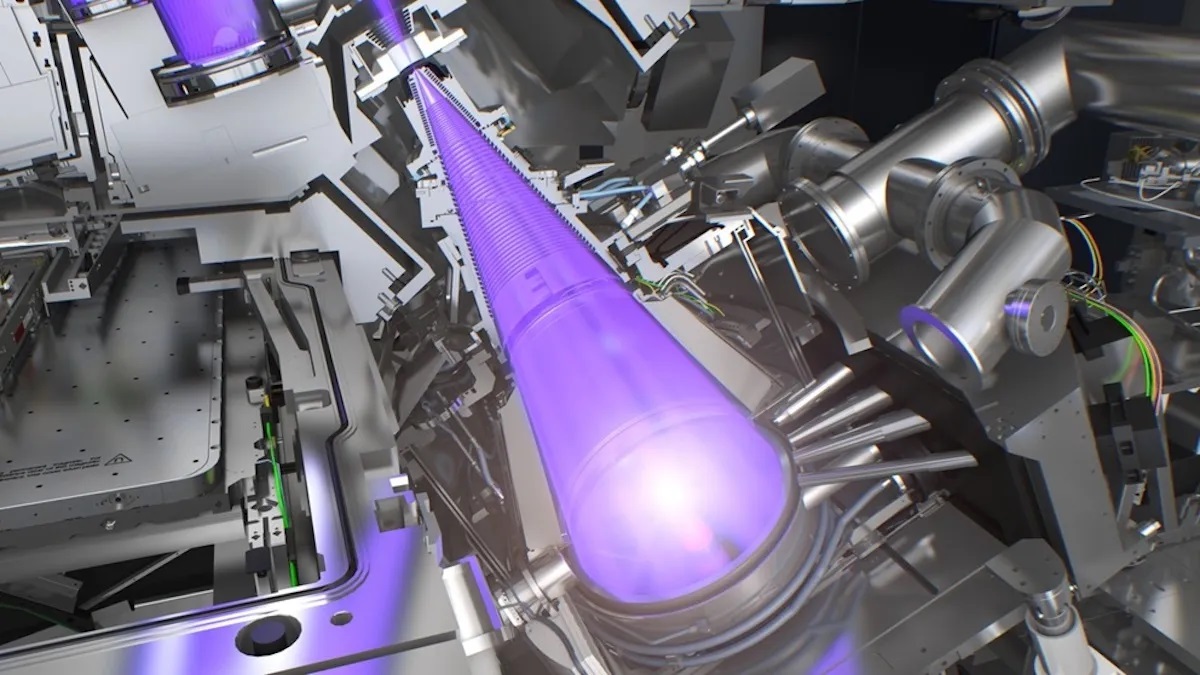
For cutting-edge processors powering artificial intelligence applications, premium smartphones and high-performance computing systems, manufacturers rely on extreme ultraviolet (EUV) lithography, a technology in which ASML remains the world’s only commercial supplier.

That distinction is critical.

While China may now be capable of producing certain DUV systems domestically, analysts say replicating ASML’s EUV technology remains vastly more challenging and is unlikely to happen anytime soon.

However, industry experts stress that merely producing a functioning lithography machine is only the first step.

The more important metric is manufacturing yield, or the percentage of usable chips produced during fabrication. Even small differences in yield can determine whether a semiconductor factory operates profitably.

“They need to get to at least yield parity, not just have a working tool,” Nick Patience, AI Lead at Futurum Group, told CNBC.

Current yields at Chinese foundries already trail global leaders such as Taiwan Semiconductor Manufacturing Company, even when using imported ASML equipment. Machines developed by an inexperienced domestic supplier will likely require years of refinement before achieving comparable levels of reliability, uptime and production efficiency.

Patience noted that reliability is built through years of deployment across multiple fabrication plants, giving ASML a significant advantage that cannot easily be replicated.

Scaling Production Remains Another Major Hurdle

Even if China’s first-generation DUV systems prove functional, manufacturing them at commercial scale presents another challenge. According to The Information, the Chinese manufacturer plans to build only five machines this year and approximately 20 units in 2027.

By comparison, ASML expects to manufacture around 130 immersion DUV systems in 2026 and plans to increase production capacity by another 30% in 2027.

Analysts at SemiAnalysis note that production scale, ecosystem support and long-term servicing capabilities remain among ASML’s strongest competitive advantages.

“Tool performance, scaling production of the machine itself, fleet performance, surrounding ecosystem and poor economics against fully depreciated ASML machines all stack up against China DUV,” the research firm said.

Servicing hundreds of machines worldwide, ensuring software updates, supplying replacement parts and maintaining consistent performance over many years represent barriers that extend well beyond building an initial prototype.

Limited Financial Impact on ASML

The market reaction may also overstate the commercial implications for ASML. China accounted for 14% of ASML’s €6.6 billion in second-quarter system sales, equivalent to roughly €924 million.

However, analysts note that export controls already prevent ASML from selling many of its most advanced immersion DUV systems to Chinese customers. As a result, domestically produced Chinese equipment would largely replace sales ASML is already prohibited from making rather than eroding existing revenue.

“A tool ASML cannot legally or physically supply being built locally does not subtract from a sold-out order book,” SemiAnalysis said.

Demand outside China also remains exceptionally strong, driven by the global AI infrastructure boom, with major foundries continuing to expand capacity using ASML’s equipment.

Paul Triolo, a partner at DGA Albright Stonebridge Group, said producing a handful of domestic machines is fundamentally different from competing with ASML globally.

“Providing a small number of even minimally capable DUV machines domestically is one thing. Supporting a global fleet that would provide real competition for ASML is quite another,” he said.

EUV Remains China’s Biggest Technological Challenge

The latest development has also renewed speculation about whether China could eventually develop an indigenous EUV lithography system. Reuters reported last year that China had completed a working EUV prototype, but analysts caution that commercial success remains a far more difficult objective.

ASML spent roughly two decades developing EUV technology and invested around $10 billion in research and development alongside strategic partners including Intel Corporation, Taiwan Semiconductor Manufacturing Company and Samsung Electronics before the technology became commercially viable. Beyond generating EUV light, the technology depends on ultra-precise mirrors, complex optics, sophisticated software and an extensive global supplier ecosystem that took decades to establish.

While some advances in DUV engineering may contribute to future EUV development, analysts say the technological leap remains enormous.

“Some breakthroughs in DUV immersion lithography are applicable to more advanced EUV technologies, but many are not. EUV light source and optics technology are much more advanced and complex,” Triolo said.

Houri echoed that assessment.

“I think EUV is out of reach. Never say never, especially with the Chinese, but it’s a completely different technology.”

Talking long-term, the emergence of a domestic Chinese DUV supplier nevertheless represents another step in Beijing’s long-term strategy to localize critical semiconductor technologies amid escalating geopolitical tensions and tightening export controls.

Success is expected to reduce reliance on foreign suppliers for mature-node manufacturing and strengthen the resilience of its semiconductor supply chain. For ASML, however, the immediate competitive threat appears limited. The company’s technological leadership, manufacturing scale, service network and monopoly in EUV lithography continue to create formidable barriers to entry.

While China’s progress deserves close attention, analysts broadly agree that producing a limited number of domestic DUV machines is far from displacing the Dutch company at the forefront of global semiconductor manufacturing equipment.

Africa’s Fintech and Logistics Sectors Dominate Startup Funding in H1 2026

0

Africa’s startup investment landscape in the first half (H1) of 2026 remained highly concentrated, with fintech and logistics & transport emerging as the dominant sectors.

According to a report by Africa: The Big Deal, the two industries together accounted for 76% of the $1.36 billion raised by startups across the continent, excluding exits, highlighting investors’ continued preference for a handful of high-growth sectors.

Fintech retained its position as the continent’s leading investment destination, attracting $556 million, representing 41% of total funding. Logistics & Transport followed closely with $472 million, or 35% of all capital raised.

Much of the sector’s strong performance was driven by electric vehicle company Spiro, whose $327 million fundraising round alone accounted for nearly 24% of all startup funding secured in Africa during the period and approximately 70% of all investment flowing into the Logistics & Transport sector.

Outside the two dominant industries, Agri & Food ranked third with $93 million (7%), followed by Waste Management with $60 million (4%), while Energy & Water secured $50 million (4%), completing the top five sectors by funding.

Despite these figures, sector-level funding trends remain difficult to interpret over the long term because overall investment volumes are often skewed by a handful of exceptionally large funding rounds.

Nevertheless, Logistics & Transport’s performance in H1 2026 marked a significant milestone, as the sector captured 35% of total funding, far exceeding its previous annual peak of 13% recorded in 2024.

In contrast, the Energy sector experienced a notable decline. Its 4% share of total funding represented a sharp drop compared with the 20% to 27% share it consistently achieved between 2023 and 2025, making it one of the weakest-performing sectors during the period.

The dominance of electric vehicle investments also boosted the broader climate technology ecosystem. Since much of the Logistics & Transport funding, led by Spiro, was directed towards EV-related businesses, alongside strong performances from sectors such as Waste Management, Climate Tech startups collectively attracted 39% of all funding raised in H1 2026.

This surpassed the sector’s 34% share in 2024 and matched its 38% performance in 2025, underscoring sustained investor confidence in climate-focused innovation.

However, when sectors were ranked by the number of startups that successfully raised funding rather than by total investment value, a more balanced ecosystem emerged.

Fintech still led with 48 funded startups, representing 25% of all funded ventures during the semester. The competition for second place was much closer, with HealthTech recording 29 funded startups, Logistics & Transport 27, and Agri & Food 26.

This broader distribution suggests that while capital remains concentrated in a few sectors and large funding rounds, entrepreneurial activity across Africa is more diverse than funding totals alone indicate. At the same time, it highlights the challenges startups in several industries face in securing larger investment tickets.

Climate Tech also demonstrated healthy participation when measured by startup activity. The sector accounted for 30% of all startups that raised funding during H1 2026.

Although this was lower than its 39% share of total capital raised, it remained broadly consistent with previous years, following 28% in 2024 and 29% in 2025.

The figures reinforce Climate Tech’s growing importance within Africa’s innovation ecosystem, both in terms of investment value and the number of ventures attracting investor interest.

Outlook

Looking ahead, Africa’s startup funding landscape is likely to remain shaped by a combination of large fundraising rounds and investor preference for sectors with proven scalability.

Fintech is expected to maintain its leadership position, driven by growing demand for digital financial services, embedded finance, cross-border payments, and financial inclusion solutions across the continent.

Overall, while funding remains concentrated among a handful of sectors and high-profile deals, Africa’s startup ecosystem continues to broaden.

If macroeconomic conditions improve and investor confidence strengthens, the second half of 2026 could see a more diversified flow of capital across industries, supporting a wider range of startups beyond the traditional fintech stronghold.

Samsung, SK Hynix Plunge Double Digits as AI Optimism Fades

0

Global financial markets endured a sharp sell-off as investor enthusiasm surrounding artificial intelligence cooled, sending semiconductor stocks into steep declines and dragging major equity indexes lower.

The S&P 500, which had traded in positive territory for much of the session, erased all of its gains before closing in the red. The downturn was fueled largely by heavy losses across the technology sector, particularly among semiconductor companies that have been at the forefront of the AI investment boom.

The pressure extended beyond the United States. South Korea’s benchmark KOSPI index suffered one of its worst trading sessions in years, plunging more than 11%. The decline reflected intense selling in the country’s largest technology firms.

With Samsung Electronics falling more than 11% and memory chip giant SK Hynix losing over 12%. Both companies are key suppliers of advanced semiconductors used in AI servers, data centers, and high-performance computing infrastructure.

The sharp reversal highlights a growing concern among investors that expectations for AI-related earnings and spending may have become too optimistic.

Over the past two years, semiconductor companies have enjoyed remarkable rallies as businesses around the world accelerated investments in AI hardware.

Demand for advanced chips, particularly those powering large language models and cloud computing services, drove record revenues and soaring stock prices. Markets have begun questioning whether the pace of AI investment can remain sustainable.

Investors are increasingly worried that technology companies may slow capital expenditures if returns on AI investments fail to meet expectations. These concerns have triggered profit-taking across chipmakers, especially after several months of exceptional gains.

Samsung and SK Hynix have been among the biggest beneficiaries of the AI boom due to their dominance in producing high-bandwidth memory, a critical component used in AI accelerators. Strong demand from leading AI hardware manufacturers significantly boosted their earnings outlook over the past year.

Yet the latest sell-off suggests investors are becoming more cautious, fearing that future growth may not justify current valuations. The weakness in semiconductor stocks quickly spread across broader equity markets.

In the United States, technology shares led declines on Wall Street, causing the S&P 500 to surrender earlier advances. Investors rotated away from high-growth sectors and into more defensive assets as uncertainty surrounding AI spending intensified.

The market reaction also reflects the importance of semiconductors to the global economy.

South Korea’s stock market is heavily weighted toward technology exports, making it particularly vulnerable to shifts in investor sentiment surrounding the chip industry. When leading chipmakers experience significant losses, the broader market often follows due to their substantial influence on major indexes.

Despite the sharp correction, many analysts believe the long-term outlook for AI remains positive. Governments and corporations continue investing billions of dollars in AI infrastructure, cloud computing, and advanced data centers.

Demand for computing power is still expected to grow over the coming years as AI applications become more widespread across industries including healthcare, finance, manufacturing, and cybersecurity.

The latest sell-off serves as a reminder that financial markets rarely move in a straight line.

Periods of rapid optimism are often followed by corrections as investors reassess valuations and growth expectations. While AI continues to represent one of the most transformative technological trends of the decade, market participants are increasingly demanding stronger evidence that massive investments will translate into sustained profitability.

The decline in semiconductor stocks has injected fresh volatility into global markets. Whether this represents a temporary pullback or the beginning of a broader reassessment of AI-related valuations will likely depend on upcoming corporate earnings, capital spending plans, and continued demand for advanced chips in the months ahead.