DD
MM
YYYY

PAGES

DD
MM
YYYY

spot_img

PAGES

Home Blog Page 237

Why It’s Not Too Late to Get on the Bitcoin Train

0

Some people still say the ship has sailed. That if you weren’t mining Bitcoin on your college laptop back in 2012 or trading it for pizza in 2010, you missed the party. But if you pause, breathe, and actually look at where we are, that sentiment falls apart like a soggy paper wallet. Bitcoin isn’t a museum exhibit. It’s not the dusty history of crypto. It’s still writing itself in real time. The doors are still open. You just have to step in with clear eyes and a little patience.

You don’t have to be a financial whiz to get involved. You don’t need to predict the next bull market. You don’t even need to buy a whole coin. A fraction is enough to begin. The key is understanding where Bitcoin fits into the wider story of money, tech, and culture. And yes, the current Bitcoin price might look intimidating at first glance. But that number is just one part of the picture. Tools now exist that break it down, simplify the entry points, and make it easy to track value over time. What matters is not what the coin is worth this minute, but what it teaches you once you start paying attention.

Bitcoin: Still Early, If You Know Where to Look

There are moments in technology that feel like they’ve passed before you even notice them. But Bitcoin doesn’t work like that. Unlike a viral trend or a startup pitch that disappears after funding dries up, Bitcoin has matured slowly, unevenly, with sharp turns and long plateaus. It isn’t past its prime. It’s just reached the part of the story where latecomers can enter without fumbling in the dark.

The protocol is stable. The networks are stronger. The learning curve has gotten flatter. People are no longer asking what is this but rather how do I use it in a way that matters. Whether you’re buying, trading, or just watching charts for fun, the entry points are smoother now. You can experiment with small amounts. You can study price movements. You can observe how it reacts to headlines, interest rate shifts, or regulatory whispers.

What Hobbyists Know That Newcomers Miss

There’s a rhythm to Bitcoin that hobbyists learn over time. They’re not in it just to get rich. They track the waves. They follow the market out of curiosity and end up picking up a new kind of financial literacy along the way.

Take the current Bitcoin price. One day it rises by six percent. The next, it drops by four. Those numbers don’t mean much alone. But hobbyists know how to zoom out. They see how volume moves with news. They notice when retail investors are nervous or when long-term holders are digging in. They’re not guessing. They’re reading signals.

You’re Not Buying the Past. You’re Participating in the Present.

Bitcoin isn’t a slot machine or a relic. It’s a mirror. And the people using it today are helping shape what it becomes tomorrow. Getting involved now doesn’t mean pretending you invented it. It means learning to navigate a digital economy as it grows legs and walks on its own.

Every asset looks expensive in hindsight. Ask anyone who waited for Amazon stock to “cool off” in 2009. What matters is not just price but access, utility, and understanding. Tools today allow you to set alerts, track trends, and build confidence before you commit to anything. You can learn at your own pace. You can start slow. No pressure, no gimmicks.

From Curiosity to Confidence

One of the best things about starting now is how much infrastructure already exists to help you. You can follow wallet activity, compare historical trends, or dive into discussions online. If it feels overwhelming, treat it like picking up any hobby. Chess, hiking, barbecuing. Nobody’s an expert on day one.

The crypto space is full of people who came in for different reasons. Some wanted an edge. Others wanted to escape the limits of traditional banks. Many were just curious. That curiosity is the starting point. If you follow it long enough, it grows into confidence. You start to understand how the blocks fit together.

A Culture in Motion

Bitcoin is no longer just for technologists or finance nerds. It has slipped into the culture. You see it in art, in headlines, in music. It pops up in late-night comedy, investment podcasts, even in courtroom drama scripts. The dialogue has shifted from is this real to what does it mean.

That shift matters. It signals a normalization. It means you can talk about Bitcoin without being laughed out of the room. And when culture moves, markets follow. Getting in now isn’t chasing a fad. It’s stepping into a conversation that is already reshaping how people think about value.

Beyond the Coin: Tech, Funding, and Everyday Use

There’s also the technology itself. Bitcoin is not just an asset, it’s a protocol. A set of rules anyone can build around. Entrepreneurs and developers are creating tools on top of it that do more than just hold or send money. Wallets. Contracts. Micropayments. Real-time tracking. New models for funding digital projects are already emerging in its wake.

That innovation is where the excitement lives now. It’s not just about price movement. It’s about possibility. What else can you build when you don’t need a middleman? What can a global currency enable when combined with smart infrastructure?

Navigating the Noise: Social Media and Signal

To get involved wisely, ignore the shouting. Social media loves extremes. One week Bitcoin is going to zero. The next week it’s the savior of global finance. Somewhere in between is the truth, and it takes time and observation to find it.

Use social feeds to spot trends, sure. But cross-check with real data. Look for patterns. Watch how the market reacts to news rather than just reading the news. Over time, your instincts sharpen. You stop chasing. You start reading the room.

The Door’s Still Open

If you’re on the outside looking in, understand this: you haven’t missed it. There is no final boarding call. Bitcoin is not a one-time event. It is an evolving network, shaped by those who choose to engage with it. That includes you.

Start small. Set alerts. Track prices. Follow stories. You don’t have to jump in all at once. You just have to start paying attention. Because the people who do that today are the ones who will have the best view tomorrow.


African Airlines Post 5.3% Growth in Passenger Demand as Global Air Travel Expands

0

African airlines continued their recovery in September 2025, recording a 5.3% increase in international passenger demand compared to the same month last year, according to the International Air Transport Association (IATA).

The data highlights growing confidence in Africa’s aviation sector amid steady global recovery in air travel.

IATA’s September 2025 global passenger market report showed that Africa’s load factor — a measure of how full flights are — rose slightly to 74.7%, up 0.1 percentage points from September 2024. Airlines on the continent also expanded capacity by 5.1% year-on-year, just below the increase in traffic, which helped improve the load factor marginally.

“African airlines saw a 5.3% year-on-year increase in demand. Capacity was up 5.1% year-on-year. The load factor was 74.7% (+0.1 ppt compared to September 2024),” the IATA report stated.

The growth, analysts say, was largely supported by increasing intra-African connectivity, business travel, and leisure demand as more routes reopened and regional carriers resumed full operations. Despite challenges such as high operating costs and limited aircraft availability, African carriers continue to see gradual gains in passenger volumes.

Globally, passenger demand climbed 3.6% in September 2025, while total capacity rose 3.7%. The global load factor stood at 83.4%, down slightly by 0.1 percentage points year-on-year. International traffic accounted for most of the gains, rising 5.1%, while domestic travel grew by just 0.9%.

IATA Director General Willie Walsh said the growth momentum reflects sustained passenger confidence and strong international demand.

“Solid international demand drove most of September 2025’s 3.6% global passenger growth. Capacity expanded slightly faster at 3.7%, but load factors remained strong at 83.4%,” he said.

Walsh added that airlines are already preparing for continued expansion into the year-end travel season. He noted that with November flight schedules showing a 3% increase over last year, airlines are preparing for continued growth into the year-end holiday season despite ongoing supply chain constraints.

Africa’s share of the global air passenger market stood at 2.2% in September 2025, significantly smaller than Asia-Pacific’s 33.5%, Europe’s 26.7%, and North America’s 22.9%. The Middle East accounted for 9.4%, while Latin America and the Caribbean held 5.3%.

Although Africa’s share remains modest, the 5.3% increase in demand and the improved load factor underscore a positive trajectory for the continent’s aviation industry. The recovery has been uneven but consistent, with regional routes seeing particular growth as governments and private investors strengthen cross-border air links.

Across regions, performance varied. Asia-Pacific airlines recorded the strongest growth at 7.4%, with a load factor of 83.3%, boosted by rising intra-Asia travel, particularly between China and Japan. Middle Eastern carriers saw a 6.2% increase in demand with a load factor of 81.8%, while Latin America and the Caribbean posted a 5.4% rise and a load factor of 83.6%.

European carriers experienced a more moderate 2.9% increase but led all regions with the highest load factor globally at 86.2%, reflecting efficient capacity management and sustained travel demand across major European hubs. North American airlines, by contrast, saw nearly flat demand growth at -0.1%, with a load factor of 81.2%, weighed down by softer trans-Pacific traffic.

Aviation experts have noted that Africa’s steady improvement could accelerate further if governments enhance aviation infrastructure and reduce barriers that continue to limit regional operations. The rise in passenger demand in 2025 signals that African aviation is firmly on a path of gradual, sustainable growth, despite challenges such as currency restrictions and jet fuel shortages in some markets.

BlackchainMining launches BTC mining contracts, helping BTC investors earn $4,777 per day

0

As Bitcoin prices continue to reach new highs, global investors are enthusiastically following the crypto market with unprecedented enthusiasm. In particular, in the fourth quarter of 2025, with BTC prices stabilizing above $110,000, market confidence is high, and traditional and institutional investors are flocking in. Riding this wave of wealth, BlackchainMining, leveraging its leading cloud computing technology and flexible contract mechanisms, has officially launched new BTC mining contracts, offering investors potential daily returns of up to $4,777, making it one of the most sought-after cloud mining platforms in the crypto world.

BTC prices soar, driving a surge in demand for cloud mining.

Since its inception, every surge in Bitcoin’s price has been accompanied by an increase in mining difficulty and a shift in its profit structure. With Bitcoin’s hash rate currently reaching record highs, individual mining machines have long struggled to achieve stable profits. The emergence of cloud mining allows ordinary investors to easily earn BTC by renting computing power through a platform, participating in mining dividends, and earning profits without having to purchase mining machines, maintain equipment, or bear electricity costs.

As Bitcoin reaches new all-time highs, BlackchainMining is launching BTC mining contracts, enabling global investors to share in Bitcoin’s growth with a low barrier to entry and high efficiency.

Why Choose BlackchainMining?

Signup Bonus: Once you create an account, you’ll receive an $18 bonus.

Secure Funds: BlackchainMining utilizes a bank-grade fund supervision and security system to ensure the safety of all user funds.

Various Options: The platform supports income settlement in nine popular currencies: [USDT-TRC20, BTC, ETH, LTC, XRP, USDC, USDT-ERC20, BCH, DOGE, SOL].

Easy Management: Users don’t need to worry about maintaining and managing mining rigs, and can earn income through contract purchases.

Flexible and Transparent: The platform offers contracts with various terms and amounts for users to consider.

Affiliate Program: Users can join and earn up to 5% referral rewards (3% + 2%).

Professional Support: BlackchainMining provides 24/7 online customer service to help you resolve any issues.

Sustainable Contracts: BlackchainMining offers a wide variety of contracts that are not only easy to use but also provide a variety of options to meet your investment needs and generate stable and efficient returns.

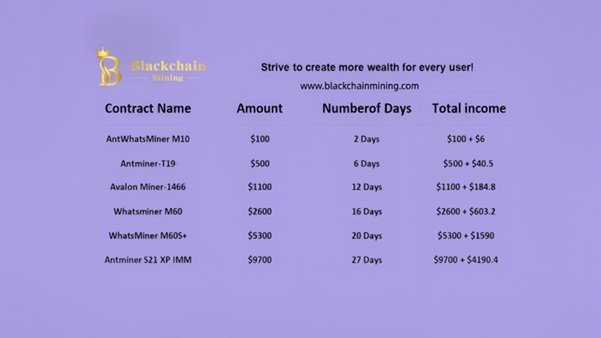
BTC Mining Contract Highlights: Daily Profits Up to $4,777

This means that even if users do not own physical mining machines, they can easily participate in the Bitcoin ecosystem by signing contracts and obtain long-term returns in a stable income system.

Conclusion: Seize the Wealth Opportunities of BTC’s New Cycle

Bitcoin is currently in a new bull market cycle, with multiple positive factors driving BTC’s long-term upward trend, including institutional entry, global inflation, and the anticipated halving. For ordinary investors, participating in mining is one of the best ways to share in Bitcoin’s dividends. BlackchainMining’s BTC mining contracts undoubtedly provide a safer, more efficient, and more transparent channel for market participation.

While others are still waiting for the next Bitcoin surge, BlackchainMining users are already steadily earning profits daily.


Official website: blackchainmining.com

App download: https://blackchainmining.com/xml/index.html#/app

BlockDAG’s $435M+ Surge Gains Strength as Ethereum Nears $3,500 and Shiba Inu Weakens

0

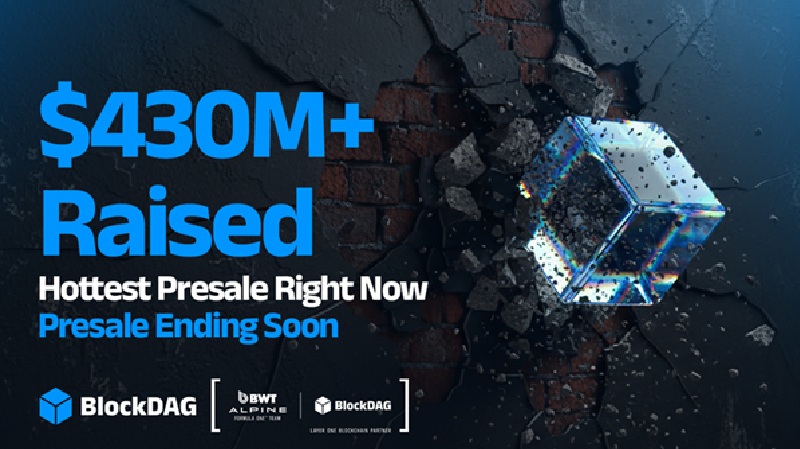
As the market cools under renewed sell pressure, BlockDAG (BDAG) continues to rise, recording over $435 million in presale funds. While Ethereum (ETH) holds near $3,500 with mixed confidence and Shiba Inu (SHIB) struggles to retain support, BlockDAG shows strong growth. Its hybrid Layer-1 setup, active miner ecosystem, and expanding global network make it the best crypto investment in 2025.

Ethereum’s cautious trading around $3,500 tests market patience, while Shiba Inu fights to stay above four zeros. Meanwhile, BlockDAG’s transparent presale, hardware deliveries, and consistent progress continue to win community trust. As short-term fear lingers, BDAG’s clear roadmap and proven delivery signal long-term confidence and genuine growth.

Ethereum Support Analysis: Buyers Hold the $3,500 Line

Ethereum’s recent chart activity shows the market standing at a key level. After several failed moves near $4,500, ETH lost strength and slipped below its upward channel. Analysts note that buyers are now defending $3,500, the key support before a possible dip to $3,200 or even $3,000.

The daily RSI sits below 50, reflecting weak buying power. Yet, a rebound above $4,000 could help ETH recover and retest $4,600. The symmetrical triangle on the 4-hour chart hints at upcoming volatility, keeping traders alert.

On-chain data offers a different picture. Exchange outflows remain steady, suggesting silent accumulation. Larger buyers seem focused on future gains instead of short-term profits. As long as inflows stay low, downside pressure could ease. The Ethereum support analysis shows that $3,500 remains the line between resilience and further decline. For many, ETH’s ability to stay above this zone will determine its next major move.

Shiba Inu Market Trend: Fragile Recovery Under Pressure

The Shiba Inu market trend reflects cautious optimism after a rough October. Following a drop that briefly added a fifth zero, SHIB recovered above $0.00001, a level that its community defends strongly. However, data from exchanges indicates a rise in selling activity. Between October 20 and 22, exchange reserves grew from 82.09 trillion to 82.14 trillion SHIB, hinting that holders might be taking profits.

Technically, SHIB’s descending triangle warns of risk. The support level near $0.00001052 has faced repeated tests since April, and a fall below could send prices back toward $0.000006. Holding above this zone may allow SHIB to stabilize before the next possible rise.

Despite weaker signals, SHIB still has strong community backing and short bursts of demand. However, compared to more technically driven projects, its progress depends more on the overall market mood. For now, the Shiba Inu (SHIB) trend shows a mix of stability and uncertainty, with cautious traders watching closely for the best crypto investment opportunities beyond meme coins.

BlockDAG’s $435M+ Presale and Global Miner Growth

As well-known coins face consolidation, BlockDAG’s presale continues to expand, confirming its spot as the best crypto investment in 2025. The project has raised over $435 million in its Batch 32 sale, priced at $0.005 per coin, before it lists on Feb 10, 2026 at $0.05. Over 27 billion coins have been purchased, supported by 312,000+ holders across global markets.

Beyond strong fundraising numbers, BlockDAG’s strength lies in practical progress. More than 20,000 miners have been sold and shipped worldwide, establishing one of the largest community-driven mining networks this year. The project’s hybrid model merges Proof-of-Work and Directed Acyclic Graph (DAG) mechanisms, allowing up to 15,000 transactions per second while ensuring decentralization and security.

Excitement builds as Genesis Day nears the event that marks full ecosystem activation. With exchange listings already in progress, the transition from presale to live trading looks steady and structured. Meanwhile, over 3.5 million X1 app users actively mine up to 20 BDAG coins daily, fueling continued network growth and engagement.

Experts suggest that BlockDAG’s launch price could surpass expectations, placing it among reliable long-term digital assets. Between its presale record, active miners, and powerful technical foundation, BlockDAG is consistently recognized as the best crypto investment available today.

Conclusion: Confidence During Market Caution

The gap between BlockDAG’s progress and the uncertainty of older coins is clear. While Ethereum holds at $3,500 and Shiba Inu faces weak momentum, BlockDAG’s $435M+ presale, real miner network, and strong community continue to move forward. Its fusion of mainstream visibility, technological depth, and active community engagement showcases how innovation can redefine global crypto adoption standards in 2025.

With listing day approaching, attention is shifting toward projects that show real-world results. BlockDAG’s transparent structure, hybrid technology, and millions of active users make it a symbol of steady progress. For anyone exploring the best crypto investment right now, BlockDAG provides both reliability and growth potential in a market often clouded by hesitation.


Presale: https://purchase.blockdag.network

Website: https://blockdag.network

Telegram: https://t.me/blockDAGnetworkOfficial

Discord: https://discord.gg/Q7BxghMVyu

Amazon Web Services to Invest $5bn in South Korea as AI Boom Spurs Global Infrastructure Race

0

Amazon Web Services (AWS) will invest at least $5 billion in South Korea by 2031 to build new artificial intelligence data centers, the South Korean presidential office announced on Wednesday.

The investment marks the escalating global race among major technology companies to build the infrastructure needed to sustain the next wave of AI development.

The announcement came during a meeting between AWS Chief Executive Officer Matt Garman and South Korean President Lee Jae Myung on the sidelines of the Asia-Pacific Economic Cooperation (APEC) summit in Gyeongju. President Lee said the investment will help “accelerate the growth of an ecosystem for the AI industry in South Korea,” reaffirming the government’s ambition to transform the country into one of the world’s top three AI powers.

Garman said the project forms part of AWS’s broader global expansion plan, which includes $40 billion in additional investments across 14 non-U.S. APEC countries by 2028.

“That $40 billion actually drives an additional $45 billion in U.S. GDP and downstream benefit, benefiting all of the APEC economy,” Garman said during a business event on the sidelines of the summit.

AWS plans to construct the new data centers on the outskirts of Seoul. Once completed, the facilities are expected to bolster South Korea’s AI infrastructure, providing data-processing capabilities for domestic tech startups and multinational corporations alike. The investment will also support Seoul’s national strategy to become a regional leader in cloud computing and advanced digital services.

The move follows AWS’s $4 billion investment announced in June to collaborate with South Korea’s SK Group in building the country’s largest data center in Ulsan. It also mirrors a global pattern among major tech firms racing to secure the computing infrastructure essential for AI model training and deployment.

The acceleration of artificial intelligence has pushed companies such as Amazon, Microsoft, Google, and OpenAI to rapidly expand data center construction both inside and outside the United States. The surge in demand for AI computing power has also transformed data center development into one of the most capital-intensive sectors of the global technology industry.

In India, AWS announced a $12.7 billion investment earlier this year to expand its cloud infrastructure by 2030, with major data hubs planned in Telangana and Maharashtra. Microsoft has likewise committed to expanding its Indian data centers in Hyderabad, while Google has accelerated its own AI-focused expansion in the country to serve its growing base of enterprise customers.

Beyond Asia, AWS has announced multi-billion-dollar data center projects in Australia, Japan, and Singapore, all aimed at supporting local AI research and enterprise adoption. In Japan, the company is investing $15 billion to expand its cloud footprint through 2027, while in Australia, it plans to inject over $9 billion to build facilities powering AI, cybersecurity, and energy-efficient computing.

The global rush reflects a new phase in the AI infrastructure arms race, driven by unprecedented demand for high-performance chips, cloud storage, and energy-efficient data processing. With AI models like ChatGPT and Gemini requiring enormous computational capacity, hyperscalers such as AWS and Microsoft Azure are positioning themselves as the backbone of the emerging AI economy.

South Korea, with its powerful semiconductor industry and growing AI ecosystem, has become a focal point in this race. Earlier this month, the country’s presidential office confirmed that OpenAI plans to establish joint ventures with Samsung and SK Group to build two data centers—dubbed a “Korean-style Stargate”—with an initial 20-megawatt capacity. OpenAI has also signed initial chip-supply deals with Samsung Electronics and SK Hynix.

Taken together, the recent commitments from AWS and OpenAI highlight South Korea’s emergence as a key node in the global AI infrastructure network. The wave of foreign investment marks not just a technological milestone for Seoul, but a strategic moment in its ambition to redefine its global economic identity—shifting from a manufacturing powerhouse to a digital innovation hub at the forefront of the AI revolution.