DD
MM
YYYY

PAGES

DD
MM
YYYY

spot_img

PAGES

Home Blog Page 244

Zero Knowledge Proof (ZKP) Whitelist Signals a New Era for Privacy and Compute Efficiency in Blockchain

0

The blockchain and artificial intelligence (AI) industries continue to converge in new ways, and Zero Knowledge Proof (ZKP) is emerging as a focal point of this evolution. As interest builds around its whitelist prelaunch, the project is being closely observed within presale crypto analysis discussions for its potential to redefine how AI workloads are processed and secured in decentralized environments. Its emphasis on balancing privacy, scalability, and verifiable computation has led some to identify it as one of the most promising contenders in the search for the next 100x crypto.

Zero Knowledge Proof (ZKP) introduces a dual consensus system that seeks to address the key inefficiencies of centralized AI processing. By combining Proof of Intelligence (PoI) and Proof of Space (PoSp), it integrates compute and storage contributions within one unified model. This approach positions the project to deliver verifiable AI computation while maintaining data confidentiality and resource fairness, a balance that has long been elusive in blockchain-based systems.

Reframing AI Compute Through Dual Consensus

At the heart of Zero Knowledge Proof (ZKP) lies its goal to create an ecosystem where distributed computing can handle increasingly complex AI workloads. This ambition comes at a time when centralized infrastructure is struggling to keep pace with the computational demand required by advanced AI models. Through its decentralized approach, Zero Knowledge Proof (ZKP) redistributes this load across a network of global nodes, each contributing verifiable intelligence and storage power to maintain system balance.

The Proof of Intelligence (PoI) mechanism introduces a verifiable model where node operators contribute measurable computational output. This method ensures that the processing of AI tasks remains transparent and efficient, providing a foundation for trust within a decentralized framework. By validating these contributions through cryptographic proofs, the system avoids the common inefficiencies of centralized AI compute systems while maintaining a higher standard of reliability.

The complementary Proof of Space (PoSp) mechanism strengthens the storage layer of the ecosystem. It incentivizes network participants who commit verifiable storage resources, creating a system where both computation and data integrity operate in parallel. This balance between processing and storage efficiency makes Zero Knowledge Proof (ZKP) a unique participant in presale crypto analysis discussions, especially for those focused on AI-related infrastructure plays.

Building Trust Through Privacy and Verifiable Computation

A defining characteristic of Zero Knowledge Proof (ZKP) is its privacy-first design. Using cryptographic tools such as zk-SNARKs and zk-STARKs, it allows for computations to be validated without exposing sensitive data or proprietary model parameters. This means that developers and organizations can work within a transparent and secure framework without revealing the specifics of their algorithms or datasets.

This ability to perform encrypted computation while preserving verifiability represents a significant advancement in both blockchain and AI collaboration. It allows organizations to participate in distributed intelligence networks without sacrificing their intellectual property, addressing one of the most critical barriers to cross-organizational AI development. This aspect has made Zero Knowledge Proof (ZKP) a frequent point of reference in presale crypto analysis reports discussing privacy-preserving blockchain systems.

The network also introduces verifiable outputs for AI computations. Rather than requiring full transparency into every data process, it produces compact proofs confirming the accuracy of computational results. This builds confidence in the network’s reliability while maintaining the confidentiality of underlying models and datasets. In an industry that values both privacy and transparency, this dual assurance system is what makes the project stand out as one of the next 100x crypto prospects in the AI blockchain segment.

The Economic Design and Whitelist Excitement

The economic layer of Zero Knowledge Proof (ZKP) has been crafted around participation, fairness, and accessibility. It features a decentralized marketplace that enables users to exchange, share, and monetize datasets and AI models in a secure and verifiable manner. This system ensures that contributors of all sizes, from individual developers to established institutions, can engage in a mutually beneficial ecosystem.

By relying on Zero Knowledge Proof (ZKP) verification, transactions within this marketplace remain confidential and authenticated, ensuring both privacy and accountability. It addresses one of the central issues in traditional AI markets, where data exchange often requires trust in intermediaries. In this case, trust is built directly into the protocol through mathematical verification.
The approaching whitelist event has become a key focal point for investors and developers alike. It signals the beginning of early participation in what could become a foundational infrastructure for decentralized AI compute. As interest continues to grow, the project has gained increasing visibility among those performing presale crypto analysis, many of whom see its architecture as aligned with the industry’s push toward scalable, verifiable, and equitable AI networks.

With anticipation rising around its whitelist phase, community discussions have highlighted Zero Knowledge Proof (ZKP) as more than just another blockchain project. Its structural approach to privacy and verifiable computation reflects a long-term vision for how decentralized networks can underpin the AI systems of the future. For participants seeking early entry into a project that combines innovation with technical rigor, this whitelist phase has generated substantial attention.

Closing Analysis

As the Zero Knowledge Proof (ZKP) whitelist nears, anticipation continues to build across both blockchain and AI communities. Its dual consensus system, commitment to privacy-preserving compute, and equitable marketplace design collectively represent a new direction for decentralized intelligence networks. Many analysts have noted that its framework aligns closely with emerging trends in verifiable computation and secure data management, positioning it as one of the more notable entries in presale crypto analysis discussions.

Zero Knowledge Proof (ZKP) remains in development, but the upcoming whitelist access underscores its growing significance as part of a broader movement to redefine the relationship between AI and blockchain. Its goal of achieving scalable, private, and verifiable AI compute has resonated strongly within the community, with increasing attention from those searching for the next 100x crypto opportunity. As the prelaunch excitement continues, Zero Knowledge Proof (ZKP) is steadily shaping the conversation around what the future of decentralized AI infrastructure could look like.

Find Out More At:

https://zkp.com/
BlockDAG’s Coinbase + Kraken Leak Sends Shockwaves Through the Market While Solana Climbs & SUI Breaks Out

0

The Solana (SOL) price movement continues to capture market attention, trading consistently in the $190–$200 range as analysts track a potential breakout above $215. Meanwhile, SUI maintains stability beyond $2.50 after record DEX activity pushed its total value locked to fresh highs. Both assets show solid technical footing, but traders seem increasingly eager for a new market leader with greater upside and fresh potential.

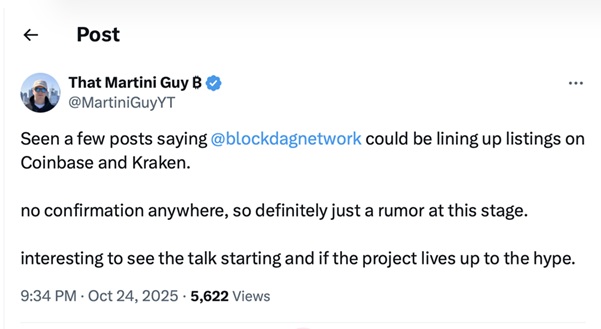
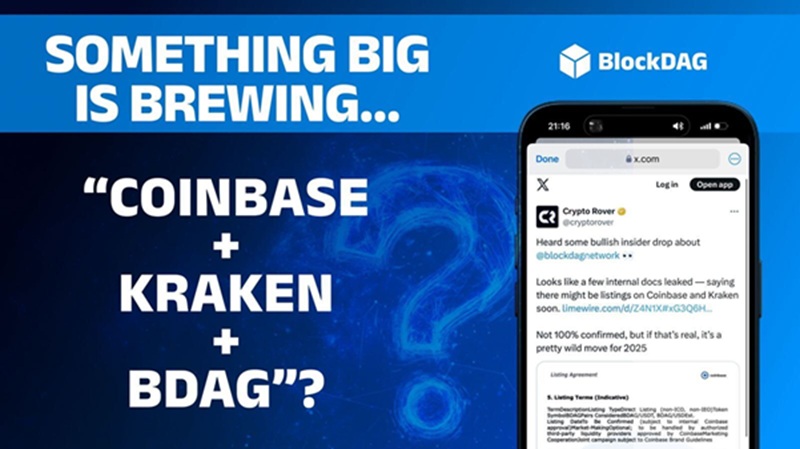
That’s where BlockDAG (BDAG) steps into focus. A recent hint from That Martini Guy’s Alpha Drop suggests this could be the final cue before BDAG becomes a household name. His mention of possible listings on Coinbase and Kraken has drawn strong attention, signaling that BlockDAG might transition from presale strength to global recognition sooner than expected. With its presale nearing $435 million, the foundation is firmly set, but entry into top exchanges could make BDAG a standout performer for 2025.

BlockDAG: Quiet Whispers Before a Global Launch

That Martini Guy’s latest update fueled speculation across the crypto community, not because of hype, but due to the credible documents circulating online. The central topic points toward BlockDAG’s potential Coinbase and Kraken listings, two of the industry’s most respected exchanges.

The stats already prove the scale. BlockDAG’s presale has now raised nearly $435 million across 32 batches, selling over 27.2 billion BDAG coins to more than 312,000 holders. BlockDAG is now in Batch 32, priced at $0.005, with its official listing set for February 10, 2026. With only 4.5 billion coins left in the presale, this marks the final stretch before BlockDAG’s highly anticipated market debut. Analysts highlight that this presale structure, along with a projected $0.05 mainnet price, positions BDAG as one of the best cryptos for high returns heading into 2025. Backed by dual audits from CertiK and Halborn, BlockDAG’s credibility is widely recognized among traders and analysts alike.

If these listing rumors materialize, BDAG could rapidly evolve from a presale star to a global market contender. Over 20,000 mining rigs have been distributed worldwide, while testnet performance has already reached 15,000 TPS. Combined with top-tier exchange exposure, BlockDAG might become one of the strongest cryptos before even entering public trading.

SOL Price Trend: Momentum Builds Near Key Resistance

Solana (SOL) continues to show strong resilience, maintaining levels above the $184–$190 zone and suggesting a bullish setup toward the $200 mark. After multiple rebounds from critical support, SOL now trades around $192–$205, with a key resistance target near $215. Market analysts stress that holding the $184 level remains vital for sustaining bullish traction. A clean break above $200 could potentially drive the next target to $230, indicating a strong short-term breakout potential.

Recent Solana network enhancements and ongoing ETF discussions have further strengthened sentiment. On-chain data reflects steady buying pressure and rising liquidity, adding to the bullish outlook. Institutional engagement and network efficiency improvements have kept SOL’s price structure stable, making it one of the most-watched large-cap assets of late.

Although some warn that a dip below $184 could prompt a retest near $175, most signals remain positive. With consistent trading activity and strong fundamentals, Solana appears ready for an upward move as October closes, positioning it among 2025’s leading crypto contenders.

SUI Price Movement: Accumulation Ahead of a Breakout

SUI continues to hover near $2.50–$2.55, showing healthy consolidation after several weeks of active trading. Daily trading volume holds above $500 million as market watchers anticipate a push past the $2.60 resistance. Key support rests at $2.35, and analysts note that maintaining this zone could enable an upward move toward $3.00–$3.40 in the short term.

Beyond price charts, SUI’s ecosystem remains robust, with total value locked (TVL) reaching around $885 million, its highest recorded level. Technical signals show a balanced setup, with moderate RSI readings and solid trading momentum. The SUI trend continues to appeal to those favoring stable accumulation patterns over speculative volatility.

While a confirmed breakout depends on surpassing immediate resistance, SUI’s blend of liquidity, expanding network adoption, and firm market sentiment highlights it as one of the steady-performing altcoins leading into late 2025.

Final Say

The price strength of Solana (SOL) and SUI shows how established and emerging projects are shaping today’s crypto market. SOL’s resilience near $190 and its goal to move beyond $200 display steady market confidence, while SUI’s consistent performance above $2.50 with record-high ecosystem growth marks its credibility among newer platforms. Together, they keep mid-cap momentum alive with dependable volume and participation.

Still, the spotlight now tilts toward BlockDAG. With its nearly $435 million presale success, verified audits, 15,000 TPS testnet results, and possible listings on Coinbase and Kraken, BDAG continues to gain major traction. Many crypto followers now regard BlockDAG as a top choice for substantial returns before its official launch. Should these rumors be confirmed, BlockDAG could set a new benchmark for early entry potential and redefine 2025’s top-performing projects.

Presale: https://purchase.blockdag.network

Website: https://blockdag.network

Telegram: https://t.me/blockDAGnetworkOfficial

Discord: https://discord.gg/Q7BxghMVyu

How Zero Knowledge Proof (ZKP) Addresses AI’s Transparency Problem

0

The emergence of artificial intelligence has created an ever-growing need for secure, transparent, and efficient computational systems. As AI models evolve and grow more complex, the challenge of maintaining privacy, fairness, and verifiability across decentralized networks becomes more pressing. The Zero Knowledge Proof (ZKP) ecosystem introduces a groundbreaking framework that merges blockchain with distributed AI computation to create a privacy-first environment for scalable intelligence.

Built on a dual consensus model combining Proof of Intelligence (PoI) and Proof of Space (PoSp), the Zero Knowledge Proof (ZKP) ecosystem is designed to handle the demands of modern AI without compromising trust or data sovereignty. With its prelaunch phase generating strong anticipation, it has quickly become one of the crypto presales to watch, drawing attention as the next presale to explode due to its innovative approach to transparency, verifiable compute, and AI scalability.

Setting New Standards Through Dual Consensus

At the heart of the Zero Knowledge Proof (ZKP) ecosystem lies its innovative dual consensus mechanism, a unique integration of Proof of Intelligence and Proof of Space. This framework enables decentralized networks to validate computational power and storage contributions simultaneously. Proof of Intelligence ensures that nodes demonstrate measurable computational performance, while Proof of Space verifies that participants allocate storage resources to support network operations.

This combination of intelligence and space-based validation allows the Zero Knowledge Proof (ZKP) blockchain to maintain efficiency, scalability, and security in distributed AI environments. Unlike traditional centralized systems, where data bottlenecks and opaque operations hinder transparency, this model empowers users to participate in a verifiable and equitable network. Each contributor’s effort is measurable, ensuring trust and accountability across all layers of the system.

As the project moves closer to its prelaunch stage, its architecture positions it as one of the crypto presales to watch, particularly for those seeking transparency in decentralized compute and AI operations. The balance of privacy and verification represents a strong signal for what could be the next presale to explode, driven by both technical innovation and growing interest in verifiable AI ecosystems.

Building a Privacy-First Framework for AI Compute

Zero Knowledge Proof (ZKP) technology introduces a method of validation where computational results can be proven correct without revealing the underlying data or model parameters. This capability is crucial in AI-driven systems where confidentiality and intellectual property protection are essential. By using advanced cryptographic proofs such as zk-SNARKs and zk-STARKs, Zero Knowledge Proof (ZKP) enables secure collaboration between AI developers, data providers, and validators without compromising privacy.

Through this mechanism, AI models can be processed on encrypted data while ensuring the integrity of the output. This framework preserves both data sovereignty and confidentiality, allowing organizations to leverage distributed compute resources without exposing proprietary algorithms. It effectively bridges the gap between decentralization and trust, marking a significant advancement in how blockchain can support AI workloads.

The emphasis on privacy and proof-based computation makes the Zero Knowledge Proof (ZKP) blockchain one of the most promising crypto presales to watch. With its whitelist coming soon, excitement is growing among investors and technologists who see its potential to redefine secure AI compute networks. This rising attention reflects the strong belief that Zero Knowledge Proof (ZKP) could emerge as the next presale to explode, especially as privacy and verifiability become central to the AI industry’s next evolution.

Verifiable Intelligence and Network Security

Transparency in AI systems has long been limited by the inability to audit processes without exposing sensitive data. The Zero Knowledge Proof (ZKP) ecosystem addresses this challenge by integrating verifiable intelligence into its core framework. Each computational task processed within the network generates cryptographic proofs confirming its accuracy. This system not only verifies the correctness of AI outputs but also ensures that contributors uphold integrity across all computational operations.

To reinforce security, the ecosystem combines multiple cryptographic techniques, including secure Multi-party Computation (MPC) and homomorphic encryption. These technologies ensure that even collaborative tasks can be executed securely, with data remaining protected throughout the process. By requiring participants to prove both computational capability and storage commitment, the network safeguards itself against malicious behavior and data manipulation.

Another key element of the Zero Knowledge Proof (ZKP) ecosystem is its decentralized data marketplace. This component allows individuals and institutions to share, trade, and monetize AI models or datasets privately and securely. Through Zero Knowledge Proof (ZKP)-based validation, every transaction remains verifiable without exposing its contents. This marketplace fosters collaboration across the AI economy while preserving ownership rights.

Such a combination of verifiable computing, data integrity, and equitable participation establishes the Zero Knowledge Proof (ZKP) blockchain as one of the most discussed crypto presales to watch. As anticipation builds, its focus on proof-based intelligence and distributed fairness continues to draw attention from communities eager to join the whitelist for this next presale to explode.

Closing Analysis

The Zero Knowledge Proof (ZKP) ecosystem represents a crucial shift in how blockchain and AI can coexist within a verifiable, privacy-focused framework. Its dual consensus model ensures that every node contributes meaningfully, while its privacy-preserving cryptography maintains the confidentiality required for sensitive AI workloads. The combination of transparency, fairness, and scalability creates a network capable of redefining how decentralized AI operates.

With its whitelist coming soon, the Zero Knowledge Proof (ZKP) blockchain continues to attract attention as one of the crypto presales to watch and potentially the next presale to explode. Its approach to AI transparency and data security positions it at the intersection of innovation and trust. For those following the evolution of decentralized intelligence, this prelaunch marks the beginning of a new era for blockchain-driven AI ecosystems.

Find Out More At:

https://zkp.com/
Connecting Your Wallet to Spartans.com: The Complete Onboarding Guide

0

Crypto betting platforms are built around convenience, and Spartans.com is no exception. Unlike traditional sites that depend on credit cards and banks, Spartans uses blockchain-based wallet transactions to make deposits and withdrawals instant. This guide walks through the full onboarding flow, from account creation to wallet integration, so new users understand how to fund and access their accounts efficiently. There’s no jargon here, just a clear, step-by-step look at how crypto moves between your personal wallet and your Spartans account. Whether you’re using MetaMask, Trust Wallet, or Coinbase Wallet, the process is fast, secure, and transparent. Let’s break it down from start to finish.

Account Creation

The entry point to Spartans is straightforward. The goal is to set up your personal account without unnecessary friction. To begin:

  1. Visit Spartans.com and click “Sign Up.”
  2. Enter your email address, choose a username and password, and confirm that you’re 18 years or older.
  3. Verify your email if prompted, and log in to access the dashboard.

There’s no need for lengthy verification or banking information at this stage. Spartans operates on a crypto-first model, meaning deposits and withdrawals are managed directly through blockchain wallets. Once the account is created, users can access all sections, casino, live games, and sportsbook, under one profile. The account also includes a wallet section where deposit and withdrawal addresses are managed. This simplicity allows players to start almost immediately, cutting out the usual delays found on traditional betting sites.

Funding the Account

Once registered, the next step is transferring cryptocurrency from your personal wallet to your Spartans account. The process begins with selecting “Deposit” on your dashboard. You’ll be shown a unique wallet address that corresponds to your chosen cryptocurrency. Supported options include Bitcoin (BTC), Ethereum (ETH), Tether (USDT), USD Coin (USDC), Avalanche (AVAX), and Cardano (ADA).

Here’s how it works:

  • Open your personal crypto wallet (e.g., MetaMask, Trust Wallet, Coinbase Wallet).
  • Choose “Send” or “Transfer.”
  • Copy the Spartans wallet address and paste it into the recipient field.
  • Specify the amount and confirm the transaction.

Funds appear in your Spartans balance after blockchain confirmation, usually within minutes. There are no intermediaries or bank fees. Once your balance updates, you’re ready to play slots, join a live table, or place sports bets instantly. The integration is designed for speed and transparency.

The Withdrawal Process

Spartans keeps withdrawals as simple as deposits. When you’re ready to cash out winnings, head to your account dashboard and select “Withdraw.” From there:

  • Choose the cryptocurrency you want to withdraw.
  • Enter the public wallet address from your personal wallet.
  • Specify the amount you wish to transfer.
  • Confirm the transaction request.

Your funds are sent directly to your wallet after a quick internal verification. No paperwork or identity proof is required for basic transactions. Blockchain confirmation ensures every payout is traceable, secure, and tamper-proof. Withdrawals are typically processed within minutes, though exact timing may depend on network congestion. For example, a $300 USDT withdrawal sent to Trust Wallet will usually reflect almost instantly. The goal is to make users feel in control of their funds without hidden steps or delays, something traditional online casinos often lack.

Supported Wallets and Assets

Spartans operates as a crypto-first platform, meaning only decentralized payment options are supported. This ensures both privacy and global accessibility. The platform currently supports leading wallet systems, including:

  • MetaMask – Commonly used for Ethereum and ERC-20 tokens.
  • Trust Wallet – A mobile wallet compatible with multiple networks.
  • Coinbase Wallet – A beginner-friendly wallet with direct exchange connectivity.

Supported cryptocurrencies include:

  • BTC (Bitcoin)
  • ETH (Ethereum)
  • USDT (Tether)
  • USDC (USD Coin)
  • AVAX (Avalanche)
  • ADA (Cardano)

Spartans plans to integrate fiat support soon, but at present, all transactions occur directly on-chain. Users can manage balances in these supported currencies and track deposits and withdrawals via blockchain explorers. This integration gives full control to the user, ensuring transparency while maintaining transaction speed and security.

Final Take

The Spartans.com wallet process is designed for clarity and independence. From creating an account to transferring crypto, every step empowers users to control their funds securely and quickly. There are no banks, delays, or unnecessary verifications, just seamless wallet-to-platform and platform-to-wallet transactions. Whether you prefer MetaMask for flexibility or Trust Wallet for mobile convenience, Spartans crypto casino keeps the experience efficient and transparent.

It’s the kind of streamlined onboarding that represents where crypto gaming is heading: simple, fast, and user-controlled. By understanding this wallet interaction process, players can confidently fund, play, and withdraw without friction or confusion.


FAQ

  1. Do I need to verify my identity to start playing on Spartans?
    No, Spartans allows crypto transactions without requiring ID verification for deposits and withdrawals.
  2. How long do deposits take to appear in my account?
    Most deposits reflect within minutes, depending on blockchain network speed.
  3. Can I use a hardware wallet like Ledger or Trezor?
    Yes, as long as the wallet supports sending to standard crypto addresses.
  4. Is there a minimum or maximum withdrawal limit?
    Yes, limits may vary depending on the cryptocurrency; these details are listed on the withdrawal page.
  5. What happens if I send the wrong crypto to a wallet address?
    Transactions on the blockchain are irreversible, so always double-check the selected currency before sending.
  6. Are there transaction fees?
    Spartans itself doesn’t charge fees, but network gas or miner fees may apply depending on the blockchain used.

Find Out More About Spartans:


Website: https://spartans.com/

Instagram: https://www.instagram.com/spartans/

Twitter/X: https://x.com/SpartansBet

YouTube: https://www.youtube.com/@SpartansBet

Polymarket’s Imminent US Relaunch is A Game-Changer for Sports Betting

0

Polymarket, the leading blockchain-based prediction market platform, is gearing up for a regulated return to the US market within weeks, with a sharp emphasis on sports betting.

This move comes after years of operating offshore due to regulatory hurdles, and it’s poised to shake up the $8.5 billion+ US sports wagering space. Initial trading is expected by the end of November 2025, aligning perfectly with peak NFL and NBA seasons to maximize early volume.

It won’t be a full nationwide rollout right away—access will start limited, likely through a waitlist system already in place on their site. Polymarket settled with the CFTC in 2022 for $1.4 million over unlicensed trading, forcing it offshore.

Now, they’ve acquired QCX a CFTC-licensed exchange and clearinghouse for $112 million, clearing the way for compliant operations on everything from game outcomes to player props.

Polymarket’s US debut will prioritize sports event contracts—think betting on NFL spreads, NBA over/unders, or even same-game parlays—over its famous election markets though those could follow.

This isn’t just a pivot; it’s a direct challenge to giants like DraftKings and FanDuel. Unlike traditional sportsbooks where you bet against the house, Polymarket lets users buy/sell outcome shares like stocks, fostering peer-to-peer liquidity and potentially higher odds.

Dropping during football/basketball prime time could siphon volume from incumbents. Shares of DraftKings dipped ~9% and Flutter Entertainment FanDuel’s parent ~5% on the news, signaling Wall Street’s jitters.

Kalshi, Polymarket’s main US foe, is already killing it—hitting $4 billion in 30-day volume 10% of total sportsbook handle and launching NFL parlays. Polymarket’s entry could spark a prediction market “supercycle,” especially with its 221K weekly unique users and 10M+ trade counts this month up 3x from April lows.

Polymarket’s eyeing $12-15 billion, fueled by crypto integrations like BNB deposits and DeFi ties. On X, the hype is real—traders are calling it an “easy bet” for liquidity surges, with posts predicting massive user influx.

Kalshi’s suing New York’s gaming commission over federal vs. state regs, and Polymarket might face similar scraps. Plus, while CFTC-approved, state-level sports betting laws vary wildly this could be your ticket to early action.

Peer-to-peer odds could undercut DraftKings/FanDuel’s margins; expect tighter lines, higher payouts. NFL/NBA season timing + crypto onboarding = instant volume; Kalshi already at $4B/30 days—Polymarket could double that.

P2P model ? better odds, lower vig vs. DraftKings/FanDuel. NFL/NBA timing + crypto rails = $1B+/mo potential. Legitimizes prediction markets: CFTC approval paves way for elections, entertainment. Hurts incumbents: DKNG/FLUT stock dips signal share loss.

Crypto gateway: USDC/BNB deposits bring DeFi users to regulated betting. Sharp bettor edge: Early waitlist access rewards liquidity providers.

CFTC-licensed sports contracts legitimize prediction markets; opens door for election, pop culture bets later. DKNG -9%, FLUT -5% on news; continued pressure if Polymarket grabs 5–10% of handle.

USDC/BNB deposits pull DeFi users into regulated betting; accelerates mainstream crypto adoption. Waitlist already live—early access = edge for sharp bettors; mass adoption hinges on UX vs. traditional apps.

Overall, it’s a bold US comeback that blends crypto, predictions, and sports—watch for fireworks come December. What markets are you eyeing first?