
DD
MM
YYYY

PAGES

DD
MM
YYYY

spot_img

PAGES

Home Blog Page 2545

Leveraging Social Media Analytics to Combat Drug Abuse Narratives

0

Social media platforms have become pivotal in shaping public perceptions and discourse around societal issues, including drug abuse. The prevalence of digital conversations on platforms like Twitter and YouTube provides valuable insights into how drug abuse in Nigeria is framed, discussed, and interpreted by different users. In this piece, our analyst explores how sentiment analysis and framing theory help us understand these narratives. This piece identifies the key differences between discussions on Twitter and YouTube.

In comparing Twitter and YouTube, our analysis identified distinct framing patterns. On YouTube, conversations were more diversified, touching on legalisation (16.49%), one-sided problematization (16.49%), and conspiracy theories (14.43%). In contrast, Twitter exhibited a more polarized discourse, with personality disparagement (31.81%) and ethnic vilification (22.27%) being dominant. This suggests that Twitter users tend to focus on individual blame and ethnic narratives, while YouTube discussions take a broader perspective on policy and systemic issues.

Sentiment Analysis: How Emotion Drives Discourse

Sentiment analysis reveals the emotional undertones in discussions. On YouTube, while there was some balance between positive, negative, and neutral sentiments, Twitter exhibited stark negativity, particularly in personality disparagement and ethnic vilification. The lack of positive sentiment in many frames highlights the need for more constructive discussions.

For instance, discussions around “Nigeria’s problem” on Twitter showed 50% neutrality, suggesting an ongoing debate without definitive conclusions. However, in frames like “personality disparagement” (50% negative) and “ethnic vilification” (33% negative), strong negative emotions dominated. This negativity fosters an environment where divisive narratives thrive, making it harder to drive meaningful engagement on solutions.

The Challenge of Hostility in Online Discourse

Hostility is a major concern in digital conversations, particularly on social issues like drug abuse. Analysis showed that Twitter discussions were significantly more hostile than those on YouTube. On Twitter, hostility was directed primarily at prominent figures such as the Nigerian President (26.31%) and ethnic groups (21.05%). On YouTube, hostility was mostly directed at fellow commenters (27.65%) and drug traffickers (14.89%).

Exhibit 1: Hostility in sentiment by platform
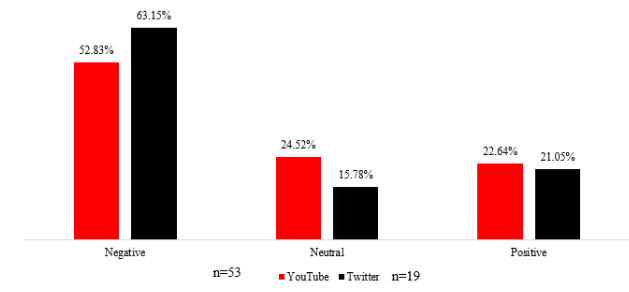
Source: YouTube, 2024; X, 2024; Infoprations Analysis, 2025

This hostility not only polarizes discussions but also hampers effective dialogue. When conversations become adversarial, the opportunity for meaningful discourse diminishes. Social media platforms, policymakers, and advocacy groups need to foster environments where constructive debates can thrive without descending into blame and hostility.

The Need for Integrated Strategies in Addressing Drug Abuse

One of the key takeaways from the study is the lack of integration between different areas of justice (economic, social, and environmental) when addressing drug abuse in Nigeria. While some NGOs and advocacy groups are attempting a holistic approach, many operate in silos, reducing the overall impact of their efforts. Social media discussions mirror this fragmentation, with users focusing on individual aspects rather than a comprehensive solution.

A practical step forward would be for stakeholders, including media organizations, government agencies, and advocacy groups, to adopt a systems-thinking approach. By integrating different justice perspectives, interventions can be more effective in addressing both the root causes and consequences of drug abuse.

While YouTube fosters a broader discussion, Twitter tends to be more polarized and emotionally charged. To create a more constructive online environment, stakeholders must adopt integrated approaches, encourage respectful dialogue, and leverage data analytics for informed decision-making.


Is Now a Good Time to Jump from Cardano and Dogecoin After Their Slip in January and Focus on Rexas Finance (RXS)?

0

After Cardano and Dogecoin plummeted in value in January, many investors wondered about their plans. While both cryptocurrencies have been attractive candidates in earlier bull cycles, their latest problems call doubt on their ability to generate significant profits. Many investors are thus considering several initiatives with stronger bases. Rexas Finance (RXS), a blockchain platform ready to revolutionize the DeFi sector by permitting real-world asset tokenization, is one such project under emphasis.

Cardano and Dogecoin Face Growing Challenges

Cardano’s emphasis on scalability and security has long made it a viable blockchain. However, investors have been disappointed by its modest growth rate and diminishing network activity. ADA has struggled to gain mass acceptance despite regular improvements, restricting its price momentum. Conversely, Dogecoin is still a speculative asset mostly motivated by social media buzz. Although well-known people like Elon Musk still support it, its lack of a solid use case keeps it from growing steadily. The January drop in DOGE has confirmed worries about whether it would be a good long-term investment. As ADA and DOGE lose momentum, investors increasingly concentrate on initiatives with more practical value. Here, Rexas Finance (RXS) is a compelling substitute.

Rexas Finance (RXS): A DeFi Powerhouse with Real-World Use Cases

Rexas Finance (RXS) offers actual value to the crypto market by emphasizing real estate tokenization, unlike Cardano and Dogecoin, which have suffered with acceptance and usage. Although the worldwide real estate market is estimated to be worth $280 trillion, many investors still find it inaccessible and illiquid. Rexas Finance seeks to close this gap by letting consumers tokenize actual assets, enabling fractional ownership and more real estate sector liquidity. Using blockchain technology, RXS offers a clear, safe, and effective financial ecosystem. For institutional and retail investors seeking exposure to tokenized assets, its distributed network allows consumers to access quick, cheap transactions, guiding their choice.

With tokens valued at $0.20, Rexas Finance is in its last presale stage, Stage 12. Overwhelming demand for the presale has driven sales of more than 442.8 million tokens, totaling over $44.5 million. This result emphasizes the rising investor trust in RXS as a highly prospective cryptocurrency asset.

The Rexas Finance team has formally announced that RXS will open on exchanges on June 19, 2025, with a confirmed listing price of $0.25, adding to the excitement. Early investors expect an instantaneous 25% return upon listing; a further increase is projected following the debut. Rexas Finance has chosen a public presale instead of many other cryptocurrency initiatives targeting venture capital companies (VCs). This strategy guarantees that the project’s early-stage progress benefits regular investors instead of major institutional entities.

Beyond its effective presale, Rexas Finance has obtained listings on three Tier-1 exchanges, which has increased liquidity, acceptance, and price stability for RXS. Major exchange listings generally increase prices, so this development is why many investors are optimistic about RXS. Rexas Finance has also presented a thorough road map for future development. After the launch, the team intends to improve platform features, widen alliances, and add fresh DeFi apps. These advances will guarantee that RXS stays competitive and continues to increase in value.

Joining the continuous presale is ideal for investors hoping to buy RXS before its June 2025 exchange debut. Visit the official Rexas Finance website first to purchase RXS safely and avoid fraud. Afterward, ensure a compatible wallet—like MetaMask or Trust Wallet—is set up appropriately. You can then buy RXS, either USDT or Ethereum (ETH). Your tokens should be safely kept after the purchase, and you should routinely monitor the presale stages for updates. Early buyers who invest before the public exchange starts can lock in a lower price, optimizing their profit potential.

Conclusion

Rexas Finance (RXS) is showing to be a high-growth substitute in the crypto scene while Cardano and Dogecoin lose momentum. Strong presale performance, confirmed exchange listings, and real-world use make it a desirable investment for 2024 and forward. Now is the perfect moment to gather tokens before the price soars since June 19, 2025, seems like a rapid increase. Investors searching for the next great crypto prospect should concentrate on Rexas Finance while it is still in presale.


For more information about Rexas Finance (RXS) visit the links below:

Website: https://rexas.com

Win $1 Million Giveaway: https://bit.ly/Rexas1M

Whitepaper: https://rexas.com/rexas-whitepaper.pdf

Twitter/X: https://x.com/rexasfinance

Telegram: https://t.me/rexasfinance

Trump Imposes 25% Tariffs on Steel and Aluminum Imports, Sparking Fears of Retaliation and Economic Disruption

0

President Donald Trump on Monday announced sweeping 25% tariffs on all steel and aluminum imports into the United States. The new levies, set to take effect on March 4, come on top of existing metals duties, marking another aggressive step in Trump’s longstanding efforts to cut trade deficits and push for greater economic protectionism.

Speaking from the Oval Office, Trump framed the move as a necessary correction to years of unfair trade practices, asserting that foreign producers had been exploiting American industries.

“Today, I’m simplifying our tariffs on steel and aluminum … This is the beginning of making America rich again,” Trump declared as he signed dual executive orders mandating the tariffs. “No exceptions, no nothing.”

Trump, who has long argued that unfair trade practices have weakened the U.S. manufacturing base, insisted that the tariffs would bring back jobs in the steel and aluminum industries.

“We were being pummeled by both friend and foe alike,” he said. “It’s time for our great industries to come back to America.”

A Repeat of 2017 – But Harsher

This is not the first time Trump has targeted industrial metals with trade barriers. Early in his first term, in 2017, he imposed 25% tariffs on steel and 10% on aluminum. However, after facing backlash from major trading partners, he granted exemptions to some allied nations, including Canada, Mexico, Australia, Brazil, South Korea, and Argentina. The latest tariffs, however, appear to eliminate those exemptions, ensuring that all steel and aluminum imports will now be subject to the full 25% duty.

The move is widely expected to trigger retaliatory actions from affected countries, many of whom vehemently opposed the previous round of tariffs. Trade experts warn that the impact could be more severe this time, as the global economic environment remains fragile, with lingering concerns about inflation and slowing growth.

Although Trump insists that the tariffs will boost domestic production, economic analysts warn that they could backfire, increasing costs for U.S. manufacturers and consumers while straining international trade relations.

Frank Lavin, a former U.S. ambassador to Singapore, told CNBC’s “Street Signs Asia” that the tariffs are “not simply symbolic but punitive and will cost jobs in the U.S.” Lavin cautioned that the move could harm the U.S. auto industry, which heavily relies on imported steel and aluminum, and could push up prices across multiple sectors.

“We’re in for a bit of bad news in the near term,” Lavin said. “It will obligate other countries to respond. So we’re going to see deterioration, and I think worst of all, from Mr. Trump’s point of view, is we’re going to see a little bit of inflationary pressure as well.”

The timing of the tariff announcement is also significant, as it could affect Federal Reserve policy. Lavin noted that the potential inflationary impact of the tariffs might force the U.S. Federal Reserve to hold off on rate cuts, a move that could dampen economic growth.

“Trump was angry at the U.S. Fed last time when there was no easing. Well, there’s not going to be any easing next time either, if he keeps these tariffs in place,” Lavin warned.

Is Trump Using Tariffs as a Bargaining Chip?

Some analysts believe Trump could be using the tariffs as leverage in trade negotiations, particularly with Canada and Mexico, to push for concessions on issues like border security and trade agreements.

However, Lavin dismissed the idea that Trump’s tariff strategy would yield quick results, pointing out that the broad, global nature of the steel and aluminum duties would make them harder to resolve through negotiation.

“When you’re talking about a global tariff on steel and aluminum and a tariff on China, you’re not going to see a quick response and a quick resolution of these matters,” he said.

Trump, however, remains defiant, emphasizing his “reciprocal” stance on tariffs, signaling that the U.S. is ready to match or exceed any duties imposed by other countries.

“If they charge us, we charge them. If they’re at 25 [percent], we’re at 25. If they’re at 10, we’re at 10. And if they’re much higher than 25, then that’s where we are at too,” Trump said.

Potential Global Trade Disruptions

With global supply chains already under stress, economists warn that Trump’s new tariffs could escalate trade tensions and further disrupt international markets. Countries affected by the tariffs may retaliate by imposing their own duties on American exports, leading to a tit-for-tat trade war.

Major U.S. trading partners, including the European Union and China, have not yet responded officially, but officials in Brussels and Beijing have previously threatened to retaliate against any new American tariffs.

If retaliation occurs, U.S. exporters, particularly in the agricultural and manufacturing sectors, could suffer. In 2018, during the last major trade war under Trump, China responded to U.S. tariffs by targeting American soybeans and other agricultural products, dealing a significant blow to American farmers.

Uncertainty in the Markets

Following Trump’s announcement, markets reacted with caution, with steel and aluminum stocks seeing temporary gains, but broader market indices showing increased volatility. Investors remain wary of how the tariffs could affect corporate earnings and whether the move will further strain relations between the U.S. and its allies.

Rising Interest In Ethereum ETFs Could Push Price To $6k, AI Coin Attracts Dogecoin Investors With 10x Potential Gain

0

According to data from Glassnode, there has been a rise in ETH ETF inflows in the past week. Over $400 million was accumulated. So, analysts say the Ethereum price might surge to $6k soon.

Meanwhile, there is another player who is slowly gaining attention and is eyeing to take over Dogecoin (DOGE). IntelMarkets (INTL) is an AI-based coin that is offering investors a 10x return. This AI-driven project presents the traders with the next big opportunity; engaging innovation with tremendous growth potential.

Ethereum (ETH) ETFs See $400M In Inflows

Ali Martinez, one of the top on-chain crypto analysts says the US Spot ETFs accumulated over $400 million in net inflows last week. These massive inflows show that bulls are gaining traction and investors’ interest is rising.

Looking ahead, Crypto Gems forecasts the Ethereum price might pump to $6k in the coming months. They said the current Ethereum price movement mirrors that of 2020/2021.

At the time, the value of the altcoin soared from $135 to about $1,200. In another tweet, Crypto Gems revealed that there is a giga bullish pattern on the Ethereum price chart. They forecast the Ethereum price might rally to $10k in the coming months if it remains above a multi-year support level.

Meanwhile, the Ethereum price has seen a little uptick in the weekly timeframe. CoinMarketCap information shows its value has surged by 2.3% on the weekly chart. This price increase could very due to the rise in Ethereum coin accumulation in the past week.

Dogecoin (DOGE) Tests Major Support

The DOGE price is still trading along the $0.2 range as the market remains under bearish control. Data from CoinMarketCap reveals the DOGE price is bearish across all timeframes except the yearly chart. There are losses of 1.8%, 20.2%, and 26.0% on the weekly, biweekly, and monthly timeframes.

VipRoseTr says the memecoin is trading within a falling wedge and is approaching major support. They forecast the DOGE price might surge to newer levels if it holds above the $0.2 support. Falling below this level could invalidate the bullish price forecast.

If the support holds, VipRoseTr says the DOGE price might rally towards $0.45304 and then $0.52918. In a very bullish scenario, the DOGE price could even climb to $0.60684. Right now, the sentiment surrounding the cryptocurrency is bearish.

The Fear and Greed Index shows that investors’ interest has reduced greatly. However, the Stoch RSI (14) is in the buy territory and supports a DOGE price surge.

IntelMarkets (INTL) Presale Figures Keep Rising

IntelMarkets (INTL) is one of the emerging AI-based cryptocurrency trading platforms that is growing in the market. INTL is in the ninth stage of its blockchain ICO and is currently valued at $0.082455, an increase of over 810% in the past few months. It has also attracted over $8.6 million in funding, which shows that investors are interested in the project.

Meanwhile, IntelMarkets offers an array of advanced trading tools. The Intell-Array Multichannel Analysis tool is one such tool. It can be used to address the problem of the large number of data and indicators on the market. It is intended to assist the trader to identify the trading opportunities and make the right decision within the shortest time possible.

In addition, IntelMarkets has an AI-based trading bot that can learn and improve with every trade. These AI bots assist the users in making good trading decisions by providing much information.

Introducing elements like AI and powerful trading tools makes IntelMarkets the best choice for crypto trading of the future. IntelMarkets is all set to revolutionize the $264 billion cryptocurrency trading market by offering the most advanced AI tools for novices and professionals.

Top Crypto Coins To Watch This Cycle

The Ethereum price is targeting $6k while the DOGE price is battling to remain above a key support level. Meanwhile, IntelMarkets is among the best altcoins to invest in this cycle. Although it is a fairly new platform, it has a good market potential to be one of the most profitable in the crypto space.

For more information about IntelMarkets (INTL) visit the links below:

Presale: https://intelmarkets.io/

Telegram: https://t.me/IntelMarketsOfficial

Twitter: https://x.com/intel_markets


Elon Musk and Investor Group Launch $97.4bn Bid for Control of OpenAI

0

Elon Musk, along with a consortium of investors, has submitted an unsolicited offer to take control of OpenAI, valuing the artificial intelligence startup at $97.4 billion.

The bid, which was confirmed by CNBC on Monday, seeks to acquire the nonprofit entity that oversees OpenAI, with Musk and his backers arguing that the company has strayed from its original mission. Musk, who co-founded OpenAI in 2015 as a nonprofit research lab focused on AI safety, has been openly critical of its transformation into a for-profit entity, particularly its partnership with Microsoft.

Musk’s attorney, Marc Toberoff, formally submitted the offer on Monday, stating that the proposed funds would be used exclusively to further OpenAI’s original charitable mission. In a statement sent to CNBC, Toberoff emphasized the need for OpenAI to return to its roots, saying, “It’s time for OpenAI to return to the open-source, safety-focused force for good it once was.”

The investor group backing Musk’s bid includes several of his long-time allies and financial supporters across his various ventures. Among them are Baron Capital Group, Valor, Atreides, Vy Capital, Joe Lonsdale’s 8VC, and an investment vehicle led by Endeavor CEO Ari Emanuel. The bid, however, comes amid heightened tensions between Musk and OpenAI CEO Sam Altman, with the two engaged in a bitter public and legal feud over the company’s direction.

OpenAI quickly rejected Musk’s bid, with Altman ridiculing the offer in a post on X (formerly Twitter). In response to the $97.4 billion offer, Altman quipped, “No thank you, but we will buy Twitter for $9.74 billion if you want.” The comment was a pointed jab at Musk’s troubled $44 billion acquisition of Twitter, which has since been rebranded as X. The platform has struggled financially under Musk’s leadership, with declining user engagement and a loss of advertisers.

Musk, known for his unfiltered social media presence, fired back at Altman by calling him a “swindler.” In another response to a different user, he referred to him as “Scam Altman.” The public exchange underlines the deepening hostility between the two former OpenAI co-founders.

Musk’s bid to acquire OpenAI comes at a time when the company has solidified its position as a dominant force in artificial intelligence. Since the launch of ChatGPT in 2022, OpenAI has attracted billions in investment, spurring a race among tech giants to develop cutting-edge AI technologies. The company is now on track for an even higher valuation, with reports indicating that SoftBank is close to finalizing a $40 billion investment in OpenAI, pushing its estimated worth to $260 billion.

Microsoft, OpenAI’s largest backer, has invested more than $13 billion in the company, a partnership that has fueled Musk’s grievances. He has accused OpenAI of essentially becoming a subsidiary of Microsoft, despite its nonprofit origins. His lawsuit against OpenAI claims that the organization has violated its founding agreement by transitioning into a profit-driven enterprise and forming a close financial relationship with a major corporate entity.

Adding a political dimension to the unfolding saga, OpenAI has also partnered with SoftBank and Oracle in a project called Stargate, which was announced by President Donald Trump after his inauguration. The initiative is designed to funnel billions of dollars into AI infrastructure in the United States, further entrenching OpenAI’s influence in the global AI industry.

The project’s announcement under Trump’s administration raises questions about whether OpenAI is aligning itself with certain political and corporate interests, a concern that Musk has repeatedly raised.

Musk’s bid for OpenAI, if successful, could lead to a dramatic restructuring of the AI industry. Reports suggest that xAI, Musk’s own artificial intelligence startup, could merge with OpenAI in the event of an acquisition. Such a move would position Musk at the helm of one of the most powerful AI research organizations in the world, giving him significant leverage over the future of artificial intelligence development.

Beyond the battle for control, regulatory hurdles may also determine OpenAI’s future. On January 7, Musk’s legal team sent a letter to the attorneys general of California and Delaware urging them to open the bidding process for OpenAI to external investors. By doing so, Musk aims to challenge OpenAI’s current trajectory, which heavily favors SoftBank’s investment and Microsoft’s influence.

Musk’s latest move underlines his determination to reclaim a role in shaping the company he once co-founded. His lawsuit against OpenAI, coupled with his aggressive takeover attempt, illustrates his belief that the company has abandoned its commitment to open-source AI research and transparency.

However, critics argue that Musk’s motivations may not be purely altruistic. With his own AI startup, xAI, attempting to gain ground in the AI arms race, some analysts speculate that his bid to acquire OpenAI is as much about eliminating a competitor as it is about restoring its nonprofit values.

The battle for OpenAI is now unfolding on multiple fronts—legal, financial, and personal. With OpenAI standing firm against Musk’s advances, Microsoft deepening its ties to the company, and SoftBank poised to inject billions into its operations, Musk’s takeover bid has slim chances.