DD
MM
YYYY

PAGES

DD
MM
YYYY

spot_img

PAGES

Home Blog Page 2592

Trump Imposes Tariffs On China, Canada and Mexico, Sparking Inflation Fears, and Trade War Threats

0

President Donald Trump has reignited a global trade battle by signing an executive order imposing sweeping tariffs on imports from Mexico, Canada, and China, setting off concerns about rising consumer prices, economic slowdowns, and the potential for retaliatory trade measures from America’s largest trading partners.

The move, announced on Saturday, aligns with Trump’s long-standing commitment to protectionism but comes at a time when inflationary pressures in the United States remain a key concern for consumers and businesses alike.

Under the new order, the U.S. will apply a 25 percent tariff on all imports from Canada and Mexico while imposing a 10 percent duty on imports from China. Trump’s administration has, however, placed Canadian energy imports—including oil, natural gas, and electricity—under a slightly lower 10 percent tariff rate, acknowledging that steep energy price hikes could directly impact American households.

The decision immediately raised alarms among economists, business leaders, and international allies, with many warning that it could exacerbate inflation and undermine the fragile economic recovery. Critics argue that tariffs will raise costs for U.S. manufacturers and consumers, ultimately leading to higher prices for goods such as automobiles, electronics, food, and construction materials.

At the core of Trump’s justification for these tariffs is the claim that Mexico and Canada have failed to curb illegal immigration and that China continues to contribute to the fentanyl crisis that has devastated American communities. Trump’s order, signed under a declared economic emergency, aims to pressure these nations into adopting stricter policies in these areas. However, the order does not specify any benchmarks or conditions under which the tariffs would be lifted, leaving both businesses and foreign governments uncertain about the long-term consequences of the policy shift.

The announcement has already triggered tense diplomatic responses from both Canada and Mexico. Mexican President Claudia Sheinbaum, speaking at a public event outside Mexico City, attempted to downplay concerns, stating that Mexico’s economy remained “very strong” and that her government would respond cautiously. In contrast, Canadian Prime Minister Justin Trudeau took a more combative stance, warning that Canada was prepared to retaliate if the tariffs were not reversed.

“No one — on either side of the border — wants to see American tariffs on Canadian goods,” he said on Thursday. “I met with our Canada-U.S. Council today. We’re working hard to prevent these tariffs, but if the United States moves ahead, Canada’s ready with a forceful and immediate response.”

Trudeau, speaking to reporters in Ottawa, emphasized that the U.S. would suffer as much from these trade barriers as its neighbors.

For American consumers, the economic risks are immediate and severe. A new analysis from the Budget Lab at Yale estimates that the tariffs will effectively reduce the average U.S. household’s annual income by $1,170, as higher costs ripple through supply chains and lead to price hikes on essential goods. The impact is expected to be especially pronounced in industries reliant on imports, such as automotive manufacturing, construction, and agriculture. The U.S. housing market, already struggling with affordability concerns, could also see costs rise as homebuilders rely on Canadian lumber, which will now be subject to a 25 percent import duty.

William Reinsch, a senior adviser at the Center for Strategic and International Studies, was quick to criticize the policy, pointing out that the tariffs contradict basic economic principles.

“Historically, most of our tariffs on raw materials have been low because we want to get cheaper materials so our manufacturers will be competitive,” Reinsch explained. “Now, what’s he talking about? He’s talking about tariffs on raw materials. I don’t get the economics of it.”

Beyond the economic ramifications, Trump’s decision also represents a major political gamble, one that could shape the trajectory of his second term in office. Throughout his campaign, he promised to tackle inflation, which surged under former President Joe Biden. However, the new tariffs could have the opposite effect, fueling inflationary pressures rather than alleviating them. Already, the University of Michigan’s consumer sentiment index has shown a rise in inflation expectations, with respondents now anticipating a 3.3 percent increase in prices, higher than December’s actual inflation rate of 2.9 percent.

The decision to reintroduce protectionist trade policies also signals a return to Trump’s signature economic doctrine, which relies on tariffs as a primary tool of leverage in international negotiations. But this time, his administration appears more aggressive in its approach, with no exemptions granted for industries that depend on imports, such as automakers, farmers, and technology companies. White House officials, speaking on condition of anonymity, admitted that there is currently no mechanism for businesses to seek relief from the tariffs, despite widespread concerns from trade groups and industry leaders.

Democrats wasted no time in blaming Trump for the economic risks associated with his latest move, arguing that the president is directly responsible for any future spikes in inflation. Senate Majority Leader Chuck Schumer took to social media to warn that Trump’s policies could drive up the cost of living for everyday Americans.

“You’re worried about grocery prices? Don’s raising prices with his tariffs,” Schumer posted. “You’re worried about tomato prices? Wait till Trump’s Mexico tariffs raise your tomato prices. … You’re worried about car prices? Wait till Trump’s Canada tariffs raise your car prices.”

The controversy is unlikely to subside anytime soon. Trump has shown signs that more tariffs could be coming, hinting at additional import duties on computer chips, steel, copper, pharmaceuticals, and even products from the European Union. If enacted, these measures could pit the United States against much of the global economy, setting the stage for widespread trade conflicts that could disrupt supply chains and potentially slow economic growth.

For now, businesses, consumers, and international partners remain in a state of uncertainty, waiting to see whether the tariffs will bring about Trump’s desired policy changes or whether they will spark a retaliatory economic showdown. What is clear, however, is that this new phase of Trump’s presidency is set to be defined by economic brinkmanship, with trade policy once again emerging as a high-stakes battleground that could determine the future of the U.S. economy.

Market Buzz Created Around Yeti Ouro To Give Same Results As Shiba Inu In 2021

0

The cryptocurrency market in 2025 is buzzing with talk about Yeti Ouro (YETIO), a token that reminds investors of Shiba Inu’s (SHIB) rapid rise in 2021. The project features a very popular Play-to-Earn (P2E) game called Yeti Go plus a smart tokenomics plan. A high number of experts believe YETIO could match the success that made SHIB well-known to crypto fans. Yeti Ouro team have currently extended their 20% bonus offering for another 48 hours ending on Sunday midnight UTC.

Yeti Ouro (YETIO): The New Contender

Yeti Ouro attracts crypto enthusiasts because it combines blockchain plus gaming with Yeti Go – a P2E racing game built on the Unreal Engine. The game offers fun as well as financial rewards for players who earn YETIO tokens via races, tactics and market deals. A smart token structure supports value over time with 1 billion total tokens plus a 5% burn rate per transaction to reduce supply. The decreasing token amount could really boost the value as more players join. Its security has been fortified through a SolidProof audit, further gaining investor confidence.

The financial outlook for Yeti Ouro looks very promising. Stage 2 of the YETIO presale now sells tokens at $0.017 and more than 153M tokens in total have been sold already with Stage 2 already reaching 51% of its goal. This proves investors trust the project. The combination of entertainment plus money-making potential next to active community work as well as the open development team suggests Yeti Ouro could match SHIB’s success from 2021.

Yeti Ouro is set to establish itself as a major player in the crypto market. With its presale success, YETIO presents a compelling opportunity for those seeking the next potential crypto breakout.

Shiba Inu (SHIB): The Meme Coin Phenomenon

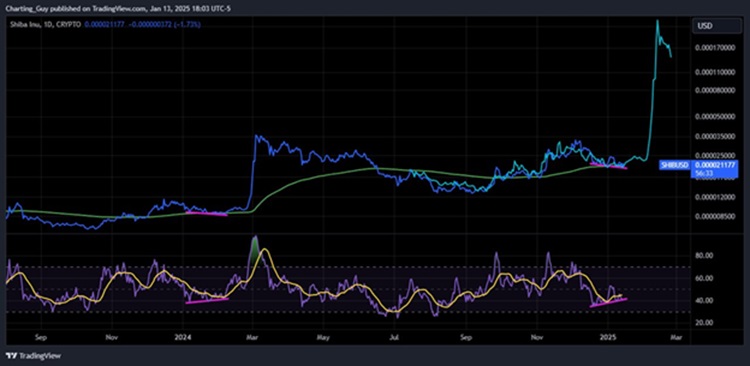
Shiba Inu experienced a remarkable surge in 2021 because of community backing and social hype as well as key projects like ShibaSwap – its decentralized exchange. SHIB evolved from an unknown token to a top cryptocurrency because of its meme appeal plus endorsements from notable figures like Elon Musk next to the vision of a growing system. But the large supply of SHIB (over 589 trillion tokens) created real obstacles for price growth after the rally.

                                                                 Source  X

The token faces new conditions in 2025 as utility matters more than novelty. A fresh Layer 2 solution called Shibarium aims to improve SHIB’s real-world use – especially in DeFi and NFTs – which could attract investors again. The huge token supply needs major burns or widespread adoption to push the price up. SHIB’s story shows how community enthusiasm along with buzz drives success but also proves that actual utility matters for long-term value.

YETIO vs. SHIB: A Financial Comparison

When we compare Yeti Ouro to Shiba Inu, the money outlook varies because of their basic methods. SHIB got really big thanks to its fans plus speculative trades. But Yeti Ouro shines through its actual gaming features, which mix fun as well as cash benefits. A key attraction includes presale perks – the Chinese New Year deal of 20% bonus stands out. These perks serve as rewards for early buyers with the chance of high profits if Yeti Go takes off. The YETIO token burn plan could create better supply control over time compared to SHIB’s unpredictable path.

Source: X

The focus on a lasting game system by Yeti Ouro makes its future clearer than SHIB’s reliance on market mood and memes. This means YETIO gives investors two options: fast gains and the shot at steady profits as games adopt blockchain tech more. A smart investor should note that YETIO’s practical use in gaming sets it apart from pure speculation coins.

The dev team recently a glimpse of level 1 map of YETI GO game

Please note that this image is from a game currently in development. It does not represent the final product.

Conclusion

The rapid success of Shiba Inu in 2021 became a milestone for meme coins plus Yeti Ouro now creates a different path in 2025. A really practical approach along with fresh ideas sets YETIO apart. The project aims to catch gamers’ attention as well as build a wider network through its plans. YETIO has a good chance to follow SHIB’s success story. This mix of entertainment and financial rewards through blockchain games just offers investors new opportunities.

Source: Youtube video

Join the Yeti Ouro Community

Website: https://yetiouro.io/

X (Formerly Twitter): https://x.com/yetiouro

Telegram: https://t.me/yetiouroofficial

Discord: https://discord.gg/YtUsEZ2ZrV

Why FX Guys Will Outshine VeChain and Algorand in 2025

0

The cryptocurrency market is crowded with contenders, but FXGuys ($FXG) is quickly becoming the talk of the town. This Top PropFi Project differentiates itself from competitors like VeChain and Algorand by combining innovative features with robust tokenomics. Here’s why FXGuys is poised to be the standout altcoin of 2025.

>>>JOIN FXGUYS HERE<<<

1. Empowering Traders with a Revolutionary Ecosystem

At the core of FX Guys lies its Trader Funding Program and Development Ecosystem, designed for smart prop traders. Retail traders who pass trading evaluations gain access to up to $500,000 in trading capital and enjoy an 80/20 profit split. This feature empowers traders and attracts the best talent, making FXGuys one of the best proprietary trading firms in the crypto space.

In contrast, projects like VeChain and Algorand have yet to establish mechanisms that cater directly to individual traders’ growth.

2. Unmatched Benefits for Token Holders

FXGuys delivers exceptional value to its community through staking and the Trade2Earn program. By staking $FXG tokens, holders can enjoy a 20% profit and revenue share from broker trading volume, ensuring passive income opportunities. Additionally, the Trade2Earn initiative rewards traders with $FXG tokens for every trade, increasing both trading activity and ecosystem value.

VeChain and Algorand, while innovative in their own right, lack similar programs tailored to reward trading activities and engage their communities at this level.

3. Seamless Accessibility and Decentralized Trading

With no buy or sell taxes and no KYC requirements, FXGuys eliminates barriers to entry. Its decentralized trading approach ensures inclusivity while supporting fiat and crypto deposits in over 100 currencies, offering same-day processing. For traders seeking flexibility, FXGuys provides its custom the FXguys Trader platform alongside support for MT5, Match-Trader, cTrader, and DXtrade.

This adaptability makes the FX Guys a leader in the instant funding prop firm category, a stark contrast to VeChain and Algorand, whose ecosystems are less trader-focused.

4. Stage 2 Presale Success: A Testament to Market Confidence

Currently in Stage 2 of its presale, $FXG is priced at $0.04, having already raised over $3.7 million. This impressive milestone signals strong investor confidence in FXGuys’ vision. The absence of buy or sell taxes further positions $FXG as one of the top defi coins to watch.

While VeChain and Algorand have struggled to maintain similar levels of excitement, FXGuys is captivating both retail and institutional investors alike.

5. High Potential Altcoin for 2025

For those searching for high potential altcoins, FXGuys checks all the boxes:

  • Innovation: Combining decentralized trading, staking, and a proprietary trading ecosystem.
  • Accessibility: Offering a range of trading platforms and fiat/crypto deposit options.
  • Community Engagement: Rewarding participation through Trade2Earn and profit-sharing programs.

Unlike VeChain and Algorand, FXGuys’ ecosystem is tailored to meet the needs of retail traders, making it a standout project in the rapidly growing PropFi sector.

>>>JOIN FXGUYS HERE<<<

Final Thoughts

With its Trader Funding Program, staking rewards, and decentralized trading infrastructure, FXGuys ($FXG) is carving out a unique niche in the cryptocurrency world. Its ability to provide direct value to traders through programs like Trade2Earn and staking gives it a clear edge over competitors like VeChain and Algorand.

As FXGuys continues its Stage 2 presale—raising over $3.7 million and counting—there’s no doubt that it’s one of the top defi coins to watch in 2025. Whether you’re a trader or an investor, FXGuys offers a promising opportunity to be part of the next big thing in crypto.


To find out more about FXGuys follow the links below:

Presale | Website | Whitepaper | Socials | Audit

Shiba Inu Price Prediction: Is SHIB Heading Towards New Highs in 2025? Will Panshibi Join The Meme Coin Trend?

0

Shiba Inu was once a dominant meme coin though it looks like its glory days may be behind it, having posted major losses on the monthly and weekly timeframes. To make matters worse, Shiba Inu is facing stiff competition from an emerging meme coin competitor, Panshibi. This project has taken the market by storm in its presale due to its offering of real utility embedded in a community-focused ecosystem. Having raised over $350,000 in just a few days, Panshibi is shaping up to be a major player in 2025. So who will prevail as these two tussle it out?

Shiba Inu Price Sees Sharp Decline

Shiba Inu (SHIB) has had a rocky month, posting an 8% loss on the whole. Though there has been a slight recovery in the last 24 hours, the general direction for the Shiba Inu price is a negative one, and its market cap looks like it may soon go below the $10 billion mark.

Shiba Inu (SHIB) has been struggling to compete with newer, utility-focused projects that are capturing investor attention. While its community remains one of the strongest, many holders are getting impatient with the slow rollout of major ecosystem updates.

Shiba Inu (SHIB) finds itself in a rough spot. If the developer team can secure more real-world adoption and push out widely anticipated updates such as ShibaSwap and refinements to Shibarium, Shiba Inu could see a price restoration. However, things are looking rather precarious for the asset as it continues to plummet.

Panshibi (SHIBI) Sets a New Standard for Meme Coins

The meme coin market has never been more explosive, with new tokens emerging daily. But while many rely solely on fleeting hype, Panshibi (SHIBI) is carving out a long-term strategy that keeps investors engaged well beyond the initial excitement.

Panshibi has introduced an ecosystem where investors actively benefit from holding and participating. The project’s AI-driven gamification model allows users to earn additional rewards through challenges, quests, and social interactions. Instead of just waiting for token appreciation, investors can engage with the platform and boost their holdings over time.

Staking is also a major draw for Panshibi. With APYs of up to 1,200% on offer, the project provides ample opportunity for gaining passive income. This staking model has a dual mechanism, rewarding long-term investors while also creating a more stable and less volatile ecosystem.

Security has long been a problem in the meme coin space, with many projects experiencing rug pulls and liquidity crashes. Panshibi is setting a new standard by implementing strict security protocols that protect investor funds. This is why Panshibi has undergone a full security audit, which has verified that Panshibi’s smart contract is resilient and free from vulnerabilities. In addition, a 10-year liquidity lock is in place, mitigating the risk of abrupt sell-offs.

These measures ensure that Panshibi is built for sustainability rather than being a short-lived market trend. Investors can confidently enter the ecosystem without concerns about manipulation or instability.

Panshibi Presale Gains Traction, Surpassing $350,000 Raised

The Panshibi (SHIBI) presale is taking the market by storm, with $350,000 raised in a matter of days.  With analysts predicting a 1,200% surge before exchange listings, the current presale price of $0.003 is a rare opportunity for investors looking to enter before valuations increase. The meme coin market continues to dominate crypto trends, and Panshibi is positioning itself at the helm of this movement. For any meme coin enthusiast looking to ride the wave in 2025, this market disruptor is not a project to pass up on.

You can participate in the Panshibi presale here:

Telegram: https://t.me/panshibi

Twitter: https://x.com/panshibi

Website: https://panshibi.com

OpenAI Business Model Looks Fragile and Stale As Microsoft, Amazon Scale DeepSeek

0

My position on the long history of how Microsoft won Linux in China is clear: the best pricing is FREE from the customer side. So when Microsoft Azure integrated DeepSeek’s model, I noted that Microsoft was essentially telling developers and users that DeepSeek is technically anointed, and available to them right in the heart of America, with no need to digitally travel to Beijing.

With that move, Amazon quickly responded and integrated DeepSeek. If Microsoft and Amazon adopt a model, that model is available to more than 80% of digital developers and builders, meaning that a shift will happen. Ironically, Microsoft was funding OpenAI which is only open by name, and  requires payment. What that means is that Microsoft can make itself irrelevant, if it is distributing a largely free model when funding a paid model, since if the two models perform at parity, no one will purchase the OpenAI model.

But  the company which operates on practical realism has done what many have expected: “Microsoft has thrown a major disruptive force into the AI market, announcing free, unlimited access to OpenAI’s powerful o1 model through Copilot’s new “Think Deeper” feature. The move undercuts OpenAI’s own pricing model,…”

Yes, if Microsoft does not do that, it may end up like IBM which made tents with Linux, and lost into oblivion. So, we can say indirectly that OpenAI is now becoming open via Microsoft. Good People, expect more shifts as Google joins the open model or free framework soon. But when you look deep into the horizon, it does seem like the OpenAI business model has faded since Microsoft can give out the goodies largely free under their contracts!

Remember: what they do at the foundation model should not overly concern you that much. We need to focus at the LLM and GenAI levels in Nigeria and Africa as I have noted here. As the foundation model becomes increasingly open, no one can give an excuse anymore on the reason why AI cannot transform,  not just run sectors and businesses in Africa.

Amazon has made DeepSeek’s R1 artificial intelligence model available on its cloud computing platforms, the latest indication Big Tech has decided to integrate the Chinese startup’s cheaper, competitive AI technology. For its part, Meta contends DeepSeek “validated” its decision to make its AI technology freely available online, arguing an open-source standard will accelerate the adoption of its models and lower costs. The company is already working to reverse engineer DeepSeek’s technology, The Information reported, citing anonymous sources – Linkedin News