DD
MM
YYYY

PAGES

DD
MM
YYYY

spot_img

PAGES

Home Blog Page 26

$50M Crypto Heist: Binance Ex-CEO Changpeng Zhao Proposes Blacklists to Combat Address Poisoning Scams

0

In recent years, cryptocurrency scams have become increasingly personalized, directly targeting individual wallet holders with alarming frequency and devastating consequences.

While these scams have already cost victims billions of dollars, another type of crypto scam is also on the rise, address poisoning attacks.

A fresh wave of concern is rippling through the crypto industry after a sophisticated address-poisoning scam led to losses exceeding $50 million, once again exposing vulnerabilities in on-chain transactions.

A post on X exposed a $50 million USDT loss from an address-poisoning scam: the victim successfully tested a small transfer but then copied a similar-looking poisoned address from history, sending the full amount within an hour.

The attached image from a security tool illustrates the scam, contrasting the real recipient address (0xcb807…6019) with the attacker’s mimic (0xbafr1…f8b5), marking it as high-risk and detailing the transaction flow.

The wallet has been active on-chain for around 2 years and was mainly used for $USDT transfers. The $50M was withdrawn from Binance shortly before the poisoned transfer took place.

This incident, confirmed by reports from SlowMist and Unchained, underscores ongoing Web3 UX flaws, with replies advocating for mandatory address verification, whitelists, and ENS integration to mitigate such exploits for large transfers.

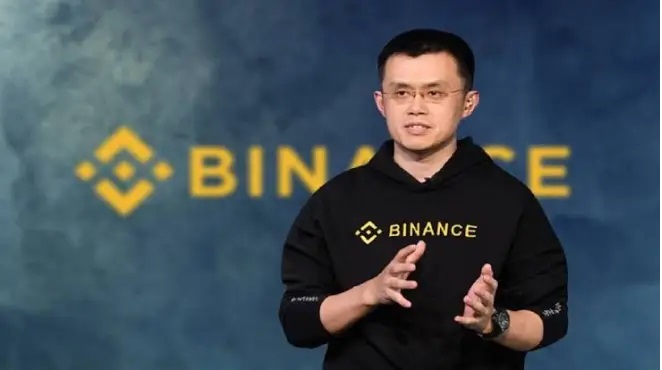
Notably, the incident has reignited debate around user safety, wallet design, and the limits of decentralization. Weighing in on the fallout, Binance founder and former CEO Changpeng Zhao (CZ)has proposed the introduction of blacklists as a defensive measure to curb address-poisoning attacks, an idea that challenges long-standing norms in the crypto ecosystem.

In his vision, promoting heightened security measures across all blockchain platforms could cultivate a more robust protective aura for participants and safeguard their financial assets.

His ambitious agenda includes the establishment of dynamic blacklists accessible across multiple platforms, alongside strong commitments to swiftly filter out suspicious transactions. “We must eradicate these poison attacks entirely and ensure the safety of our users,” he asserted.

As crypto scams grow more complex and costly, CZ’s suggestion underscores a pivotal question for the industry, how far should crypto platforms go in prioritizing security over absolute permissionless freedom?

How the Address Poisoning Scam Works

An address poisoning attack is a particularly pernicious crypto scam that uses customized on-chain infrastructure to deceive victims out of their funds.

These scams often focus on high-value targets or those with frequent, regular crypto transactions.

Address poisoning exploits users copying addresses from transaction history; scammers send micro-transactions from near-identical addresses to insert fakes, a tactic increasingly common in Web3 per security reports.

The approach is simple, yet highly effective:

  1. Scammers begin by studying a target’s transaction patterns, looking for frequently used addresses.
  2. The scammers will then algorithmically generate new crypto addresses until they create one that closely resembles the address that the target most often interacts with.
  3. Once they have a convincing lookalike address, the scammer then sends a small, seemingly harmless transaction from this newly generated address, effectively “poisoning” the target’s address book.

The hope is that, when the target sends funds in the future, they will rely on their transaction history for convenience and mistakenly send funds to the scammer’s look-alike address instead of to the intended recipient address.

As headlines continue to spotlight the exponential rise of scams and breaches, the urgency for resilient security protocols is paramount. The integration of innovative technologies within blockchain security, together with thorough user education, will serve as pivotal elements in shielding against future threats.

Outlook

Looking ahead, address poisoning scams are likely to become even more sophisticated as attackers leverage automation, AI-driven address generation, and deeper behavioral analysis of on-chain activity.

As transaction volumes grow and wallets continue to optimize for speed and convenience, the attack surface for UX-based exploits will expand unless deliberate safeguards are built into the ecosystem.

On the other hand, CZ’s call for shared blacklists signals a broader shift in philosophy: a growing willingness to trade some degree of permissionless purity for collective security.

While such measures may face resistance from decentralization purists, high-profile losses and institutional participation could accelerate acceptance of coordinated defense mechanisms, especially for large-value transfers.

Hyperliquid’s Foundation formal Burning of HYPE Tokens Signals Continued Scarcity for HYPE

0

The Hyper Foundation officially announced that the governance vote has passed, formally recognizing all HYPE tokens held in the Assistance Fund as permanently burned.

The vote was stake-weighted: 85% in favor, 7% against, and 8% abstaining. This removes approximately 37–37.5 million HYPE tokens worth around $900 million to $1 billion at recent prices from both circulating and total supply metrics.

The tokens were accumulated automatically from protocol trading fees and were already inaccessible no private key exists, making them irretrievable without a hard fork. The “burn” is a social/governance consensus: validators committed to never approving any protocol upgrade to access the funds, plus future fee inflows will continue to this address.

This move enhances supply transparency, eliminates perceived overhang risks, and reinforces Hyperliquid’s deflationary tokenomics, as ongoing fees now effectively act as continuous burns.

Despite the positive development, HYPE’s price saw a slight dip shortly after the announcement around -2-3% to ~$23-24, likely due to broader market conditions or profit-taking. This follows their initial proposal on December 17, 2025, which received strong community and validator support leading into the vote deadline.

The formal recognition of ~37-37.5 million HYPE tokens valued at ~$900M-$1B as permanently burned marks a significant shift in Hyperliquid’s tokenomics. Reduces both circulating and total supply by ~13%, eliminating any perceived future overhang from the Assistance Fund.

Ongoing trading fees will continue routing to the inaccessible address, effectively turning all future fee inflows into permanent burns. This creates a truly continuous deflationary pressure tied directly to protocol revenue and volume.

Net effect: Strengthens HYPE’s value accrual model, where higher trading activity directly benefits holders through reduced supply similar to Ethereum’s EIP-1559 but more aggressive, as ~97-99% of fees historically fuel buybacks/burns.

Aligns reported supply metrics on CoinGecko, CoinMarketCap with on-chain reality—the tokens were already irretrievable, but now they’re officially excluded. Removes ambiguity that previously led to mispricing of circulating market cap and fully diluted valuation (FDV).

Analysts note this corrects “lazy” metrics, potentially leading to revaluation upward as investors recalibrate. Signals strong governance credibility: 85% stake-weighted approval demonstrates community/validator alignment on long-term holder value over short-term flexibility.

HYPE dipped slightly post-announcement— 2-3%, trading around $23-24, likely due to broader market weakness, profit-taking, or ongoing token unlock pressures. Long-term bullish catalyst: Reduces selling pressure, boosts scarcity narrative, and could attract deflationary-asset seekers. If volume sustains, projected annual burns could outpace emissions/inflation significantly.

Ongoing monthly unlocks ~$200M+ recently and competition in perps DEX space may cap upside unless revenue grows 2-3x to fully offset dilution. Permanently forgoes a ~$1B reserve that could have funded grants, ecosystem development, insurance backstops, or emergency interventions.

Hyperliquid now relies purely on organic product strength leading perps volume, no-gas L1 and cash flow for growth—no “war chest” fallback. Some community concern: Increases vulnerability if volume drops sharply, though current dominance mitigates this.

It’s reinforces Hyperliquid’s commitment to decentralized, holder-aligned decisions via stake-weighted voting bypassing traditional on-chain limits. Sets a model for other protocols: Binding social consensus to treat inaccessible funds as burned, enhancing trust without code changes.

Positive for DeFi narrative in 2025—amid competition and unlocks, this prioritizes sustainable tokenomics over incentive farming. This is widely viewed as a net positive for long-term HYPE holders, cementing deflationary credibility at the cost of flexibility.

It addresses key criticisms while Hyperliquid maintains perps leadership, but success hinges on sustained or growing trading volume to maximize ongoing burns.

Key Implications of Upexi’s $1 Billion Shelf Registration Filing

0

Upexi Inc. (NASDAQ: UPXI), a Nasdaq-listed company originally focused on consumer brands and e-commerce, has pivoted heavily into cryptocurrency.

It adopted a Digital Asset Treasury (DAT) strategy centered on Solana (SOL), holding approximately 2–2.1 million SOL tokens (valued at around $250–260 million at current prices near $124 per SOL). This makes it the fourth-largest corporate Solana holder among public companies.

Upexi filed a $1 billion shelf registration with the U.S. SEC. This allows the company to issue up to $1 billion in securities like common stock, preferred stock, debt, warrants, or units over time, providing flexibility to raise capital when market conditions are favorable.

The proceeds are intended for: General corporate purposes. Expanding its Solana DAT strategy acquiring more SOL, staking for yield, and potentially buying discounted tokens. This filing signals strong conviction in Solana as a long-term treasury asset, especially amid a late-2025 price correction that dropped SOL over 50% from its highs and reduced Upexi’s holdings value from over $500 million earlier in the year.

Market reaction was negative initially: Upexi shares fell about 7.5% on the news closing around $1.84–$1.85, likely due to dilution concerns, as the company’s market cap is only ~$115 million. No funds have been raised yet—this is just the registration to enable future offerings.

The company has emphasized it will only pursue raises that are accretive to SOL exposure per share. This move aligns with broader trends of public companies building Solana treasuries; total corporate SOL holdings across firms exceed 15–16 million tokens. though demand slowed in late 2025 alongside the price dip.

SEC Form S-3 shelf registration allows the company to potentially issue up to $1 billion in securities (common stock, preferred stock, debt, warrants, or units) over the next three years. This is not an immediate raise—it’s a flexible toolkit for future capital access.

Proceeds are broadly earmarked for general corporate purposes, working capital, acquisitions, R&D, debt repayment, and explicitly advancing its Solana Digital Asset Treasury (DAT) strategy (buying more SOL, staking for yield, or acquiring discounted tokens).

The market reacted negatively, with shares dropping ~7.5% to close at $1.84— market cap ~$115–125 million. Investors fear equity issuances could flood the market, reducing SOL exposure per share. Upexi emphasizes raises will only be “accretive” increasing SOL per share via smart timing, e.g., buying SOL at dips.

They plan to terminate an unused equity line for more efficient, lower-cost capital via the shelf. High volatility ahead: With heavy crypto exposure ~$250–260 million in 2–2.1 million SOL at ~$122–124 per SOL as of December 24, UPXI acts like a leveraged SOL play. Paper losses are currently ~19% from cost basis.

Potential upside: If executed well during SOL weakness, it could massively scale holdings, positioning Upexi as a top corporate SOL holder. Upexi doubling down amid a 57%+ drawdown from 2025 highs ~$293 ATH shows conviction in SOL as a long-term treasury asset.

Corporate SOL treasuries across public firms exceed 15–16 million tokens, but demand slowed in late 2025. Potential buying pressure: If/when raises occur, funds could flow into SOL purchases, especially at current discounted prices. This aligns with trends like institutional partnerships and regulatory clarity.

Mirrors MicroStrategy’s Bitcoin strategy but for Solana—public companies blending tradfi capital markets with crypto treasuries. Could encourage more firms if SOL recovers. Slowed corporate buying in H2 2025 reflects waning confidence in treasury strategies during bearish phases. No purchases by Upexi since July.

SOL trading ~$122–126, down significantly YTD. Crypto markets remain pressured; L1 tokens underperformed despite institutional wins. Reaction on X is mixed: Some see it as a strong SOL endorsement, others highlight dilution and risks.

This filing underscores maturing crypto-traditional finance bridges but highlights risks in volatile assets. If SOL rebounds, Upexi could benefit enormously; otherwise, dilution and losses amplify downside. It’s a high-conviction bet on Solana’s ecosystem growth.

Ripple’s (XRP) $10 Dream in 2025 Dies as New Coin Below $0.003 Takes Over as the Best Crypto to Buy Now

0

The crypto market is entering a brutal phase for altcoins, and XRP is at the center of the breakdown. Its long-awaited push toward $10 looks more distant than ever, especially after today’s decisive crack below the $2.00 support.  Meanwhile, a new presale coin, Little Pepe (LILPEPE), priced under $0.003, is capturing market attention as a high-momentum opportunity with 2025 upside that XRP can no longer promise. As confidence drains from older alts, early-stage meme coins with real ecosystems are quickly becoming the dominant narrative. Below, we break down why XRP’s situation is turning from concerning to critical, and why many investors are now redirecting capital into Little Pepe’s fast-moving presale.

XRP’s $10 Narrative Falls Apart as Price Crashes Below $2.00

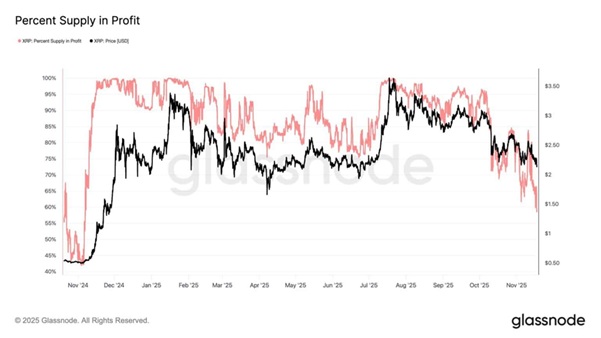
XRP’s drop today wasn’t just another red candle; it was a structural breakdown. The chart sliced under the $2.00 support, a level bulls absolutely needed to defend. On-chain data confirms that 42% of XRP holders purchased around $3, meaning a significant block of holders is now sitting on 40%+ losses. That’s the exact kind of pressure that triggers capitulation during weak market conditions.


XRP Holders’ Percent Supply in Profit | Source: Glassnode

Sentiment is already terrible, altcoins are bleeding across the board, and Bitcoin’s dominance is climbing to 58.45%, indicating that investors are fleeing alts altogether. Even Bitwise’s new spot XRP ETF listing on NYSE Arca, something that should have been a bullish catalyst, failed to provide any lift. Instead, whales dumped 190 million XRP in 24 hours, a clear rejection of the bullish ETF narrative. Everything now points to the same conclusion: the $10 dream isn’t just delayed; it’s slipping out of reach.

Technical Breakdown Suggests More Pain Ahead

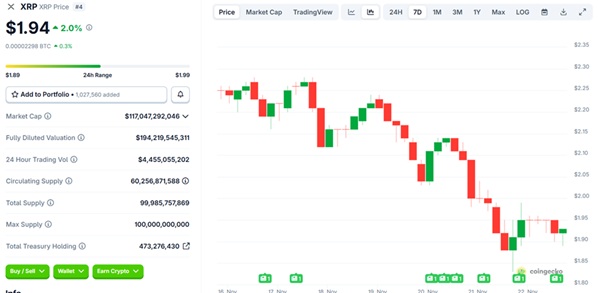
Today’s candle sent XRP to a fresh low, briefly bouncing back from a small demand pocket at $1.94. The wick shows buyers are attempting to defend the level, but the pressure remains heavy and emotional. XRP’s RSI collapsing near 18 tells you the market is massively oversold, often the precursor to a temporary relief move.


XRP Price Chart | Source: CoinGecko

Bulls can still push the XRP price above $2 if the current level holds. However, if XRP fails to maintain this zone, the next liquidity magnet is around $1.90, and that level could easily become a trapdoor for a deeper slide. Currently, the entire structure is teetering between a brief bounce and a full continuation breakdown, and momentum is leaning toward weakness unless buyers step in with force.

Little Pepe Surges as Investors Rotate Into High-Growth Low-Cap Plays

With XRP struggling, traders are pivoting toward early-stage tokens that offer explosive upside with minimal capital required. That’s where Little Pepe (LILPEPE) has separated itself from the rest of the pack. Priced under $0.003, this meme-powered ecosystem is building on a sniper-bot-resistant EVM Layer 2, delivering zero buy/sell tax, near-zero trading fees, and a meme-exclusive launchpad that will roll out post-launch. The presale has already raised over $27.6 million, with more than 16.7 billion tokens sold, confirming intense demand from retail investors. Stages are selling out rapidly, and LILPEPE now sits on CoinMarketCap with a confirmed $0.003 launch price and a $300 million market cap at listing.  Add the CertiK audit, strict vesting (0% at TGE with a 3-month cliff), and high staking APY, and it becomes clear why investors view LILPEPE as the safer high-reward play compared to bleeding large caps. The crypto market isn’t showing a nice picture of legacy tokens. Currently, attention is focused on fresh legs with enough fuel to run.

Why Analysts Say LILPEPE Could Be the Top Crypto to Buy in 2025

Ripple’s $10 dream is fading, but the opportunity for a new breakout project is emerging. Little Pepe’s fundamentals position it as one of the few meme coins capable of delivering a massive 2025 run. Analysts point to three core reasons:

  • Low entry price below $0.003 makes early multiples realistic
  • Layer 2 infrastructure gives it utility that older meme coins never had
  • Presale momentum mirrors early-stage SHIB and PEPE before their exponential rallies

With retail liquidity rotating and altcoins struggling, LILPEPE is becoming the clear favorite for traders searching for the next notable upside wave. XRP’s breakdown may be painful, but it’s also revealing where the real opportunity is now.

For more information about Little Pepe (LILPEPE) visit the links below:

Website: https://littlepepe.com

Whitepaper: https://littlepepe.com/whitepaper.pdf

Telegram: https://t.me/littlepepetoken

Twitter/X: https://x.com/littlepepetoken

$777k Giveaway: https://littlepepe.com/777k-giveaway/

Happy Birthday, Ifeoma

0

It is Christmas, a day we remember the beginning of that journey from miry clay to pastures of hope and redemption for the birth of our Christ Jesus. In our family, it is also a special day as we celebrate my best friend and wife, Ifeoma, on her birthday.

I celebrate her uncommon grace in managing everyone with grace and love: “2pm, there is an early dismissal for [son]. I will remind you again at 1:45pm.” Yes, she makes sure nothing important slips through the cracks even though she has more important daily tasks, seeing her patients. Ifeoma is an accomplished professional woman, the first proofreader of my best work, and the finest project manager I know. She makes me better every day.

A true scholar with five academic degrees, she balances intellectual excellence with an unalloyed commitment to family and a deep respect for the divine institution of marriage. In a world that often demands trade-offs, Ifeoma has shown me that purpose, professionalism, and partnership can coexist. I am a village boy, and she treasures a union with this villager! Thanks.

This year, she did something that touched me deeply and for which I will publicly thank her. When my mother had a fall and was not making rapid progress with treatment in Nigeria, Ifeoma left the United States to bring her here for better care. She then took weeks of leave to ensure that the surgery and recovery went well. She joined the operating room. After what can only be described as a God-directed scientific miracle in an American hospital, with everything successful, she traveled again, quietly living out the testimony of a virtuous woman. A selfless and uncommon devotion so much that my mother noted that Christmas truly sent her son multiple blessings.

It was during a layover in Europe that I asked for this photo to be taken, just to check if she was still smiling. And yes, she was, still smiling, still strong. Baby, thank you. Tochi, Emeka, and I appreciate you deeply.

Good People, join me in wishing her a happy birthday and many more years filled with grace, wisdom, and good health. She is the endless love of my life, and Ovim’s special gift to this village boy from Ovim. And let me also add Merry Christmas from our family to yours.