DD
MM
YYYY

PAGES

DD
MM
YYYY

spot_img

PAGES

Home Blog Page 269

Shiba Inu Price Predictions Are Rising, but Ozak AI Could Outshine Every Meme Coin

0

Shiba Inu is gaining bullish momentum as rising price predictions and key support around the $0.0000080 point to a potential breakout, but many traders believe Ozak AI could be the real game changer of the next bull run. While SHIB thrives on meme coin hype and community strength, Ozak AI pairs an early-stage entry with real AI and blockchain infrastructure, integrating 700,000+ AI nodes through partnerships with Perceptron Network and SINT.

In its 6th presale stage at $0.012, with over $4.1M raised and 975M+ tokens sold, Ozak AI is listed on CoinMarketCap and CoinGecko and has passed security audits from CertiK and Sherlock. With whales accumulating early, many see it as a 100x project capable of outshining even the biggest meme coins in 2025. 
Shiba Inu Is Fueling Meme Coin Hype Once Again

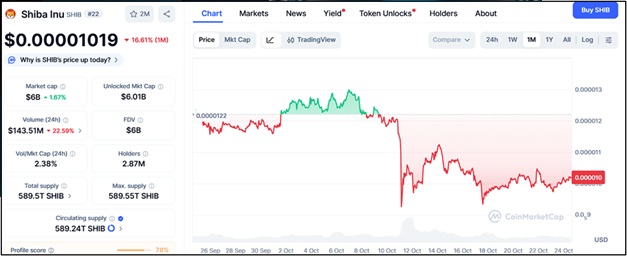
Shiba Inu is once again making waves in the crypto market as bullish forecasts point to a major rally ahead. Currently trading around $0.00001019, SHIB has support levels at $0.0000080, $0.0000065, and $0.0000052, while resistance levels are set at $0.000012, $0.000016, and $0.000022. This structure suggests that the meme coin is positioned for a potential breakout, especially as retail participation picks up and social media sentiment strengthens.

Shiba Inu’s incredible history—turning small early investments into life-changing gains—continues to attract both new and experienced traders. However, as meme coins become more saturated and their upside starts to shrink compared to earlier cycles, many investors are shifting focus toward new high-upside narratives. This is where Ozak AI enters the spotlight.

Why Investors Are Rotating Beyond Meme Coins

Meme coins like SHIB thrive on community strength and viral momentum, but their massive market caps make it increasingly difficult to deliver the kind of 50x or 100x returns seen in their early days. Smart money that once flowed into SHIB is now seeking projects with early-stage entry, strong narratives, and real utility. In the 2025 cycle, the most powerful narrative emerging isn’t meme coins—it’s AI + blockchain.

Ozak AI has positioned itself right at the center of this narrative, capturing early whale and retail interest alike.

Ozak AI Brings Real Infrastructure to the AI Narrative

Unlike meme coins that depend purely on hype, Ozak AI combines a powerful narrative with tangible technology. Currently in its 6th OZ presale stage at $0.012, the project has already raised over $4.1 million and sold more than 975 million tokens. Through partnerships with Perceptron Network and SINT, Ozak AI integrates over 700,000 AI nodes that enable predictive analytics, real-time signal processing, and agent-based intelligence systems.

The project is also listed on CoinMarketCap and CoinGecko and has completed security audits by CertiK and Sherlock, boosting its credibility among serious investors. This makes it more than just another presale token—it’s a fundamentally strong early-stage opportunity.

Whale Accumulation Is a Major Bullish Signal

Whales have a track record of identifying breakout narratives before retail investors. They accumulated Ethereum before the DeFi boom, Solana before its parabolic run, and SHIB before it went viral. The same pattern is now appearing with Ozak AI, as whales accumulate early during its presale.

This quiet accumulation often precedes massive price discovery once a token lists on major exchanges and retail interest surges—setting the stage for exponential gains.

Ozak AI Could Outshine SHIB in the 2025 Bull Run

While SHIB’s rising price predictions and strong community make it a solid meme coin play, Ozak AI offers something meme tokens can’t: a powerful narrative backed by real utility. Its early entry point, whale accumulation, AI-driven infrastructure, and presale momentum give it the potential to deliver 100x returns, far outpacing meme coin rallies.

For traders looking to capture the next major breakout story, Ozak AI stands out as a project that could outshine every meme coin in the 2025 bull run. SHIB may rally, but Ozak AI could lead the narrative.


About Ozak AI

Ozak AI is a blockchain-based crypto project that provides a technology platform that specializes in predictive AI and advanced data analytics for financial markets. Through machine learning algorithms and decentralized network technologies, Ozak AI enables real-time, accurate, and actionable insights to help crypto enthusiasts and businesses make the correct decisions.


For more, visit:

Website: https://ozak.ai/

Telegram: https://t.me/OzakAGI

Twitter: https://x.com/ozakagi

Afreximbank to Launch Special Financing for Mineral Processing Projects as George Elombi Targets End to Raw Exports

0

The African Export-Import Bank (Afreximbank) is setting a bold new direction under its new president, George Elombi, who has announced the creation of a special financing window dedicated to processing Africa’s raw minerals into semi-finished and finished products.

The initiative, revealed during his swearing-in ceremony in Cairo on Saturday, marks one of the most ambitious industrialization drives in the bank’s history and a significant step toward reshaping Africa’s place in the global economic value chain.

Elombi declared that his administration would no longer tolerate the unprocessed export of Africa’s mineral wealth — a practice that has historically deprived the continent of industrial growth, skilled jobs, and economic resilience.

“No more Nigerian bauxite, or Gabonese manganese, or Cameroonian bauxite, or South African bauxite, raw. We are not interested,” he said. “We will focus on domestic processing. This has numerous benefits.”

He explained that the bank’s new strategic direction would center on building value chains that retain a greater share of Africa’s mineral wealth at home, stimulating local industries, and promoting technological advancement.

“Afreximbank will therefore create a new high-impact financing window, specifically for projects that process raw minerals into semi-finished goods or finished goods,” Elombi said.

Elombi also announced plans to launch a Strategic Minerals Development Programme, which will provide financing for the entire value chain — from extraction and refining to manufacturing. The programme, he explained, will prioritize cross-border projects that connect mining hubs with regional industrial zones.

He noted that historically, less than 20 percent of total investment in Africa’s mineral sector goes into actual mining operations, while more than 80 percent is channeled into supportive infrastructure like railways, ports, and power stations. The new Afreximbank initiative, he said, would focus on harmonizing these investments to deliver stronger industrial outcomes.

“Afreximbank will accelerate investments in critical trade-enabling infrastructure projects that directly connect African markets to one another,” Elombi added.

He indicated that the bank will also invest in modernizing seaports, highways, railways, pipelines, and logistics hubs, with priority given to infrastructure linking industrial and production centers with regional and global markets.

A Broader Economic Vision

Elombi’s remarks come on the back of a growing consensus among African policymakers and economists that the continent must break its long-standing dependence on raw commodity exports. For decades, Africa’s mineral wealth — including cobalt, lithium, copper, and bauxite — has been extracted and exported for processing abroad, leaving the continent with limited industrial output and minimal value capture.

According to the Office of the U.S. Trade Representative, Africa’s contribution to global manufacturing remains under 2%, while its share of global trade stands below 3%, despite being one of the most resource-rich regions on earth.

The Afreximbank president’s declaration aligns with repeated calls from some of Africa’s leading economic voices — including WTO Director-General Ngozi Okonjo-Iweala and former African Development Bank (AfDB) President Dr. Akinwumi Adesina — for the continent to transition from exporting raw materials to refining and processing them locally.

Okonjo-Iweala has consistently argued that Africa must move beyond the traditional commodity-based model if it is to achieve sustainable growth. She has said that without value addition, African economies will remain vulnerable to global commodity price shocks and external dependence.

“We need to develop our processing industries to create jobs, boost intra-continental trade, and ensure we stop exporting raw materials without value addition,” she stated early this year.

Similarly, Adesina has warned that continued export of raw materials is “the door to poverty,” while value-added exports are “the highway to wealth.” Speaking in April, he said: “Africa must end the exports of its raw materials. The export of raw materials is the door to poverty. The export of value-added products is the highway to wealth. And Africa is tired of being poor.”

Economists say both leaders’ positions reflect the urgent need for Africa to capture more of the value from its resources — particularly as global demand for critical minerals surges due to the clean energy transition. With countries worldwide competing for cobalt, lithium, nickel, and rare earth elements to power electric vehicles and renewable energy systems, Africa’s ability to process these minerals locally could redefine its role in the global economy.

Afreximbank’s proposed financing window is expected to support industrial plants, refineries, and midstream processing facilities that can transform raw materials into higher-value exports. The bank also intends to leverage public-private partnerships to mobilize funds for regional infrastructure, which Elombi said remains one of the continent’s biggest bottlenecks to intra-African trade.

By directly linking resource-rich regions with industrial zones, the initiative could also help expand the African Continental Free Trade Area (AfCFTA), which aims to create a unified African market of 1.4 billion people. Economists believe that boosting intra-African trade through industrial integration could help the continent capture greater value from its resources and reduce dependence on foreign markets.

Shifting the Continental Economic Paradigm

Experts view Elombi’s industrialization agenda as a continuation of Afreximbank’s recent efforts to transform Africa’s trade ecosystem. The bank has been a key player in supporting the AfCFTA’s Pan-African Payment and Settlement System (PAPSS), designed to simplify cross-border transactions and reduce reliance on the U.S. dollar in African trade.

If successfully implemented, Afreximbank’s new mineral processing fund could serve as a catalyst for a broader industrial renaissance, creating jobs, stimulating technological transfer, and positioning African nations as competitive players in the global supply chain.

However, analysts caution that the success of this vision will depend on strong policy coordination, political stability, and technological investment.

Red Star Express Doubles Profit as E-commerce and Logistics Growth Drive 98% Surge in Pretax Earnings

0

Red Star Express Plc has nearly doubled its pretax profit to N371.2 million for the second quarter ended September 2025, up from N186.7 million in the same period last year, marking one of its strongest quarterly performances in recent years.

The company’s six-month pretax profit also climbed 98% year-on-year to N675 million, supported by rising revenue and a surge in other income.

Turnover for the quarter grew by 14.24% to N5.8 billion, bringing total revenue for the six months to N11.1 billion, up 14.9% year-on-year. The courier segment remained the company’s largest revenue driver, contributing N5.2 billion, followed by freight (N2.4 billion), logistics (N1.9 billion), and support services (N1.4 billion).

Strong operational growth amid rising costs

The company’s cost of sales rose by 8.27% to N4.7 billion, but this was outpaced by a sharp increase in gross profit, which reached N1.15 billion, up 47.74% from N781 million a year earlier.

Red Star’s other income rose 281.27% to N76.3 million, buoyed by sundry and non-core earnings, which helped offset increased administrative and operating expenses. These expenses climbed 47.89% to N829.7 million, reflecting higher logistics and maintenance costs amid inflationary pressures and rising diesel prices.

Operating profit grew 66.68% to N336.5 million, while finance income of N44.8 million more than covered finance costs of N10.2 million, leaving pretax profit at N371.2 million, up 98.83% from the previous year.

After-tax profit rose even more sharply, nearly doubling to N252.4 million from N126 million in the same quarter of 2024.

Resilient balance sheet and strong equity position

Total assets stood at N10.4 billion, up 1.55% from the previous period, with trade debtors of N3.1 billion and property, plant, and equipment valued at N2.9 billion forming the largest asset components. Total equity rose to N5 billion, driven mainly by retained earnings, which climbed 4.33% to N3.01 billion.

Liabilities were largely stable at N5.4 billion, up slightly from N5.3 billion, with other creditors and accruals (N2.9 billion) accounting for the bulk.

Red Star’s stock has been one of the strongest performers on the Nigerian Exchange in 2025, trading at N11 per share as of October 24 — a 149.43% gain year-to-date, signaling robust investor confidence.

E-commerce and logistics demand boost performance

Analysts attribute Red Star Express’s impressive results to rising demand for e-commerce deliveries and logistics services across Nigeria. With more businesses moving online and consumers increasingly relying on home deliveries, logistics companies like Red Star have experienced a steady rise in parcel volumes.

The company has also benefited from increased trade activity driven by the post-subsidy removal environment, where businesses are optimizing distribution networks to manage costs. Its freight and logistics segments, which saw higher utilization rates, have particularly contributed to the improved turnover.

Outlook: Expansion and digital transformation

Red Star Express’s ability to maintain profitability despite cost pressures is attributed to growing operational efficiency and diversification. The company has been expanding its warehousing and cold chain logistics capabilities, while also investing in technology platforms to enhance route optimization and customer tracking.

Nigeria’s courier and logistics market has grown rapidly in recent years, bolstered by digital commerce, fintech-driven payment systems, and an expanding consumer base. Red Star Express’s strong half-year results position it well to capture further market share as logistics and supply-chain solutions become critical to the nation’s post-pandemic economic structure.

With its profitability and equity base improving, analysts believe Red Star Express could be better positioned to attract institutional investors or explore capital market instruments to fund expansion in 2026, particularly in regional freight and express delivery services.

First Bank Integrates PAPSS Into Its Digital Banking App, to Boost Cross-border Payments

0

First Bank, Nigeria’s premier bank, has integrated Pan-African Payment and Settlement System (PAPSS) into its flagship digital banking platform, the LIT App.

This integration enables customers to make instant, secure, and local currency-based cross-border payments across Africa. Also, it will enable FirstBank customers to send and receive payments across participating African countries directly from the LIT app, using their local currency. This advancement eliminates the need to route transactions through intermediary banks outside Africa, thereby reducing transaction costs and settlement times.

Launched in January 2022, PAPSS, a centralized financial market infrastructure, facilitates secure and efficient cross-border payment transactions across Africa. It aims to minimize risks and enhance financial integration among African countries, enabling the flow of money in local currencies.

Speaking on the Integration into the LIT app, Chuma Ezirim, Group Executive, e-Business and Retail Products at Firstbank, described it as a major step forward in the bank’s innovation journey.

He said,

“The integration of PAPSS into the LIT app is a testament to FirstBank’s commitment to delivering innovative, customer-centric solutions that simplify and enhance financial transactions. This milestone aligns with the Bank’s strategic goal of deepening digital capabilities and expanding access to seamless cross-border payment services across Africa.”

Also commenting on this collaboration, Mike Ogbalu, CEO of PAPSS, said,

Every time an individual, an SME, or a Company sends money instantly within Africa in their own currency, we are not just moving funds, we are connecting ambitions, supporting livelihoods, and bridging dreams across borders. This collaboration with FirstBank and their LIT app brings us a step closer to making African borders invisible to the movement of money, so that the continent’s entrepreneurs and families can focus on what matters most: building their future, not battling payment barriers.”

The LIT app is First Bank’s proprietary mobile banking application designed to provide customers with easy access to their banking needs. The app was launched to revolutionize the culture and experience of mobile banking in Nigeria.

The state-of-the-art banking app exposes customers to a wealth of opportunities to promote safety and convenience whilst ensuring they are at an edge in today’s digital banking world.

Key features include;

  • Instant virtual card generation and loan applications.
  • User-friendly interface that allows customers to manage their accounts conveniently.
  • Access to various banking services such as bill payments and account management.

With the addition of PAPSS on the LIT app, it expands its capabilities to support cross-border commerce, especially for individuals and SMEs engaged in pan-African business.

Nonetheless, the integration of PAPSS into FirstBank’s LIT app represents a transformative milestone for Africa’s financial ecosystem. It lays the groundwork for a more connected, inclusive, and efficient payment infrastructure, one that supports the continent’s broader goals of economic integration and sustainable development.

FirstBank has taken a bold step toward realizing the vision of a borderless African payment system by embedding PAPSS into its digital platform. The move not only enhances convenience for customers but also strengthens the foundation for intra-African trade and financial inclusion.

As more African banks follow suit, PAPSS could very well become the cornerstone of Africa’s next financial revolution, one powered by technology, collaboration, and a shared vision for continental prosperity.

Access Holdings’ H1 2025 Profit Dips 8% to N320.57bn Despite Strong Revenue Growth and Subsidiary Expansion

0

Access Holdings Plc, one of Nigeria’s largest financial services groups, has released its audited half-year financial results for the period ended June 30, 2025, reporting a pre-tax profit of N320.57 billion — an 8.12% year-on-year decline from N348.92 billion recorded in the corresponding period of 2024.

Post-tax profit also fell by 23.25% to N215.92 billion, compared to N281.33 billion in H1 2024.

Despite the earnings drop, top-line performance remained solid. Gross earnings rose by 13.81% to N2.50 trillion, reflecting the Group’s robust revenue base and diversified operations.

“The financial results for the half year ended June 30, 2025, reflect the resilience of our business model, the diversification of our revenue streams, and the steady progress in executing our five-year strategic plan,” Access Holdings said in its report.

Banking Subsidiary Dominates Performance

The Group’s performance in H1 2025 was largely anchored by its banking subsidiary, which contributed the bulk of profitability, posting a pre-tax profit of N303 billion and a post-tax profit of N199.3 billion.

Interest income remained the key driver of growth, rising by 38.87% year-on-year to N2.04 trillion, representing over 58% of the full-year 2024 total. This growth was underpinned by stronger lending activities and higher yields on investment securities amid Nigeria’s elevated interest rate environment.

Interest income from loans and advances to customers grew by 36% to N944 billion, while earnings from investment securities jumped 46% to N956.56 billion, jointly accounting for over 93% of total interest income. This sharp rise in core earnings highlights the Group’s strategy of leveraging higher rates to maximize returns from its loan book and investments.

Interest Expenses and Impairments Pressure Bottom Line

Interest expenses grew at a slower pace than income, rising 10.53% to N1.10 trillion. Most of this came from customer deposits, which accounted for over 85% of the total. Deposits from customers increased marginally by 1.69% to N22.9 trillion, while deposits from financial institutions fell sharply by 47% to N4.94 trillion, reflecting reduced reliance on short-term institutional funding.

The resulting wide spread between income and expenses drove a 92% surge in net interest income to N984.63 billion. However, the Group faced heavier impairment charges, which rose 87% year-on-year to N230 billion. Loan loss provisions alone soared 240% to N209 billion, reflecting the impact of credit risk adjustments amid a challenging macroeconomic environment marked by inflationary pressures and currency volatility.

Even after accounting for impairments, net interest income after provisions stood at N754.56 billion — almost double last year’s level — reinforcing the Group’s strong core performance despite market headwinds.

Non-Interest Income and Subsidiary Growth

Access Holdings’ non-interest income also remained a bright spot. Fee and commission income grew significantly, driven by robust activity in digital channels and credit-related services. Credit-related fees rose 24% to N114 billion, while channels and e-business income surged 38% to N102 billion, reflecting growing digital adoption among customers.

Beyond the core banking business, the Group’s diversified non-bank subsidiaries delivered standout performances.

Access ARM Pensions recorded a 65.1% rise in pre-tax profit to N13.1 billion. At the same time, Hydrogen Payments — its financial technology arm — reported a 273% increase in pre-tax profit and processed N41.1 trillion in transactions, up 211% year-on-year. Access Insurance Brokers posted a 161% jump in pre-tax profit, with gross written premiums up 125%, while Oxygen X, the Group’s digital lending platform, generated N5.4 billion in revenue and N2.2 billion in profit.

Operating Costs and Market Factors

Despite strong revenue performance, higher operating expenses and a steep decline in fair value and foreign exchange gains weighed on profitability. Fair value and FX gains fell by 89% to N45.94 billion, from N407 billion in H1 2024, reflecting a tougher currency environment and lower revaluation gains.

Total assets rose 2.29% year-on-year to N42.45 trillion, supported by solid liquidity and a growing deposit base. Gross loans and advances to customers stood at N11.15 trillion, a slight 2.9% decline, as the Group adopted a cautious lending stance to preserve asset quality. Cash and cash equivalents rose by 10.09% to N5.75 trillion, highlighting improved liquidity buffers.

  • Key Highlights (H1 2025 vs. H1 2024):
  • Gross earnings: N2.499 trillion (+13.81% YoY)
  • Interest income: N2.044 trillion (+38.87% YoY)
  • Interest expenses: N1.060 trillion (+10.53% YoY)
  • Net interest income: N983.63 billion (+91.79% YoY)
  • EPS: N3.71 (-51.12% YoY)
  • Loans and advances: N11.154 trillion (-2.90% YoY)
  • Cash and cash equivalents: N5.748 trillion (+10.09% YoY)
  • Total assets: N42.447 trillion (+2.29% YoY)
  • Customer deposits: N22.905 trillion (+1.69% YoY)

Market Standing and Capital Strength

Access Holdings’ shares closed at N25 per share on Friday, October 24, 2025, representing a modest year-to-date gain of 4.82%. The Group remains one of the most capitalized financial institutions in Nigeria, having met and surpassed the Central Bank’s new recapitalization requirement. Its combined share capital and premium of N594.90 billion comfortably exceed the N500 billion threshold.

While profit dipped due to impairments and weaker FX gains, the strong revenue growth across banking and non-banking operations signals that the Group’s diversification strategy is taking root.

Analysts expect the Group’s continued expansion into payments, insurance, and pensions to buffer against future earnings volatility. The Group’s robust capital position also places it on a strong footing to sustain growth and absorb potential credit shocks in the second half of 2025.