DD
MM
YYYY

PAGES

DD
MM
YYYY

spot_img

PAGES

Home Blog Page 2755

Fintech Evolution in West Africa: Innovations Driving Financial Inclusion And Growth Narrative

0

West Africa’s financial landscape is undergoing a transformative shift, driven by the rapid growth of innovative Fintech startups. These startups are addressing the financial needs of a largely unbanked population, leveraging technology to provide accessible and affordable financial services.

Fintech startups in West Africa are a force to be reckoned with, with the region alone housing most of the continent’s unicorns. In 2021, five startups across the region, Flutterwave, Opay, Wave, Chipper Cash and Andela earned unicorn status.

One of the most impactful solutions in the region has been the emergence of mobile money, which has gained substantial momentum and adoption across the region. With a user base exceeding 100 million, mobile money has become a popular tool for financial transactions, enabling money transfers, bill payments, and retail transactions via mobile devices.

Cross-border payments have become more accessible and cost-efficient, thanks to Fintech solutions that make transferring money between West African countries and beyond easier and more affordable. This has been bolstered by increased investments, with Nigeria alone receiving over US$1.5 billion in funding across 257 rounds since 2015. Nigeria’s Fintech sector accounts for 41.6% of the funding for Fintech startups in Africa, contributing to the rise of unicorns like Interswitch, Flutterwave, Opay, and Kuda.

Nigeria’s established ecosystem of financial services providers has enabled Fintech entrepreneurs to create solutions in banking, lending, and insurance, although insurance penetration remains low at just 0.4%. Additionally, only 30% of adult Nigerians use financial services from non-banking institutions, and 97% lack health insurance, wealth management services, or access to cross-border payments. These areas present vast opportunities for Fintech startups to partner with financial institutions.

Another rapidly developing area across West Africa is online financing. Fintech companies are leveraging mobile applications and websites to provide loans to individuals and businesses. This offers a more accessible way for people to secure financial resources without the complexities associated with traditional banking.

The use of artificial intelligence (AI) is also on the rise, with Fintech firms adopting AI to automate processes, enhance customer experience, and develop new products and services. AI has proven especially valuable in areas like fraud detection, personalized marketing, and financial advisory services.

Regtech, which involves using technology to help financial institutions comply with regulations, is also gaining significant importance. Governments in West Africa are implementing new regulatory frameworks for the Fintech sector, making Regtech a critical area for future growth.

Notably, in the region’s rapidly evolving landscape of financial technology, “Buy Now, Pay Later” (BNPL) services have emerged as a significant trend, revolutionizing how customers make purchases. These services offer a flexible alternative to traditional credit, allowing customers to buy products and pay for them in installments, without the need for credit cards or lengthy approval processes. The Buy Now, Pay Later (BNPL) model also holds promise, particularly as credit card ownership across the region is low, with only a few members of the population holding one.

Furthermore, the rise of e-commerce across the region presents another opportunity for Fintech growth. With online shoppers poised to significantly increase by 2025, Fintech startups are well-positioned to support e-commerce through payment and lending infrastructure.

In conclusion, the Fintech evolution in West Africa is gaining momentum, with startups playing a pivotal role in transforming the financial landscape. By addressing the needs of the unbanked population and leveraging technology, these startups are driving financial inclusion and economic growth in the region.

Politics or Economics of Flyover Bridge Construction in Nigeria?

0

The construction of flyover bridges in Nigeria has increasingly become a common sight in urban centres across the country. These massive infrastructural projects, often aimed at easing traffic congestion and improving mobility, are typically framed by state governments as signs of progress and development. However, our analysis reveals that these projects are not solely driven by urban planning necessities but are often deeply entangled in political and economic motives. As debates arise over the utility, cost, and necessity of flyover bridges, the question emerges: Are these projects more about politics or economics?

Political Motivations Behind Flyover Construction

In the Nigerian political landscape, infrastructure projects like flyover bridges are frequently used as instruments for political gain. The visibility of such projects makes them valuable assets in the political branding and legacy-building efforts of state governors. Flyovers, in particular, serve as powerful symbols of governance, allowing politicians to showcase their commitment to urban development.

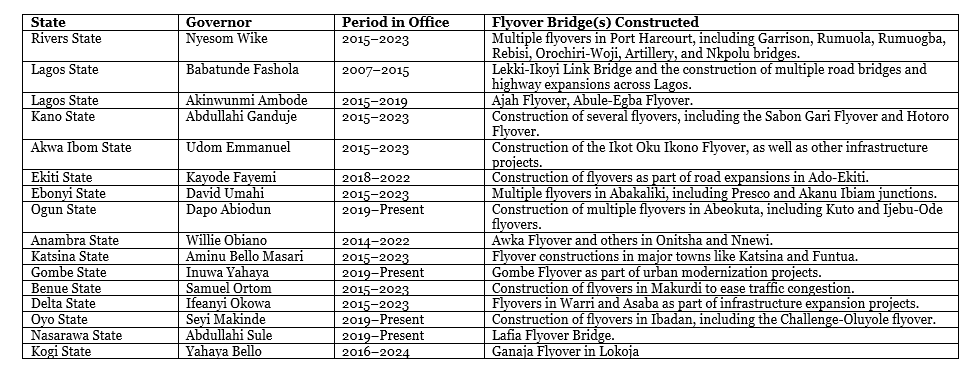
In Rivers State, former Governor Nyesom Wike’s administration became known for its ambitious flyover construction projects. These developments were not just about easing traffic; they were about crafting a legacy of progress that the public could physically see and remember. Critics, however, argue that Wike’s flurry of flyovers was more about political showmanship than genuine infrastructural need. Similar trends are observed across the country where the decision to prioritize flyover construction often aligns with political objectives, particularly during election cycles when politicians seek to garner favour with voters.

flyover
Source: Multiple newspapers; Infoprations Analysis, 2024

This phenomenon is closely linked to the concept of governmentality, which refers to how governments use tools, policies, and projects to assert control and regulate society. Flyovers, while ostensibly meant to improve urban mobility, also serve as manifestations of state power, reinforcing the authority of political leaders and their ability to shape the physical and economic landscape. The high visibility of such projects gives them immense political capital, making them attractive to governments looking to make a quick impact.

Economic Considerations: Funding, Costs, and Mismanagement

While political motivations play a significant role, the economics of flyover bridge construction cannot be ignored. The financial implications of these projects are often staggering, with many flyovers costing billions of naira. For instance, in states like Lagos and Rivers, the cost of building these bridges has sparked widespread debate, with critics questioning whether the funds could be better allocated to other pressing needs such as healthcare, education, and rural infrastructure.

Cost overruns are a recurring issue in flyover projects. In many cases, budgets initially set for construction are exceeded, often by significant margins. These overruns are frequently attributed to poor project planning, inefficiencies in execution, or in some cases, corruption. Contractors may inflate prices, while governments may fail to monitor spending adequately. For example, the high costs of flyovers in Delta and Osun States have led to public scrutiny, with citizens questioning whether these bridges provide value for money, given the other critical infrastructural deficits that persist in these regions.

The problem of budget mismanagement in flyover projects highlights broader issues of governance and resource allocation in Nigeria. From an economic perspective, the opportunity cost of focusing on flyovers at the expense of other essential infrastructure is significant. Many rural areas remain underdeveloped, with poor road networks that contribute to economic stagnation. Critics argue that investing in rural infrastructure could help alleviate urban migration and provide a more balanced approach to development, rather than concentrating resources in urban centres where political gains are more visible.

Urban Planning and Environmental Concerns

Another critical issue tied to flyover construction is the question of urban planning and environmental sustainability. In cities like Lagos and Port Harcourt, flyovers have been constructed as a quick fix for traffic congestion. However, the absence of long-term urban mobility strategies, such as integrated public transportation systems, suggests that these projects are not part of a comprehensive solution to urban challenges. Once the initial congestion is eased, cities often continue to face the same problems due to poor planning and lack of complementary infrastructure.

Environmental considerations are frequently overlooked in the rush to complete these projects. Flyover construction can disrupt existing road networks, displace businesses, and impact residential areas, sometimes with little to no compensation for those affected. This lack of strategic planning not only leads to short-term urban disruption but also raises concerns about the long-term sustainability of these projects. The political economy of flyover construction reveals that short-term political gains often take precedence over long-term urban development goals.

The Public’s Response and the Question of Necessity

Public reactions to flyover construction have been mixed. In some cases, the public supports these projects, especially in areas where traffic congestion is a significant issue. In other cases, citizens have expressed frustration, arguing that the flyovers do not address the most pressing needs of the community. In states like Rivers and Kogi, residents have questioned the rationale behind building multiple flyovers when other infrastructure, such as healthcare, education, and rural development, remains neglected.

This public outcry reflects a broader issue of governance in Nigeria: the lack of participatory decision-making in infrastructural projects. Flyovers are often seen as top-down projects imposed by the government, with little consultation with the communities they are meant to serve. The disconnect between political elites and the populace further fuels the perception that flyovers are more about politics than addressing the genuine needs of the people.

NIBSS to Launch Non-resident BVN to Enable Nigerians In Diaspora Operate Local Bank Accounts

0

The Nigerian Inter-Bank Settlement System (NIBSS) is poised to launch a non-resident Bank Verification Number (BVN) platform by December 2024, a groundbreaking move aimed at enabling Nigerians in the diaspora to operate local bank accounts, run their businesses, and resolve Know Your Customer (KYC) requirements from any part of the world.

This initiative marks a significant step in easing the difficulties non-resident Nigerians face in accessing banking services back home.

This development was announced by the Governor of the Central Bank of Nigeria (CBN), Yemi Cardoso, during a meeting with the Nigerian community in Washington, D.C., on the sidelines of the World Bank and IMF annual meetings. Cardoso highlighted that the initiative is part of broader efforts to facilitate the involvement of Nigerians abroad in the Nigerian economy, particularly by removing the hurdles associated with KYC verification and other banking challenges.

“As far as we are concerned, it is totally unacceptable that you should be out here and be having hassles in operating your accounts or doing your business in your original country,” Cardoso stated. “Starting in December 2024, Nigerians in the diaspora will no longer face the hurdle of traveling long distances for physical biometric verifications to access financial services.”

The new non-resident BVN platform will enable enhanced KYC processes remotely, ensuring more convenient, faster, and cost-effective interactions with the Nigerian banking system. According to the CBN governor, this initiative represents a leap toward greater financial inclusion and easier accessibility for the diaspora, demonstrating the Nigerian financial sector’s commitment to rolling out innovative solutions in collaboration with local banks.

Currently, Nigerians living abroad face several challenges when attempting to register for BVNs. They are required to use third-party services like OIS Services, VFS Global, or Avantech Services, which have a limited presence in select countries. Additionally, these services come with a $45 fee, making the process more expensive and inconvenient, particularly for Nigerians in regions without easy access to these services. It remains unclear whether the new NIBSS platform will carry a similar fee or be more cost-friendly for users.

By offering this service remotely, the NIBSS platform will eliminate the need for physical verification, making it easier for Nigerians abroad to stay connected with the local financial system. This solution is part of efforts by the Nigerian government to increase financial inclusivity for all citizens, regardless of their location.

Boosting Diaspora Remittances

The launch of the non-resident BVN platform also ties into broader efforts by the CBN to integrate Nigerians in the diaspora into the national economy, particularly when it comes to remittance inflows. Remittances from Nigerians living abroad play a crucial role in the country’s foreign exchange reserves and overall economic stability. In 2023, Nigeria received $19.55 billion in international remittances, the highest in Africa, but reports suggest that up to 50% of these remittances still come through unofficial channels.

To address this, the CBN has been working to streamline and formalize remittance channels. In May 2024, the CBN granted preliminary licenses to 14 International Money Transfer Operators (IMTOs), while earlier in the year, 62 IMTOs were approved to provide international money transfer services. These efforts are aimed at encouraging diaspora Nigerians to send money through official channels, improving transparency, and boosting the volume of remittances through legal avenues.

Currently, the CBN has reported that monthly remittance inflows through official channels using IMTOs have risen from $300 million to $600 million. However, the apex bank has set an ambitious target of increasing monthly remittances to $1 billion, a figure they hope to reach with the help of these reforms, including the non-resident BVN platform.

By simplifying the BVN process for Nigerians abroad, the CBN aims to foster stronger engagement between the diaspora and the local economy, which could spur further investment and boost economic activities. Nigerians in the diaspora represent a significant source of investment capital, foreign exchange inflows, and remittances, all vital to the nation’s financial stability.

A Look into Andy Barr’s ‘Vision’ for House Financial Services

0

Congressman Andy Barr has articulated a clear vision for the future of the House Financial Services Committee as he runs to succeed the current Chair, Patrick McHenry. Barr’s perspective is one of unity and forward-thinking, aiming to bridge gaps and foster bipartisan cooperation. His approach suggests a commitment to maintaining America’s financial integrity while adapting to the evolving landscape of global finance.

Barr’s vision includes a strong emphasis on cryptocurrency and its integration into the U.S. financial system. Recognizing the importance of innovation in the financial sector, Barr appears to be positioning himself as a leader who can guide the committee through the complexities of new financial technologies while ensuring that the U.S. remains at the forefront of financial innovation.

One of his key initiatives is the promotion of partnerships between financial institutions and fintech companies to increase access to financial services. This includes leveraging third-party relationships to provide more efficient and inclusive financial services to consumers and businesses.

Barr has also expressed a commitment to supporting community banks and credit unions, emphasizing the importance of these institutions in serving local communities and fostering economic growth. He advocates for a balanced approach to regulation that encourages innovation while ensuring safety, soundness, stability, and consumer protection. Congressman Andy Barr, in his vision for the House Financial Services Committee, has outlined several specific policy initiatives. These include:

Oversight of the Federal Reserve’s approach to price stability, which is a critical aspect of the committee’s mandate to ensure economic stability and growth. Addressing regulators’ proposed changes to capital requirements for banks, which could have significant implications for the banking industry and the broader financial system.

Promoting the establishment of new banks and credit unions, including community development financial institutions (CDFIs) and minority financial institutions, through legislative measures such as the Promoting Access to Capital in Underbanked Communities Act.

Encouraging an economic and regulatory environment that supports the chartering of new financial institutions, which can increase banking options and competition, thereby serving families, small businesses, and local communities better. Focusing on international investment policies, U.S. sanctions policy, and the roles of the Export-Import Bank, International Monetary Fund (IMF), and the World Bank in fostering global economic development.

These policies reflect Barr’s commitment to revamping and revitalizing banking in the 21st century, with a particular emphasis on innovation, consumer protection, and market integrity. As the financial landscape evolves, these initiatives could shape the future of financial services in America.

On a broader scale, Barr’s policy positions reflect a focus on job creation, strengthening small businesses, and promoting economic prosperity. He has voiced concerns over historic inflation and its impact on American families, indicating a need for policies that address these economic challenges.

The Kentucky lawmaker’s bid for the chairmanship comes at a critical time when the financial services industry is grappling with the challenges and opportunities presented by digital currencies and blockchain technology. Barr’s leadership could shape the committee’s approach to regulation and legislation that will impact the future of finance in America and beyond.

His leadership could shape the committee’s stance on critical issues such as stablecoin legislation, market structure bills, and the oversight of the Securities and Exchange Commission. With the retirement of current Chair Patrick McHenry, Barr’s vision presents a roadmap for the committee’s future direction, potentially influencing U.S. capital markets and banking sectors.

His campaign to lead the House Financial Services Committee reflects a broader vision for an America that is prepared for the future of finance, one that balances regulatory oversight with the need for innovation and growth. As the financial landscape continues to evolve, Barr’s ‘Vision’ for the committee could play a pivotal role in shaping the direction of U.S. financial policy in the years to come.

Top 3 Best Altcoins to Buy in October 2024: Ripple (XRP), Tron (TRX), Rexas Finance (RXS)

0

After a rough start, which saw many cryptocurrencies shed their September gains, October flipped green, and the market is preparing for a long bull run. With investors also on the lookout for potential millionaire makers, experts are bullish on these three altcoins: Ripple (XRP), Tron (TRX), and Rexas Finance (RXS). Let’s explore why they are the 3 top altcoins to buy in 2024.

Rexas Finance (RXS): Transforming the Real-World Asset Tokenization Sector

Rexas Finance (RXS) distinguishes itself as a revolutionary participant in the blockchain market by offering a unique platform linking real-world assets (RWA) with the digital world. The rising popularity of the RXS token results from users’ ability to buy, sell, and hold fractional ownership of valuable assets, including gold, real estate, and collectibles. Democratizing access to markets once limited by financial and geographical restrictions makes foreign investments from the comfort of one’s house possible.Since its recent listing on CoinMarketCap, Rexas Finance has attracted more attention and trust from prospective investors. Token performance tracking has become simpler for users due to the enhanced openness brought about by the CoinMarketCap listing, which has also served as project validation. Now in its fourth stage of presale, RXS is trading at $0.060 and has raised over $3.7 million.

Early investors are set to experience substantial gains because the final listing price is anticipated to be $0.20. The Rexas ecosystem offers several user-friendly tools, including the Rexas Token Builder, Launchpad, AI Shield, and GenAI. With these features, users may tokenize assets, raise money for tokenized projects, and protect their investments with security protocols powered by AI. Crypto enthusiasts are also talking about the ongoing $1 million giveaway, in which 20 lucky winners will receive RXS tokens valued at $50,000. With October finally taking shape, Rexas Finance is a must-buy for investors looking to gain exponentially on their investments.

Ripple (XRP): Gearing Up for Regulatory Victory

XRP price development has been badly influenced by the continuous legal wrangle with the US SEC, but the project has also taken the front stage. However, there are indications that the case might be coming to a close soon. The positive outlook for the case’s possible conclusion has contributed to Ripple’s consistent rise in price since September. Market observers anticipate that once regulatory obstacles are removed, XRP, already trading at $0.75, may surpass $1.Aside from the litigation, Ripple has seen notable institutional interests.  Recently, Bitwise and Canary Capital filled for XRP ETFs. Should this move materialize, XRP might see an explosive surge in its price, as witnessed with the BTC rally post-Bitcoin ETF launch earlier this year. With its price still at $0.54, XRP is a good altcoin to buy in October, considering the anticipated huge return in the coming weeks.

Tron (TRX): Potential for a Bull Market Pop

Tron (TRX) has seen its price jump 4% in the past day, currently trading at $0.17. Its recent progress has been driven by the network’s expanding user base. The number of daily active addresses on TRX has increased significantly, even outpacing that of Ethereum. As evidence of its dominance as a top Web3 ecosystem, Tron’s total value locked (TVL) has surpassed $7.4 billion.With the success of Sundog (SUNDOG), Tron’s network has also profited from the growing interest in meme coins. Market observers predict a rise as the broader altcoin market rallies and the current bullish feeling is expected to drive TRX past the $0.20 resistance level. Thanks to its robust fundamentals and expanding ecosystem, Tron is a top among the best altcoins to buy in October 2024.

Conclusion

Rexas Finance (RXS), Ripple (XRP), and Tron (TRX) are leading the way as the top three best altcoins to buy in October 2024, owing to their impressive performances so far. As a leading contender, Rexas Finance stands out for its creative approach to tokenizing real-world assets and continuous presale. Join Rexas Finance today to take advantage of the expanding cryptocurrency industry. Don’t miss this opportunity.


For more information about Rexas Finance (RXS) visit the links below:

Website: https://rexas.com

Win $1 Million Giveaway: https://bit.ly/Rexas1M

Whitepaper: https://rexas.com/rexas-whitepaper.pdf

Twitter/X: https://x.com/rexasfinance

Telegram: https://t.me/rexasfinance