DD
MM
YYYY

PAGES

DD
MM
YYYY

spot_img

PAGES

Home Blog Page 2862

EssayService Homework Planner Review: Your New Study Buddy

1

We all know that feeling: a new semester starts, and suddenly, you’re drowning in a sea of syllabi, due dates, and exams. But fear not! EssayService, a trusted name in academic support, is here to help you stay afloat.

They’re expanding their horizons beyond just essays, offering students a whole toolkit to help them navigate the challenges of school and come out on top.

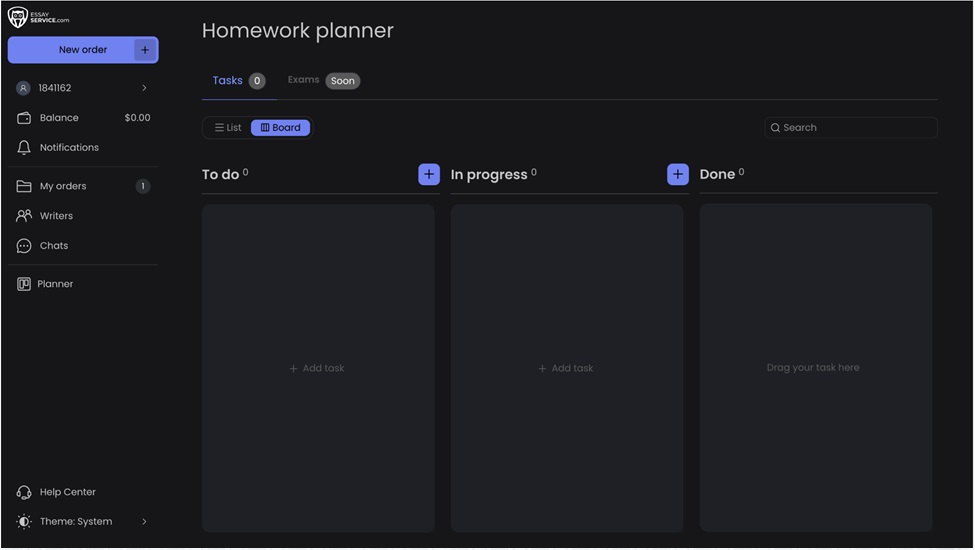
And with the new school year upon us, Essay Service has unveiled its latest innovation: the Homework Planner. This nifty tool promises to be your ultimate organization sidekick.

It’s basically your digital sidekick for staying organized, helping you keep tabs on assignments, due dates, and those all-important exams. This way, you can ditch the stress and focus on what’s truly important: learning and getting those A’s!

So, is the Homework Planner the key to a stress-free semester? Let’s dive into this EssayService review and find out!

We’ll explore its features, its ease of use, and its overall impact on your academic life. Get ready to learn if this tool is truly worth adding to your study arsenal.

Homework Planner: Your Key to a Stress-Free Semester

Let’s face it: juggling multiple classes, assignments, and extracurriculars can feel like a circus act. Keeping track of everything can be a nightmare, leading to missed deadlines, forgotten readings, and a whole lot of stress. That’s where EssayService’s Homework Planner swoops in to save the day.

We put this new tool to the test, and we were seriously impressed. It’s like having a personal assistant for your academic life, keeping everything organized and reminding you when things are due.

The Homework Planner lets you create a personalized calendar where you can input all your assignments, exams, and other important dates. It becomes super easy to visualize your workload at a glance.

But it’s not just a fancy calendar. The Homework Planner also has some clever features to help you stay on top of things. You can set reminders for upcoming deadlines, break down large tasks into smaller steps, and even track your progress as you complete each assignment.

We found that using the Homework Planner reduced our stress levels. It’s reassuring to know that everything is organized in one place, and we no longer have to worry about forgetting important deadlines or scrambling to finish assignments at the last minute.

EssayService’s Homework Planner is a fantastic tool for any student who wants to stay organized, boost their productivity, and achieve academic success.

Whether you’re a chronic procrastinator or a natural planner, this tool can help you take control of your workload and make the most of your time.
From Planning to Problem-Solving: Customer Support

After exploring the impressive Homework Planner, we turned our attention to another crucial aspect of the EssayService experience: their customer support. After all, even with the best tools, questions and issues can arise.

We’re pleased to report that our interactions with EssayService’s support team were overwhelmingly positive. They were consistently helpful, knowledgeable, and eager to assist us with any queries we had. No matter if we used live chat or email, they always got back to us quickly with helpful answers.

However, we did notice a slight delay in response times during peak hours, which is understandable given the high demand for their services. While this wasn’t a major issue for us, it’s worth noting for those who require immediate assistance.

Even though it took a little longer sometimes, the support team was always super helpful and patient. They even offered helpful tips and suggestions beyond our initial inquiries.

We have to admit EssayService’s customer support team is a valuable asset to the platform. While there might be slight delays during peak times, their dedication to assisting customers and resolving issues is commendable.

Quality: Delivering on the Promise of Excellence

Now, let’s get to the heart of the matter: the quality of the work itself. We’re pleased to report that EssayService exceeded our expectations.

The essay we received was well-researched and meticulously written. It was clear that the writer had a deep understanding of the topic and a knack for crafting compelling arguments.

We also ran the essay through plagiarism and AI detection checks, and it came back clean. This commitment to originality and academic integrity is a major plus for any student worried about getting caught using a writing service.

Yet, there were a couple of minor areas where we saw room for improvement. The writing style, while grammatically sound, could have been a bit more polished and engaging. Additionally, incorporating a few more sources could have added further depth and nuance to the arguments.

However, despite these minor suggestions, the essay was still top-notch, demonstrating the expertise and professionalism of EssayService’s writers.

User Experience: Streamlined and Efficient, as Expected

EssayService’s platform is a testament to user-centric design. From the moment you land on their website, you’re greeted with a clean, intuitive layout that makes navigation effortless. Ordering is a piece of cake, with easy-to-follow instructions and helpful hints along the way.

During our evaluation, the platform performed flawlessly, with no technical glitches or downtime. This reliability ensures a smooth and uninterrupted user experience.

Several key features further enhance the impression. The real-time order tracking system keeps you informed about the progress of your essay, while direct communication with your writer fosters collaboration and ensures your expectations are met.

EssayService prioritizes user convenience, providing a streamlined and efficient platform that caters to students’ needs. From placing an order to receiving the final draft, the entire process is designed to be hassle-free and supportive.
Pricing: A Relief for Budget-Conscious People

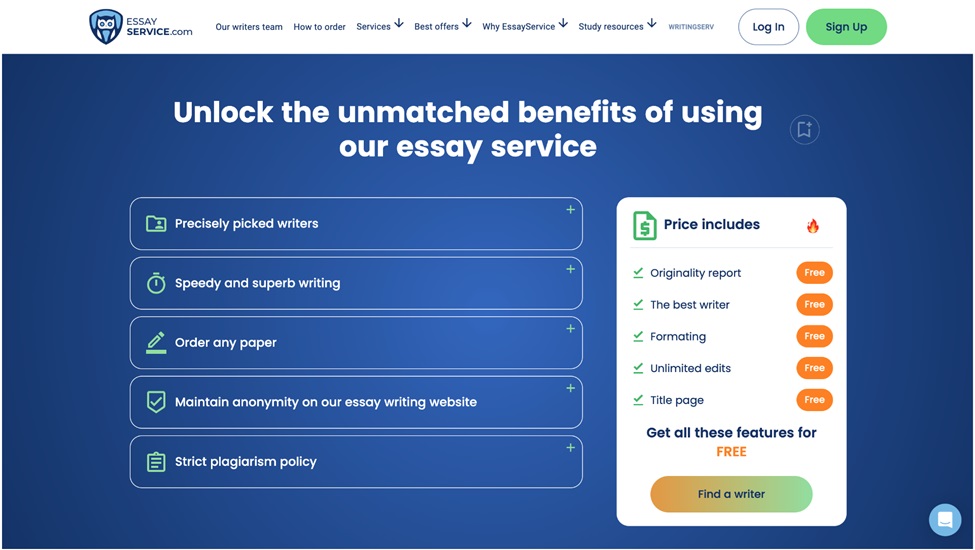
When it comes to pricing, EssayService pleasantly surprised us. For our evaluation, we ordered a 4-page research paper with a 7-day deadline, and we opted for the additional plagiarism and AI detection checks.

The final price (after applying our 15% discount) was a mere $41.99. That’s a steal, especially considering the exceptional quality of the work we received!

We did our research and compared EssayService’s prices to those of other services in the market. We found that their rates are consistently lower than those of many competitors.

This affordability, combined with high-quality work and reliable service, makes EssayService an excellent value for money. You get top-notch help with your schoolwork without having to skip meals or give up your Netflix subscription.
Let’s Wrap It Up

Our exploration of EssayService has left us thoroughly impressed. It’s a reliable and comprehensive platform that caters to students’ needs. All because it provides high-quality academic assistance at affordable prices.

The Homework Planner feature provides a practical and effective solution for managing the chaos of the school year. It’s a valuable tool for any student striving for organization and success.

While there’s always room for minor tweaks, like improving website navigation and ensuring even faster support during peak hours, these drawbacks are overshadowed by the platform’s numerous strengths. From their responsive customer support to their top-notch essay quality and commitment to originality, EssayService consistently delivers.

Start with their Homework Planner and experience the difference it can make in your studies. You won’t be disappointed!

Key Elements of Technical Analysis

0

We cannot ignore analysis while discussing trading and investing. Like a soldier’s armament before entering the war, analysis is a vital process for both traders and investors. An analysis is helpful not just for attacking (profit-seeking) but also for reducing risk, defending against battlefield threats, and even preventing death (margin call).

In trading and investing, we generally distinguish between two forms of analysis: technical analysis and fundamental analysis. But in this article, we’ll concentrate more on technical analysis.

Technical analysis is the process of examining price changes by using historical data, usually represented by charts. These historical price changes are shown in the chart.

Why do charts need to be used?

Price charts are always the main focus of technical analysis. Why is this important? The rationale is that each price movement depicted on a chart sums up the activities of all market participants. The chart gives data that may be evaluated in the future and reflects the actions of buyers and sellers in every price rally and decline.

Three aspects of technical analysis that require our attention

  1. Trend

The trend is the overall direction of price movement over a specific time period, typically seen in a daily timeframe. Trends can be categorized into three types:

  • Uptrend (Bullish): This occurs when the price of a financial instrument increases over a set period. The XAUUSD chart below illustrates an example of a bullish trend:
  • Downtrend (Bearish): A downtrend, or bearish trend, occurs when the price of a financial instrument declines over time. This is illustrated in the GBPUSD chart below:
  • Sideways Trend: In this case, the price of a financial instrument moves within a limited range without a clear direction. This can be seen as follows:
  1. Support and Resistance

Another essential aspect of technical analysis, along with trends, is support and resistance.

  • Support: Support is a lower price level that prevents further declines. It often forms based on historical data and serves as a future support level.
  • Resistance: Resistance, on the other hand, is the opposite of support, acting as a barrier that limits further price increases. Like support, resistance levels are shaped by previous price action, and prices may revisit them in the future.

These levels are important because they highlight key areas where significant market activity occurs, potentially signaling either a trend continuation or a trend reversal.

  1. Indicators

Tracking indicators is an important part of technical analysis, in addition to observing candlestick patterns. Indicators provide an additional tool to help make trading decisions. Popular indicators include trend indicators (such as moving averages and Bollinger Bands), oscillators (such as stochastic and the relative strength index), and volume indicators (such as volume and accumulation/distribution).

By monitoring and understanding these technical factors, investors and traders can gain deeper insights into the market, allowing them to make more informed adjustments to their trading and investment strategies. Technical analysis also confirms an asset’s fundamental outlook, offering extra support to the overall analysis.

Dex Screener vs. DexTools: A Comparative Guide

1

Decentralized finance (DeFi) is a major component of blockchain infrastructure. Given its open and advancing nature, traders and investors need to have a solid understanding of the market to minimize financial risks and properly manage their portfolios.

To achieve this, traders must perform due diligence using a variety of research tools to gain timely market insights. While there are many such tools available, this article will focus on Dex Screener and DexTools, highlighting their features and differences.

What Is Dex Screener, and What Does It Do?

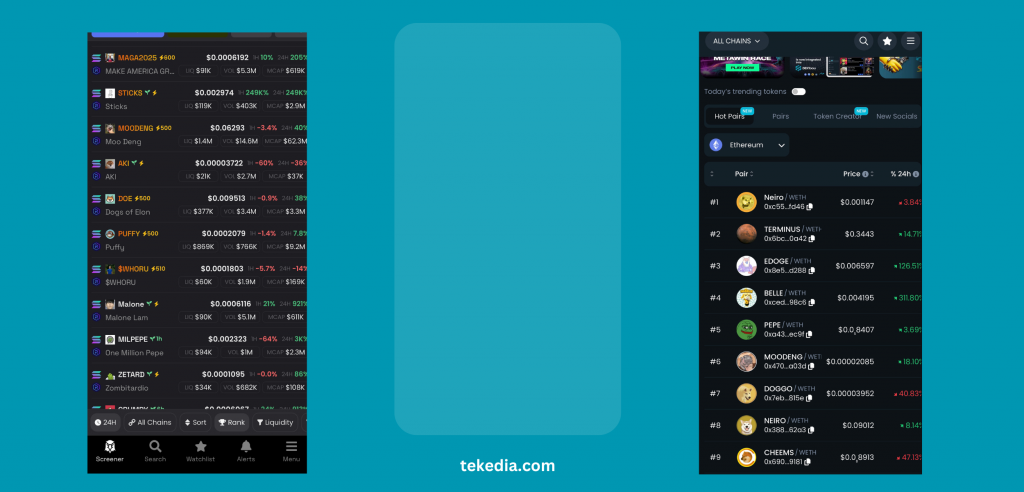
Dex Screener is a DeFi analytics tool that provides real-time data from multiple decentralized exchanges (DEXs). It offers insights into trending tokens and tracks trading volume and liquidity across various token pairs on multiple blockchains. It aggregates token performance data from different decentralized exchanges and blockchain networks.

What are the Top Features of Dex Screener?

Dex Screener provides users with multiple insights to help analyze the DeFi market and ecosystem. Here are some of its features:

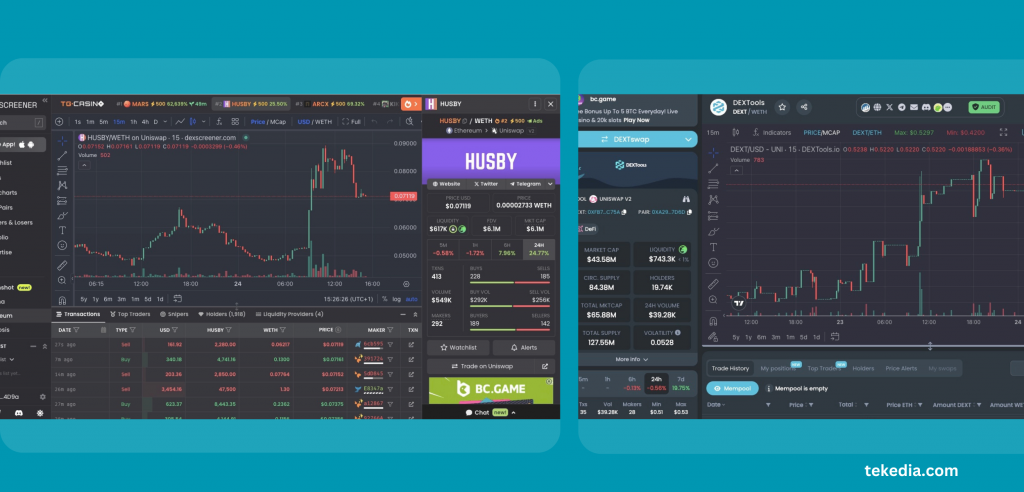
Blockchain Token Pairs: This feature covers multiple blockchains and their token pair performance. It displays real-time token transactions, top traders, holders, asset values, liquidity providers, and the percentage of burned tokens. Additionally, it includes bubble maps that track wallet interconnectedness and a real-time trading chart showing price, liquidity, Fully Diluted Valuation (FDV), market capitalization, transactions, volume, and unique wallets (makers).

Gainers and losers: This feature shows the highest and lowest-performing token pairs across multiple blockchains. It also allows users to view performance over different timeframes, ranging from 5 minutes up to the past 6 hours.

New Pairs: This feature shows new token pairs on the platform. It includes how long they’ve been listed, the buyers and sellers, trading volume, and liquidity.

Portfolio: This lets users track assets or follow someone else’s investment (usually smart money).

Multichart: This feature lets traders check the price performance of many decentralized (DEX) asset pairs across different chains at the same time. Instead of focusing on a single chart, they can view up to 16 charts at once.

Watchlist: Users can add their favorite pairs to the Watchlist and monitor price movement.

Alert: This feature sends real-time updates to traders about their favorite decentralized pairs.

What Is DexTools, and What Does It Do?

DexTools is a decentralized finance tool that gives traders real-time data to help analyze market trends. It offers token pair analysis, transaction history, performance tracking, safety scores, and educational resources to support decentralized trading and on-chain analysis.

Top Features of DexTools

Below are some of the core features of the DexTools platform:

DEX Explorer: This feature lets users search for different pairs, view live charts and transaction history, and see top traders, trading positions, and swaps.

Live New Pairs: This lets users see new token pairs across different blockchains. They can check the token price, time listed, initial liquidity date, token liquidity, pool amount, variation, and remaining pool price.

Safety Score:  This feature lets users check the security strength of tokens, scored from 1 to 99.

Big Swap Explorer: Users can see the latest big swaps on several blockchains. They can view the swap time, quantity, total amount, variation, and wallet address.

Token Creator: This lets users create tradable tokens in minutes. The fee depends on the blockchain they use, such as Ethereum, Binance Chain (BNB), Polygon, Base, Arbitrum, Avalanche, Optimism, or Pulse.

MultiChart: This feature lets users view up to 10 charts of different pairs across blockchains at the same time.

Multiswap: Users can view and make multiple swaps across different chains.

DEXTstats: This lets users check trending pairs across several decentralized exchanges.

Wallet Info: This premium feature enables users to track specific wallet activities.

DX Fun: This feature lets users create tradable meme tokens instantly for less than $2. They can add a ticker symbol, token image, description, and social media links to make their token.

Simulator: Users can test-trade without investing real money.

DexTools Price Alert: This feature lets users set custom price levels for specific tokens. When the token’s price hits the chosen level, users receive a real-time alert, helping them stay on top of market movements without constantly watching the charts.

Dex Screener Vs. DexTools

Dex Screener vs. DexTools

Both Dex Screener and DexTools give real-time insights to help users do due diligence before investing. However, their features are different. Below is a detailed comparison of the two platforms:

User Interface

Dex Screener and DexTools both have easy-to-use interfaces with strong design, making DeFi research engaging for users.

Both platforms focus on simplicity, accessibility, and a good user experience. Dex Screener has a more streamlined interface, while DexTools offers more features.

Mobile Accessibility

Dex Screener vs. DexTools

Both Dex Screener and DexTools are available on Android and iOS. The apps are user-friendly and equally accessible.

Charting Tools

Dex Screener and DexTools offer complete charting tools for traders to help analyze market trends. Both platforms show different timeframes, real-time charts, candlesticks, indicators, and many drawing tools powered by TradingView.

Data Analytic Tools

Dex Screener vs. DexTools

Both Dex Screener and DexTools provide real-time data across multiple blockchains. They help users track historical data, liquidity, token pairs, market depth, and token metrics. In terms of data analysis, both platforms are equally thorough and useful.

Pricing

DexTools offers many free trading and research features like an aggregator, price alerts, multichart, pair explorer, multiswap, and more. It also has extra features like a private group, position tracker, and wallet info that come with a monthly fee of 1,000 DEXT for the standard plan and 100,000 DEXT for the premium plan.

Although Dex Screener offers similar features, like multichart, live pairs, price alerts, pair explorer, and a wallet tracker for free, it doesn’t offer as many advanced features as DexTools.

For users seeking a completely free DeFi research and trading tool, Dex Screener excels in this area.

Community Features

Dex Screener and DexTools both build a sense of community on their platforms. Dex Screener has a live chat where users can react to price movements and talk to each other. DexTools offers a similar feature only on DX Fun, where users can respond to live prices of meme tokens.

Additionally, DexTools has a DEXT Force Private Group for its holders, which supports community engagement. It also offers the DEXT Community feature, where holders of 1,000 DEXT tokens or more can vote on project trust scores; however, this requires a paid subscription.

For users looking for a free option, Dex Screener is better at promoting community interaction without any cost.

Wallet Integration and dApp Compatibility

Dex Screener vs. DexTools

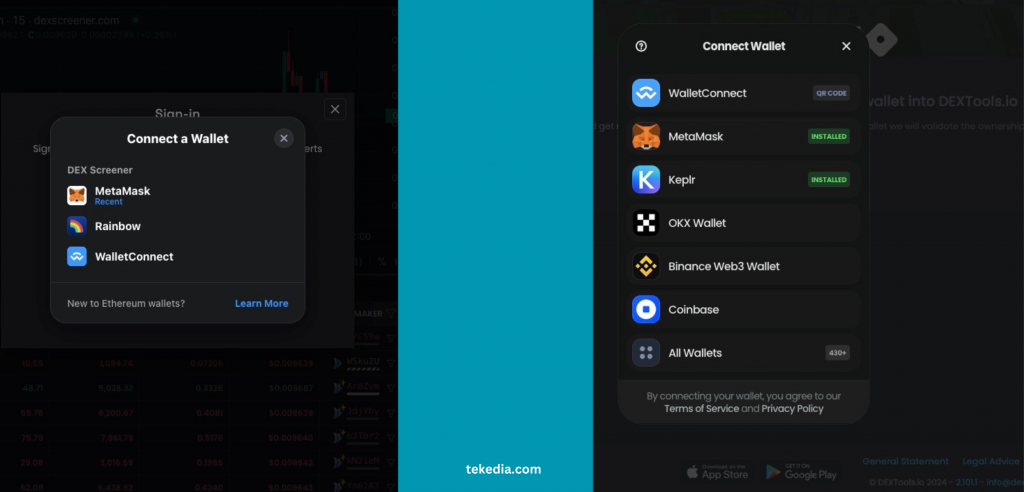
Dex Screener allows users to connect with three wallets: MetaMask, Rainbow Wallet, and WalletConnect, enabling access to various decentralized applications using a QR code.

DexTools, on the other hand, lets users connect through MetaMask, Kepl Wallet, Coinbase Wallet, WalletConnect, or over 430 wallet varieties.

While both Dex Screener and DexTools work with many wallets and dApps, DexTools stands out by supporting more wallets.

Portfolio Tracking

While Dex Screener lets users track various wallets for free, DexTools allows tracking up to 500 wallets, but only with a paid plan. So, Dex Screener is better for free wallet tracking. However, if you want to track smart money with more detailed portfolio info, DexTools might be the better choice.

Safety and Security

Both Dex Screener and DexTools let users sign a signature request before logging in. While neither platform guarantees 100% accuracy in their data, Dex Screener uses Bubblemaps to show wallet connections, while DexTools uses DEXTscore to rate project reliability.

Demo Trading

Dex Screener is solely a live-trading platform. DexTools, on the other hand, lets users test-trade using its Simulator feature before going live, which gives it an advantage in this area.

Educational Support

While both platforms address product concerns by providing relevant answers through their Frequently Asked Questions (FAQs), DexTools improves the learning experience with DEXT Academy, which offers educational resources on using DexTools and navigating the DeFi ecosystem. Therefore, DexTools is ahead in this aspect.

API Access

Both Dex Screener and DexTools let developers access data through APIs. However, Dex Screener offers free API access with Google Sheets integration, while DexTools requires a subscription for API keys. This makes Dex Screener the better option.

Token Listing

Neither Dex Screener nor DexTools allows token listings directly. Instead, they gather data from several blockchains when a token is added to a liquidity pool with at least one trade.

However, DexTools lets users create tokens and add liquidity, making them tradable across various dApps on the token’s blockchain. So, DexTools may be better for those who want to deploy and list their tokens on multiple dApps.

Multi-Language Support

Dex Screener is available in English, while DexTools supports nine languages: English, Chinese, Spanish, Russian, Arabic, French, Hindi, Turkish, and Portuguese. This gives DexTools an advantage in language support.

Bottom Line

Dex Screener and DexTools are both important tools for DeFi data tracking across different dApps. They have similar features but also unique strengths.

Depending on your needs and budget, either platform is good for token tracking and research.

Disclaimer!: This article is for educational purposes only and should not, in any manner, be interpreted as a piece of financial advice.

X (Twitter) Bleeds Value As The Villages of Advertisers Cook for It

0

It is becoming a very expensive game for Elon Musk as Twitter (yes, X) continues to bleed value: “Fidelity Investments, a major asset management firm, that helped Musk acquire X, has significantly reduced the value of its stake, cutting the platform’s valuation to just $9.4 billion, a steep drop from Elon Musk’s initial $44 billion purchase price.”

Musk is a brilliant businessman but he needs to understand that in any business which runs on aggregation, there are catalysts which must play a role to keep the money-equilibrium in phase. He wants to offer a place for freedom of speech. That is noble but the advertisers might have voted otherwise.

One of the most difficult things in business is to be popular and not being valued. Yes, you can grow your user base but no one thinks you are good enough to ship any funds to you. Simply, it comes down to who are those users?

The only time I received a violation notice on Linkedin was the day the queen of the English people died. I had argued that the world must not forget that under her leadership, Nigeria caused super-genocide where Igbo sons and daughters perished, not just in Nigeria, but also in Britain. Of course, there was no UN anywhere to feed people as is done in Gaza right now.

My mother’s brother, Augustine, a brilliant engineer whose village contributed money to train, was among many Igbo sons who mysteriously died in Britain during the war. I added that as a way of giving the full picture of the queen and her records. Many Nigerians were offended because I was taking “Nigeria backward” (they were more offended by their feelings and not to the pain of my family). But it all ended well as LinkedIn later sent a note that the “violation notice” was an error.

Imagine if those Nigerians  are advertisers with $billions to spend. That is what Elon Musk’s X is going through. And Musk has no chance because in the Igbo Nation, if the village cooks for you, you are done; the village of advertisers are cooking for X, and unless it dances to their tune, it is a lost mission.

Fidelity Slashes X’s Valuation by 78.7%, Now Worth $9.4 Billion

Fidelity Slashes X’s Valuation by 78.7%, Now Worth $9.4 Billion

0

Fidelity Investments, a major asset management firm, that helped Musk acquire X, has significantly reduced the value of its stake, cutting the platform’s valuation to just $9.4 billion, a steep drop from Elon Musk’s initial $44 billion purchase price.

This represents a sharp 78.7% reduction in value, reflecting growing concerns about X’s uncertain future and the challenges it faces under Musk’s leadership.

According to Fidelity’s Blue Chip Growth Fund, the firm’s investment in X is now worth $4.18 million as of August, down from $5.5 million in July. Fidelity initially invested $19.66 million to support Musk’s acquisition of the platform, but this latest valuation marks a significant decline from the company’s previous stake.

This marks the latest in a series of downward adjustments by Fidelity over the past year. The firm first cut X’s valuation by 65% in 2023. Fast-forward to January 2024, the global investment firm Fidelity marked down its investment in Musk-run X Holdings (the parent company of X) by a whopping 71.5 percent from the original value.

The continued markdown signals low investor confidence as X struggles to regain momentum amidst rising debt and operational challenges. Despite these significant reductions, neither Musk nor representatives from X or Fidelity have commented on the updated valuation. X’s current valuation of $9.4 billion places it at less than a quarter of what Musk paid for the company. With Musk having secured a $13 billion loan to complete the acquisition, creditors are now facing difficulties recovering even 60% of the loan’s value, adding further pressure on the platform’s financial outlook.

As Fidelity scales back its valuation of X, the platform continues to face hurdles, leaving many questioning its long-term viability. Recall that the platform in September faced a $1.9M fine to end the ban in Brazil. X has been banned in Brazil since late August after a judge ruled that the social media platform did not comply with orders to restrict hate speech and naming a local legal representative.

In response to the platform’s challenge in Brazil, Musk had vowed to defy the court’s orders to take down certain accounts in the country. He called the court’s actions “censorship”, and railed online against de Mores, describing the judge as a “criminal” and encouraging the U.S. to end foreign aid to Brazil. In mid-August, Musk closed down X offices in Brazil. That left his company without a legal representative in the country, a federal requirement for all tech platforms to do business there.

However, despite all these, Musk remains focused on raising capital for his other ventures, including $6 billion for his AI project, xAI, while the future of X remains uncertain.