DD
MM
YYYY

PAGES

DD
MM
YYYY

spot_img

PAGES

Home Blog Page 2983

Nigeria Has Spent N9.3tn on Petrol Subsidy in 19 Months Despite Government Denials

0

In a startling revelation, recent data has shown that Nigeria’s government has spent a staggering N9.31 trillion on petrol subsidies in just 19 months, covering the final five months of former President Muhammadu Buhari’s administration and the first seven months under President Bola Tinubu.

This enormous expenditure, which surpasses the N8.15trn spent on subsidy in 16 years, has occurred despite repeated official claims that the petrol subsidy was abolished, exposing the heavy financial burden it continues to place on the nation’s economy.

When President Tinubu took office on May 29, 2023, he declared the end of the petrol subsidy in his inaugural speech, marking what was supposed to be a turning point in Nigeria’s economic policy. However, despite this public commitment, the government has continued to spend massively on what it now refers to as “shortfalls” rather than subsidies. NNPCL said the government now requires it to sell PMS at half the landing cost, with the difference being reconciled between NNPCL and the federation.

This rebranding effort was aimed at maintaining the narrative that the subsidy had been removed, but the financial implications tell a different story.

According to data compiled by Agora Policy and supported by sources such as FAAC communiqués, NEITI reports, and the NNPC Limited’s 2023 Annual Financial Statements (AFS), Nigeria spent N5.10 trillion on petrol subsidies in 2023 and an additional N4.21 trillion in the first seven months of 2024. This spending, far from decreasing, has escalated significantly compared to previous years, largely due to economic factors such as the devaluation of the naira.

Recently, Tinubu reportedly asked the NNPC to use the 2023 final dividends owed to the federation to pay for petrol subsidies. Additionally, the president agreed to suspend the 2024 interim dividend payments to the federation, allowing NNPC to bolster its cash flow amidst the mounting financial pressure.

This decision is part of a broader effort by the government to manage the subsidy payments discreetly, even as public discourse continues to focus on the supposed end of the subsidy regime. The NNPC has forecasted that the cumulative petrol subsidy bill from August 2023 to December 2024 will reach N6.884 trillion, highlighting the ongoing financial challenges posed by these “shortfalls.”

Impact of Naira Devaluation

The government’s narrative is further complicated by the significant devaluation of the naira following the liberalization of the foreign exchange market in 2023. Since this policy shift, the naira has lost over 60% of its value, with the exchange rate soaring from N740 per dollar in June 2023 to N1,600 per dollar recently. This depreciation has had a profound impact on the cost of petrol imports, leading to a sharp increase in the subsidy bill.

Analysts have noted that although Tinubu’s initial announcement of the subsidy removal in May 2023 saved the government N400 billion by June, the benefits were quickly eroded by the adverse effects of the naira’s devaluation.

Analysis from Agora Policy shows that Nigeria’s subsidy as a percentage of GDP rose to 2.2% in 2023, the highest level since 2011, despite the government’s claims of subsidy removal. This increase underscores the disconnect between the official narrative and the economic realities that continue to place a heavy burden on Nigeria’s finances.

The Lingering Petrol Subsidy Story

Nigeria’s struggles with petrol subsidies are not new. From 2006 to 2021, the country spent N8.15 trillion on subsidies. When including the period up to mid-2024, total expenditure balloons to N20.37 trillion. The year 2022 alone saw a subsidy bill of N2.911 trillion under Buhari’s administration, demonstrating the persistent financial strain these subsidies have placed on the country.

In August 2023, the NNPC’s fuel importation costs shifted from a surplus to a negative balance, resulting in a subsidy bill of N52.73 billion. The situation worsened over the following months, with the subsidy bill peaking at N833.68 billion in April 2024. In 2023, the NNPC raised alarms, stating that the subsidy payments were severely impacting its cash flow and threatening its viability as a “going concern.”

The NNPC also expressed concerns about its ability to sustain petrol imports, attributing its difficulties to “forex pressure.” Although the subsidy bill slightly decreased to N537.66 billion in December, it surged again to N693.67 billion in January 2024.

The ongoing payments, despite being labeled as “shortfalls,” have exposed the government’s difficulty in transitioning away from the subsidy regime. The economic strain has been compounded by the naira’s devaluation, leading to a situation where the supposed savings from ending the subsidy have been more than offset by rising costs.
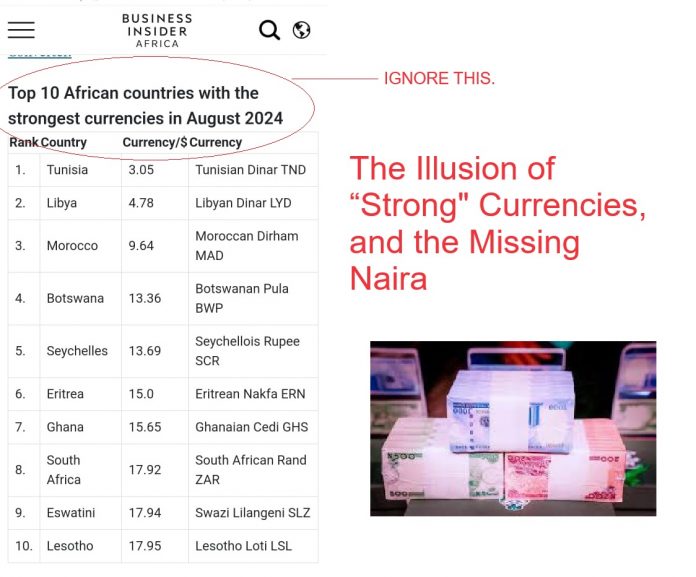

The Illusion of “Strong” Currencies, and the Missing Naira

1

You might have seen the Business Insider article where it ranked the “strongest” currencies in Africa, and our Naira was missing.  Let me help here because BI was totally wrong.

In 2007, when Ghana pegged $1 = 1Cedi (days before that translation, it was $1 = 10,000 old Cedis), Naira was trading around $1= N125. Today, both are about $1 = 15Cedi and $1 = N1600 which means Naira is still ahead.

Nigeria can decide to cut-out two digits in the exchange value with USD (you need to spend money on that as every contract in Nigeria will be off by two digits). Seriously, the strengths of currencies are not defined by pure exchange rate values. This BI article is fundamentally defective and should be ignored. That is not how to rank currencies. 

Note: I USD = 144 Japanese Yen. Does it mean those currencies are “stronger” than Yen? Also, 1USD = 1,325 South Korean won. Does it also mean that Ghana’s Cedi is stronger than South Korea’s Won?

Here is the deal: Central banks work to stabilize national currencies by managing inflation (and some others like the US Federal Reserve add the additional role of boosting employment/economic output via interest rate management). The absolute number is marginal provided that number is stable. So, it is the STABILITY (yes, volatility) that matters. 

If Naira is N3,000 and stays within a range of N2990 – N3010 over 6 months, you are better off there than Naira which is oscillating around N1000 to N1600 over the same period.

But if you have to measure by “strong”, consider purchasing power parity. Purchasing power parity (PPP) is a currency conversion rate that compares the purchasing power of different currencies by adjusting for price level differences between countries. It’s calculated by dividing the price of a basket of goods in one location by the price of the same basket in another location. The basket of goods includes those that are part of final expenditures, such as household and government consumption, fixed capital formation, and net exports. PPP is measured in national currency per US dollar.

The Chinese Continue to Collect Over Failed Ogun State Deal – Confiscates Nigerian Jet in Canada

1

The Chinese continue to collect: “The escalating legal confrontation between Nigeria and Zhongshan Fucheng Industrial Investment Ltd, a Chinese firm, has turned a new leaf, as Zhongshan confiscates another luxury jet owned by Nigeria in Canada. This move is part of a broader campaign by Zhongshan to recover assets as compensation for an unresolved arbitration award.”

This paralysis is coming from Ogun State but nobody knows Ogun or any state outside Nigeria. If the Nigerian government signed a sovereign guarantee on the transactions, Nigeria should step forward, and take over all elements of this arbitration from Ogun State.

Simply, no one cares about what Ogun State is saying now. What matters now is how Nigeria will get itself out of this maze. If you look carefully, it was not only the Chinese company that was affected (yes, Nigerian companies could have been harmed also). However, the difference here is that it was only the Chinese firm which might have received a sovereign guarantee from Nigeria.

It is a lesson for Nigerian leaders: you do not just abandon projects recklessly. Sure, I am not passing any judgment on this particular case; I am simply saying we need to do better. In Imo State a few years ago, a new governor came and froze a real estate project started by his predecessor, with no feeling that ordinary citizens took loans to invest in that project. In Kano, a governor bulldozed a fully developed project. They did those things and got away, but here, we are learning how it could look when the victims are not Nigerians and Nigerian companies.

Chinese Firm, Zhongshan Fucheng, Seizes Another Nigeria’s Jet in Canada

Crypto Fundings Account for nearly half of U.S. Election Donations

0

In the grand theater of U.S. Elections, where democracy dances with dollars, a new player has entered the stage with a bang – or should we say, a Bitcoin? Yes, folks, crypto companies are now the nouveau riche of political donations, accounting for nearly half of the corporate contributions. It’s a financial fiesta, and everyone’s invited.

Let’s set the scene: It’s 2024, and the U.S. is buzzing with election fever slated for November. The usual suspects – big oil, pharma, and tech giants – are there, but wait, who’s that throwing around money like it’s going out of style? Ah, the crypto companies, with their digital wallets bursting at the seams, have decided that politics is the next frontier to conquer.

Coinbase and Ripple, not content with just disrupting the financial world, are now splashing cash in the political pond. They’ve contributed a whopping $119 million to the election cause. That’s right, million with an ‘M’. They’re backing candidates who can say ‘blockchain’ three times fast and have ‘HODL’ tattooed on their hearts.

But what does this mean for the average voter? Well, if you thought deciphering cryptocurrency was hard, try unraveling the web of political donations. It’s like trying to understand the plot of a Christopher Nolan movie after missing the first half-hour. You know it’s important, but you’re not quite sure why everyone’s running around so frantically.

The Fairshake PAC, a major recipient of these digital dollars, has seen more money than a Bitcoin miner during a bull run. With $107.9 million from crypto, they’re shaping election outcomes like a potter shapes clay – if the potter was wearing a VR headset and trading NFTs on the side.

Now, some might say that this influx of crypto cash is a concern for democracy. But let’s be real – in the land of the free, where freedom includes the right to spend your money as you, please, who are we to judge? After all, isn’t the American Dream all about making it big and then using that bigness to influence… well, everything?

With crypto companies pouring millions into political campaigns, we’re seeing a shift in the power dynamics of election financing. Imagine a world where campaign rallies are replaced with virtual reality meetups and debates are settled with a competitive round of “Who Can Explain Blockchain Better?”

Then there’s the regulatory tango. Politicians who once couldn’t tell a Bitcoin from a Beanie Baby are now singing praises of the blockchain, hoping to secure a slice of that sweet, sweet crypto pie. It’s like watching your grandpa suddenly become a TikTok sensation – unexpected but oddly captivating.

And let’s not forget the voters. With the crypto industry’s influence, we might just see campaign promises like “A Dogecoin in every digital wallet”. The political landscape is changing, and it’s got more ups and downs than the price of Bitcoin on a rollercoaster ride.

So, as we gear up for the 2024 elections, let’s raise our glasses (or our mining rigs) to the crypto companies. They’ve gone from being the outsiders to potentially deciding who gets to sit in the Oval Office. And who knows? Maybe the next campaign slogan we’ll hear will be “Make America Mine Again!”

Remember, politics, just like in crypto, volatility is the only constant. So, strap in, keep your private keys private, and enjoy the ride. It’s going to be a wild one.

Nigerian Government to Kick Off 90,000km Fiber-optic Cable Project Across the Country

0

The Nigerian Federal Government is embarking on a transformative digital infrastructure project aimed at deploying 90,000 kilometers of fiber-optic cable across the country. This ambitious initiative, set to begin within the next six months, is designed to significantly enhance Nigeria’s national connectivity backbone by increasing the current network from 35,000 kilometers to a robust 125,000 kilometers.

The Minister of Communications, Innovation, and Digital Economy, Dr. Bosun Tijani, announced the Federal Government’s plan, highlighting the progress made under his leadership over the past year.

The deployment of the fiber-optic network is expected to start between now and February 2025.

Through the project, the government aims to improve internet connectivity by expanding the country’s digital infrastructure, ensuring more Nigerians have access to reliable and affordable internet services, and ultimately stimulating economic growth.

However, this expansion represents more than a move to improve telecom services. Many believe it represents a strategic move to make the Nigerian market more competitive especially as international tech giants like SpaceX’s Starlink expand their presence in the country.

The global tech company SpaceX, through its satellite internet service, Starlink, is rapidly expanding its footprint in Nigeria by establishing ground stations across the country. Starlink’s entry into the Nigerian market has introduced a new level of competition, particularly for local internet service providers (ISPs), who now face the challenge of competing with Starlink’s high-speed, low-latency internet offerings.

Funding and Partnership Model

To finance this large-scale project, the Nigerian government is working with international funding partners, including the World Bank. Dr. Tijani revealed that the Federal Executive Council (FEC) has approved a Special Purpose Vehicle (SPV) to manage the project’s delivery. This SPV, modeled after successful Public-Private Partnerships (PPPs) like the Nigeria Inter-Bank Settlement System (NIBSS) and Nigeria LNG Limited (NLNG), is expected to help in securing the necessary funds and ensuring the effective deployment of the fiber-optic network.

“The Federal Executive Council (FEC) FEC has approved the SPV that will deliver on this project, and our development funding partners are currently finalizing the SPV structure to ensure the aggregation of funding required for the effective deployment of the fiber-optic network.

“Our target is for this deployment to start within the next six months,” Dr. Tijani stated, noting that the project is critical for creating a more vibrant digital ecosystem.

“By connecting more communities across the country, we will ensure that many more of our citizens can connect to the benefits of the digital economy,” he added.

Impact on the Nigerian Internet Market

The deployment of the fiber-optic network is particularly necessary for the survival of local ISPs, which have served as Nigeria’s economy’s backbone, especially in the face of increasing pressure from Starlink’s aggressive expansion.

Starlink’s satellite internet service, known for its high speed and global reach, has already started making inroads into underserved and remote areas of Nigeria. While Starlink’s presence is a boon for consumers, offering them more choices and better service, it presents a formidable challenge for local ISPs who rely on ground-based infrastructure.

Local ISPs need large-scale fiber-optic infrastructure to remain competitive in this new landscape. Without such infrastructure, they may struggle to offer the same level of service as Starlink, potentially leading to a loss of market share. Thus, many believe that the government’s fiber-optic deployment plan, therefore, is not just about improving national connectivity but also about empowering local ISPs to compete effectively against global giants.

Economic and Social Benefits

The project is also expected to have far-reaching economic and social benefits. The government aims to raise internet penetration to over 70% and reduce the cost of internet access by more than 60% by increasing the country’s fiber-optic coverage. This would bring more than half of the 33 million Nigerians currently without internet access into the digital economy, fostering greater inclusion and participation.

Moreover, the project is projected to contribute up to 1.5% growth in GDP per capita, potentially raising Nigeria’s GDP from $472.6 billion in 2022 to approximately $502 billion within the next four years. By connecting more communities, especially in rural and underserved areas, the project will unlock new economic opportunities, drive innovation, and improve the quality of life for millions of Nigerians.

The Challenge of Right of Way

Despite the potential benefits, the project faces significant challenges, particularly concerning the issue of Right of Way (RoW). RoW regulations, which differ across Nigeria’s 36 states, have historically slowed down infrastructure development due to high costs and bureaucratic delays imposed by state governments.

Telecom industry experts have said that for the fiber-optic deployment to succeed, the Federal Government will need to secure the cooperation of state governments and streamline RoW processes. They warned that without addressing these challenges, the project could face significant delays, undermining its potential impact.