DD
MM
YYYY

PAGES

DD
MM
YYYY

spot_img

PAGES

Home Blog Page 3004

Dormant $1 Million Wallet Stirs Up Excitement After Buying IntelMarkets (INTL) – Why Are Experts Favoring It Above Ethereum and Dogecoin?

0

Sentiment might be largely cautious but a full-blown bull run is imminent. With investors strategizing ahead of the up-only bull phase, a dormant $1 million wallet stirred excitement after stockpiling IntelMarkets (INTL), an AI crypto.

This altcoin, hailed as the next crypto unicorn given its bullish narrative and impending transformation of the crypto scene, is a new DeFi project to watch. Capturing the attention of industry experts, it has been favored ahead of Ethereum (ETH) and Dogecoin (DOGE).

IntelMarkets (INTL): A New Crypto Contender to Bet on

The viral AI crypto IntelMarkets (INTL) is a new favorite among experts and whales due to its bullish narrative and real-world applications. Its AI-powered trading platform is set to reshape the $36 billion global crypto trading market, aiming to challenge the dominance of established players.

By taking a different approach to trading, INTL will set itself apart from conventional exchange protocols. Its self-learning trading robots will give users access to top-notch trading strategies and handle high data volumes with lightning speed from different trading sources. Further, the Intelli-M trading systems will be able to perform rigorous technical calculations from multiple markets in seconds, allowing traders to maximize opportunities.

Given the above, there has been rising interest in the ongoing presale—over $1 million has been raised in early funding. In the third stage of the ICO, a token costs $0.027 but will jump to $0.036 in the coming days. Time to stack up? Meanwhile, experts project a 55x rally after its launch, potentially outclassing Ethereum (ETH) and Dogecoin (DOGE) in gains.

Ethereum (ETH): Tipped for a Jump Above $3,000 in the Coming Days

Ethereum (ETH), the next after Bitcoin (BTC) in market size, is an important player in the crypto landscape. It introduced smart contracts into the blockchain, facilitating the creation of cutting-edge decentralized applications (dApps).

The Ethereum blockchain is the most adopted and its ecosystem is the most vibrant. By integrating Layer-2s and addressing scalability challenges like high transaction costs, ETH is on track for further gains. While it had a slow start to the final quarter, a comeback is close.

Amid a choppy market, the Ethereum price recorded a modest 1.5% gain in the past 7 days, exchanging hands around $2,400. However, top analysts believe it is on track for a break above $3,000 in the coming days, placing it on the list of altcoins to watch out for.

Dogecoin (DOGE): $1 at the Peak of This Bull Run?

Dogecoin (DOGE) is the first fun-themed digital asset and a top-10 cryptocurrency. The dog-themed altcoin has become more than just a meme; it is a good store of value. Equally important is its vibrant community, largely unrivaled in the crypto space.

With memecoins set to be at the forefront of this bull run—as they did during the 2021 run—Dogecoin (DOGE) might lead the charge. However, considering its limited upside potential due to its large market size, DOGE is being overlooked by investors and experts.

However, it is a good crypto to buy for modest gains. The Dogecoin price increased by 3% in the past 7 days, trading above $0.1. Tipped to hit $1 at the peak of this bull run, it is one of the best cryptos to invest in.

Conclusion

Rising whale interest in IntelMarkets (INTL) can be linked to its AI-DeFi narrative and significant upside potential. Hence, it is a compelling alternative to Ethereum (ETH) and Dogecoin (DOGE) and explains the rising interest. Further, its low entry makes it budget-friendly—a good shot at substantial gains without breaking the bank.

Buy Presale

Website

Telegram

Spotlight on 4 Leading Altcoins: Evaluating Cosmos, Solana, 99Bitcoins, and BlockDAG’s Prospects

0

Ever feel like you missed out on Bitcoin’s big spike while others cashed in? The crypto world is fast-moving, and chances to make more money can disappear quickly. As Bitcoin’s rise slows down, many are hunting for the next big opportunity.

Altcoins have become popular for those looking for quick profits without the long wait. These promising cryptocurrencies might offer huge gains like those from Bitcoin’s early days, but faster. Let’s check out the best altcoin to buy now that might deliver up to a 30,000x return.

1.  BlockDAG: Scaling New Heights in Blockchain Technology

BlockDAG uses a special Directed Acyclic Graph (DAG) setup along with a Proof-of-Work (PoW) consensus method, putting it at the forefront of blockchain technology. This setup ensures the network can expand smoothly as more users join, keeping it fast and secure. Its design supports rapid, affordable transactions, making BlockDAG a leading choice for a foundational blockchain project.

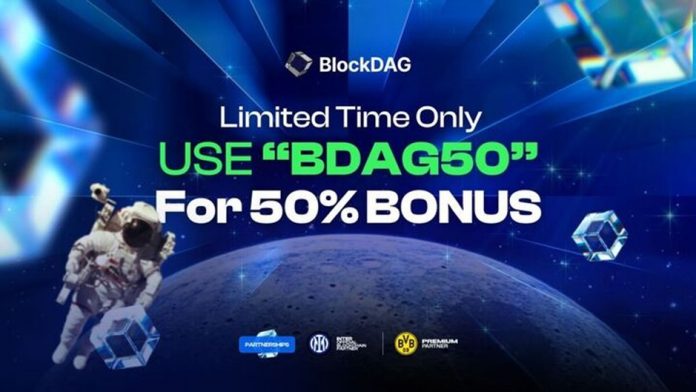
BlockDAG’s initial sale has been hugely successful, bringing in $92 million by selling more than 14 billion BDAG coins, now in its 24th round. Additionally, its current 50% limited bonus offer on BDAG coin purchases with the code ‘BDAG50’ has sparked excitement among traders, leading to quick sales.

With a current price of just $0.0206, BlockDAG offers a great chance to get involved at a low cost. As more traders join, experts believe the price of BDAG coins could hit $30 by 2030, potentially giving early participants 30,000x returns.

2.  Cosmos (ATOM): Connecting Blockchains Smoothly

Cosmos (ATOM) tackles the problem of blockchains not working well together by linking different networks for easy cooperation. Its design lets various blockchains run efficiently while keeping their unique traits. Owners of ATOM can get involved in staking, earning yearly profits of 9% to 10%, which is quite appealing for those looking for a steady income stream.

Beyond just staking, Cosmos facilitates decentralized finance (DeFi) activities, giving users a range of ways to earn money. Its well-connected ecosystem supports better growth and user-friendly apps, pulling in developers and money-makers alike.

3.  Solana (SOL): Speeding Ahead in DeFi and NFT Markets

Solana (SOL) is celebrated for its rapid processing, managing over 65,000 transactions each second with its Proof of History (PoH) mechanism. This speed makes Solana a great choice for decentralized apps (dApps), particularly in the DeFi and NFT realms where quick transactions are vital. The network’s high efficiency means lower transaction fees, enhancing its attractiveness.

Solana’s growing network, with new partnerships and projects, boosts its standing in the market. SOL plays a key role in the network by being used for transaction fees, staking, and governance.

4.  99Bitcoins (99BTC): Where Learning Meets Earning

99Bitcoins (99BTC) introduces a platform where users can learn and earn simultaneously, offering a novel way for users to gain knowledge while receiving rewards. The platform has introduced its 99Bitcoins, which opens doors to special training sessions, VIP groups, trading tips, and staking rewards. With its presale already attracting nearly $400,000, it’s turning heads.

Users can buy these using ETH, USDT, or BNB, and even with standard methods like credit or debit cards. The setup increases user participation in 99Bitcoins’ expanding network, enabling participants to earn as they learn.

Ending Debate for Best Altcoins

While Cosmos (ATOM), Solana (SOL), and 99Bitcoins make strong points with their cutting-edge technology and market potential, BlockDAG is the top pick among the four best altcoins to buy now.

Its successful initial sale, scalable blockchain architecture, and the possibility of a 30,000x return on investment set it apart from the rest. For those aiming for big returns and new blockchain technologies, BlockDAG lays out a clear path to tap into the next big surge in crypto.

BlockDAG’s 50% Bonus Offer is Good For 4 More Days!  XRP Continues Legal Battle & Solana Tries to Sustain Upward Momentum

0

Volatility is the name of the game when it comes to crypto – a reality most investors embrace as it might be a rocky road but it yields the best returns. XRP & its holders are waiting for the outcome of the SEC’s appeal while Solana tries to maintain upward momentum despite market volatility.

But BlockDAG stands to the positive side of that volatility seeing $10M in just 3 days time. WIth 4 days left for traders to cash in on their 50% bonus offer – it is expected the BLockDAG will continue to see this increase in their presale.

XRP News: Settlement Speculation & SEC Appeal

XRP news has been littered with speculation about a potential settlement in the ongoing SEC vs. Ripple case. While XRP declined by 0.94% on October 7, reflecting broader market trends, settlement rumours have cushioned the downside. Analysts believe the SEC’s appeal, focused on XRP’s Programmatic Sales ruling, could further impact XRP’s price.

Investors are closely monitoring these developments, with XRP either looking at a drop towards $0.40 or a rally toward $1, depending on the outcome of the SEC’s actions. The ongoing legal battles will likely play a significant role in XRP’s near-term price movements.

Solana Price Forecast: Can SOL Hold Above $140?

Solana (SOL) has shown resilience, bouncing back from a low of $133 to reach $150.39 before facing rejection. The Solana price forecast suggests that if market volatility continues, SOL could potentially dip below $140, especially as it approaches critical support levels.

Currently trading around $146.95, Solana risks breaking the rising channel pattern, with the next support level at $134.77. However, a bullish breakout could see the price challenge overhead resistance and aim for targets at $154.60 and $160. Analysts remain cautious but optimistic, watching closely to see if Solana can sustain its upward momentum or face further decline.

BlockDAG’s 50% Bonus is Ending but Raised $10M in 72H

BlockDAG has seen an impressive surge in whale activity, raising $10 million in just three days during its presale. This brings the total raised to over $92 million, with 13.9 billion coins sold, as the coin price sits at $0.0206. The recent wave of positive sentiment in the crypto market has positioned BlockDAG as one of the main beneficiaries, with major capital inflows coming from large-scale investors.

Contributing to this heightened activity is the 50% bonus offer, which is set to end in just four days. This limited-time promotion has attracted crypto enthusiasts and whales alike, eager to maximise their returns before the window closes.

Early backers of BlockDAG have already seen an impressive 1960% return on investment, as the presale momentum continues to rise. With BlockDAG’s growing reputation as the best long term crypto in the market and strong technological foundation, the presale offers an attractive opportunity for investors looking to capitalise on future gains. As the bonus deadline approaches, the rush to accumulate BDAG coins is expected to continue, driving even more interest in this emerging blockchain project.

BlockDAG Shines as the Best Long Term Crypto

The crypto market continues to evolve with its characteristic volatility, offering both opportunities and challenges for investors. XRP, embroiled in its legal battle with the SEC, faces uncertainty with its price potentially swinging between $0.40 and $1, depending on court outcomes. Meanwhile, Solana’s recent performance shows resilience but risks dipping below $140, especially if market volatility intensifies.

On the other hand, BlockDAG is coming out strong, raising $10 million in just 72 hours during its presale. With early backers enjoying 1960% ROI and a 50% bonus offer ending soon, BlockDAG is solidifying itself as one of the best long-term crypto investments on the market.


Join BlockDAG Presale Now:

Website: https://blockdag.network

Presale: https://purchase.blockdag.network

Telegram: https://t.me/blockDAGnetworkOfficial

Discord: https://discord.gg/Q7BxghMVyu

SUI Blockchain sets a new ATH with $1.1B in TVL, as North Korean Operatives Infiltrate Crypto Industry

0

The SUI blockchain, developed by Mysten Labs and powered by the innovative Move language, has quickly become a hub for a variety of projects since its mainnet launch in May 2023. SUI blockchain has recently set a new all-time high (ATH) with an impressive $1.1 billion in Total Value Locked (TVL), marking a significant milestone in the decentralized finance (DeFi) space. This achievement not only demonstrates the growing trust and interest in the SUI platform but also underscores the expanding landscape of blockchain technology and its applications.

The SUI blockchain, known for its industry-leading performance and infinite horizontal scaling, has surpassed other prominent players in the market, such as Polygon and Optimism, in terms of TVL. This surge in TVL is a clear indicator of the platform’s strong liquidity and the increasing number of users who are engaging with its ecosystem.

One of the key factors contributing to SUI’s success is its strategic integrations and innovations. The integration of Circle’s USDC stablecoin and the Cross-Chain Transfer Protocol (CCTP) has been pivotal in enhancing the platform’s liquidity and facilitating seamless cross-chain transactions. These developments have not only bolstered SUI’s market position but have also attracted a wider audience to its network.

As of now, the SUI ecosystem boasts a diverse range of applications, with over 85 projects spanning across different sectors such as decentralized finance (DeFi), gaming, non-fungible tokens (NFTs), and other utility applications.

Here’s a glimpse into some of the vibrant projects building on SUI:

Cetus Protocol: A multichain decentralized exchange operating on both SUI and Aptos networks, Cetus Protocol offers users decentralized asset exchange and liquidity mining opportunities. It introduces the Concentrated Liquidity Market Maker (CLMM) system, which allows liquidity providers to offer liquidity within defined price ranges, enhancing the trading experience.

Gaming Ventures: The SUI blockchain is also home to several gaming projects. Notable names include NHN’s Pebble City, ONBUFF x SNK’s Samurai Shodown, NDUS Interactive’s Xociety, Orange Comet’s The Walking Dead: Lands, and Ambrus Studio’s E4C: Final Salvation. These games leverage SUI’s performance to provide immersive and responsive gaming experiences.

The rapid growth of SUI’s TVL is particularly noteworthy given the network’s relatively short time in the market. Achieving such a feat in less than two years speaks volumes about the network’s potential and the robustness of its underlying technology. Moreover, the network’s ability to top other chains in daily net inflows reflects strong investor confidence and a solid foundation for future growth.

SUI’s recent rise in the DeFi space can be attributed to its focused approach and the continuous building of projects on its blockchain. With liquidity continuing to flow into the network and more positive expectations on the horizon, SUI is poised to play a significant role in the evolution of decentralized finance.

As the blockchain ecosystem continues to mature, platforms like SUI are setting new standards for performance and scalability. The crossing of the $1 billion mark in TVL is just the beginning for SUI, and the industry eagerly anticipates its next moves. With a strong presence already established, SUI is well on its way to shaping the future of DeFi and blockchain technology.

Infiltration of the Crypto Industry by North Korean Operatives

The crypto industry, known for its innovative approach to finance and technology, has not been immune to the sophisticated cyber threats that plague the digital world. A recent investigation has shed light on a concerning trend: the infiltration of the crypto industry by North Korean operatives. This alarming development poses significant cybersecurity and legal risks, as well as ethical dilemmas regarding the hiring practices within the industry.

The CoinDesk investigation revealed that more than a dozen blockchain firms inadvertently hired IT workers from North Korea, who used fake identities to bypass security measures and gain employment. These individuals presented convincing credentials, passed reference checks, and even contributed to open-source software repositories, making their deception all the more challenging to detect.

The implications of such infiltration are far-reaching. Not only does it violate international sanctions and laws, particularly in countries that have strict regulations against employing North Korean workers, but it also endangers the security of the companies involved. The FBI has warned that North Korean hackers, often using malware, target crypto exchanges and platforms to steal funds. The United Nations reported that these activities could generate as much as $600 million annually for North Korea’s regime, potentially funding its nuclear weapons program.

Another emerging threat is the targeting of decentralized finance (DeFi) protocols. These platforms, which operate on the principles of blockchain technology, are particularly attractive to state-sponsored actors due to their often-lax security measures and the large amounts of funds that flow through them. The exploitation of vulnerabilities within these systems can lead to significant financial losses and undermine the credibility of the DeFi ecosystem.

Moreover, the rise of cryptocurrency-related financial products, such as exchange-traded funds (ETFs), has opened new avenues for state-sponsored cyber threats. These products, which offer exposure to crypto assets without the need for direct ownership, can be manipulated through market interference or cyber-attacks, leading to destabilization of the broader financial market.

The geopolitical implications of these threats are profound. State-sponsored actors may use the stolen funds for a variety of purposes, including financing terrorism, evading international sanctions, or engaging in war crimes. This not only affects the targeted organizations but also has wider implications for global security and stability.

To combat these threats, the crypto industry must adopt a proactive and comprehensive approach to cybersecurity. This includes implementing robust security protocols, conducting regular audits, and collaborating with international law enforcement agencies. Additionally, there is a need for increased awareness and education within the industry to ensure that all stakeholders understand the risks and are equipped to respond effectively.

The crypto industry must now grapple with the reality that its rapid growth and the demand for skilled IT professionals have made it a prime target for state-sponsored cyber espionage. Companies must enhance their vetting processes and remain vigilant against social engineering schemes that threaten to compromise their operations and the security of their clients’ assets.

As the industry continues to evolve, it must also consider the ethical implications of its hiring practices. The allure of remote work and the global nature of the crypto market have created opportunities for exploitation by malicious actors. It is imperative for crypto businesses to establish robust security protocols and to work closely with international law enforcement agencies to prevent such breaches.

The infiltration by North Korean operatives serves as a stark reminder of the vulnerabilities within the crypto industry. It underscores the need for a concerted effort to protect the integrity of this burgeoning sector and to ensure that innovation does not come at the cost of security or compliance with international laws.

The Nkwo Day and OpenAI’s Projected $44 Billion Loss

1

The elders gather on Nkwo day, which is an important day of the week in that ancestral Igbo village tradition, as men take time out of work, to discuss the state of the community over palm wine. The village palm wine tapper had  brought all his brews that day, as no person sells any wine on Nkwo day. The wine served by the “Diobu” is a prepaid service for a day his kinsmen will gather without wine, but would be expected to abandon whatever they are doing, and enter bushes to look for him, as most times, palm wine tappers fall at work.

The matter to be discussed is an important one and the associated task is daunting on resources. Yes, massive communal energy required for another project. As the elder speaks, one by one, men begin to depart, leaving the village square for their homes.

One murmured “we like these projects, but we’re not ready for another, because we need time to recover…the bridge at Umundereke is still fine. Everyone should use that until after the next yam festival. Then, we will have resources to fix the broken one at Umundikaike”.

Then Ndoziobodo, the great yam farmer, raised his voice and shouted, “agwa ogbenye ihe eji abu ogaranya, ? s? ka ya buru ogbenye ya bu” [If you tell the poor what it takes to be rich, he will likely accept to stay poor]. He promised to provide all the resources to fix the broken wood bridge. “You will live long” was the chorus, as men asked for more wine, and those leaving reversed course.

Good People, read this line from LinkedIn News: ”OpenAI … the artificial intelligence company still has a long road to profitability… OpenAI projects it will not become profitable until 2029, financial documents viewed by the publication show. It also estimates that its losses could reach $14 billion in 2026 — almost triple its projected losses in 2024. The company, which is said to be exploring a public-benefit structure, expects revenue to hit $100 billion by 2029, with losses of $44 billion between 2023 and 2028.”

Do you still want to build an AI company in the image of OpenAI if within 5 years, you have to lose $44 billion?

Comment on Feed

Comment 1: While the perspective shared highlights the immense costs associated with building a large-scale AI company like OpenAI, there are other angles to consider when contemplating entering the AI space.

Yes, building an AI company to rival OpenAI might involve significant financial risk, but that doesn’t necessarily mean it’s unwise to do so. A key factor to think about is scalability. Companies like OpenAI are operating on a global scale, with monumental ambitions, cutting-edge research, and infrastructure costs that reflect their objectives. However, building an AI company doesn’t always have to follow that path. There are smaller-scale opportunities that can be just as impactful and, more importantly, sustainable.

Here are some points to consider:

(1) Niche Specialization: While OpenAI is aiming to solve a broad range of AI challenges, a smaller AI startup could focus on solving industry-specific problems. For instance, AI applied to healthcare, education, agriculture, or even logistics can be much more manageable in terms of resources.

(2) Partnerships and Open Innovation: By collaborating with universities, governments, or industry stakeholders, you can share the financial burden. Many AI projects benefit from grant funding or joint ventures.

(3) Open Source Communities: Rather than reinventing the wheel, many AI companies tap into open-source communities that provide a wealth of pre-built models and frameworks. This can significantly reduce R&D costs.

(4) Incremental Progress: You don’t need to shoot for the moon right away. AI advancements often happen in increments. By focusing on building products that solve immediate problems, you can generate early revenue streams while gradually expanding your AI capabilities.

In contrast to the “massive communal effort” mentioned in the Igbo village tradition, where the burden might seem overwhelming, starting small in the AI industry might allow you to make strategic, thoughtful investments without incurring massive losses upfront. Yes, the bridge at Umundereke is still fine—perhaps the key is ensuring the bridges you build now are sustainable before attempting to cross larger rivers.

In short, the path to building an AI company may not have to involve the kind of eye-watering losses projected for OpenAI. With the right strategy, focus, and incremental approach, you can create something valuable without having to replicate the enormous financial risks taken by larger players.

Comment 2: I feel that it’s normal to not make huge profits in the early years for such big projects/investments like OpenAI.

Amazon had similar stories. To me, what is most important is that they are able to determine appropriately at what point the break even point is and the expected rate of returns and the related profit growth rate after they break even. This they have already done according to the narration.

If they have all the accurate data in place, their continued investments in the project is deliberate as they are sure that the years of earning huge returns will come and they are willing to wait for it. The years of losses will certainly be submerged with long years of huge profits to be earned.

It is common with big and long term capital intensive projects not to make profits in the early years. That’s the reason such investors must be serious minded risk takers that demonstrates patience; especially with huge projects/investments like OpenAi.

Comment 3: Key Points:

• The Nkwo day gathering of Igbo elders over palm wine represents a traditional communal decision-making process, where important matters are discussed and resources are pooled together for critical projects.

• The story connects this to the modern challenge of building an AI company like OpenAI, which anticipates significant financial losses, but envisions long-term success.

• OpenAI expects to lose $44 billion by 2028 but aims for profitability by 2029, projecting $100 billion in revenue.

• The lesson is that large-scale projects require massive resources and patience, and decisions must be timed carefully to ensure community (or business) recovery and success.

• Ndoziobodo’s offer to fund the repair of the broken bridge mirrors the idea of someone stepping up to sustain the effort when others are hesitant, much like investors backing AI companies despite initial losses.