DD
MM
YYYY

PAGES

DD
MM
YYYY

spot_img

PAGES

Home Blog Page 3239

‘…extreme insensitivity to citizens’ struggles’ – Peter Obi Criticizes Nigerian Government’s Plan to Add New Aircraft to Presidential Fleet 

0

The Labour Party Presidential flag bearer, Peter Obi, has strongly criticized the Federal Government’s consideration of adding new aircraft to the existing Presidential fleet.

This condemnation comes in response to a recent recommendation by the House of Representatives Committee on National Security and Intelligence for the Federal Government to purchase new aircraft for President Bola Tinubu and Vice-President Kashim Shettima. This recommendation followed an investigation into the current status of the aircraft in the presidential air fleet.

Just a few months ago, three planes from the Presidential Air Fleet were marked for sale. Obi, reacting on his X handle on Monday, expressed his dismay at the government’s contemplation of new jet purchases amidst a severe economic crisis characterized by hyperinflation, a devaluing currency, and widespread poverty. He labeled the decision as a blatant display of insensitivity to the plight of Nigerians.

“This demonstrates extreme insensitivity to citizens’ struggles,” Obi stated. “With rising insecurity, poverty, hunger, and homelessness, this decision highlights the disconnect that is apparent between the government and the people. It is unacceptable as the situation in the country today more than ever demands a more compassionate use of resources, prioritizing citizens’ welfare.”

Obi pointed out that the presidential jets have an average age of 12 years, purchased when the economic conditions allowed most Nigerians to afford basic necessities. Given the current high debt profile and significant economic challenges, he argued that the government should focus on alleviating the citizens’ suffering rather than enhancing its luxuries.

The former Anambra governor also criticized past expenditures on presidential amenities, citing the $2 million refurbishment of the old Vice President’s residence, and contrasted it with the U.S., where the Vice President’s residence, over 100 years old, has only undergone extensive renovations twice, in 1993 and 2021, funded by taxpayers. He suggested that minor refurbishments in the U.S. are personally financed by the incoming Vice Presidents.

“It is, therefore, time to stop this impunity, insensitivity, and shamelessness and refocus on the needs of our people. We must prioritize education, healthcare, and lifting our citizens out of poverty. Let us work together to build a nation that truly serves its people, not just the interests of a few,” he stated.

Nigeria, Africa’s most populous country, has more than 87 million people living below the poverty line, making it the second-largest poor population globally after India, a country with seven times Nigeria’s population. The World Bank has forecasted that the already dire poverty rates will rise further due to punishing inflation.

The economic crisis has pushed Nigerians to extreme measures to survive. A scathing report from The New York Times on Nigeria’s economic woes, which the government defensively rebutted, painted a grim picture of widespread suffering. The report highlighted unions striking over meager salaries of around $20 a month, fatal stampedes for free rice, and hospitals overwhelmed with patients suffering from nutritional deficiencies.

Last week, nationwide strike resulted in the shutdown of hospitals, courts, schools, airports, and even the Parliament, in a bid to force the government to increase the minimum wage.

In a desperate attempt to survive, many Nigerians are turning to crypto-mining games known as ‘the tapping craze’, which promise income based on the time spent playing. This phenomenon has become so pervasive that people engage in these activities everywhere, including during prayers, at schools, and even at funerals.

“People tap as they pray, in mosques and churches. Children tap under desks at school. Mourners tap at funerals,” the NYT reported, illustrating the lengths to which Nigerians are going to eke out a living.

Amidst this economic turmoil, the Nigerian government has yet to develop a clear-cut economic plan to tackle the challenges. The absence of a coherent strategy to address hyperinflation, falling currency, and widespread poverty leaves the populace in a state of uncertainty and despair. This lack of direction further compounds the economic woes and heightens the frustration among Nigerians, who feel increasingly disconnected from their leaders.

The decision to contemplate the purchase of new presidential aircraft at such a time has, therefore, been met with widespread criticism. Obi, alongside many Nigerians, views the government’s plan to prioritize the purchase of new planes for the president and vice president as predatory and disconnected from the urgent needs of the populace.
Fetch.ai Price Prediction: 5thScape’s June 2024 Presale Sets Record

0

Fetch.ai FET token has witnessed a remarkable price hike in the last 24 hours. The token of the AI blockchain network is currently $1.62. This is a pretty intense 5.18% increase, which indicates a bull market. According to CoinMarketCap, the market capitalization rose to $1.4 billion.

Fetch. Ai now holds the 64th position in the list of cryptocurrencies by market capitalization. The 24-hour trading volume is about $193.6 million. This demonstrates a high investor appetite even with the unstable market condition. It correlates with the buzz around the 5thScape June 2024 presale. This event has attracted much attention and has become a record-breaking event.

5thScape: A VR Powerhouse Primed to Reshape Entertainment

The 5thScape project is a rising star in the crypto world. It is generating buzz with its bright vision for a comprehensive VR entertainment hub. This platform is more than just a VR game library; it is a one-stop destination that houses mesmerizing immersive experiences encompassing VR games, movies, and interactive educational content.

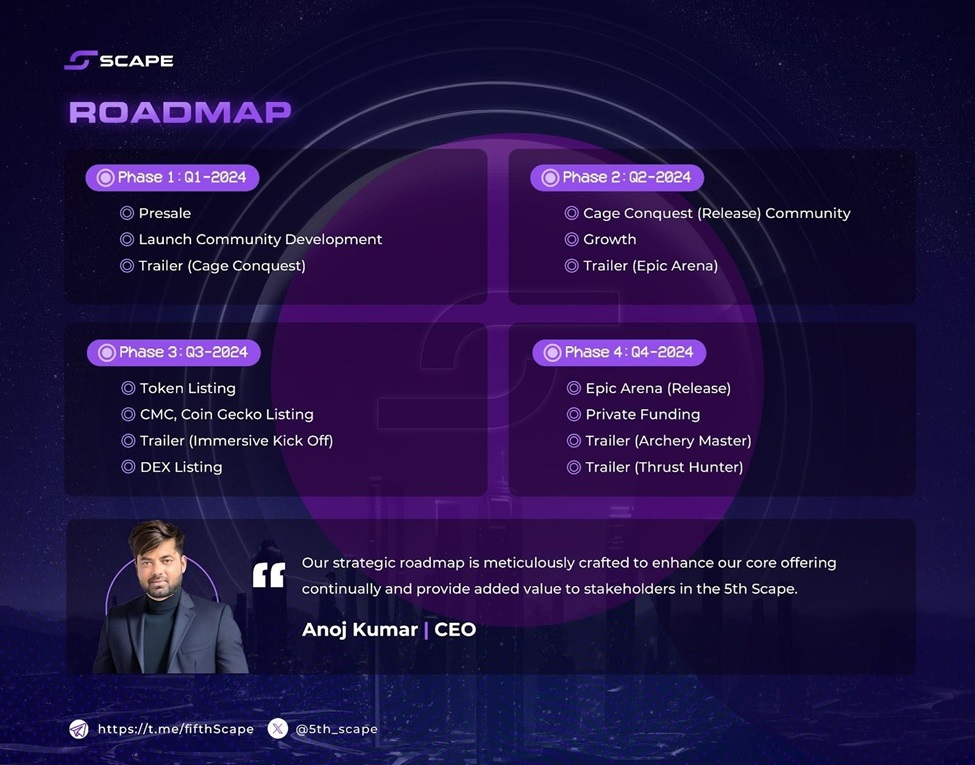
Early Traction, Big Dreams: The project has already secured over $6.7 million in funding during its presale phase, fueled by the sale of its utility token, 5SCAPE. This early financial backing demonstrates strong investor confidence and highlights the project’s potential.

The recent launch of their highly-anticipated VR game “Cage of Conquest” on MetaQuest marks a significant milestone.

Click here to know more about 5thScape!

Crafting a Comprehensive VR Universe: The project’s development team continuously adds fresh content to its VR library, ensuring users constantly explore new experiences. Additionally, they plan to add AR features in the future, hinting at an even more expansive and versatile platform encompassing both augmented and virtual reality. This commitment to continuous development positions 5thScape as a potential leader in the immersive entertainment space.

5SCAPE Token: A Ticket to the VR Boom?

The 5SCAPE token is your golden ticket to the hidden cache of VR experiences offered by the 5thScape platform. Owning 5SCAPE grants access to premium content and potentially lucrative staking opportunities. Here’s a closer look at why this token could be a potential windfall:

  • Riding the VR Wave: The value of the 5SCAPE token is intrinsically linked to the growth of VR technology. With VR user adoption exploding, the token has the potential for significant appreciation. Early investors who got in during the first presale round are projected to see returns exceeding 600%.
  • Early Traction, Early Gains: The token has already experienced a 165% growth since the last presale round, likely fueled by the excitement surrounding the launch of “Cage of Conquest” and the upcoming “Thrust Hunter.”
  • Limited Supply, High Demand: The project emphasizes a limited supply of 5SCAPE tokens while user demand steadily increases. This scarcity model could contribute to significant price hikes once the token hits mainstream exchanges.
  • Get Ready for Lift Off: The project is nearing the end of its presale rounds and is primed for a massive listing on crypto exchanges. This broader availability will skyrocket its price.

FET vs. 5SCAPE

Fetch.ai powers an AI marketplace. The futuristic idea behind this project has fueled interest in the FET token, particularly as AI continues to dominate headlines. While the current price hovers around $1.62, some analysts predict a rise to $1.71 by July 14th. Several trends back this potential increase.

First, the global AI market is projected to reach $1.5 trillion by 2030, suggesting a growing demand for solutions that Fetch.ai brings. Second, Fetch.ai boasts a strong online community, indicating high user interest. Its team is actively developing new features and partnerships, which could further bolster investor confidence and potentially lead to a price increase for the FET token.

However, the project faces intense competition as the crypto market already has several AI-backed projects. They are all trying to compete with each other to get to the top of the leaderboard and catch investor interest. In such a scenario, the project may face volatility if you consider it a long-term investment option.

However, 5thScape can potentially become a major player in the VR landscape. Its innovative approach, early financial backing, and focus on building a comprehensive VR ecosystem make it a project worth watching closely.

Don’t Miss Out: The 5SCAPE Presale will Ending Soon with Bonus Rewards!

The clock is ticking on the 5SCAPE token presale – it’s your last chance to snag them at the best price before they hit mainstream exchanges! Owning 5SCAPE positions you perfectly to capitalize on the booming VR market.

Exclusive Presale Perks: 

  • Limited-Time Discounts: Secure your 5SCAPE tokens at a pre-launch price before they soar in value.
  • Bonus Rewards: Invest over $500 and choose from exciting rewards like a free lifetime membership to 5thScape’s expansive content library or a 50% discount on their physical VR accessories (subject to availability).
  • Upgrade your existing crypto holdings: Looking to diversify? During the presale, you can exchange your ETH, MATIC, or BNB holdings for 5SCAPE tokens to qualify for these bonus rewards.

Spread the Word, and Win Big!

The 5thScape team is increasing the excitement with a massive $100,000 contest prize pool. Here is how you can be a part of it:

  • Become a YouTube VR Critic: Create a video reviewing 5thScape. Share your thoughts, showcase its features, and include a link to their website and your unique referral code. The most engaging and informative reviews will be handsomely rewarded.
  • Write the Future of VR: Craft a blog post analyzing 5thScape’s impact, potential, and why you believe it’s a game-changer in the VR landscape. Share your post on social media and relevant forums to spread the word.
  • Join the Twitterverse: Follow 5thScape on Twitter (@5thScape), retweet their pinned contest post, tag three friends, and include the hashtag #5thScapeContest. Every retweet is an entry!

Don’t miss out on this golden opportunity. Grab your presale discount, unlock exclusive rewards, and stand a chance to win the $100,000 prize pool!

Apple’s Artificial Intelligence (AI) Strategies

0

In the ever-evolving landscape of technology, artificial intelligence (AI) has become a cornerstone for innovation and user experience enhancement. Apple Inc., known for its commitment to privacy and user-centric design, has recently unveiled its AI strategy, which is set to redefine the role of AI in personal computing.

Dubbed “Apple Intelligence,” this initiative marks a significant shift in Apple’s approach to AI, focusing on privacy, security, and the seamless integration of AI into the daily lives of users. With the introduction of Apple Intelligence, the tech giant aims to set a new standard for privacy in AI, leveraging the power of generative models with personal context to deliver relevant and helpful intelligence.

One of the key features of Apple Intelligence is its deep integration into iOS 18, iPadOS 18, and macOS Sequoia. This integration harnesses the power of Apple silicon to understand and create language and images, take action across apps, and draw from personal context to simplify and accelerate everyday tasks. The Private Cloud Compute feature is particularly noteworthy, as it allows computational capacity to flex and scale between on-device processing and server-based models that run on dedicated Apple silicon servers.

The new systemwide Writing Tools built into the latest operating systems exemplify Apple’s commitment to enhancing user productivity. These tools enable users to rewrite, proofread, and summarize text nearly everywhere they write, including Mail, Notes, Pages, and third-party apps. The Rewrite function allows users to adjust the tone of their written content, while Proofread checks grammar, word choice, and sentence structure, suggesting edits along with explanations.

Apple’s strategy with AI revolves around leveraging the technology within its proven capabilities, primarily as an assistive tool for automating mundane tasks like summarizing emails or transcribing calls. This approach demonstrates AI’s potential to simplify daily digital interactions without attempting to break new ground in AI capabilities.

However, Apple’s AI strategy is not without its risks. The company is making a significant bet on the future development of AI, particularly on the ability to deliver desired functions and features primarily on-device. This bet hinges on the continued optimization of AI models to mimic the capabilities of large AI models, such as OpenAI’s GPT-4, in much smaller packages.

While smaller models have been successful in certain tasks, they may not be as capable across different tasks as the largest models, especially in reasoning, which could be a challenge as AI assistants evolve to plan and take complex actions on behalf of users.

Moreover, Apple’s decision to limit AI enhancements to specific hardware, such as the iPhone 15 Pro and Pro Max with the A17 Pro chip and devices equipped with the M1 chip or later versions, has raised questions about the underlying reasons for this restriction. This move could potentially boost sales for these devices, but it also limits the accessibility of these AI features to a subset of Apple users.

Apple’s AI strategy represents a thoughtful and user-focused approach to integrating AI into personal computing. By prioritizing privacy and practicality, Apple is setting realistic expectations for AI and offering users a unique choice in how they interact with AI-powered features. As the company continues to navigate the complexities of AI development, it remains to be seen how this strategy will impact the broader AI landscape and Apple’s position within it.

Technologies and Governance areShaping New World Orders

0

The concept of a “New World Order” has been a topic of discussion and speculation for decades, often associated with the idea of a significant shift in the geopolitical landscape. As we move through 2024, it’s clear that the interactions between nations are evolving, influenced by a myriad of factors including economic shifts, technological advancements, and global challenges such as climate change and pandemics.

The Council on Foreign Relations suggests that while the world order constructed post-World War II is still evident, there is a clear shift in the global distribution of power, with new powers rising and influential non-state actors emerging. This transition period is marked by the United States’ reluctance to bear the costs of world leadership, especially in military terms, and the assertiveness of China and Russia in pursuing their interests.

Moreover, the backlash against globalization in Western countries, including the United States, indicates a reevaluation of the benefits of a free-flowing international system. This sentiment has been further complicated by the public health and economic crises spurred by the COVID-19 pandemic, which have prompted nations to reconsider their dependencies and alliances.

The Center for Strategic and International Studies (CSIS) offers scenarios for the geopolitical order of 2025-2030, highlighting the importance of the relative influence and leadership of the United States and China. The scenarios suggest that the U.S.-China relationship will remain competitive, with cooperation possible on shared global interests when U.S. power equals or surpasses that of China.

Technological advancements and governance are also reshaping the global order. The ability to quickly build relationships across national borders, the role of regional institutions like the African Union and NATO, and the stretching of businesses’ supply chains over vast distances are all contributing to a more interconnected yet complex world stage.

Regional institutions are actively adapting to the rapidly changing world order of 2024, a landscape that is increasingly influenced by emerging economies and shifting power dynamics. The expansion of the BRICS+ group is a prime example of this adaptation. With new members such as Egypt, Ethiopia, Iran, Saudi Arabia, and the UAE joining the original BRICS nations, the group now represents a significant portion of the world’s population and economic output.

This enlarged BRICS+ bloc is challenging the dominance of traditional Western-led institutions like the World Bank and the International Monetary Fund by starting to build its own political and financial institutions, including a payment mechanism for transactions. This move could have profound implications for global trade, energy markets, international finance, and technological research, reflecting a desire for a more multipolar world order where emerging markets have a greater voice.

Similarly, the G20 is experiencing a transformation as its largest developing economies assert their voices within BRICS+, while its most economically advanced members strengthen ties through the G7. This indicates a fragmentation of the previous global economic alignment, with regional institutions seeking more autonomy and influence.

The reshaping of the global order also necessitates adaptability from international institutions such as the United Nations, World Trade Organization, and World Health Organization. These entities must evolve to reflect the new realities, ensuring they remain relevant and effective in a world where regional alliances and priorities are becoming increasingly important.

In a speech at the Munich Security Conference, UN Secretary-General António Guterres called for a new global order that works for all, emphasizing the need for inclusive and equitable governance structures. This reflects a growing recognition that the future global order must account for the diverse needs and contributions of all nations, rather than being dominated by a few.

The “New World Order” of 2024 is not a singular, monolithic entity but a dynamic and evolving set of circumstances that reflect the changing priorities, capabilities, and strategies of nations and other global actors. As these entities navigate the complexities of the 21st century, the international community faces the challenge of fostering cooperation while respecting the sovereignty and diversity of its members. The path forward will likely be one of cautious negotiation, innovative collaboration, and a redefined understanding of power and influence on the global stage.

Apple Halts Issuing Loans on Buy-Now Pay-Later Program in U.S, Introduces New Loan Offering

0

Tech giant Apple has announced plans to halt the issuing of loans through its buy-now-pay-later program in the United States, opting to roll out a new installment loan offering.

Apple disclosed that users who wanted installment plans at checkout would gain access to them through other financial intermediaries in more countries across the globe.

This strategic shift is coming after the Cupertino giant announced that it would start allowing installment loans later this year in its Apple Pay checkout processes through third-party companies, such as Affirm and Citigroup.

Affirm will surface as an option for U.S Apple Pay users on iPhones and iPads later this year, providing users with additional payment choices and offering the ease of convenience and security of Apple Pay alongside the features in Affirm such as flexibility, transparency, etc.

With the integration of Citigroup in its Buy-Now Pay Later Program, Apple noted that it would introduce installment loans via credit and debit cards, as traditional credit card players have begun offering BNPL-style installment loans which gained popularity during the COVID pandemic.

A spokesperson at Apple said,

“Starting later this year, users across the globe will be able to access installment loans offered through credit and debit cards, as well as lenders, when checking out with Apple Pay. With the introduction of this new global installment loan offering, we will no longer offer Apple Pay Later in the U.S”.

Apple said its priority with Apple Pay, the brand name for its contactless and online payment software, was to enable secure and private payments. Users with open loans will continue to have access to Apple Pay Later features to manage and pay their loans, Apple said.

The new installment loan service will allow Apple customers to make larger purchases and spread the cost over a fixed period with equal monthly payments. Unlike the BNPL model, which typically breaks down payments into a few smaller installments over a short term, Apple’s new offering will cater to those seeking longer repayment terms and greater financial flexibility.

Before it was discontinued, Apple Pay Later enabled users to apply for loans within the iPhone Wallet app, and approved users would see a “Pay Later” option when checking out online.

Notably, Apple’s strategic shift in loan offering is expected to impact the competitive landscape of digital lending and consumer finance. The offering will likely attract consumers who prefer the stability and predictability of longer-term repayment plans over the convenience but potential pitfalls of BNPL options.

In conclusion, Apple’s introduction of installment loans in place of BNPL services signifies its commitment to evolving and improving its financial products. This new offering is designed to provide customers with a more manageable and transparent way to finance their purchases, reinforcing Apple’s position as a leader in both technology and consumer finance.