DD
MM
YYYY

PAGES

DD
MM
YYYY

spot_img

PAGES

Home Blog Page 326

Solana and XRP Forecasts Look Strong, Yet Ozak AI’s Flip Potential Is What Traders Are Chasing

0

Solana and XRP are both showing strength heading into the next leg of the bull market, and their price forecasts continue to reinforce confidence among long-term holders. SOL is riding strong momentum from growing network activity, while XRP’s recent technical structure hints at a potential breakout if macro market conditions align. Yet despite these solid setups, many traders are shifting their attention elsewhere—not to big caps, but to early-stage plays. Ozak AI has become one of the hottest targets for those seeking exponential returns, not just steady gains.

Ozak AI Attracts Traders Looking Beyond Solana and XRP

Solana’s ecosystem expansion and XRP’s network utility are well-documented, but their upside potential is far more conservative compared to early presale projects. SOL pushing to $300 or XRP breaking $2 would be impressive, but those moves pale in comparison to the kind of multiples possible when getting in early on a promising low-cap token.

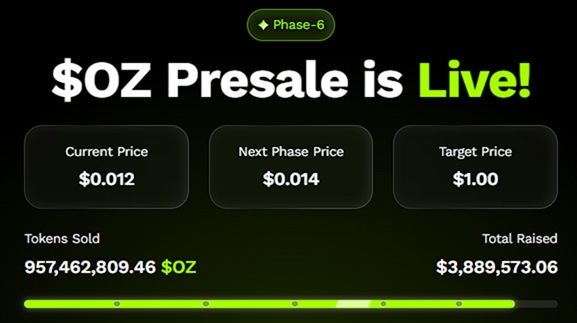
Ozak AI, currently in its 6th OZ presale stage at $0.0012, offers traders that very early entry point. With more than 950 million tokens sold and over $3.8 million raised, the project has already drawn significant attention from both retail investors and early whale capital. For traders seeking 20x, 50x, or even 100x upside potential, Ozak AI represents an opportunity that Solana and XRP simply can’t match at their current valuations.

Ozak AI’s Flip Appeal Comes From Early Positioning

The biggest fortunes in crypto are often made by those who position early, long before tokens become mainstream. Ozak AI’s presale stage gives traders a front-row seat to exactly that kind of positioning. At $0.0012, even a modest allocation can secure a large token stack. If Ozak AI lists between $0.01 and $0.05 during a heated bull market, the resulting returns could easily dwarf those from larger, more established projects.
While Solana and XRP provide stability and steady appreciation, Ozak AI caters to traders chasing aggressive upside. It’s the same mentality that fueled early investments in meme coins like Dogecoin and Shiba Inu, but with a narrative rooted in one of the fastest-growing sectors in tech: artificial intelligence.

Ozak AI Rides the Strongest Narrative of the Cycle
This bull run is already being defined by the rise of AI narratives. Just as DeFi dominated 2020 and meme coins defined 2021, AI integration with blockchain is emerging as the star theme of this cycle. Ozak AI sits directly at that intersection, leveraging AI-powered predictive agents and data intelligence to create real utility on-chain.

For traders, narrative matters just as much as fundamentals. When the broader market begins chasing a dominant narrative, tokens aligned with that story often experience explosive demand. Ozak AI is already building traction before listing—a sign that momentum could accelerate sharply post-launch.

Ozak AI Could Outperform Even Strong Forecasts

Solana and XRP are positioned to deliver respectable returns for investors who prefer larger caps, but traders seeking outsized gains are increasingly looking toward Ozak AI. The combination of low entry price, strong narrative positioning, and growing presale traction creates a setup that mirrors some of the biggest winners of past cycles.

If the AI narrative continues to heat up and Ozak AI executes on its roadmap, it could deliver far more dramatic flips than SOL or XRP in this bull run. While big caps build the foundation, it’s often the early-stage plays like Ozak AI that define the stories traders talk about for years.


About Ozak AI

Ozak AI is a blockchain-based crypto project that provides a technology platform that specializes in predictive AI and advanced data analytics for financial markets. Through machine learning algorithms and decentralized network technologies, Ozak AI enables real-time, accurate, and actionable insights to help crypto enthusiasts and businesses make the correct decisions.


For more, visit:

Website: https://ozak.ai/

Telegram: https://t.me/OzakAGI

Twitter: https://x.com/ozakagi 

How Nigeria’s National Job Centres Can Truly Empower Youth

0

When the Minister of State for Labour and Employment, Nkeiruka Onyejeocha, unveiled the National Job Centre initiative, the message was clear: Nigeria wants to create a future where young people are not just searching for jobs but connecting with opportunities that match their skills, ambitions, and the realities of a digital economy. The project promises to integrate digital job matching, data tracking, and career advisory services into a single national framework that can help youth contribute meaningfully to local industries while competing confidently on the global stage.

This vision is both ambitious and timely. Across the world, the connection between education, skills, and work is being reshaped by technology. For Nigeria, where millions of young people enter the job market every year, building an integrated system that truly aligns these elements could be transformative. But for that to happen, every player in this ecosystem must be part of a living network that works in sync.

Connecting the Dots Between Policy, People, and Technology

The National Job Centre is not just a set of offices or websites. It represents a growing web of relationships linking human talent, digital systems, data, and public institutions. Each of these parts has a role to play. Policymakers design the framework that guides how job centres operate. Technology developers create the digital tools that match candidates to opportunities. Employers share real-time information about vacancies and required skills. Career advisors guide young people through training and job readiness. Data systems track trends that can inform smarter decisions. The quality of connection among these parts will determine whether the vision of a “harmonised and inclusive system” can hold.

The promise of inclusion lies in how well the system can bridge Nigeria’s deep divides. For young people in cities with strong connectivity and access to training, digital job centres can open new doors quickly. But for those in rural or underserved communities, poor internet access and limited awareness may keep them outside the loop. To make the system inclusive, investment in connectivity, local capacity, and digital literacy must go hand in hand with technological rollout. Otherwise, the job centres may end up amplifying existing inequalities instead of reducing them.

Building Partnerships and Trust

Partnerships will also shape how the centres evolve. The government has already signaled collaboration with organisations such as the Mastercard Foundation through its Young Africa Works strategy. Such partnerships bring resources and innovation but also introduce new priorities and expectations. The success of the initiative will depend on balancing national goals with the influence of external partners. Nigeria’s job framework must remain responsive to its local realities, even as it connects to global opportunities.

Another crucial factor is trust. Young people must believe that these platforms can genuinely help them find decent work. Employers must see value in sharing accurate information and hiring through these channels. Data protection and transparency will be essential for building and sustaining that trust. A single weak link, whether unreliable data, poor maintenance of digital tools, or a lack of follow-up support, can undermine the credibility of the entire system.

Turning Vision into Reality

Technology can be a great equaliser, but only when combined with human guidance and institutional reliability. This is why the advisory component of the National Job Centres is so important. Job seekers need more than job postings. They need mentorship, feedback, and opportunities to learn new skills that keep them competitive. Career advisors and trainers can turn the promise of digital platforms into real human progress.

Ultimately, the National Job Centre initiative represents more than a labour market reform. It is an attempt to weave together the people, technologies, and institutions that shape the future of work in Nigeria. Its success will not depend solely on how advanced the software is or how impressive the launch ceremony appears. It will depend on how well all actors involved stay connected, share information, and adapt to one another’s needs. Creating a harmonised and inclusive system is not a one-time event but an ongoing process of coordination and learning.

China Accuses U.S. of Stoking ‘Panic’ Over Rare Earths as Tension Escalates

0

China on Thursday accused the United States of deliberately stoking “panic” over Beijing’s new export restrictions on rare earth minerals, escalating a dispute that has revived fears of another trade war between the world’s two largest economies.

“The U.S. interpretation seriously distorts and exaggerates China’s measures, deliberately creating unnecessary misunderstanding and panic,” Ministry of Commerce spokesperson He Yongqian said at a press briefing in Beijing, according to the state-run Global Times.

The remarks came a week after Beijing unveiled sweeping controls on exports of rare earth elements — minerals essential to defense and advanced manufacturing — in a move that coincided with preparations for a meeting between President Donald Trump and President Xi Jinping in South Korea later this month. Trump has warned that if Beijing does not reverse the curbs, he could impose 100% tariffs on Chinese goods as early as November 1.

The Ministry of Commerce said Thursday that China remains “open to talks” to defuse the situation, signaling that the door is not yet closed on negotiations.

China insists the restrictions are a matter of national security, designed to prevent rare earth materials from being used in the development of weapons of mass destruction.

“The accusations from the U.S. reveal that the U.S. is projecting its own behavior onto others,” He said, pointing to Washington’s own restrictions on semiconductor exports and “foreign content” rules that limit China’s access to advanced technologies.

Rare earths — a group of 17 elements used in the production of magnets — are critical inputs for U.S. defense systems such as the F-35 stealth fighter jet, Tomahawk cruise missiles, and Predator drones. They are also essential to electric vehicles, robotics, and semiconductor manufacturing, industries that have become flashpoints in the intensifying U.S.–China technology rivalry.

Washington has long viewed China’s dominance of the global rare earths market, controlling nearly 90% of processing capacity, as a strategic vulnerability. Beijing’s decision to impose export curbs has therefore been seen as a direct challenge to the Trump administration’s industrial policy and its efforts to secure U.S. supply chains.

The Trump administration has responded by doubling down on efforts to build a domestic rare earths ecosystem independent of China. In July, the Department of Defense signed a landmark deal with MP Materials, the largest rare earth miner in the United States, involving an equity stake, a price floor, and an offtake agreement designed to guarantee a stable supply for U.S. defense needs.

Treasury Secretary Scott Bessent told CNBC on Wednesday that the administration could take similar steps across other critical sectors.

“I wouldn’t be surprised,” Bessent said when asked about additional equity stakes. “When we get an announcement like this week with China on the rare earths, you realize we have to be self-sufficient, or we have to be sufficient with our allies.”

Bessent accused Beijing of using its market dominance to distort global prices, saying China had “slashed prices to drive foreign competitors out of the market.” He added that Washington plans to impose price floors in several industries to counter what he called “market manipulation” by China.

“When you are facing a nonmarket economy like China, then you have to exercise industrial policy,” Bessent said at the CNBC Invest in America Forum in Washington, D.C.

The Trade Stakes

The rare earth standoff marks a new phase in the U.S.–China trade confrontation, one that extends beyond tariffs into the strategic resources underpinning modern technology. U.S. Trade Representative Jamieson Greer told CNBC earlier in the week that China’s export controls were “a clear attempt to control the world’s technology supply chains.”

Greer warned that Beijing’s actions would determine whether Trump proceeds with the threatened 100% tariffs. Still, he noted that the White House remains open to diplomacy and confirmed that Trump’s planned meeting with Xi in South Korea is still on schedule.

For China, the calculus is equally complex. While Beijing sees rare earths as a strategic lever, analysts note that further escalation could undermine its broader manufacturing sector, which relies heavily on stable access to U.S. markets.

Economic and Political Undercurrents

The rare earth confrontation has emerged against the backdrop of Trump’s broader trade and industrial agenda, which includes sweeping tariffs and efforts to reassert U.S. manufacturing strength. Just this week, S&P Global estimated that Trump’s tariffs would cost global companies more than $1.2 trillion in 2025, with most of that cost likely to fall on consumers.

Those policies, combined with targeted restrictions on Chinese technology and renewed scrutiny of critical mineral supply chains, form part of what administration officials describe as a strategy to “reindustrialize America.”

For Trump, who has made economic nationalism a pillar of his presidency, the dispute offers both political risk and opportunity. The President’s trade team argues that curbing dependence on China is necessary to safeguard national security and protect U.S. workers. But business leaders warn that the cost of decoupling — both for American manufacturers and global supply chains — could be substantial.

Trump’s team views the South Korea meeting with Xi as a test of whether diplomacy can avert an all-out economic confrontation. For Beijing, the challenge lies in balancing its need to defend strategic interests while preventing a repeat of the 2018–2019 trade war, which slowed growth and triggered capital flight.

Uber Turns Its Drivers Into AI Data Trainers: Inside the Company’s Bid to Build the ‘Ultimate Flexible Work’ Platform

0

In its latest push to redefine flexible work, Uber has launched a pilot program in the United States that allows its drivers and couriers to earn extra income by completing “microtasks” designed to train artificial intelligence models — a move that could mark the company’s most ambitious step yet into the AI economy.

The initiative, introduced on Thursday, enables Uber’s vast workforce of independent contractors to perform small, app-based assignments such as recording voice clips, uploading images, or submitting documents in multiple languages, according to The Verge. Some of the sample prompts include “upload images of cars,” “record yourself speaking in your language or local dialect,” or “upload a menu written in Spanish.” Depending on the complexity, these tasks can earn drivers up to a dollar per submission.

Uber CEO Dara Khosrowshahi unveiled the program during an event in Washington, D.C., describing it as part of the company’s mission to “build the best platform for flexible work.” The move positions Uber not only as a ride-hailing and delivery service but also as a potential player in the fast-growing data-labeling and AI training industry — a field currently dominated by specialized firms such as Scale AI and Amazon’s Mechanical Turk.

The new feature repurposes Uber’s existing workforce into an on-demand digital labor pool, capable of supporting AI companies that require massive datasets to train models. Human feedback remains crucial for developing advanced AI systems, from recognizing accents and dialects to labeling real-world images used in robotics and self-driving cars.

Until now, most of this type of labor has been outsourced to lower-cost markets in Africa, Asia, and South America. By contrast, Uber’s pilot recruits workers already operating in the U.S., effectively giving them a dual role as both drivers and digital annotators.

The company has experience in this space. Uber’s internal AI Solutions Group has previously relied on “human-in-the-loop” systems — processes where human judgment complements machine learning — to refine its navigation and mapping algorithms. Earlier this year, Uber acquired the Belgian startup Segments.ai, signaling its intention to scale up its data-labeling operations.

Similar pilots had already been introduced in India, where drivers were paid small sums to respond to in-app prompts. The U.S. expansion marks a major step toward integrating these digital tasks into Uber’s broader business ecosystem.

A Competitive Pivot Toward AI

Analysts view the move as a significant diversification for Uber. By connecting its flexible labor network with AI development, the company is positioning itself as a hybrid technology and workforce platform. The potential scale is enormous: Uber has over 5 million active drivers and couriers worldwide, representing a distributed workforce that can generate vast amounts of labeled data quickly.

If successful, Uber’s entry could reshape the economics of AI training, which depends heavily on human participation despite automation advances. It could also allow Uber to capture part of a growing industry projected by PwC to exceed $50 billion globally by 2030.

Still, the program’s success depends on participation rates. Many Uber drivers already complain about declining pay and rising expenses, and some may not see the value in taking on additional “micro” assignments for minimal pay. A driver might, for instance, earn less than a dollar for recording a voice clip — a small supplement compared to time spent on rides or deliveries.

Labor advocates warn that these developments could further blur the line between employment and contract work. Uber continues to classify its drivers as independent contractors, which exempts the company from providing benefits such as minimum wage guarantees, overtime pay, or healthcare coverage. Yet critics argue that Uber’s heavy use of algorithmic management exerts employer-level control — from setting fares to determining when drivers are deactivated — undercutting the notion of full independence.

Broader Overhaul of the Driver Experience

Beyond AI microtasks, Uber announced a range of updates aimed at improving the experience and security of its drivers and couriers. The company is redesigning its trip offer cards — the interface where drivers accept or reject rides — to include more time and details before making a decision. Couriers delivering multiple orders will now see clearer instructions, including simplified pickup and drop-off details and alerts for commonly missed items.

Uber also introduced a new “heatmap” to show real-time demand across cities. The map uses colors to indicate where drivers can expect shorter wait times or higher surge pricing. Drivers commuting toward high-demand areas can now choose between a route that maximizes earnings or one that minimizes travel time.

Expanding Safety and Fairness

Uber also announced a wider rollout of its Women Rider Preferences feature, initially launched last year, which lets women drivers accept only women passengers. The feature — now available in Baltimore, Minneapolis, Philadelphia, Seattle, Portland, and Washington, D.C. — has been used in over 100 million trips, with more than half of participating drivers keeping it activated for most of their rides.

The company is also allowing drivers to set minimum passenger ratings and toggle the feature depending on circumstances, such as using it for late-night trips. Combined with ID verification for riders, Uber says the measures give drivers “more peace of mind on every trip.”

On fairness, Uber acknowledged complaints about sudden account deactivations — often triggered by rider reports — and said it would now allow drivers to respond before any final decision. Drivers accused of minor issues, such as disputes over alcohol deliveries, could still access other earning options on the platform.

Uber also announced a Delayed Ride Guarantee, allowing drivers to earn more if a trip is delayed due to the passenger or unforeseen traffic. Additionally, the company is expanding tipping reminders, including real-time notifications through Apple’s Live Activities feature, to encourage more consistent gratuities from riders.

Redefining the Future of Flexible Work

Uber’s push to merge traditional gig work with AI-based digital labor represents a shift in how the company defines flexibility. Uber aims to maintain engagement across a workforce increasingly skeptical of the platform’s pay structure by offering drivers multiple revenue streams — rides, deliveries, and now digital microtasks.

But the move also raises questions about the future of work itself. As Uber integrates AI development into its gig economy model, it blurs the boundary between physical and digital labor, positioning its drivers not just as participants in the transportation economy but as contributors to the infrastructure of artificial intelligence.

Whether this model can sustainably benefit drivers remains unclear. But as Uber moves deeper into AI, the company seems determined to prove that flexible work — from car rides to data labeling — can evolve into a single, seamless ecosystem, where human input continues to fuel the next generation of intelligent machines.

Ethereum Price Prediction: $5000 Back in Sight as This New Crypto Coin Positions for 100x Gains

0
Blazpay - new crypto coins

The crypto market in October 2025 is once again heating up, driven by Ethereum’s strong price rebound and Blazpay’s rapidly advancing presale. Together, these projects represent two of the most promising new crypto coins capturing investor attention.

While Ethereum (ETH) solidifies its position as the institutional favorite, Blazpay’s AI-powered DeFi architecture is quickly becoming the talk of crypto presales 2025, attracting both retail and early-stage investors looking for exponential upside.

Ethereum: Institutional Strength Amid Market Volatility

After a turbulent start to October, Ethereum has stabilized above the $4,000 mark, regaining strength following a flash crash that saw billions wiped from the crypto market. The rebound was largely fueled by institutional inflows, with major players like BlackRock and BitMine Immersion Technologies reportedly accumulating more ETH as part of long-term holdings.

On-chain data shows record ETF inflows of $1.48 billion, pushing Ethereum’s liquidity and confidence back up. Despite brief pullbacks caused by geopolitical tension, ETH continues to attract institutional capital, thanks to its spot ETF approvals and growing dominance across DeFi ecosystems.

Currently trading around $4,082, Ethereum’s market capitalization exceeds $490 billion, confirming its resilience as a core digital asset. Analysts forecast that if support holds above $3,800–$4,000, ETH could retest the $4,700–$5,000 range before the end of Q4 2025.

For long-term investors, Ethereum remains one of the best presale crypto benchmarks, symbolizing maturity, liquidity, and network stability even during volatile cycles.

Blazpay - new crypto coins

Blazpay: The AI Crypto Presale Redefining New Crypto Coins

In contrast to Ethereum’s established dominance, Blazpay (BLAZ) is emerging as one of the most dynamic new crypto coins in 2025. The ongoing presale has already crossed 37.8 million tokens sold, marking 68.8% completion of Phase 1 and raising over $226,000.

Presale Highlights:

  • Entry price: $0.006 per BLAZ token
  • Phase 2: to increase the price to $0.0075
  • Join thousands of early investors before the next phase ends

At the core of Blazpay lies BlazAI, an intelligent assistant designed to make DeFi operations effortless. From automated swaps and liquidity optimization to NFT marketplace integration and portfolio tracking, BlazAI brings institutional-grade intelligence to everyday crypto users.

What truly sets Blazpay apart is its Multichain architecture — allowing seamless interaction across Ethereum, Polygon, Solana, and BNB Chain — and its Gamified Rewards ecosystem, which transforms DeFi engagement into a fun, rewarding experience.

Through achievements, NFT-based incentives, and leaderboard challenges, users earn real rewards while trading, staking, and participating in the Blazpay ecosystem. This combination of gamification and multichain efficiency makes Blazpay one of the best presale crypto projects in 2025.

Why Ethereum and Blazpay Define the Future of Crypto Presales 2025

Ethereum represents stability and credibility, backed by years of infrastructure and institutional recognition. Meanwhile, Blazpay represents innovation and accessibility, powered by AI-driven automation and cross-chain functionality.

Together, they showcase the two sides of the evolving crypto landscape:

  • Ethereum anchors portfolios with proven value and yield.
  • Blazpay unlocks new opportunities for early investors in AI crypto.

As the market shifts toward automation, DeFi integration, and gamified finance, this pairing symbolizes the next wave of digital investment strategies — where technology and usability meet.

$3,000 Investment Strategy: Balancing Stability with Growth

For investors seeking a smart mix between blue-chip reliability and early-stage growth, a $3,000 portfolio spread between Ethereum and Blazpay offers a well-balanced approach.

Coin Allocation Entry Price Tokens Acquired 2026 Target Price Potential Value
Ethereum (ETH) $2,000 $4,000 0.50 ETH $5,000 $2,500
Blazpay (BLAZ) $1,000 $0.006 166,666 BLAZ $0.25 $41,666

Projected Portfolio Value (2026): ? $44,000

This approach gives you:

  • Stability from Ethereum’s institutional growth, ETF inflows, and DeFi dominance.
  • High-growth potential from Blazpay’s AI-driven multichain architecture and gamified ecosystem.

By securing Blazpay early in its presale phase and holding Ethereum as a base layer asset, this allocation provides both short-term upside and long-term sustainability — perfect for navigating 2025’s dynamic crypto cycle.

Blazpay - new crypto coins

Price Forecasts: What Analysts Expect Next

Ethereum (ETH): Analysts predict Ethereum will maintain strong support near $3,800–$4,000, with potential upside to $4,700–$5,000 by early 2026 if institutional inflows persist and regulatory clarity improves.

Blazpay (BLAZ): Based on the pace of its presale, BLAZ could close above $0.0075 in Phase 2. Post-listing projections estimate a potential valuation between $0.15 and $0.25, depending on exchange liquidity and early trading volume.

This dual exposure offers a strategic balance for investors seeking both security and exponential upside in new crypto coins.

Final Thoughts: The Perfect Blend of Stability and Innovation

Ethereum continues to act as the foundation of decentralized finance, while Blazpay is spearheading the next leap with AI-driven multichain finance and Gamified Rewards. Both appeal to different investor segments, yet both are shaping what the best presale crypto landscape looks like in 2025.

For those watching the evolution of crypto presales 2025, this duo represents two critical pillars:

  • Ethereum’s institutional credibility
  • Blazpay’s technological creativity

In an AI-powered world of decentralized liquidity, Ethereum secures the base — and Blazpay builds the future.

Blazpay - new crypto coins

Join the Blazpay Community

Website: https://blazpay.com
Twitter: https://x.com/blazpaylabs
Telegram: https://t.me/blazpay


FAQs

  1. What makes Blazpay one of the best new crypto coins?
    Blazpay combines AI automation, multichain functionality, and gamified engagement — making it a standout project in crypto presales 2025.
  2. How much is Blazpay’s presale price?
    The current presale price is $0.006, with nearly 70% of Phase 1 completed.
  3. Why is Ethereum still popular among institutions?
    Ethereum’s ETF approvals, scalability upgrades, and liquidity dominance keep it as one of the safest long-term crypto investments.
  4. What are Blazpay’s utilities?
    Blazpay offers Multichain integration and Gamified Rewards, allowing users to earn while engaging with DeFi tools and games.
  5. What’s the future price prediction for Ethereum?
    Analysts see Ethereum testing $4,700–$5,000 by early 2026 as institutional inflows continue.