DD
MM
YYYY

PAGES

DD
MM
YYYY

spot_img

PAGES

Home Blog Page 3274

As Nigeria Arrests Binance Executives, It Must Follow Global Best Practices Even As It Enforces Its Laws

0

A big one for Binance Nigeria: “Nigeria…has intensified its efforts to curb speculation on the national currency, the naira, by cracking down on cryptocurrency exchanges as the nation’s economic downturn deteriorates. The Financial Times reported, citing sources, that two senior executives at Binance, one of the world’s largest cryptocurrency exchanges, have been detained in Nigeria in connection with these regulatory measures.”

We must support the Nigerian government to do its work. If Binance broke the law, it  must pay. There is no need to criticize the government for actually doing its work. I am not worried that Binance executives are detained provided those executives are treated according to the rule books.

Nonetheless, I concede that these guys may be innocent; we always arrest on emotions before we investigate. And if that is the case, they should be allowed to go home. Simple!

In America, if you break the law, you pay the price. Some Nigerians have been arrested and put in jails for breaking financial laws in the UK, US, etc. Please allow the government to breathe. We should only ask the government to follow due process.

Yet, I am unhappy that the Financial Times broke this news. You cannot arrest people in Lagos and allow a London-based newspaper to drive the narratives. The leakers should have leaked to local newspapers instead of FT which has limited understanding of Nigeria in this context. #MayNigeriaWork!

They accused Binance of facilitating $26B without KYC in Nigeria. That is a crime in America and should be a crime in Nigeria based on NITDA ordinance. If you check, Binance CEO was convicted for the same crime in the US.

Binance Executives Detained in Nigeria As Government Intensifies Cryptocurrency Crackdown

Binance Executives Detained in Nigeria As Government Intensifies Cryptocurrency Crackdown

0

Nigeria, Africa’s largest economy, has intensified its efforts to curb speculation on the national currency, the naira, by cracking down on cryptocurrency exchanges as the nation’s economic downturn deteriorates.

The Financial Times reported, citing sources, that two senior executives at Binance, one of the world’s largest cryptocurrency exchanges, have been detained in Nigeria in connection with these regulatory measures.

This development comes shortly after the revelation by Nigeria’s central bank governor, Olayemi Cardoso, that over $26 billion in illegal transactions had flowed through Binance’s crypto platform in the span of a year. The detained executives reportedly flew to Nigeria following the country’s recent ban on several cryptocurrency trading websites.

According to the sources familiar with the matter, the executives were detained by the office of Nigeria’s national security adviser upon their arrival in the country, with their passports confiscated. While an adviser to the office declined immediate comment, Binance itself refrained from offering any statement on the situation.

Nigerian authorities have shifted their focus to cryptocurrency websites following a significant devaluation of the naira, which contributed to soaring inflation rates. These platforms have emerged as alternative avenues for trading and establishing unofficial exchange rates for the Nigerian currency.

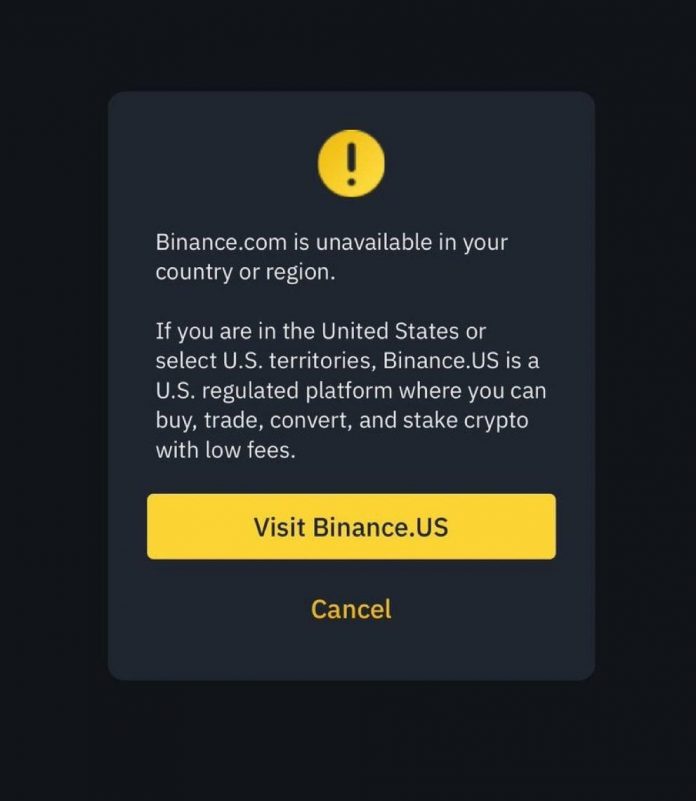
In response to the executives’ detention, Binance halted trading of the naira against bitcoin and tether digital coins on its exchange.

During a press conference on Tuesday, Governor Cardoso highlighted concerns regarding illicit financial flows through crypto exchanges, specifically mentioning Binance.

“We are concerned that certain practices go on that indicate flows, going through a number of these entities and suspicious flows. In the case of Binance, in the last year, $26 billion has passed through Binance Nigeria from sources and users who we cannot identify,” he said.

As part of their investigation into cryptocurrency exchanges, Nigerian authorities, including the anti-corruption agency, police, and national security adviser, are reportedly seeking access to a comprehensive list of Binance’s Nigerian users since its establishment.

Last week, Nigeria’s telecommunications regulator ordered telecoms companies to block access to major cryptocurrency exchanges like Binance, Coinbase, and Kraken. This move reflects the government’s broader efforts to attract foreign investment and stabilize the economy through market-friendly reforms, including currency devaluations.

The situation poses a significant challenge for Binance, which has been grappling with internal reform efforts. In November, the company faced substantial penalties from US authorities for money laundering and violating international sanctions rules. Former CEO Changpeng Zhao pleaded guilty to related charges and resigned from his position.

Bayo Onanuga, a special adviser to President Bola Tinubu, accused Binance of manipulating exchange rates for Nigeria, infringing upon the central bank’s role as the currency rate setter.

The crackdown on cryptocurrency exchanges comes amid broader efforts by Nigerian authorities to address currency speculation and stabilize the national currency, the naira. In addition to targeting digital asset platforms, the CBN has also taken decisive action against Bureau De Change operators, who play a significant role in the foreign exchange market.

In recent weeks, the CBN has implemented stringent measures to rein in BDCs, including suspending the issuance of licenses to new operators and restricting access to foreign exchange for certain transactions. These measures aim to curb currency speculation and illicit financial flows, which have contributed to the devaluation of the naira and soaring inflation rates in Nigeria.

The CBN’s crackdown on BDCs is part of a broader strategy to strengthen the country’s financial system and promote economic stability. By clamping down on currency speculation and illegal financial activities, Nigerian authorities seek to restore confidence in the national currency and create a more conducive environment for sustainable economic growth.

However, the detention of Binance executives and the crackdown on cryptocurrency exchanges raise questions about the regulatory approach to digital asset trading in Nigeria. As the government grapples with the challenges posed by cryptocurrencies, stakeholders emphasize the need for balanced regulation that fosters innovation while mitigating risks.

Nigeria Detains Two Binance Executives as The Country Cracks Down on Cryptocurrency Platforms

0

Recent reports have revealed that the Federal government of Nigeria has detained two Binance top executives, as the country cracks down on crypto platforms over alleged destabilization of the Naira.

Financial Times reports that the executives flew into the country following the government’s decision to ban several crypto platforms, but were. unfortunately detained by the office of the country’s national security adviser with their passports seized, according to people familiar with the matter.

Following the detention of the executives, Binance has halted trading of the Naira against Bitcoin and Tether digital coins on its exchange.

Check out some reactions of Nigerians on X, following the arrest of two top Binance executives,

@Ebuka Nwafor wrote,

“This is a serious red flag for a country that is traveling around the world seeking for investors. Why is he detaining two Binance executives for a Centralized exchange platform that thrives on P2P amongst other valuable services”.

@OgbeniBiodun wrote,

“This is what happens when you have individuals in positions of power who would rather blame everyone and everything for their own failures and bad policies, how can you detain executives who came to negotiate with you, and you expect foreigners to invest in your country?”.

@YusufZone wrote,

“No matter what anyone feels or thinks, change is always inevitable and constant. The future of money is digital and that future is already here! Attempting to block or frustrate digital money is like attempting to arrest the breeze and locking it up in a cage! Is that possible?”

@iOXRael wrote,

“Detention is overkill. Binance has a thorough KYC scheme and the T&C allows them to share info with government agencies, especially those involved in anti-fraud and anti-money laundering. NSA only needed to ask.”

It is worth noting that the arrest of Binance’s top executives is coming after the Central Bank of Nigeria (CBN) Governor Olayemi Cardoso recently disclosed that over $26 billion in illegal transactions have passed through the crypto platform Binance in one year.

In his words,

“We are concerned that certain practices go on that indicate flows, going through a number of these entities and suspicious flows. In the case of Binance, in the last year, $26 billion has passed through Binance Nigeria from sources and users who we cannot identify”.

Cardoso further added that the Apex bank  has collaborated with different agencies which include the EFCC (Economic and Financial Crimes Commission), the police, and the office of the NSA (National Security Adviser), noting that the bank is determined to do everything it takes to ensure that they take charge of the market and put it differently.

With the Naira’s continuous devaluation against the dollar and other foreign currencies, the Nigerian government has intensified its crackdown on cryptocurrency platforms. The crackdown follows a period after several of these platforms emerged as the preferred choice for Nigerians to trade the Nigerian currency, which has continued to suffer a fall.

Notably, Nigeria’s economy has been experiencing crippling dollar shortages that have pushed its currency to record lows.

Join “AI in Business” Lecture Tomorrow

0

Join us tomorrow at Tekedia Mini-MBA for an “AI in Business”’ lecture.  AI is reshaping the ordinance of the market system, and Tekedia Institute is committed to educate, inform and train lectures on the fundamental components of AI business. Zoom link in the class board https://school.tekedia.com/course/mmba13/

CBN allocates $20,000 FX supply to BDCs across Nigeria

0

In response to the persistent imbalances observed in Nigeria’s foreign exchange market, the Central Bank of Nigeria (CBN) has initiated proactive steps to bridge the widening gap in exchange rates by supplying Bureau De Change (BDC) operators with dollars daily.

In a recent circular signed by Dr. Hassan Mahmud, the Director of the Trade & Exchange Department, the CBN announced its decision to allocate $20,000 to eligible Bureau De Change (BDC) operators across the nation.

The move is part of a comprehensive strategy aimed at achieving a more market-driven exchange rate for the Naira while mitigating pressures on the parallel market.

Under the directive, the allocated funds will be sold to BDCs at a fixed rate of N1,301/$, mirroring the lower band rate of executed spot transactions at the Nigerian Autonomous Foreign Exchange Market (NAFEM) as of the previous trading day, dated February 27, 2024. This strategic intervention is anticipated to infuse much-needed liquidity into the market, thus stabilizing the Naira’s value.

Additionally, the circular delineates specific guidelines for BDC operators, limiting their margin on foreign exchange sales to end-users to not more than one percent (1%) above the purchase rate from the CBN. This measure aims to curb excessive mark-ups and safeguard consumers from price exploitation.

“The CBN has approved the sale of foreign exchange to eligible BDCs to meet the demand for invisible transactions. The sum of $20,000 is to be sold to each BDC at the rate of N1,301/$—(representing the lower band rate of executed spot transactions at NAFEM for the previous trading day, as at today, 27th February 2024),” the circular highlights. “All BDCs are allowed to sell to end-users at a margin NOT MORE THAN one percent (1%) above the purchase rate from CBN.”

Furthermore, eligible BDCs are required to deposit their Naira payments into designated CBN Foreign Currency Deposit Naira Accounts and furnish confirmation of payment along with other requisite documentation for disbursement at select CBN branches in Abuja, Awka, Lagos, and Kano.

This strategic move by the CBN is aimed at enhancing the efficiency and transparency of the foreign exchange market, fostering a conducive environment for Naira trading. By directly addressing distortions in the retail market, the CBN seeks to promote economic stability and growth.

In addition to these measures, the CBN has implemented various reforms to counter Naira depreciation, including the resolution of FX backlogs, restrictions on forex for foreign education and medical tourism, augmentation of BDCs’ minimum share capital, and measures to deter FX speculation. The central bank said on Tuesday it has cleared an additional $400 million in the nation’s FX obligations, leaving outstanding of about $4 billion.

However, the efforts have failed to tackle the prevailing foreign exchange challenges, which have contributed significantly to the mounting inflation rates in the country. With the nation’s headline inflation at 29.90%, the CBN increased the interest rate once again, to 22.75%, following the Monetary Policy Committee meeting which was concluded on Tuesday.

Consequently, this fresh move by the CBN to supply BDCs with dollars has come with skepticism due to insufficient liquidity of forex. Though the CBN governor Yemi Cardoso said on Tuesday that the Nigerian foreign reserve, from where it is expected to sustain the supply of FX to the BDCs and banks, has risen to $34 billion, there is concern that the recent increase in the fund will not be sustained. This is because of the continuous decline in the nation’s oil output, attributed to oil theft and vandalism of oil installations.

The naira closed at N1,615.94 per dollar in the official (NAFEM) market and N1,630 in the parallel market on Tuesday.