DD
MM
YYYY

PAGES

DD
MM
YYYY

spot_img

PAGES

Home Blog Page 345

Goldman Sachs Expands Venture Footprint With Acquisition of $7bn Industry Ventures

0
The logo for Goldman Sachs is seen on the trading floor at the New York Stock Exchange (NYSE) in New York City, New York, U.S., November 17, 2021. REUTERS/Andrew Kelly/Files

Goldman Sachs has struck a deal to acquire San Francisco-based Industry Ventures, one of America’s most established venture capital firms, in a move that deepens the Wall Street giant’s push into alternative investments.

The transaction, valued at $665 million in cash and equity, could rise by another $300 million depending on Industry Ventures’ performance through 2030, according to a statement released by Goldman on Monday.

The deal, expected to close in the first quarter of 2026, marks one of Goldman’s most significant expansions into private markets in years. It comes as the bank doubles down on its $540 billion alternatives investment platform, which CEO David Solomon has described as a “growth engine” for the firm. By absorbing Industry Ventures, Goldman is seeking to strengthen its venture capital pipeline and create more opportunities for its wealthy clients to invest in high-growth startups and emerging technology sectors.

Founded 25 years ago by Hans Swildens, Industry Ventures has been a key player in shaping the U.S. venture ecosystem. The firm has built a reputation for investing in both early- and late-stage startups, as well as acquiring secondary interests in venture funds — a strategy that gives investors access to maturing private companies without having to wait for IPOs or acquisitions.

Since its inception, Industry Ventures has made more than 1,000 investments and currently manages about $7 billion in assets. It reported an impressive internal rate of return of 18%, making it one of the more consistently profitable firms in its class.

Goldman CEO David Solomon said the acquisition would combine the “global resources of Goldman Sachs” with the “venture capital expertise of Industry Ventures,” opening the door for broader access to fast-growing companies around the world.

“Industry Ventures’ trusted relationships and venture capital expertise complement our existing investing franchises and expand opportunities for clients to access the fastest-growing companies and sectors in the world,” Solomon said in the statement.

Swildens, who will continue to lead the firm after the merger, echoed that sentiment, calling the partnership a natural fit.

“By combining the global resources of Goldman Sachs with the venture capital expertise of Industry Ventures, we are uniquely positioned to serve the increasingly complex needs of entrepreneurs, private technology companies, limited partners, and venture fund managers,” he said.

All 45 employees of Industry Ventures will join Goldman Sachs as part of the agreement, bringing their deep experience in the startup ecosystem into Goldman’s asset management division.

The deal, for Goldman Sachs, marks a strategic pivot toward longer-term, fee-based businesses after years of volatility in investment banking and trading revenue. The firm has been steadily building its private markets presence through a combination of organic growth and targeted acquisitions, seeking to compete more aggressively with firms like Blackstone, KKR, and Apollo in the lucrative world of alternative assets.

Some analysts believe the move positions Goldman to play a bigger role in the intersection of technology and finance at a time when the venture market is undergoing a reset. Following a two-year slump in startup valuations and IPO activity, there is renewed interest in the secondary market — where Industry Ventures has historically excelled. Goldman is expected to leverage its balance sheet and client network to take advantage of discounted opportunities in private tech investments.

The acquisition also underlines Goldman’s ongoing effort to appeal to ultra-wealthy individuals and institutional clients seeking exposure to private markets. The bank’s alternatives platform already spans private equity, real estate, infrastructure, credit, and hedge funds. Adding Industry Ventures’ expertise in venture capital fills a critical gap — especially as AI, clean tech, and cybersecurity startups attract massive investor interest globally.

For Swildens and his team, joining Goldman represents a chance to scale their operations globally. The firm, which started with a focus on U.S.-based startups, will now have access to Goldman’s international deal flow and capital base, potentially allowing it to compete more directly with top-tier Silicon Valley players like Sequoia Capital, Andreessen Horowitz, and Tiger Global.

The acquisition comes as Goldman continues to recover from a challenging period for its consumer banking efforts, which led to the winding down of its Marcus retail unit and a renewed emphasis on its core strengths: wealth management and institutional investing. The bank is now signaling that its next phase of growth will be driven by high-value, long-horizon investments in innovation and technology.

Once completed, the Industry Ventures deal is expected to further solidify Goldman Sachs’ position as a major player in the global venture capital ecosystem — connecting Wall Street’s deep capital reserves with the entrepreneurial energy of Silicon Valley.


The Weirdest Slot Machine Themes You’ve Never Seen (Yet)

0

Strange can be wonderful. The most memorable social slots often lean into bold, unexpected motifs—neon taxis, moonlit forests, party piñatas—while still keeping symbols readable and timing crisp. Below is a curated tour of unusual-but-friendly themes you can actually find on American Luck, plus quick tips for testing new picks in a few minutes.

One principle ties everything together: clarity first. Even the quirkiest idea feels welcoming when icons have strong silhouettes, backgrounds stay soft, and celebrations are short and tidy so your attention never gets overwhelmed.

What Makes “Weird” Work on Mobile

Two design pillars carry quirky themes on a phone screen. First, visual grammar: bold edges, consistent highlights, and a limited color set that keeps foreground icons front and center. If you can recognize a symbol in an instant, the round feels effortless.

Second, pacing: a clean loop of anticipation ? reveal ? feedback. Brief audio stingers label moments without drowning the scene, and a neat end-of-round summary confirms what just happened so you can relax into the next spin.

Unexpected—but Real—Themes You Can Try

Mad Cabs Hold & Win

Imagine rush-hour energy distilled into slick, readable rounds. Bright signage, quick cuts, and taxi motifs give this title a witty sense of motion. It’s “city chaos,” but with UI spacing that keeps every icon legible on small screens.

3 Crazy Tikis

Tropical masks, firelight glows, and island percussion create a playful late-night mood. Thick outlines and soft-focus backdrops ensure even the brightest colors remain easy to parse—no squinting required.

Pinata Go Go

Confetti pops, cheerful palettes, and party vibes. Despite the color, the symbol family is simple, and the motion language is rhythmic rather than noisy. It’s a fast way to brighten a short break.

Blood Moon Hold & Win

Gothic ambience meets glossy highlights. Deep reds and moody shadows could feel heavy elsewhere, but here they’re balanced by clear frames and decisive audio tags. The result: stylishly spooky without visual clutter.

3 Porky Banks Hold & Win Extra

A cheeky heist aesthetic—pigs, vaults, and shiny trinkets—presented with confident pacing. The contrast between matte backdrops and reflective icons makes the playful details pop without overwhelming the eye.

Piggy Bank Cash

Another pig-powered crowd-pleaser, this one leans into cartoon charm. The readability trick: foreground symbols with bold borders over soft gradients, so the “cute chaos” always stays clear.

3 Hot Chilli Peppers

Spice-forward art direction done right: high-contrast peppers, festive frames, and upbeat percussion. The UI keeps a tight cadence so the fiesta vibe stays fun and tidy.

Electric Diamonds Hold & Win

Retro-arcade sparkle with faceted shapes on dark velvet backdrops. It’s a minimalist, high-contrast approach that makes results instantly understandable—great between more elaborate themes.

3 Dragon Pots

Gold-and-jade elegance with lucky motifs. While “dragons” sound traditional, the pot trio setup and crisp icon frames add a slightly offbeat, ceremonial feel that stands out from typical fantasy looks.

How to Test a Quirky Theme in 3 Minutes

  • Look once, then look again: Do symbols read instantly at arm’s length and in motion?
  • Listen briefly: Audio tags should label moments, not dominate them.
  • Skim the help panel: A tidy summary means you’ll understand the flow without guesswork.
  • Time-box it: Two or three rounds should leave you feeling refreshed; save it to favorites if so.

Where to Spot Timely Promos

Before browsing for your next oddball favorite, it helps to see what’s current on-site. The daily login bonus casino page highlights one of the best Gold Coins promotions for getting started, so it’s worth checking it out.

Comfort & Accessibility Tips

  • Prefer bold icon sets: Thick outlines and consistent highlights beat intricate detail on small screens.
  • Adjust motion: If a theme is extra lively, dial down animation intensity where available.
  • Tune audio peaks: Keep celebration sounds pleasant and brief so the rhythm stays relaxing.
  • Find your contrast sweet spot: A small brightness tweak can sharpen edges without glare.
  • Rotate themes: Keep one calm pick and one festive pick handy to match your evening mood.

Conclusion

Weird works when it’s readable, coherent, and kind to your attention. From neon taxis to moonlit mansions and party piñatas, these real American Luck titles show how unusual ideas can feel instantly comfortable on mobile. Try a couple during a short, upbeat session, save your favorites, and let those tiny bursts of delight turn spare minutes into something memorable.

What Is a Cost Recovery Model, and How Does It Work?

0

Companies today are always searching for ways to improve their operations and control resources. Among them, the cost recovery model is a remarkable method. By enabling the business to plan its usage of expenses strategically, you ensure that the allocation of resources is done efficiently while continuously maintaining financial health.

With knowledge of this model and the practice, organizations can increase their business performance and maintain growth. A cost recovery model provides a structured approach that helps businesses align their costs with revenue generation, creating a foundation for long-term success.

Understanding the Cost Recovery Model

A cost recovery model is a technique for recovering costs and helps businesses sync costs with their revenue generation. In this model, the pricing strategies ensure the recovery of all expenses incurred in producing the goods and/or services. Organizations can use it as a guiding system to evaluate and understand their financial performance.

Elements of the Cost Recovery Model

This model is based on a few elements. Businesses that want to adopt it must first understand these elements.

Direct Costs

Direct costs are those associated with the production of a good or service. These are the cost of materials, the cost of labor, and the cost of manufacturing. It is essential for businesses to accurately account for these costs when determining the required price for cost recovery.

Indirect Costs

Although these costs are not directly associated with production, they remain essential for conducting business operations. This might include things like utilities, rent, or administrative costs. Proper allocation and identification of these costs is crucial for a successful cost recovery strategy.

Pricing Strategies

Secondly, pricing is a large portion of the cost recovery model. Organizations need to determine prices that cover direct and indirect costs while being competitive in the marketplace. It may require closely studying market dynamics and the demand for the pricing of competitors.

Revenue Management

Another aspect of effective revenue management is that revenue will match expenses. Businesses need to track sales and price accordingly to remain profitable. This continual evaluation aids in things like adjusting to changes in the market and staying above water financially. According to the U.S. Small Business Administration, effective revenue management is critical for maintaining business sustainability and growth.

Advantages of Adopting a Cost Recovery Model

Many companies favor adopting this model because it provides multiple benefits to businesses.

Financial Stability

By accounting for all expenses, businesses can enhance their financial stability. This cuts the risk of running short on funds and increases the ability to plan the next investment.

Informed Decision-Making

Having a clearer picture of costs and revenues allows organizations to make more informed choices. By having such a model, we can visualize the insights that can help us strategize and optimize resources, which will lead toward operational efficiency.

Competitive Advantage

A good cost recovery model provides the opportunity for businesses to provide their product at a competitive price. When you have a clear understanding of costs, organizations can provide attractive prices to consumers without jeopardizing profitability.

Sustainability

This model helps encourage the responsible usage of resources. By tying expenses to revenue generation, companies can sustain their business operations over the long term.

Challenges in Implementing the Cost Recovery Model

As beneficial as this model might be, it is not without its challenges of implementation. By knowing these challenges, businesses can prepare and adapt accordingly.

Accurate Cost Allocation

Pinpointing costs and knowing exactly where to assign them can be difficult. It requires time and resources to make sure every expense is recorded correctly, which isn’t easy, especially for big companies.

Market Fluctuations

Pricing is highly dependent on changing conditions, and these market circumstances change quite rapidly. Organizations must be flexible and adapt to these changes to continue to meet their cost recovery targets.

Consumer Perception

Aiming for prices that can cover every expense will cause prices to go up for consumers. Fortunately, between cost recovery and consumer aspirations, businesses have to strike the right balance or risk losing market share.

Resource Intensity

Having an effective cost recovery model needs money to establish and sustain. It requires the allocation of personnel and technology to track and analyze costs and revenues, which is resource-intensive for businesses.

Conclusion

This cost recovery model can be a very beneficial tool for a business to run most efficiently in terms of finance. With this model in hand, organizations will be equipped to remain financially stable, make better choices, and also be well-positioned to stay ahead of the competition. Although it has its challenges, businesses can easily adapt and implement the model into their businesses if they know the right strategies and are committed to using it with a long-term growth mindset.

Nigeria’s Benin Win: Victor Osimhen as a Renewed Hope Site for 2026 World Cup

0

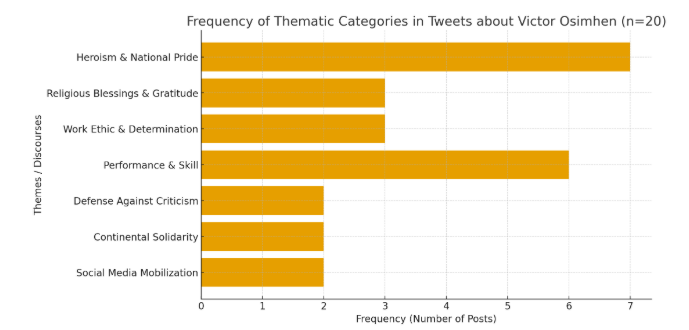
When Victor Osimhen scored a hat-trick against Benin, the moment went far beyond football. It became a shared expression of joy, pride, and renewed confidence in Nigeria’s ability to rise again. Across social media, fans celebrated not just the victory, but the man who made it possible. Their words revealed a deeper narrative about how Nigerians find meaning, faith, and hope through sport, especially in moments of national uncertainty.

The reactions of fans tell a story about the cultural power of football in shaping collective emotions. Many messages praised Osimhen as a blessing to the nation, a man whose passion and commitment reflect the best of Nigeria. Statements such as “You are a huge blessing to Nigeria” and “May God bless the womb that birthed you” combined patriotism with spirituality. This kind of praise reflects a broader moral framework in which achievement is not just a product of talent and discipline, but also of divine grace. For many Nigerians, Osimhen’s journey from modest beginnings to international success symbolizes both destiny and hard-earned merit.

Osimhen’s image as a hero operates on several levels. His performance on the pitch displays unmatched focus, power, and technical skill. Yet, beyond football, he represents an ideal figure of national responsibility. Fans see him as someone who gives everything for the country, who carries the weight of expectation without losing his determination. When supporters write “He carried his nation” or “He’s HIM,” they express a longing for figures who embody excellence and accountability. In a society often frustrated by leadership failures, Osimhen becomes a model of what it means to deliver when it truly counts.

Source: X Accounts, 2025; Infoprations Analysis, 2025

The religious tone in many comments reveals how faith continues to frame national hope. Fans speak blessings over Osimhen and his family, not simply to honour him, but to connect their joy to a sense of divine order. In a context where people often face political and economic struggles, this spiritual dimension provides comfort and meaning. Osimhen becomes a vessel for both national pride and divine favour. He represents a form of emotional renewal, a sign that greatness is still possible for Nigeria and its people.

The celebration also crossed borders. South African fans, for example, called him a “true hero,” highlighting the continental appeal of his achievements. Osimhen’s success resonates as part of Africa’s shared pursuit of recognition and respect in global football. His performance reminds Africans everywhere that excellence does not need external validation. It stands on its own.

Not all the online conversations were purely celebratory. Some fans rose to defend Osimhen from critics who questioned his personal life or social connections. They argued that his private choices should not affect his professional reputation. One supporter wrote, “The man is young, successful, and enjoying his life. That doesn’t change the fact that he’s still one of the best strikers we’ve ever had.” This kind of defense marks a shift in public discourse, as more Nigerians learn to separate character judgment from athletic performance. It shows a growing awareness that celebrities are complex individuals, not moral templates.

Social media itself plays a crucial role in sustaining this culture of fandom. When users call for likes, retweets, and hashtags, they are doing more than celebrating a footballer. They are performing a shared identity. Each interaction becomes a small act of belonging, an expression of unity in a digital community built around pride and optimism. Through this participatory energy, football becomes a cultural language of togetherness.

Our analyst notes that Osimhen’s brilliance represents the idea that Nigeria’s future is not limited by its past. His journey and his goals tell a story of perseverance and hope, a message that resonates far beyond football. As the countdown to 2026 begins, his performance offers more than victory. It gives Nigerians a reason to believe again in their collective strength and the promise of better days ahead.

How AI, Human Expertise Are Transforming Fact-Checking in Nigeria

0

Across Nigeria, a new generation of fact-checking organisations is using artificial intelligence in combination with human expertise to strengthen the verification process. In this piece, our analyst notes that understanding how these tools work and the challenges they face reveals the growing sophistication of digital truth-seeking and the urgent need to balance technology with human judgment.

Artificial Intelligence Enters the Fact-Checking Room

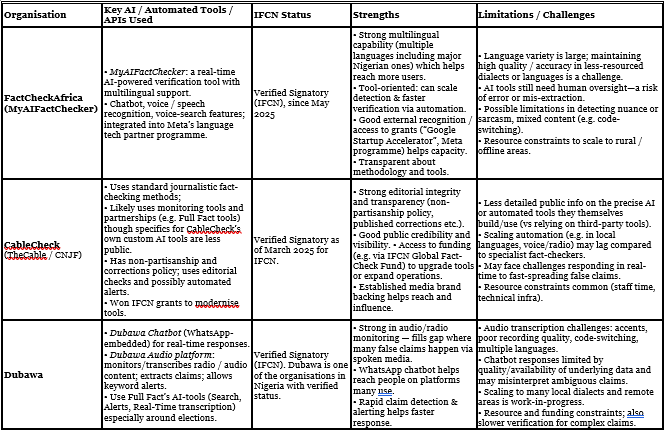
Artificial intelligence is now a partner in the newsroom. Nigerian fact-checkers have adopted automated systems that scan digital platforms for potential misinformation. These tools identify trending claims, transcribe audio broadcasts, detect manipulated visuals, and even provide automated responses to user queries. While AI offers unprecedented speed and reach, it is the human fact-checker who ensures that evidence is valid, context is correct, and communication remains ethical. The collaboration between machines and people defines the future of verification.

FactCheckAfrica’s MyAIFactChecker 

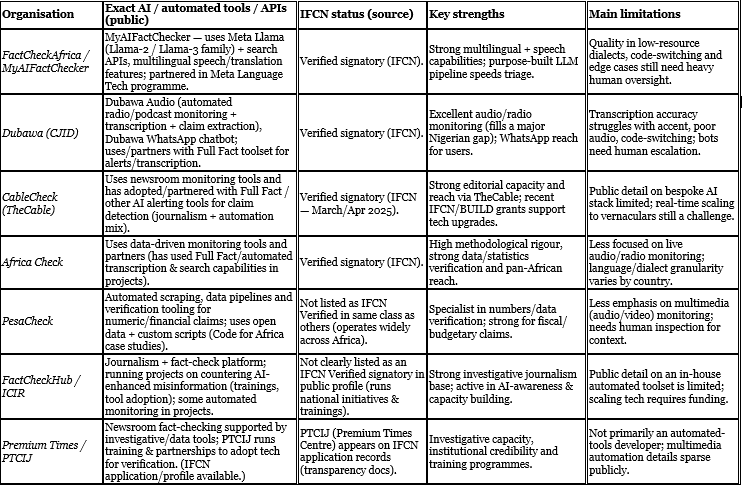
At the forefront of this movement is FactCheckAfrica.net with its MyAIFactChecker tool. Built on large language models such as Meta’s Llama and integrated with multilingual speech recognition, the platform enables quick checks across text and voice formats. The system can process claims in several African languages, making it especially valuable in multilingual societies. Yet, it remains supervised by editors who validate each claim before publication. This human oversight is critical to prevent the algorithm from spreading false positives that arise from sarcasm, cultural nuance, or regional slang.

Dubawa’s Innovation in Audio and Chat Verification

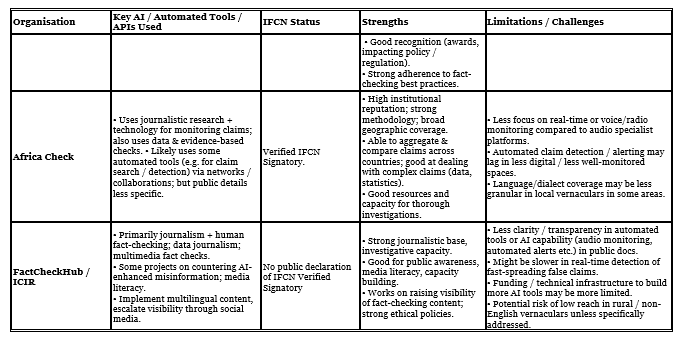
Dubawa, operated by the Centre for Journalism Innovation and Development, represents another major step in AI-driven verification. Its audio platform monitors radio shows, transcribes them, and flags possible claims for investigation. This innovation is significant because information pollution (misinformation, disinformation, fake news, and hate speech) in Nigeria often circulates through radio conversations rather than only on social media. The same organisation also manages a WhatsApp chatbot that allows citizens to check viral messages in real time. Through these tools, Dubawa shows how artificial intelligence can extend the reach of verification to places where journalists cannot be present physically.

CableCheck and the Power of Partnerships

CableCheck, the fact-checking arm of The Cable newspaper, has integrated AI alert systems developed through partnerships with Full Fact, a United Kingdom organisation that pioneers automated claim detection. These collaborations show how international cooperation accelerates innovation. By combining AI tools with experienced reporters, CableCheck can quickly identify misleading statements made by public officials and media outlets.

Regional and Youth-Led Innovators

Pan-African initiatives such as Africa Check and PesaCheck demonstrate the regional dimension of the verification network. Africa Check uses automated search and transcription tools to monitor political and social discourse across multiple countries, while PesaCheck applies algorithmic scripts to verify statistical and financial claims.

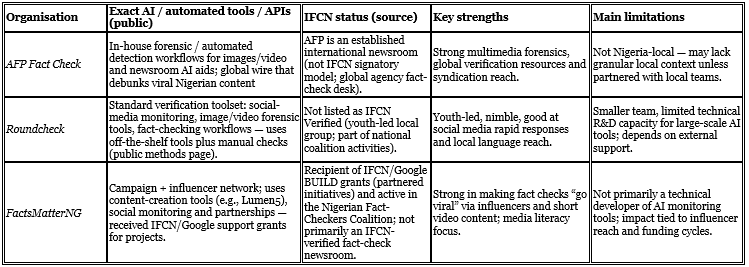
The younger generation of Nigerian fact-checkers is also experimenting with automation. Projects such as Roundcheck and FactsMatterNG use open-source forensic software, influencer networks, and automated content-creation tools to monitor and correct misinformation. These efforts are less about building complex AI systems and more about adapting existing technologies to local realities. They show that innovation in information verification does not always require massive funding, but rather strategic creativity.

The Persistent Challenges

Despite the progress, there are significant challenges. Many AI systems still struggle to interpret local dialects, cultural idioms, and the fluid mix of English and Nigerian languages common in online conversations. Audio transcription tools may misinterpret poor recordings or background noise. Automated systems cannot yet fully understand context, intent, or the political undertone of a message. Therefore, human intervention remains the ethical and analytical backbone of fact-checking.

The key issue is sustainability. Developing and maintaining AI systems demands technical capacity, reliable funding, and secure infrastructure. Fact-checking organisations rely on grants and partnerships to stay afloat, which may limit their independence. Our analyst stresses that transparency in how AI models reach conclusions is essential to preserve public trust. “When algorithms are opaque, the risk of bias or misuse increases,” he pointed out.

The Human-AI Partnership for Truth

The integration of AI into fact-checking in Nigeria is not about replacing journalists with machines but about empowering them. Artificial intelligence enhances speed, detects patterns at scale, and filters massive amounts of information, while human fact-checkers provide context, ethics, and judgment. The strongest systems will continue to be those that recognise this partnership as symbiotic rather than competitive.

As information pollution evolves with the same technological sophistication, the fact-checking community must also adapt. Nigeria’s fact-checkers are showing the world that responsible use of AI can make truth more discoverable and accessible. The lesson for media, academia, and policymakers  is that technology alone cannot defend the truth, but when guided by human values and critical reasoning, it can help rebuild public trust in information.

This position has been earlier emphasised by our analyst during AI Fundamentals Workshop held in Ibadan, where we walked participants through the processes of applying existing AI tools by exploring different information pollution cases. According to him, critical thinking is a key element in the verification and acting stages of controlling information pollution as well as protecting information ecosystem.