DD
MM
YYYY

PAGES

DD
MM
YYYY

spot_img

PAGES

Home Blog Page 351

Trump Declares Middle East War Over as Gaza Peace Deal Sparks Global Optimism — Oil Prices Expected to Drop

0

U.S. President Donald Trump on Monday declared that the war in the Middle East was “over,” as he arrived in Tel Aviv to oversee what he described as the “final phase” of a long-awaited Gaza peace deal.

The president’s visit marked a pivotal moment in the two-year conflict between Israel and Hamas — and a potential turning point for the region’s stability, global diplomacy, and oil markets.

Trump’s declaration came hours after the release of Israeli hostages held by Hamas since the 2023 assault that ignited the war. Speaking at the Knesset, Israel’s parliament, he announced that Hamas would disarm as part of the peace accord and confirmed that the fighting had officially ended. When asked by reporters if the war was truly over, Trump responded succinctly: “Yes.”

Greeted with trumpet fanfare and a standing ovation, the president told lawmakers that the “long and painful nightmare” was finally ending for both Israelis and Palestinians.

“America joins its ally in two everlasting vows,” he said. “Never forget, and never again.”

His remarks carried both triumph and restraint. Trump hailed the ceasefire as “a very exciting time for Israel and the Middle East,” adding that Israel had “won all it could by force of arms.” He urged the country to turn its military victories into peace and reconstruction.

“Now it is time to turn that strength into prosperity,” he said.

Trump extended a diplomatic olive branch to Iran, the chief backer of Hamas, calling for an end to hostility.

“The hand of friendship and cooperation is always open, even to Iran, whose regime has inflicted so much death on the Middle East,” he said. “I’m telling you, they want to make a deal. We are ready when you are.”

That overture underscores how deeply the Iran-Israel conflict has shaped both the Gaza war and global energy markets. Since the 2023 Hamas attack on Israel that killed 1,200 people and led to a devastating military response in Gaza, tensions between Israel and Iran have repeatedly threatened to spiral into a regional war. Those hostilities pushed oil prices to multiyear highs, with Brent crude briefly surpassing $110 per barrel in late 2023 amid fears that Iranian proxies could target shipping routes and oil infrastructure across the Gulf.

Analysts say that if Trump’s ceasefire and outreach to Iran hold, global energy markets could finally experience some relief. The Gaza war — coupled with Red Sea shipping disruptions caused by Yemen’s Houthi rebels — had driven up transport costs and added volatility to crude prices throughout 2024.

The Gaza war, one of the most destructive in modern Middle Eastern history, has left deep scars. More than 67,000 Palestinians have been killed, according to Gaza’s Health Ministry, while most of the enclave’s infrastructure — from schools to hospitals — lies in ruins. Israel’s two-year military campaign displaced millions, leaving the territory facing one of the worst humanitarian crises in decades.

“You’ve won, and now you can build,” Trump told Israeli lawmakers. “You can do something you never even thought possible.”

He emphasized that the “total focus of Gazans must be on restoring stability, safety, dignity, and economic development,” pledging that the United States would support Gaza’s rebuilding efforts.

The president’s address came as 20 Israeli hostages were released, along with 28 additional captives — including 26 confirmed dead — in exchange for nearly 2,000 Palestinian prisoners and detainees. The deal was hailed as a humanitarian breakthrough and a significant step toward ending the cycle of violence.

Economic and Diplomatic Implications

Trump’s peace effort has drawn cautious praise from economists and foreign policy experts who see the development as both a humanitarian and geopolitical milestone.

“It shows that the U.S. can get results if it wields its still unsurpassed global clout the right way,” said Holger Schmieding, chief economist at Berenberg Bank. “The impact on the global economy and markets should remain limited for now, but if tensions in the Middle East subside much further, the global impact could be more pronounced — especially through lower oil prices and reduced shipping disruptions.”

The Israeli-Iran standoff has long been one of the biggest geopolitical risks in the oil market. Iranian-backed Houthi attacks on Red Sea vessels forced shipping companies to reroute tankers around the Cape of Good Hope, adding weeks to delivery times and driving freight costs sharply higher. If the peace deal leads to a sustained truce and reduces these threats, analysts say oil could retreat below $60 per barrel — down from the $80 average that persisted through much of 2024.

A Personal Triumph for Trump

The peace deal marks a personal and political milestone for Trump, who has repeatedly portrayed himself as a master dealmaker capable of solving global conflicts. It builds on his earlier Middle East diplomacy, including the Abraham Accords, and could become a defining achievement of his presidency. Trump praised Israeli Prime Minister Benjamin Netanyahu, U.S. Secretary of State Marco Rubio, and senior aides such as Jared Kushner, Steve Witkoff, and Pete Hegseth for their roles in brokering the accord.

Following his meetings in Tel Aviv, Trump is expected to travel to Sharm El-Sheikh, Egypt, for a summit with about 20 world leaders to finalize the Gaza peace framework. The conference will focus on reconstruction funding, Gaza’s future governance, and regional security guarantees. Gulf nations, including Saudi Arabia, Egypt, and the UAE, are expected to play major roles in financing Gaza’s rebuilding.

However, Gaza’s humanitarian crisis is far from over, and skepticism runs deep about whether Hamas’s disarmament can be verified or whether Iran will curb its proxy networks in Lebanon, Syria, and Yemen. Yet, for the first time in two years, the prospect of lasting calm seems within reach.

Microsoft Quells Xbox Death Rumors Amid Retail Confusion, Assures Fans It’s Not Exiting the Console Business

0

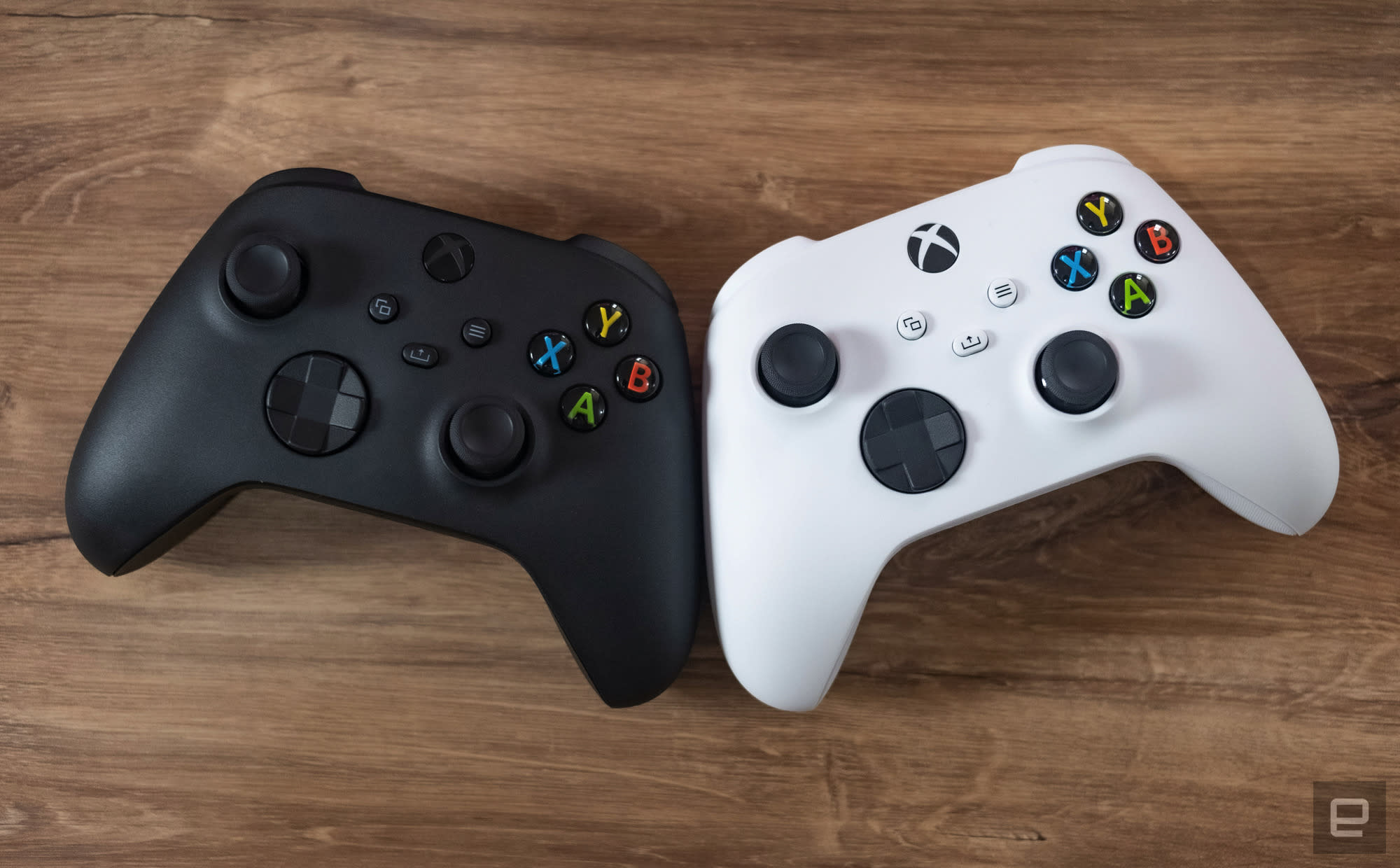
Microsoft has moved to put to rest mounting speculation that it is pulling out of the console hardware business, confirming that the Xbox line remains very much alive.

The clarification followed a storm of reports over the weekend suggesting that major U.S. retailers, including Walmart and Target, were removing Xbox products from their stores — fueling fears that the company was quietly winding down its gaming console division.

The controversy began when posts surfaced on Reddit claiming that Target had started taking down its Xbox sections, with some users alleging that Walmart had not restocked the consoles in weeks. Soon after, a wave of social media chatter and online publications amplified the story, with some declaring that Microsoft was phasing out its Xbox Series X and S consoles altogether. The claims appeared plausible given a string of recent developments that had left gamers anxious about the brand’s future.

For months, Microsoft has faced accusations of deprioritizing its console business in favor of a “play anywhere” model focused on cloud streaming and cross-platform gaming. The company’s push into cloud-based gaming, powered by its Xbox Cloud Gaming service, allows users to play without owning a console — a model seen by many as the future of gaming. Microsoft’s support for handheld devices like the ASUS ROG Ally and the upcoming ROG Ally X only added to the perception that the company was shifting away from traditional living-room consoles toward portable and multi-device gaming.

The situation was compounded by deeper challenges facing Microsoft’s gaming division. Earlier this year, the company increased the price of its Xbox Series consoles twice — a move that dented sales and made the devices less attractive compared to Sony’s PlayStation 5. Several game studios under Microsoft’s ownership were also shut down amid cost-cutting and restructuring efforts, while the price of Xbox Game Pass, its flagship subscription service, rose by 50% for the top-tier plan. All of these developments fueled the belief that Microsoft was repositioning itself away from hardware and into software and services.

By the time the retail rumors emerged, many fans were ready to believe them. Reports circulated widely that Costco, too, had removed Xbox consoles from its inventory. The speculation snowballed, with headlines across gaming blogs declaring that Microsoft might be preparing to sunset its console business altogether.

However, evidence soon emerged to contradict those claims. YouTuber and gaming journalist Destin Legarie contacted several Target and Walmart locations to verify the reports. Employees from both chains reportedly confirmed that there were no internal memos or instructions to remove Xbox stock or clear inventory. One Target employee noted that while the store hadn’t received new shipments in about a week, more consoles were expected to arrive soon — albeit in small quantities.

Adding weight to the denials, Larry Hryb — better known as “Major Nelson,” a longtime public face of the Xbox brand who served 23 years as Director of Programming for Xbox Live — weighed in on social media. Hryb said he had personally visited several Target and GameStop outlets and found Xbox hardware and accessories still being sold. His comments helped steady fans’ nerves as confusion rippled through the gaming community.

Windows Central later conducted its own checks and confirmed that Xbox consoles were still listed and available at Target, although stock levels were low and availability appeared inconsistent. A Target employee told the outlet that the Xbox section was not being removed but acknowledged that console stock often fluctuates, particularly during transitional production periods or before restocks.

Microsoft itself then issued a statement to Windows Central, affirming that “Target and Walmart, among other retailers, remain committed partners for Xbox consoles, accessories, and games.” While the company stopped short of explicitly naming the Xbox Series X and S in its statement, the inclusion of the word “consoles” indicated that the hardware business remains part of its ongoing strategy.

Still, Microsoft’s vague wording left some observers parsing its every phrase. Some analysts suggested that the term “consoles” could refer not only to current-generation devices but also to the company’s expanding hardware ecosystem — including upcoming models and handhelds. That ambiguity reflects how Microsoft has subtly shifted its vision of what “Xbox” means in the modern gaming landscape.

Indeed, Microsoft is already planning future iterations of its hardware lineup. Reports suggest that the company is preparing a refreshed version of the Xbox Series X with a more compact design and possibly an all-digital variant. Executives are also said to be working on next-generation hardware slated for release around 2026, potentially featuring AI-driven optimization and hybrid streaming capabilities.

For now, Microsoft appears eager to reassure gamers that it is not abandoning the platform that helped define its gaming legacy. Despite sluggish sales and temporary retail confusion, Xbox consoles remain in production and on shelves — even if not in abundance.

Gold’s Glittering Run: Bank of America Lifts 2026 Price Forecast to $5,000 as Investors Flock to Safe-Haven Assets

0

Bank of America Global Research has raised its price forecasts for precious metals, projecting that gold could surge to an unprecedented $5,000 per ounce by 2026, supported by a sustained wave of investment demand and growing geopolitical and economic uncertainty.

The forecast, released on Monday, signals that the bank expects gold’s historic rally to continue, albeit with potential corrections along the way. The outlook also underlines the shifting global economic climate, where fears of trade tensions, inflation, and interest rate uncertainty have reignited gold’s long-standing appeal as a safe-haven asset.

Gold broke new ground on October 8, climbing above $4,000 per ounce for the first time in history. The metal extended its record-setting momentum this week, reaching a fresh high of $4,079.62 on Monday. Analysts say the rally was fueled by renewed tariff threats from U.S. President Donald Trump against China, alongside expectations that the Federal Reserve will cut interest rates in the coming months to cushion the American economy.

“Looking into 2026, a 14% increase of investment demand—similar to what we have seen this year—could lift gold to $5,000 per ounce,” the bank said.

The bank projects that gold will average around $4,400 in 2026, suggesting that while some price volatility is likely, the general trajectory will remain upward. However, it cautioned that a short-term correction could occur as traders consolidate profits from the historic surge.

The Drivers Behind Gold’s Record Rally

Gold’s dramatic rise has been underpinned by a confluence of macroeconomic and political forces. Chief among them is the renewed strain in U.S.-China relations after Trump threatened to reimpose tariffs on Chinese imports, rekindling fears of a global trade slowdown. The announcement rattled equity markets, prompting investors to shift their holdings toward more stable assets like gold.

Adding to that, expectations of an imminent rate cut by the U.S. Federal Reserve have bolstered gold’s outlook. Lower interest rates tend to weaken the dollar and reduce the opportunity cost of holding non-yielding assets like gold, making the metal more attractive to investors.

The Federal Reserve, which has already paused its tightening cycle, is widely expected to pivot toward rate reductions by early 2025 if inflation continues to moderate and labor market growth cools. Such a move could further weaken the dollar, adding momentum to gold’s rally.

The Safe-Haven Surge

Investors have been piling into gold-backed exchange-traded funds (ETFs) and physical bullion purchases throughout 2024 and into 2025, seeking stability amid persistent market volatility. According to the World Gold Council, global holdings in gold ETFs have reached their highest levels since the pandemic year of 2020. Central banks, particularly in emerging markets, have also been heavy buyers, diversifying their reserves away from the U.S. dollar amid fears of sanctions and currency volatility.

In addition, concerns over geopolitical risks—ranging from renewed Middle East tensions to uncertainty in Eastern Europe—have further boosted gold’s appeal. It is believed that this “fear factor” could continue to underpin demand well into 2026, particularly if global conflicts remain unresolved or escalate.

While the rally has lifted gold to breathtaking levels, Bank of America cautioned that the market may experience short-term pullbacks as speculative positioning becomes crowded. Historically, gold prices have tended to retrace briefly after such rapid climbs.

Still, the underlying fundamentals remain robust. The bank’s research indicates that a continued increase in investment demand—particularly from institutional funds and central banks—could push gold higher in the medium term. The projection for a 14% growth in demand mirrors this year’s strong performance, which has already sent shockwaves through commodity markets.

A Broader Precious Metals Rally

Gold’s surge has also lifted sentiment across the broader precious metals complex. Silver and platinum have both recorded notable gains, tracking the momentum of the yellow metal. Bank of America noted that while gold remains the “core anchor” of investor portfolios, silver could benefit disproportionately if industrial demand strengthens alongside investment flows.

However, it is gold’s unique dual role—as both a commodity and a financial asset—that has kept it at the center of investor focus. As global uncertainty deepens, its reputation as a store of value appears stronger than ever.

Looking ahead, if Bank of America’s forecast proves accurate, gold could enter a historic new phase, breaking not just price records but redefining investor behavior in an era of heightened financial instability. Analysts say the key variables to watch will be the trajectory of U.S. interest rates, China’s economic performance, and geopolitical developments in the Middle East and Eastern Europe.

With inflation still elevated in major economies and public debt levels reaching record highs, gold’s narrative as a hedge against both monetary and political risk is gaining renewed legitimacy. Investors, it seems, are betting not only on the metal’s luster but also on the world’s enduring uncertainty.

Flipping Gains From Solana and XRP Into Ozak AI Could Deliver Life-Changing ROI

0

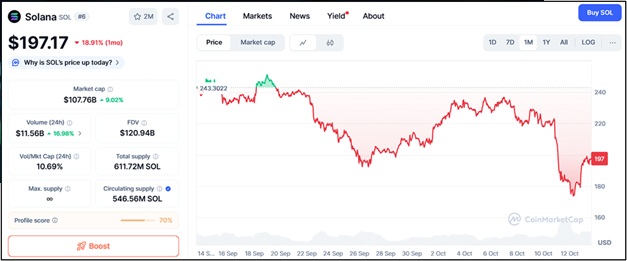
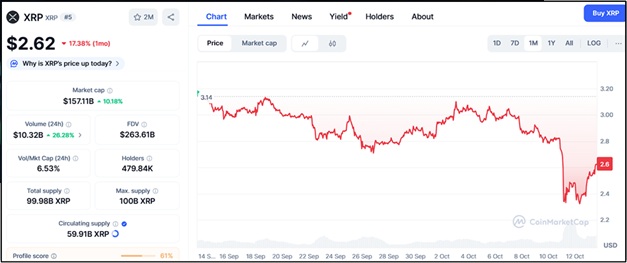
Solana and XRP are two of the strongest-performing altcoins as the 2025 bull run gains momentum. Solana is currently trading near $198, while XRP sits at $2.64, both enjoying renewed institutional interest and strong retail participation. Analysts predict Solana could rally toward $500 and XRP could climb beyond $5 in the coming months, offering investors steady and respectable returns.

But seasoned traders and early adopters know that the biggest fortunes in crypto aren’t made by simply holding blue-chip assets. Instead, they’re made by flipping a portion of those profits into early-stage tokens with explosive growth potential. That’s why many investors are rotating some of their Solana and XRP gains into Ozak AI—a presale project currently priced at $0.0012, with over $3.7 million raised and more than 945 million tokens sold. This kind of early entry could be the key to life-changing returns.

Solana and XRP Offer Strength

Solana continues to prove its strength as a high-performance Layer-1, with resistance around $235, $315, and $500, and support at $160, $130, and $110. Its ecosystem is expanding rapidly, fueling consistent growth.

XRP, meanwhile, remains a top choice for long-term holders due to its utility in global payments. It faces resistance at $3.15, $4.30, and $5.00, and support at $2.20, $1.85, and $1.40.

While both assets are primed for further appreciation, their upside is measured in multiples—not the kind of explosive 100x returns that define early-stage opportunities. For investors who already hold SOL and XRP, flipping even a small portion of their profits into Ozak AI could massively amplify their portfolio’s growth potential.

Ozak AI’s Flip Math Is Hard to Ignore

Ozak AI offers the kind of asymmetric risk-reward that experienced traders seek during bull markets. At $0.0012, a $1,000 investment secures approximately 833,000 tokens. If Ozak AI reaches $1, that $1,000 turns into $833,000. At $5, it grows to more than $4 million. And at $10, it surpasses $8 million.

This is why investors aren’t abandoning SOL or XRP—they’re simply strategically rotating a fraction of their gains into an asset with far greater upside. This move allows them to keep their blue-chip exposure while positioning early in a project with massive growth potential.

Ozak AI Sits at the Heart of the AI Megatrend

The driving force behind Ozak AI’s explosive potential is its position within the AI + blockchain megatrend, expected to define this bull run much like DeFi did in 2021 and ICOs in 2017. Ozak AI is building predictive AI agents, trust-based data layers, and on-chain intelligence, creating infrastructure that connects AI innovation with decentralized ecosystems.

Through partnerships with Perceptron and HIVE, Ozak AI has laid down a technological foundation that separates it from hype-only presales. It’s not just a token—it’s a platform designed to evolve with the AI narrative.

Early Credibility Builds Confidence

Presale projects often come with risks, but Ozak AI has made transparency and security a priority. The project has completed audits with CertiK and Sherlock and is listed on CoinMarketCap and CoinGecko. These early credibility markers have given both retail investors and whales confidence to enter before listings drive prices higher.

Flipping Early Could Be a Defining Move

Solana and XRP are excellent assets for steady gains, but they won’t deliver the kind of explosive returns that change portfolio trajectories entirely. Ozak AI, with its early entry price and AI narrative tailwind, offers that kind of potential.

By flipping a portion of their profits into Ozak AI now, investors position themselves ahead of the curve—before the listings, before the hype, and before the price runs away. In past cycles, early movers into breakout narratives have been the ones to write the next millionaire stories. In 2025, Ozak AI could be that story.


About Ozak AI

Ozak AI is a blockchain-based crypto project that provides a technology platform that specializes in predictive AI and advanced data analytics for financial markets. Through machine learning algorithms and decentralized network technologies, Ozak AI enables real-time, accurate, and actionable insights to help crypto enthusiasts and businesses make the correct decisions.


For more, visit:

Website: https://ozak.ai/

Telegram: https://t.me/OzakAGI

Twitter: https://x.com/ozakagi

Tekedia Capital Investment Meeting Day Is Saturday, Oct 18, 2025 [Join Us]

0

Greetings! The Tekedia Investment Meeting Day is scheduled for Saturday, Oct 18, 2025, at 1.30pm WAT. For 90 mins, we will present and answer questions about the 18 startups. More details in the active area of the investment dealroom.

  • Event: Cycle Meeting Day
  • Date: Saturday, Oct 18, 2025
  • Time: 1.30-3pm WAT
  • Venue: Zoom link

Video overview of all the startups is here.

We welcome you to explore these startups here.

Regards,

Tekedia Capital