DD
MM
YYYY

PAGES

DD
MM
YYYY

spot_img

PAGES

Home Blog Page 3518

Nigerian Banks Must Show Up or Exit the Scene

0

In 2004, the Central Bank of Nigeria (CBN) forced banks to recapitalise, raising their capital base from N2 billion to N25 billion. That year, the exchange rate was around N135/$.  With that, you have about $185 million capital base requirements.

The CBN has updated that number today, from N25b to N500 billion for the largest banks. At N1,300/$, you have $385 million. So, we have an effective 2x bump ($385m/$185m) from 2004 to 2024! (During that period, the GDP has increased 3X from $135b to about $420 billion now).

The Central Bank of Nigeria (CBN) has embarked on a comprehensive financial reform aimed at bolstering the stability and resilience of the nation’s banking sector.

This reform, unveiled on Thursday, March 28, 2024, by the CBN’s Acting Director of Corporate Communications, Mrs. Hakama Sidi Ali, introduces substantial increases in the minimum capital requirements for different categories of banks, tailored to the scope of their operations.

Under the latest policy directive, commercial banks holding international authorization are mandated to fortify their capital base to an impressive N500 billion. This significant augmentation underscores the CBN’s commitment to fortifying the financial robustness of banks operating on a global scale, ensuring they can weather economic uncertainties and mitigate risks effectively.

Ask me if this will make banks give loans to traders and businesses in Oriendu Market in Ovim? No really. But it could be necessary under the present circumstances. The big banks will be fine; if they decide NOT to pay dividends for 2023, their profits alone can meet whatever the apex bank wants. My concern is the small banks which may disappear. Yes, in the year Access Bank’s parent firm recorded N612 billion profit, Unity Bank was painted red in massive losses [CBN does not allow the use of profits for meeting this specific requirement].

Yes, you can call that banking inequality; it is big in Nigeria as the gaps are so much that we have the strong or dying banks, with thin middle. Just hope the CBN does not hasten this trajectory as jobs could be lost. Yet, the apex bank has got to do what it has to do, with Naira yoyo’ing the USD dollars. So, show up or exit the scene, banks!

Dreams Are Turned To Reality As Bitcoin Dogs Launch Upcoming Turns Investors To BlockDAG’s $9.9M Presale

0

The recent stir caused by the Bitcoin Dogs listing has stirred a mix of emotions among investors. While for some, it is a dream come true; for others, it is a less-than-ideal reality.

But amidst this tumultuous scenario, there’s a shining light on the horizon that’s capturing the attention of investors worldwide: BlockDAG. With its recent presale success raising $9.8 million, BlockDAG is carving out a niche as the crypto guardian angel, promising an astounding potential return on investment of easily 5000x.

BlockDAG’s Emergence

The narrative around investments took an unexpected turn with the Bitcoin Dogs Launch Upcoming saga, proving yet again the volatile nature of this domain.

However, BlockDAG emerges as a beacon of hope and stability, offering a safe harbour. It’s not just about finding shelter from the chaos; it’s about embracing a platform that’s set for exponential growth, driven by its groundbreaking technology and an unwavering focus on community building.

For those still reeling from the Bitcoin Dogs Launch Upcoming whirlwind, BlockDAG doesn’t just offer sanctuary—it promises a fertile ground for unparalleled growth. This platform’s rise to prominence is no fluke. It stems from a visionary application of Directed Acyclic Graph (DAG) technology, which ensures transactions are faster, more scalable, and efficient.

But why does BlockDAG stand out amidst all options? The answer lies in its dual commitment: to relentless innovation and to fostering a robust, transparent community. In the fast-paced crypto market, BlockDAG’s DAG-based system is a game-changer, providing speed and efficiency that leaps and bounds ahead of traditional blockchain technologies.

Beyond The Dawgs

Looking beyond the Bitcoin Dogs Launch Upcoming, BlockDAG is not just an alternative but a harbinger of the future of finance. Its robust presale, impressive technological foundation, and strong sense of community place BlockDAG in a unique position to lead the crypto revolution. Standing $9.8 million strong to join a journey not just of recovery, but of discovery and unprecedented growth.

The BDAG Road

In a world of uncertainties, BlockDAG shines as a testament to what’s possible with the right blend of innovative technology and community spirit. Its use of cutting-edge DAG technology offers transactions that are not just fast but blazing-fast, coupled with scalability that remains unmatched. The community at BlockDAG is vibrant and transparent, fostering an environment where trust and security are not just buzzwords but the foundation of investment.

With an impressive batch 5 presale coins at $0.003 each, BlockDAG doesn’t just aim to lead in the short term, it’s positioned itself for the long haul. As we navigate the post-Bitcoin Dogs Launch Upcoming era, BlockDAG invites us to explore and experience first-hand the future of finance, a future where innovation, community, and growth converge.


Invest in BlockDAG Presale:

Website: https://blockdag.network

Presale: https://purchase.blockdag.network

Telegram:https://t.me/blockDAGnetworkOfficial

Discord: https://discord.gg/Q7BxghMVyu

Central Bank of Nigeria (CBN) Orders Mega Banks to Recapitalize with N500bn, Smaller Banks N50bn

0

The Central Bank of Nigeria (CBN) has embarked on a comprehensive financial reform aimed at bolstering the stability and resilience of the nation’s banking sector.

This reform, unveiled on Thursday, March 28, 2024, by the CBN’s Acting Director of Corporate Communications, Mrs. Hakama Sidi Ali, introduces substantial increases in the minimum capital requirements for different categories of banks, tailored to the scope of their operations.

Under the latest policy directive, commercial banks holding international authorization are mandated to fortify their capital base to an impressive N500 billion. This significant augmentation underscores the CBN’s commitment to fortifying the financial robustness of banks operating on a global scale, ensuring they can weather economic uncertainties and mitigate risks effectively.

Similarly, national banks are tasked with meeting a minimum capital threshold of N200 billion, reflecting the CBN’s concerted efforts to strengthen domestic financial institutions. Meanwhile, commercial banks with regional authorization must augment their capital to N50 billion, ensuring they possess adequate resources to support their operations within specific geographic regions.

Confirming these policy adjustments in Abuja, Mrs. Hakama Sidi Ali noted the critical importance of capital adequacy in safeguarding the integrity and stability of the banking sector. Mrs. Ali further disclosed that merchant banks now face a minimum capital requirement of N50 billion, while non-interest banks with national and regional coverage must elevate their capital to N20 billion and N10 billion, respectively.
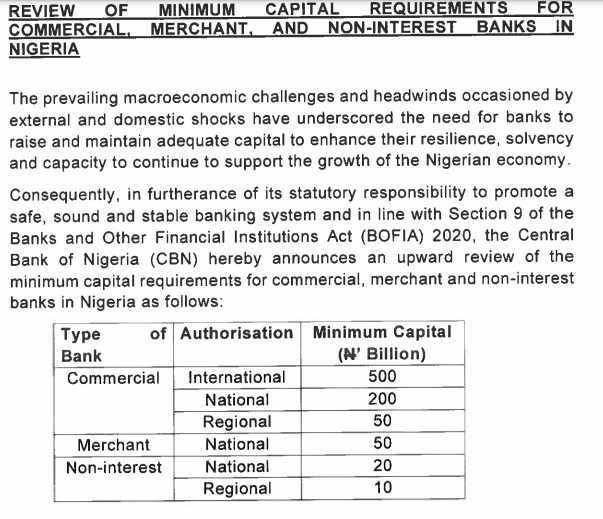
Here’s the breakdown of the new capital requirement set by the Central Bank of Nigeria (CBN):

  1. Mega Banks (Operating all over Nigeria and internationally): N500 billion
  2. Smaller Commercial Banks (Operating all over the country only): N200 billion
  3. Regional Banks (Operating in some parts of the country only): N50 billion
  4. Merchant Banks: N50 billion
  5. Non-interest Banks (Operating all over Nigeria and internationally): N20 billion
  6. Non-interest Banks (Operating in the country only): N10 billion

It’s important to note that the new capital requirement will be comprised solely of paid-up capital and share premium. Shareholders’ Fund will not be considered in meeting this requirement.

The implementation timeline for these revised minimum capital requirements is stringent, with all banks mandated to comply within 24 months, commencing from April 1, 2024, and culminating on March 31, 2026.

To facilitate the implementation of the new capital requirements, the CBN has outlined various avenues for banks to raise fresh equity capital, including private placements, rights issues, offers for subscriptions, and strategic mergers and acquisitions. Notably, the CBN has emphasized that the minimum capital will exclusively comprise paid-up capital and share premium, with Shareholders’ Funds excluded from the calculation, ensuring a focus on tangible financial resources.

Moreover, strict adherence to the minimum Capital Adequacy Ratio (CAR) requirement applicable to banks’ license authorization is paramount, with banks falling short required to inject fresh capital to rectify their standing.

“Additional Tier 1 (AT1) Capital will not be eligible for meeting the new requirement. Despite the increase in capital, banks must ensure strict compliance with the minimum Capital Adequacy Ratio (CAR) requirement applicable to their license authorisation,” a circular from the CBN stated.

The recent circular from the Central Bank of Nigeria (CBN) outlined the minimum capital requirement for newer banks. It specified that the paid-up capital would serve as the minimum capital requirement for proposed banks. This requirement would apply to all new applications for banking licenses submitted after April 1, 2024.

The circular also mentioned that the CBN would continue processing all pending applications for banking licenses where a capital deposit has been made or an Approval-in-Principle (AIP) has been granted. However, it stipulated that the promoters of such proposed banks must bridge the gap between the capital deposited with the CBN and the new capital requirement by no later than March 31, 2026.

In the interim, the CBN mandated all banks to submit an implementation plan outlining their chosen methods for meeting the new capital requirement, along with the activities and timelines involved, by April 30, 2024.

Additionally, the CBN announced its commitment to monitoring and ensuring compliance with the new requirements within the specified timeframe.

In response to these regulatory changes, Nigerian banks are diligently evaluating their capital positions and formulating comprehensive implementation plans to meet the new requirements within the stipulated timeframe.

The CBN has reiterated its commitment to monitoring and enforcing compliance with the regulations, underscoring its dedication to ensuring the resilience and stability of the banking sector.

While members of the FUGAZ – mainly Zenith Bank, First Bank of Nigeria Holdings (FBNH), Access Bank, United Bank for Africa (UBA), and Guaranty Trust Bank (GTB), may find it to raise the required capital, others – including all tier 2 and tier 3 may not.

A new report from Ernst and Young earlier this month revealed that 17 out of 24 banks could potentially fall short of meeting the capital requirement set by the central bank if it is increased by 15-fold from its current N25 billion.

According to the report, many banks may need to consider mergers and acquisitions (M&A) to shore up their capital base, a strategy reminiscent of the consolidation witnessed during the last recapitalization exercise in 2004/2005, which saw the number of banks reduced from 89 to 25.

Bitcoin Rally: Price Nears Record High as Analysts Predict Bullish Move

0

The price of Bitcoin has continued on an upward trajectory trading at $70k price, as it nears a record high of $73k price which it traded in the early period of March.

Currently, crypto markets are abuzz with speculation as a clear ascending triangle formation emerges on the Bitcoin dominance chart. Typically viewed as a bullish indicator, this pattern has ignited discussions among traders regarding the potential implications for Bitcoin’s market share.

After a massive sell-off last week, Bitcoin whales have increased their accumulation pace since Monday. According to the latest weekly report from CoinShares, more than $940 million was withdrawn from crypto investment products last week, led by Bitcoin. However, market data provided by Santiment shows that Bitcoin whales have accumulated more than 100,000 BTCs in the past seven days, around $7 billion.

Remarkably, Bitcoin’s funding rate ratio spiked to a two-week high, thus signaling an imminent bullish breakout. 10x Research CEO and head analyst Markus Thielen says the current rally is “undoubtedly on par” with the 2020 and 2021 bull market, which initially peaked in April 2021.

Based on historical price changes and Bitcoin’s recent new highs, 10x Research projected that Bitcoin would reach $77,000 by early April and $99,000 by May 2024.

CEO/Founder of Cryptoverse Benjamin Cowen expressed optimism that the price of Bitcoin will go higher in the next months.

Analyzing the Bitcoin chart, he wrote on X,

“BTC  risk is now 0.700. You can see how 2013 had a brief summer lull before another mania phase later, whereas 2019 basically just faded for 9 months. I think there is evidence to support both views. I believe the answer to which one ends up happening will be dependent on #BTC ’s reaction after rate cuts arrive in a few months.

“I do not really have a preference at this time for which one will play out, but I do feel confident that no matter what, #BTC  dominance will go higher over the next few months. So rather than concern myself with which narrative will win in the end, I will just keep my portfolio #BTC  heavy (as it has been for a while). #BTC  dominance should go up no matter the direction of BTC/USD.”

Some traders anticipate a surge in Bitcoin’s dominance, predicting that this year Bitcoin is poised to be the biggest in history, others hold contrasting views, suggesting a possible downtrend in the long term.

With the highly anticipated halving event drawing closer, optimism prevails among investors, with predictions abound that Bitcoin may establish a new peak before the historic event.

The Bitcoin halving in April will only be one small part of why the cryptocurrency could see phenomenal gains this year, according to multiple industry analysts.

Investment researcher Lyn Alden thinks the halving is important, but disclosed that it is only one factor out of many that determines the occurrence and timing of a bull market. He attributed that various measures of global liquidity, HODL waves, and other catalysts combine to serve a larger role.

He further hinted that he is bullish for the next two years due to a combination of the halving, expectations for improved global liquidity, and the fact that so many coins have rotated to strong hands in the bear market

The Dislocation and Disintermediation by Dangote Refinery on Europe’s Refineries

0

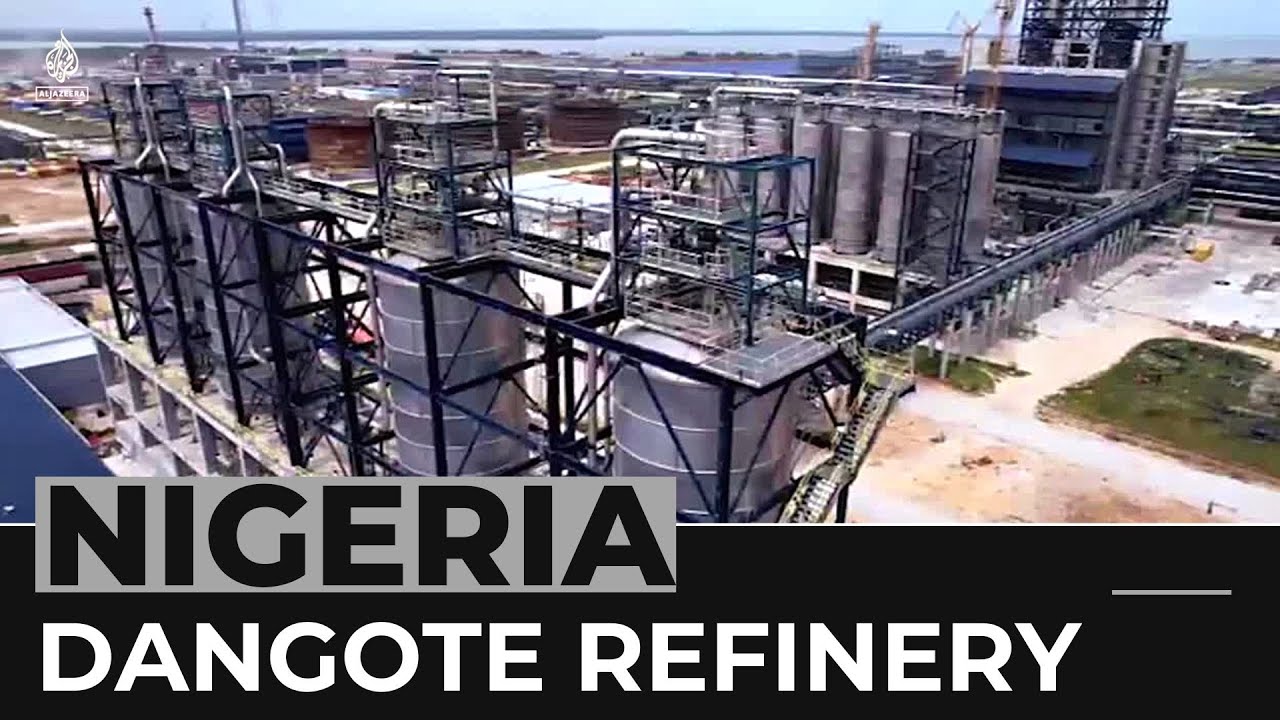
It is a massive dislocation and disintermediation by Dangote Refinery on Europe’s refineries: “Reuters reports that analysts are predicting that the commencement of operations at the Dangote refinery could signal the demise of the decades-old gasoline trade from Europe to Africa, valued at a staggering $17 billion annually.”

In other words, when Dangote Refinery begins to operate at full capacity, meeting local West African needs, some refineries in Europe which have served West Africa may have to become museums if they do not find new customers.

I wish Dangote Refinery the best of luck in this gasoline business. With what China is doing with EV, the market will change within a decade; China’s consumption of petrol is down year-on-year by 4.5%, and if not for import restrictions which Europe and US have put on their EV cars, they would have crashed the sales of petrol-powered cars in those markets.

Nigeria’s Dangote Oil Refinery Set to Disrupt European Gasoline Trade