DD
MM
YYYY

PAGES

DD
MM
YYYY

spot_img

PAGES

Home Blog Page 3585

When Nigeria’s Corporate Affairs Commission Caused Panic And How Nigeria Has Lost Its Next Generation Companies

1
CAC

There was a massive panic in the startup world when Nigeria’s Corporate Affairs Commission (CAC) dropped a notice, telling the general public that companies with foreign participation must have a N100,000,000 (about US$100,000) minimum paid-up capital. First, for most startups and companies with foreign investors and shareholders, this is nothing. Of course, that is not where Nigeria is going; Nigeria is not going after the Delaware- and London-holding companies, but their Nigerian subsidiaries.

In other words, if you have a startup in Nigeria but have a holding company in Delaware, USA, the government expects that paid-up capital to be applied in the Nigerian subsidiary. Of course, when that is done, there is a stamp duty and other fees which can also help the economy.

Understand that most major startups are structured in such a way that Nigeria’s slow, opaque and unpredictable legal system will not derail them. In other words, most investors will not invest directly in the Nigerian entity because our legal system can make a dispute which Delaware can resolve in 3 months to run into a decade. And if you are a fund manager who must return money to your limited partners (investors in your fund), you have no luck with the Nigerian legal system if there is a disagreement. As a result of this, about 90% of all startups in Nigeria which have raised at least $1 million are headquartered in the US or UK.

This setup deprives Nigeria of huge foreign direct investment which ends up affecting the economy in many ways since most of the raised funds are left in American banks (not in Lagos). As I have noted previously, if the funds raised by Nigerian startups are kept in Nigerian banking, our FX paralysis will not be this severe.

Of course, you cannot blame the founders and the investors. He who pays the piper dictates the tune. If the investor does not want to wire $20m to a Lagos bank, because he is afraid of Nigeria’s legal system, you will likely agree to set up a company in Delaware, re-domicile, and then access that money, since no one is going to make-up in Lagos on that investment. 

People, Nigeria has lost the next generation of its finest companies to America and England. Imagine if GTBank, Zenith Bank, etc of the 1990s were not Nigerians, possibly, we may not have them in the stock market today. By 2030 when we are expected to replenish our stock market with new species of companies, Nigeria will not have any because we have lost them already:

Every ten years, something great happens in the Nigerian/African economy. In the 1990s, the new generation banks were established, and they used technology to create competitive advantages in markets. In the 2000s, the voice telephony era came at scale, led by MTN.  The 2010s provided the mobile internet era as mobile phones connected to the internet, enabling new vistas of opportunities. Right now, in this decade of the 2020s, we’re in the application utility era where the power of cloud computing, mobile internet and software will redesign market sectors across territories in Africa. “

Yes, the 2020s belong to the application utility era which most of the digital startups fall under.

Back to the notice, the CAC has clarified that it was not “paid-up” but “issued capital” [issued share capital refers to the total shares that have been given to shareholders while paid-up share capital refers to the amount of issued share capital that has already been fully paid for].  Nonetheless, even if it did not clarify, that notice would not have affected many companies as many are well paid–up to in excess of $100k even locally. Also, the fee may not even be much (possibly less than N100,000 using recent guidance).

Nonetheless, Nigeria should focus on why its young people and its young companies are abandoning it even as it clarifies that it was “issued capital” and not “paid-up capital”.


Shiba Inu and TRON Price Projections – Everlodge To Feature AI

0

Shiba Inu (SHIB) was originally released in 2020, and since then, it has increased in value by 17,831,065.48%, making it one of the most sought-after meme coins. During the past week, it also experienced a 20% upswing as the entire market moved towards a bullish direction.

Alongside it, TRON (TRX) also experienced notable gains, and pseudonymous analyst Rekt Capital is bullish on its future. Everlodge (ELDG) also showcased a lot of interest from traders, especially with its vast ecosystem featuring a Property Launchpad, Rewards Club, and AI tools that can help disrupt the real estate market. Today, we will explore all of them to see which is the best cryptocurrency.

Shiba Inu (SHIB) Increases by 20% – Can Rise to $0.000017 in 2024

Shiba Inu (SHIB) is a highly popular meme-inspired cryptocurrency that is based on top of the Ethereum blockchain. It’s inspired by a Japanese dog breed used for hunting, which serves as its logo. Shiba Inu has been one of the biggest meme coins in the market for years, second to the legendary Dogecoin crypto. It was propelled to success by the massive SHIB Army, and during the past seven days, it’s up 20%.

During the year, the Shiba Inu ecosystem expanded with Shibarium, a Layer-2 network that has processed over 59,922,150 transactions since its launch, signifying massive network usage. During the past week, the crypto saw its low point at $0.00000829, with its high point at $0.00001032. According to the Shiba Inu price prediction, it can reach $0.000017 by the end of 2024.

TRON (TRX) Remains Above $0.10 – Rekt Capital Projects $0.13 by the End of Q4

The TRON (TRX) crypto has remained above the $0.10 support and between the moving average lines since November 27. Its Doji candlesticks dominated the market movement, and the altcoin is now consolidating above the support due to tiny candlestick bodies.

The price bars on the charts are not below or above the moving average lines, but TRON did showcase an upswing from $0.102362 to a high point at $0.106105 during the past week.

Rekt Capital told his over 373,000 followers on X (Twitter) that TRON could see short-term dips to convert previous resistance levels into support before moving toward the upside target. According to the analyst, the TRON price prediction puts it at its highest point of $0.13 by the end of 2023.

Everlodge (ELDG) to Introduce a Rewards Club and Property Launchpad

Everlodge (ELDG) has begun pumping in value, and this is due to a rich feature set and vast ecosystem with various elements that appeal to whales globally. Most platforms today require users to have millions in upfront capital in order to get access to real estate markets. Through minting properties as NFTs and then fractionalizing them, Everlodge makes this accessible for as little as $100.

There is also a Rewards Club where token holders can access free nightly stays. Ecosystem participants can also access the Property Launchpad, where builders can access capital from the community, while early investors can get the highest ROI.

The platform will feature a dedicated AI tool that can monitor different areas in the world to determine where real estate properties can blow up in value the most. As a result, it can be used as a prediction system. Due to this, the Everlodge crypto is seen as one of the best coins to invest in.

Summary

Shiba Inu and TRON have both historically risen in value and could soon experience a price rally. Alongside them, however, Everlodge is getting the most attention and could see the highest upswing.

During its crypto ICO at Stage 7, ELDG trades at just $0.025. With its current momentum and massive appeal, it can rise by 3,200% in value following its listing on Tier-1 exchanges, and its seen as the best cryptocurrency.

For more information about the ongoing Everlodge (ELDG) Presale, please visit their website.

Effective Hybrid Working In The Age of Remote and On-site

1

To adapt to recent changes in the work environment, workplaces are now adopting a two-tiered workforce. This means having some completely remote workers and some that are entirely on-site. This is different from a hybrid work plan where your workers work a couple of days remotely and the remaining days on-site.

With a two-tiered workforce, the employer would define the job descriptions and define those that a remote talent can do and those that require physical presence at the office location. For instance, you could decide to have the customer service and marketing team work remotely so long as they deliver on their targets and KPIs. On the other hand, the logistics department may need to be entirely on-site to ensure that orders are correctly packaged and sent out for delivery.

It may not always take this form, though. For instance, even within a department, one or two roles could be remote, while the others would be on-site. The implication is that you could have people work together for months without physically meeting.

Why a two-tier workforce?

The global talent pool has many more options for you as an employer and could give you the ability to get some of the best talents in a role outside your physical location. So, while you can have the on-site team doing their part, it is okay to tap from some outstanding talents outside your location. Remote work allows organizations to access a diverse talent pool, breaking geographical barriers and fostering a more inclusive hiring process.

Since this offers the employer flexibility to tap into a wealthy global talent pool, it comes with challenges. Mainly, it can create a sense of division and isolation between team members if there is no proper structure or culture to manage the situation. There could be a breakdown in communication, collaboration, and overall team cohesion.

Conversely, many remote workers report higher productivity levels, citing fewer distractions and a more comfortable work environment as contributing factors. Also, the on-site team may experience increased productivity due to a focused work environment and immediate access to resources.

Challenges you can expect with a Two-tier workforce

  1. Communication Disparities:

The absence of casual, in-person interactions that typically characterize an on-site team will be missing in a two-tier workforce, impacting team building and camaraderie. Also, occasional breakdowns in effective communication can lead to misunderstandings, missed information, and a lack of cohesion.

2. Cultural and Team Dynamics:

Team dynamics may differ between remote and on-site teams, potentially leading to feelings of exclusion or a lack of understanding. This way, establishing a unified organizational culture transcending physical locations becomes crucial to maintaining a cohesive workforce.

How to get the best of a Two-tier workforce

  1. Make use of Unified Communication Platforms: The use of robust communication tools can facilitate seamless collaboration and real-time interaction for both remote and on-site teams. Also, the management will need to include regular video meetings into the schedule, plus some other virtual team-building activities that can help bridge the communication gap and build some camaraderie.
  2. Equal Access to Opportunities: Ensure remote and on-site employees have equal access to career development opportunities, promotions, and recognition programs. Implement transparent performance evaluation processes to mitigate bias and ensure fairness.
  3. Cultural Integration Initiatives: Establish initiatives that foster a sense of unity and shared identity among all employees, regardless of their physical location. Come up with fun projects that get team members across departments to collaborate and work together.

Dangote Refinery Gears Up for Production as First Crude Shipment Arrives

0

Nigeria’s monumental $19 billion Dangote Refinery project is set to commence fuel production as the first crude shipment arrives at the facility, marking a significant milestone for the country’s oil industry.

The OTIS tanker, carrying a 950,000-barrel cargo of Nigeria’s Agbami crude, set sail on December 6 and is en route to Lekki, the nearest land port to Dangote’s offshore crude receiving terminal, according to industry sources and tanker tracking data reported by S&P Global. The tanker is expected to arrive on December 7 around 8pm.

This development follows months of delay that has dampened the hope of many Nigerians who are hoping on the refinery to ease the pain of the high cost of petroleum products, orchestrated by the petrol subsidy removal.

The state-owned Nigerian National Petroleum Company (NNPC), which holds a 20% stake in the refinery with a payment mechanism that includes both cash and crude oil supply, chartered the Suezmax tanker, symbolizing the initiation of crude supplies for the refinery’s operations, according to industry reports.

While many attribute this development to the NNPC’s reported plans to supply the Dangote Refinery with six crude oil cargoes in December for a test run, it unequivocally signifies the initiation of the refinery’s full-scale operation.

Despite the refinery’s official completion in May, the lack of domestic crude feedstock had hindered oil product manufacturing. To address this, the NNPC recently entered an agreement to supply 6 million barrels of crude oil as feedstock to the Dangote refinery in December, aiming to kickstart operations.

However, a development last month, when a report emerged that the NNPC is facing challenges in meeting its obligation, cast doubt on the refinery’s capacity to commence operation. The NNPC is expected to supply crude oil worth $1 billion to the Dangote Refinery, part of its payment for the acquisition of a 20 percent equity stake in the refinery.

The Agbami crude, operated by Chevron, is one of Nigeria’s major deepwater developments with a daily output of approximately 100,000 b/d in the central Niger Delta. It is known for its light sweet crude qualities with a specific gravity measuring 47.9 API and a low sulfur content of 0.04%, yielding significant proportions of naphtha and kerosene.

NNPC has chartered further shipments from various Nigerian offshore fields to the refinery, signifying the beginning of a series of scheduled crude supplies throughout this month, according to industry insiders.

The Dangote Refinery, located on the outskirts of Lagos, faced recurrent delays since its announcement in 2013. Despite substantial installation progress in 2019, delays persisted.

In June, a report from Energy Times indicated that the refinery is not anticipated to become operational until March 2024. This delay was attributed to the refinery being at an 88% completion stage, with some equipment still awaited from manufacturers. Additionally, those components that had been installed were yet to undergo the necessary integrity tests at the commissioning stage.

The refinery, designed to process multiple crudes concurrently, aims to process three Nigerian crude grades — Escravos, Bonny Light, and Forcados. At full operational capacity, the facility is expected to produce a daily output of 327,000 b/d of gasoline, 244,000 b/d of gasoil/diesel, 56,000 b/d of jet fuel/kerosene, and 290,000 mt/year of propane/LPG.

While Dangote officials anticipate an initial output of 370,000 b/d, industry analysts expect the refinery to reach its full operational capacity around mid-2025, though potential delays still loom.

The commencement of Dangote’s operations raises hopes for Nigeria’s aspiration to reduce its reliance on petrol imports, potentially transforming the country’s oil industry landscape.

Nigerian Banks Directed to Remove Non-Deposit-Taking Financial Institutions from Fund Transfer Channels

0

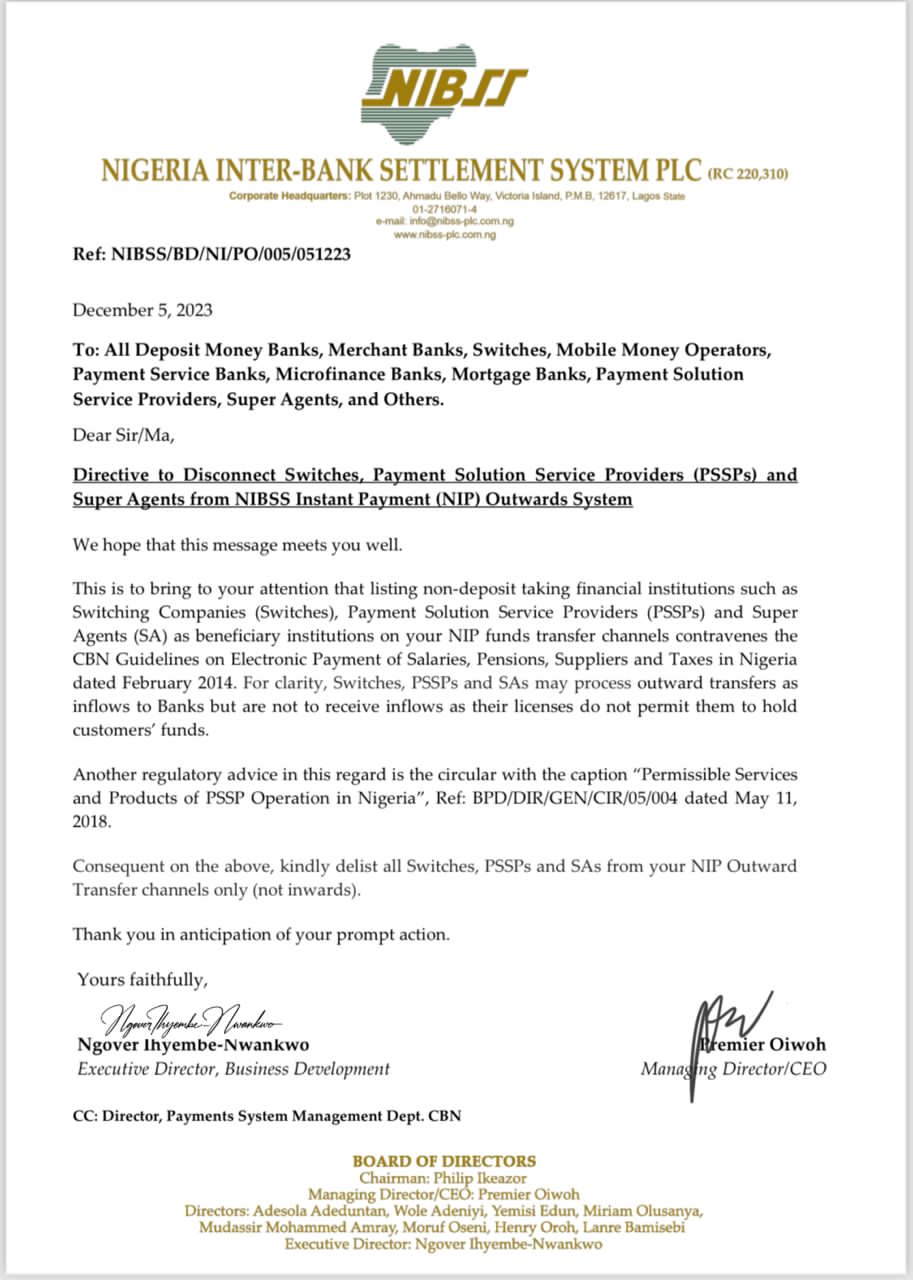
Banks in Nigeria have received a directive from the Nigeria Interbank Settlement System Plc (NIBSS) to eliminate non-deposit-taking financial institutions from their NIP (NIBSS Instant Payment) fund transfer channels. 

The affected entities include switching companies, payment solution service providers (PSSPs), and super agents. The NIP fund transfer channels encompass USSD, mobile banking apps, POS, ATMs, as well as web and internet platforms.

According to the circular issued by NIBSS, the inclusion of non-deposit-taking financial institutions as beneficiaries on NIP funds transfer channels violates the Central Bank of Nigeria (CBN) Guidelines on Electronic Payment of Salaries, Pensions, Suppliers, and Taxes dated February 2014.

The circular explicitly states, “listing non-deposit taking financial institutions such as switching companies (switches), Payment Solution Service Providers (PSSP), and Super Agents (SA) as beneficiary institutions on your NIP funds transfer channels contravenes the CBN Guidelines.”

However, the circular clarifies that while these financial institutions will be prevented from receiving inflows, they are permitted to process outflows as inflows to banks. It emphasizes that switches, PSSPs, and SAs may process outward transfers as inflows to banks but cannot receive inflows, as their licenses do not permit them to hold customers’ funds.

“For clarity, Switches, PSSPs, and SAs may process outward transfers as inflows to Banks but are not to receive inflows as their licenses do not permit to hold customers’ funds,” the NIBSS stated.

This action aligns with the New License Categorization of the Nigerian Payment System, which specifies that among various payment licensing categories—such as Switching and Processing, Payment Solutions Services encompassing Super Agent, PTSP, and PSSP—only MMOs, standing for Mobile Money Operators, are authorized to hold customer funds.

The enforcement of this policy will impact fintechs without banking licenses, requiring their removal from banks’ fund transfer channels. These platforms will still be able to facilitate outward transfers to banks but won’t be able to receive fund inflows. 

While the directive is geared towards regulatory compliance and adherence to CBN guidelines, it may have consequences for small business owners who heavily rely on these fintech platforms for their financial transactions. 

The expectation is that affected fintechs will swiftly pursue banking licenses to continue their operations without interruptions. Hence, fintech companies aiming to provide specific deposit-taking services may opt for Microfinance Banks (MfBs), while larger entities such as telecommunications companies choose Payment Service Banks (PSBs) if they intend to offer such capabilities.

Several fintech companies such as Opay, PiggyVest, and Flutterwave, who are not affected by the new directive, have quickly issued statements to allay the fears of their customers.

OPay: “We wish to state that OPay is not affected by the recent circular published by NIBSS. The focus is on Payment Service Solution Providers, Switches and Super Agents. OPay is a Mobile Money Operator (MMO) licensed by the CBN and insured by the NDIC. Your funds are safe and secure with OPay.”

Piggyvest: “Hi guys! Kindly note that Piggyvest is not affected by the recent NIBSS circular. Please disregard the misinformation. All Piggyvest virtual account numbers are provided by our licensed partners and do not fall into any of the listed categories. Your funds remain safe.”

Paystack: “Hi team, we wanted to reassure you that the recent NIBSS circular does not impact Paystack-Titan or any other Paystack services. We developed Paystack-Titan in partnership with Titan Trust Bank in a way that allows the service to operate compliantly, and it passed review from NIBSS.”

PocketApp: “Hello, Following the recent NIBSS circular, kindly note that PocketApp is a Mobile Money Operator duly licensed by the CBN under Abeg technologies. Our virtual account numbers are provided by licensed bank partners and they do not fall into any of the categories listed by NIBSS. Rest assured, your funds remain safe.”

Flutterwave: “The recent NIBSS circular has ZERO impact on our services because we are not deposit-taking like a bank. We are a licensed Switching and Processing company & an International Money Transfer Operator – this means our services remain unaffected, and we will continue to deliver best-in-class excellence to you, our customers. We are connected to NIBSS for the purpose of outward money transfer in Nigeria. Rest assured, we are open for business as usual!”

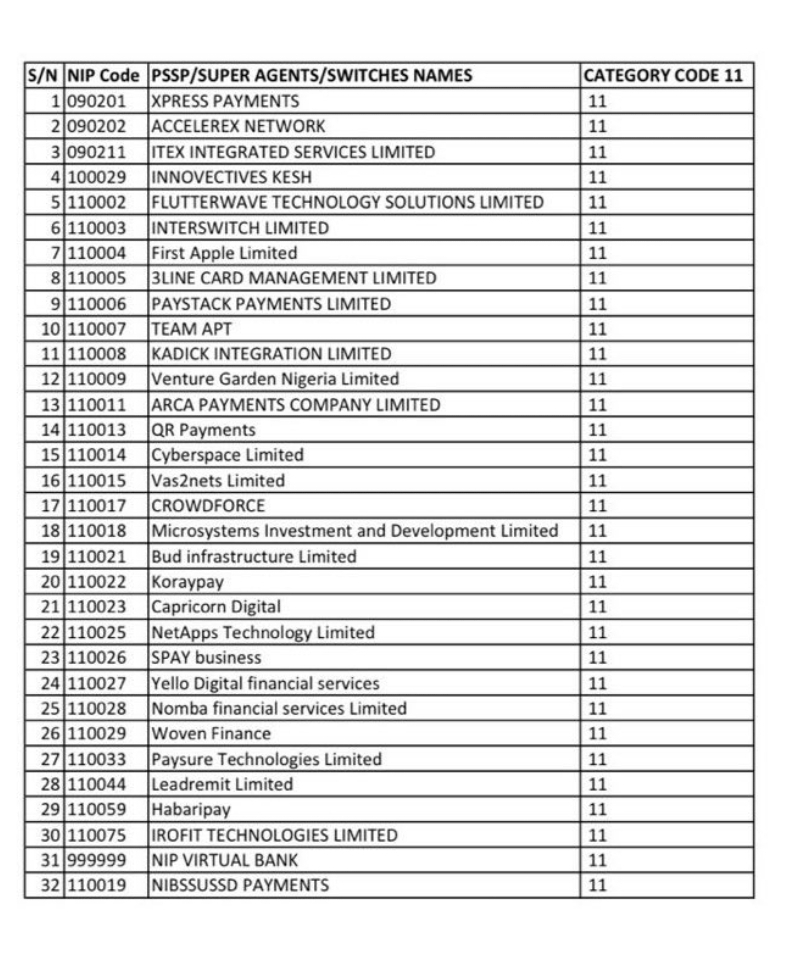
The affected fintechs are listed below: