DD
MM
YYYY

PAGES

DD
MM
YYYY

spot_img

PAGES

Home Blog Page 3685

Nigerian Crypto Exchange Platform Coinazer Expands Operations to Brazil

0

Coinazer, a Nigerian Web 3.0 crypto exchange platform has broadened its presence by expanding to Brazil.

The company announced that the expansion plan was to position itself as a globally recognized leader in digital remittances and blockchain-based financial services.

Speaking on the company’s expansion to Brazil, CEO of Coinazer Achigonye Joh Paul said,

“Coinazer global footprint has expanded to Brazil, which is a significant step in our efforts to reach a broader audience. We have forged partnerships with over 40 key players in the blockchain and Fintech industries.

“These partnerships enable us to enhance our services, expand our reach, and collaborate with like-minded organizations dedicated to advancing financial exclusivity. Coinazer’s expansion strategy extends beyond Nigeria and Brazil, as we aspire to become a globally recognized leader in digital remittances and blockchain-based financial services”.

Coinazer is reported to have clocked 5,000 customers and has facilitated over $3.8 million worth of transactions.

Founded in April 2022 by CEO Achigonye JohnPaul, alongside Egbuonu Ikenna, Malachi Chidera, and Nnaji Joshua, Coinazer is on a mission to empower individuals and businesses by providing them with secure, seamless, and cost-effective access to the world of cryptocurrencies and blockchain technology.

The crypto exchange wallet is designed to give users full control over their digital assets, while Coinazer provides a platform for users to buy, sell, and trade a wide range of cryptocurrencies.

Coinazer offers a crypto payment Gateway, Peer 2 Peer trading, Swap Farming, Exchange, Mining Investment, Conversion of crypto assets to cash, easy-to-integrate payment link, as well as structured API documentation for developers.

Currently, it supports more than 20 crypto assets, running on 18 different blockchain networks and offering low transaction fees.

Coinazer’s vision extends beyond itself, the company envisions a world where everyone has the opportunity to participate in the global financial landscape with confidence and control, including the seamless settlement of remittances, both locally and internationally.

While many crypto wallets and exchanges have high fees, transaction failures, and limited accessibility, Coinazer aims to be the opposite of that. It wants to reduce fees, enhance security, and increase accessibility and reliability.

Coinazer’s competitive edge lies in its commitment to addressing the identified market gaps and providing a holistic solution that combines the benefits of blockchain technology with financial inclusivity.

As the African digital remittance market continues to grow, Coinazer is well-positioned to capture a significant share of this expanding market by offering secure, efficient, and cost-effective remittance services

The crypto exchange platform initially secured funding from an angel investor, and is now in the pre-seed phase, with plans to further develop and expand its offerings.

Huawei Surpasses Apple’s iPhone to Claim The Top Spot in The Chinese Smartphone Market – Report

0

A recent report by Jefferies analysts has revealed that Huawei has dethroned Apple’s iPhone from its position as the smartphone market share leader in China.

According to the analysts, it reports that smartphone sales in China have shown positive growth year-over-year driven by high double-digit growth in Android sales led by Huawei, but Apple’s iPhone has seen a significant double-digit decline.

The analysts wrote,

We believe weak demand in China would eventually lead to lower than expected global shipments of iPhone 15 in 2023”, adding that the trend suggests the iPhone will lose to Huawei next year.

The Jefferies analysts wrote that Android’s volume growth can’t be chalked up to discounts and that discounts on iPhones, excluding the iPhone 15 models, have been stable, while the average discount for Android is not high.

It further noted that resale of iPhone 15 devices are all trading at discounts to official selling prices, which also reflects the weak demand in China.

After Apple released the latest model of its iPhone 15 last month September, the Cupertino giant expected the device to be a top seller, unfortunately, it recorded a massive decline in sales.

Market tracker counterpoint Research estimates a 4.5% decline in iPhone 15 sales compared to the iPhone 14 during the first 17 days after release. Apple stock fell 1.2% on the news.

Recall that Huawei also launched its latest mobile device Mate 60 Pro in the same month of September, while the 7-nanometer processor is not as advanced as Apple’s 3-nanometer, Huawei’s technological development however represents a significant advancement in the US-China chip war.

This highlights the challenges Apple is encountering in China, where economic struggles and competition from companies like Huawei are impacting iPhone sales.

Analysts predict that Huawei could sell 5 to 6 million units of the Mate 50 pro alone this year, and the numbers could hit double digits in 2024.

Reports reveal that analysts are concerned about Apple’s longer-term impact in China, the world’s largest smartphone arena. Many analysts argue that Huawei’s rising prominence could erode Apple’s dominance of the higher end of the market.

Counterpoint blamed the iPhone’s slump in China mainly on an economy struggling to rebound from its Covid trough. It stressed that in the US, the iPhone 15 likely posted a double-digit rise over 2022 in the first nine days of sales.

Also, the US and China relations are said to have impacted the smartphone war. Recall that last month, Chinese officials banned government employees from using iPhones at work, one week before Apple unveiled the iPhone 15.

While Huawei, which is seen as a national champion has enjoyed strong support from the Chinese government which includes favorable regulatory treatment, and partnerships with local carriers, all of which have contributed to Huawei’s success in the Chinese market, impacting the sales of iPhone.

It is also worth noting that China has vowed to cut reliance on foreign technologies, and doing so could hurt Apple’s market capitalization in the country, one of its biggest markets.

The ban on iPhones in China, reflects similar United States policies, such as the Federal Communications Commission designating Huawei a national security risk.

Luring Nigerians Abroad for Sustainable Development

0

The allure of the West and developed countries has seen a significant migration of Nigerian talent and resources over the past years. The exodus of Nigerians, particularly the youth, has had undeniable consequences, leaving gaps in our economy, institutions, and communities. However, it’s high time we contemplated a new narrative—a story of Nigeria’s potential and the opportunity for those who’ve ventured overseas to return and be catalysts for sustainable development.

 Building on the Strength of Our Diversity

Nigeria’s cultural wealth is a treasure trove waiting to be fully harnessed for national development. Our diverse ethnicities, languages, and traditions are sources of strength, not division. The Diaspora can play a crucial role in celebrating and preserving this cultural richness. The exchange of cultural knowledge and practices between Nigerians abroad and those at home can be a driving force for unity and shared identity.

Moreover, the return of Nigerian expatriates brings fresh perspectives and global experiences, enriching our cultural landscape. They can actively contribute to the development of the arts, including music, film, fashion, and literature, ensuring that the world continues to marvel at our creative talents.

 Streamlining the Bureaucracy

It’s no secret that bureaucracy and red tape have been a deterrent to Nigerians abroad considering a return. Administrative inefficiencies often hinder investments and discourage those wishing to engage in public service. We must commit to making our institutions more efficient, transparent, and accountable. Simplifying business registration, property acquisition, and immigration procedures is crucial. Nigerians returning home should be welcomed with open arms, not cumbersome forms. Creating a “one-stop shop” for administrative processes could go a long way in easing the transition.

The administrative framework should also extend to fostering partnerships with international organizations, NGOs, and philanthropic institutions to ensure a smooth reintegration for returning Nigerians. Engaging the Nigerian Diaspora in policy formulation, such as through advisory councils, is an effective means to harness their expertise and build trust in the administrative system.

Regional Development and Urban Planning

Regional disparities have been a driving factor in emigration. To attract Nigerians back home, we must address geographical imbalances in development. Urban centres like Lagos, Abuja, and Port Harcourt have been the primary beneficiaries of growth, while many rural areas remain underdeveloped. We need a plan for equitable regional development, with investments in infrastructure, healthcare, education, and agribusiness to stimulate economic activity outside major cities.

The return of skilled Nigerians from developed countries can be a catalyst for creating sustainable urban centres in underdeveloped areas. Investing in infrastructure and urban planning will not only ease congestion in existing cities but also create hubs of innovation and economic growth.

Investment and Entrepreneurship

The economic potential of Nigeria is immense, and returning Nigerians have a pivotal role to play in unlocking it. Initiatives like the Presidential Enabling Business Environment Council (PEBEC) have already improved the ease of doing business. We need to build on this foundation to foster a favourable environment for investments and entrepreneurship.

The government should provide incentives for returning Nigerians who invest in critical sectors such as technology, agriculture, renewable energy, and manufacturing. Tax breaks, access to credit, and supportive policies can stimulate investment.

Entrepreneurship is another vital avenue for sustainable development. The Nigerian Diaspora is already known for its entrepreneurial spirit, which can be harnessed for the benefit of the nation. Initiatives like business incubators and mentorship programmes can nurture entrepreneurial talent.

Embracing a New Narrative

Nigeria’s development journey is intrinsically linked to the return of its skilled expatriates. By adopting a cultural framework that celebrates our diversity, streamlining administrative processes, addressing geographical disparities, and fostering investment and entrepreneurship, we can create a compelling narrative that lures Nigerians back for the country’s sustainable development.

Let us remember that Nigeria is not just a land of challenges but also a land of boundless opportunities. The potential for growth, innovation, and prosperity is unparalleled. It’s time for Nigerians abroad to reconsider their role in the country’s renaissance and be part of a brighter future. Together, we can build a nation that is not just admired for its cultural richness but also celebrated for its sustainable progress.

Nigeria’s Migration Dilemma and the Path to Progress

0
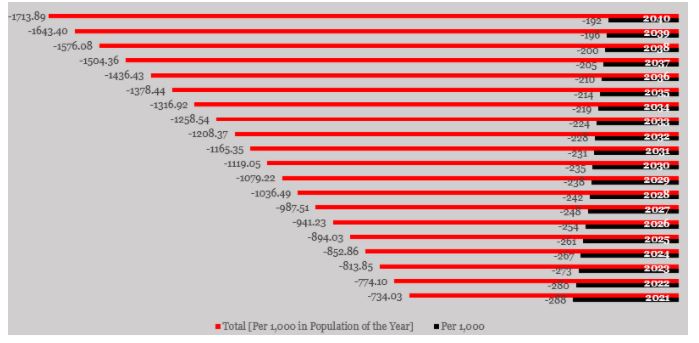
Source: Macrotrends, 2021; Infoprations Analysis, 2021

In recent years, the world has witnessed a significant exodus of Nigerian youths to Western countries and Europe. The quest for better opportunities, education, and improved living standards has driven this migration wave. This piece delves into the challenges posed by this phenomenon and explores pathways for Nigeria to address them, while also highlighting opportunities for those who choose to remain in their homeland.

Departure and its Impact

The departure of the youth has left a profound mark on various sectors, particularly education, technology, banking, and law. These sectors bear the brunt of the talent drain as skilled professionals seek their fortunes abroad. The education sector, which should be the backbone of a nation’s progress, witnesses a loss of educators and academicians to foreign shores. This exodus results in a shortage of experienced teachers and researchers, which, in turn, affects the quality of education in the country.

The technology sector in Nigeria, which has been experiencing rapid growth and innovation, also faces a significant setback due to this migration. The departure of tech-savvy youths leaves tech startups and companies in need of skilled workers. This exodus disrupts the technology landscape, stalling the growth of this promising industry. The banking and financial sector grapples with a talent shortage, and the law industry, which relies on experienced legal professionals, sees a steady outflow of talent. Both of these sectors require an influx of fresh minds and seasoned experts to thrive.

The Root Causes

To understand this migration wave, we must consider its underlying causes. Economic factors play a significant role, as Nigeria grapples with limited job opportunities and high youth unemployment rates. The desire for financial stability pushes young Nigerians abroad, where they hope to secure better-paying jobs.

Social and political instability also act as powerful push factors. Instability can discourage individuals from investing their time and skills in a nation where their future remains uncertain. Furthermore, the erosion of trust in local institutions impacts sectors like banking and law. In a climate where people lack confidence in the justice system and financial institutions, they may be less inclined to build their careers within these sectors.

Youth aspirations are another driving force behind this migration. The dream of attaining a higher quality of life abroad often lures young Nigerians. Improved access to healthcare, education, and a higher standard of living are powerful motivators.

Addressing the Challenge

To mitigate the challenges posed by youth migration, Nigeria must embark on a multifaceted approach. Firstly, it should strive to enhance educational and job opportunities within its borders. Investments in education, both in terms of quality and access, are crucial. Providing youths with opportunities to gain valuable skills and knowledge can encourage them to stay and contribute to the nation’s development.

Political and social stability must also be a priority. A stable political environment and a strong social fabric instil confidence in the nation’s future, making it more appealing for its youth to stay and contribute to its growth. Strengthening local institutions and restoring trust in them is essential, especially in sectors like banking and law. Efforts to improve transparency and accountability can help regain public trust and encourage young professionals to build their careers at home.

Furthermore, Nigeria should consider programs and incentives that attract skilled expatriates back to their homeland. Leveraging the knowledge and experience of those who have succeeded abroad can greatly benefit the country.

Opportunities Within Nigeria

While many Nigerian youths migrate in search of better opportunities, there are emerging prospects within the country itself. Nigeria’s technology sector, for instance, is growing at an impressive rate. The nation’s young and vibrant population presents a significant advantage for innovation. Encouraging entrepreneurship, supporting startups, and fostering a culture of innovation can harness the potential of local talent.

The banking industry also offers room for investment and growth. Nigeria’s large population, coupled with increasing access to financial services, creates a fertile ground for the banking sector to thrive. The legal landscape in Nigeria is evolving as well. Legal reforms are gradually improving the legal framework, offering exciting opportunities for those in the legal profession to make a positive impact.

Encouraging Reverse Migration

To encourage the return of skilled expatriates and reverse the brain drain, Nigeria should create incentives for their homecoming. Programs that facilitate reintegration, provide job opportunities, and support entrepreneurship can entice those who have succeeded abroad to return.

Supporting entrepreneurship is particularly crucial. Many expatriates may have gained valuable skills and insights while abroad and could use these to create successful businesses in Nigeria. Establishing mentorship programs and building networks can ease the transition for returnees. Fostering a culture of giving back to the community can also be instrumental in encouraging reverse migration. When professionals see opportunities to make a meaningful impact in their homeland, they are more likely to consider returning.

Collaboration for a Brighter Future

The journey to addressing the challenges of youth migration and seizing the opportunities within Nigeria requires collaboration between the government and the private sector. Government policies play a pivotal role in attracting talent and fostering a conducive environment for businesses to thrive. Public-private partnerships can be instrumental in driving economic growth and job creation.

The migration of Nigerian youths to the West and Europe is a complex issue with both challenges and opportunities. By addressing the root causes of migration, improving local opportunities, and creating a supportive environment for those who choose to return, Nigeria can harness the potential of its young population and ensure a brighter future for the nation. It’s a collective effort, with government, the private sector, and the youth themselves playing pivotal roles in shaping the destiny of the nation.

All You Need To Know About Memoranda & Articles Of Association Under CAMA 2023 Nigeria

0

Corporate Law :- Memoranda & Articles of Association Under CAMA 2023- All You Need To Know

This article deals with the topic of Memoranda & Articles of Association being one of the mosr important pieces of documentation required for incorporation and their pursuant regulations as provided under the Companies and Allied Matters Act (CAMA) 2020. 

A memorandum of association is a document which breaks down incorporation information of a company from its shareholder information to its objects clause while a company’s articles are a compilation of its bye-laws beyond which the company cannot act. 

This article will be focused on the requirements for Memoranda if Companies under CAMA 2020, articles of association, registration documents and statement of a company’s objects.

Requirements With Respect To The Memorandum Of A Company

The act provides that :-

-The memorandum of association of every company shall state :

(a) the name of the company ;

(b) that the registered office of the company shall be situated in Nigeria ;

(c) the nature of the business or businesses which the company is authorised to carry on, or, if the company is not formed for the purpose of carrying on business, the nature of the object or objects for which it is established ;

(d) the restriction, if any, on the powers of the company ;

(e) that the company is a private or public company, as the case may be ; and

(f ) that the liability of its members is limited by shares, by guarantee or unlimited, as the case may be.

-If the company has a share capital :

(a) the memorandum of association shall also state the amount of the minimum issued share capital which shall not be less than N100,000.00 in the case of a private company and N2,000,000.00, in the case of a public company, with which the company proposes to be registered, and the division thereof into shares of a fixed amount ; and

(b) each subscriber shall write opposite his name the number of shares he takes.

– A subscriber of the memorandum who holds the whole or any part of the shares subscribed by him in trust for any other person shall disclose that fact and the name of the beneficiary in the memorandum of association.

-The memorandum of association of a company limited by guarantee shall also state that:

(a) the income and property of the company shall be applied solely towards the promotion of its objects, and that no portion thereof shall be paid or transferred directly or indirectly to the members of the company except as permitted by, or under this Act ; and

(b) each member undertakes to contribute to the assets of the company in the event of its being wound up while he is a member or within one year after he ceases to be a member for payment of debts and liabilities of the company, and of the costs of winding-up, such amount as may be required not exceeding a specified amount and the total of which shall not be less than N100,000.

– The memorandum of association shall be signed by each subscriber in the presence of at least one witness who shall attest the signature.

– The memorandum shall be stamped as a deed.

Articles of Association

-A company shall have articles of association prescribing regulations for the company.

– Unless it is a company to which model articles apply by virtue of the relevant provisions of CAMA it shall register articles of association.

-Articles of association registered by a company shall be:

(a) contained in a single document, and

(b) divided into paragraphs numbered consecutively.

– Reference in this Act to a company’s “articles” are to its articles of association.

The Power of a Minister to prescribe Model Articles

-The Minister may by regulations prescribe model articles of association for companies.

-Different model articles may be prescribed for different descriptions of companies.

– A company may adopt all or any of the provisions of model articles.

– Any amendment of model articles by regulations does not affect a company registered before the amendment takes effect.

– In this section, “amendment” includes addition, alteration or repeal.


Default Application of Model Articles.

– The act provides that on the formation of a limited company if articles are:

(a) not registered ; or

(b) registered, in so far as they do not exclude or modify the relevant model articles, the relevant model articles form part of the company’s articles in the same manner and to the same extent as if those articles expressly included the relevant model articles in the form in which those articles had been duly registered.

– In this section, the “relevant model articles” means the model articles prescribed by the Commission for a company of that description as in effect at the date on which the company is registered.

Statement of a Company’s Objects

-The act provides that unless a company’s articles specifically restrict the objects of the company, its objects are unrestricted.

-Where a company amends its articles to add, remove or alter a statement of the company’s objects:

(a) it shall give notice to the Commission ;

(b) on receipt of the notice, the Commission shall register it ; and

(c) the amendment is not effective until after the entry of that notice in the register.

– Any such amendment does not affect any right or obligation of the company or render defective any legal proceeding by or against it.


Registration Documents

– The act provides that the memorandum of association shall be delivered to the Corporate Affairs Commission (CAC) together with an application for registration of the company, the documents required by this section and a statement of compliance.

– The application for registration shall state:

(a) the company’s proposed name ;

(b) the registered office address and head office address if different from the registered office address ;

(c) whether the liability of the members of the company is to be limited and, if so, whether it is to be limited by shares or by guarantee ; and

(d) whether the company is to be a private or a public company.

– If the application is delivered by a person as agent for the subscribers to the memorandum of association, it shall state the name and address of that agent.

-The application shall contain:

(a) in the case of a company that has a share capital, a statement of initial issued  share capital and initial shareholdings ;

(b) in the case of a company that is limited by guarantee, a statement of guarantee;

(c) a statement of the company’s proposed directors ;

(d) a statement of the proposed registered office of the company ; and

(e) a copy of the proposed articles of association to the extent that these are not supplied by the default application of model articles.

The Capacity & Powers Of Companies Under CAMA 2023

Companies are well known to be juristic persons, meaning that they have legally recognized personalities distinct from those of their directors, founders and members.

This article however looks at the provisions of the Companies and Allied Matters Act (CAMA) on the extent of the powers and capacity granted to companies as well as the exercise of those powers.

Powers of Companies & Prohibition of Donations for Political Purposes

The act (CAMA) provides that :

– Except to the extent that the company’s memorandum or any enactment otherwise provides, every company shall, for the furtherance of its business or objects, have all the powers of a natural person of full capacity.

– A company shall not have or exercise power either directly or indirectly to make a donation or gift of any of its property or funds to a political party or political association, or for any political purpose, and if any company, in breach of this subsection makes any donation or gift of its property to a political party or political association, or for any political purpose, the officers in default and any member who voted for the breach shall be jointly and severally liable to refund to the company the sum or value of the donation or gift and in addition, every such officer or member commits an offense and is liable to a fine equal to the amount or value of the donation or gift.

Effects of Ultra Vires Acts

– A company shall not, carry on any business expressly prohibited by its memorandum and shall not exceed the powers conferred upon it by its memorandum or this Act.

-A breach of the above-mentioned provision, may be asserted in any proceeding under the relevant provisions of this Act .

-Notwithstanding the provisions of the act, no act of a company, conveyance or transfer of property to or by a company shall be invalid by reason of the fact that such act, conveyance or transfer was not done or made for the furtherance of any of the authorized business of the company or that the company was otherwise exceeding its objects or powers.

– On the application of:

(a) any member of the company, or

(b) the holder of any debenture secured by a floating charge over all or any of the company’s property or by the trustee of the holders of any such debentures, the Court may prohibit, by injunction, the doing of, any act,conveyance or transfer of any property in breach of the relevant provisions of the act.

– If the transactions sought to be prohibited in any proceeding under this act are being, or are to be performed or made pursuant to any contract to which the company is a party, the Court may, if it deems the same to be equitable and if all the parties to the contract are parties to the proceedings,set aside and prohibit the performance of such contract, and may allow compensation to the company or to the other parties to the contract for any loss or damage sustained by them by reason of the setting aside or prohibition of the performance of such contract but no compensation shall be allowed for loss of anticipated profits to be derived from the performance of such contract.

The Effect of Reliance on Restrictions in the Memorandum

The act provides here that :-

– Where there is provision in the memorandum of association of a company restricting the powers and capacity of the company to carry on its authorised business or object, the restriction may be relied on and have effect only for the purpose of proceedings-

(a) against the company by a director or member of the company, or where the company has issued debentures secured by a floating charge over all or any of the company’s property, by the holder of any of the debentures or the trustee for the holders of the debentures ;

(b) by the company or a member of the company against the present or former officers of the company for failure to observe any such restriction ;

(c) by the Commission or a member of the company to wind up the company ; or

(d) for the purpose of restraining the company or other person from acting in breach of the memorandum or directing the company or such person to comply with the same.

– A person may not in the proceedings referred to in the relevant provisions of this act, rely on a restriction of the power or capacity of the company contained in the memorandum in any case where he voted in favour of, or by conduct agreed to the doing of an act by the company or the conveyance by or to the company of property which, it is alleged in the proceedings, was or would be contrary to the restriction.

Legal Effects of Memoranda & Articles

– Subject to the provisions of this Act, the memorandum and articles, when registered, shall have the effect of a deed between the company and its members and officers and between the members and officers themselves whereby they agree to observe and perform the provisions of the memorandum and articles, as altered in so far as they relate to the company,its members, or officers.

– All money payable by any member to the company under the memorandum or articles shall be a debt due from him to the company and shall be of the nature of a specialty debt.

– Where the memorandum or articles empower any person to appoint or remove any director or other officer of the company, such power shall be enforceable by that person notwithstanding that he is not a member or officer of the company.

– In any action by any member or officer to enforce any obligation owed under the memorandum or articles to him and any other member or officer, such member or officer may, if any other member or officer is affected by the alleged breach of such obligation, with his consent, sue in a representative capacity on behalf of himself and all other members or officers who may be affected other than any who is a defendant and the provisions of this Act shall apply.

Restrictions on Alteration of Memorandum

– The act provides that a company may not alter the conditions contained in its memorandum except in the cases and in the manner and to the extent for which express provision is made in this Act.

– Only those provisions which are required by any specific provision contained in this Act, to be stated in the memorandum of the company concerned, are deemed to be conditions contained in its memorandum.

Alteration of Memorandum

– Under CAMA 2020, the name of the company shall not be altered except with the consent of the Commission in certain circumstances.

– The business which the company is authorised to carry on or, if the company is not formed for the purpose of carrying on business, the objects for which it is established, may be altered or added to in accordance with the provisions of the act.

– Any restriction on the powers of the company may be altered in the same way as the business or objects of the company.

– The share capital of the company may be altered in accordance with the provisions of CAMA 2020, but not otherwise.

– Under CAMA 2020, any other provision of the memorandum maybe altered in accordance with outlined conditions and procedures , or as otherwise provided in this Act.