
DD
MM
YYYY

PAGES

DD
MM
YYYY

spot_img

PAGES

Home Blog Page 3690

Unveiling the Dialectical Dance: Nigerian Newspapers’ Response to 5 Years of Narcotics Prevalence

0

Between 2016 and 2020, Nigeria witnessed a concerning rise in the use of narcotics, particularly among the youth. As this societal challenge unfolded, Nigerian newspapers such as The Punch, The Guardian, and Vanguard stepped into the role of informers, shedding light on the growing issue and its deep-seated implications. This piece embarks on a journey through their response, weaving a narrative of the lessons learned and engaging in a dialectical exploration of the potential implications for the future in the ongoing struggle against drug abuse in Nigeria.

A Five-Year Chronicle

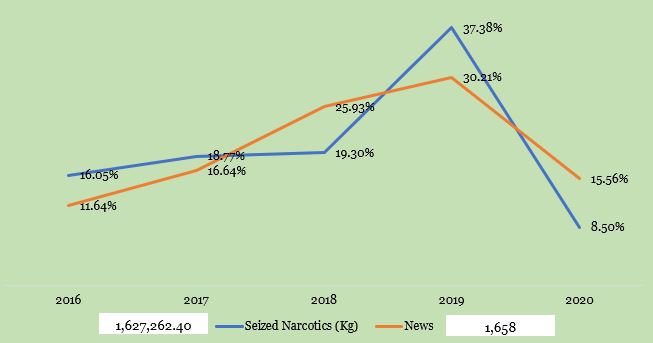
From 2016 to 2020, Nigerian newspapers etched a compelling narrative of Nigeria’s struggle against narcotics. The narrative unfolds as a story of two protagonists – the percentage of seized narcotics and the percentage of media attention directed toward this escalating problem. 2016 marked the beginning of our narrative. Even before a substantial increase in drug seizures, the media was already actively addressing the narcotics issue. This suggests that drug abuse was already a subject of concern for both the public and the media, setting the stage for heightened awareness.

As we venture into 2017, both the percentage of seized narcotics and media coverage surged, indicating a growing awareness and concern regarding the issue. The moral panic surrounding drug abuse was slowly gaining momentum, with the media playing a pivotal role in its dissemination. 2018 emerged as a turning point in our narrative. This year saw a significant surge in media coverage, outpacing the percentage of seized narcotics. This disproportionality hinted at a heightened emotional response to the problem, signifying the “hostility” stage of the moral panic. Society was becoming increasingly alarmed about the consequences of drug abuse.

The year 2019 witnessed a substantial increase in both seized narcotics and news coverage. The media’s extensive coverage indicated that the country was deep into the “disproportionality” stage, with a focus on enforcement and control. A noticeable intensification in the fight against narcotics was underway. Despite a decrease in the percentage of seized narcotics in 2020, news coverage remained relatively high. This disproportionality suggested a continued concern and response to the issue, emphasizing the persistence of the moral panic surrounding drug abuse.

Exhibit 1: Dialectical relationship between the volume of seized narcotics (kg) and newspapers response
Source: United Nations Office on Drugs and Crime, 2016-2020; Infoprations Analysis, 2023

Lessons Learned

The response of Nigerian newspapers to the narcotics issue over the past five years has offered several valuable insights through the dialectical lens. Firstly, the media has played a pivotal role in raising awareness and shaping public perception about drug abuse. This aligns with the dialectical notion of the media as both the narrator of the story and a character within it, actively influencing the narrative.

Secondly, the data reveals a dialectical tension between the two protagonists: the percentage of seized narcotics and the media’s attention to the issue. This dialectical relationship signifies a push and pull, as increasing media coverage both influences and is influenced by the severity of the problem. The disproportionality can potentially lead to stricter laws, increased law enforcement efforts, and more aggressive approaches to tackling the problem. Lastly, the persistence of media coverage, even when actual drug seizures fluctuated, reflects a dialectical tension between the ongoing concern and the tangible measures taken. This dynamic suggests that the moral panic was ongoing. The media continued to play a significant role in discussing and addressing the consequences of drug abuse.

Future Implications

The dialectical framework, rooted in the lessons learned, provides a unique perspective on the potential implications for the future stemming from Nigerian newspapers’ response to narcotics. The moral panic ignited and fueled by extensive media coverage, may lead to changes in policies and regulations regarding drug abuse. This dialectical tension between public concern and policy reform could result in stricter enforcement and control measures, aimed at curbing the drug trade and its associated consequences.

The persistent media focus on drug abuse is likely to raise public awareness further. This dialectical relationship between media influence and public response could lead to an increased emphasis on prevention and education programs in schools and communities. Moreover, the continuous societal awareness generated by media coverage might prompt a more significant investment in addiction treatment and rehabilitation facilities. This dialectical balance between the growing need for treatment and public awareness could ensure that individuals grappling with substance use disorders have improved access to effective treatment options.

Collaboration between public and private organizations and non-governmental organizations may create a dialectical synergy, strengthening the support network for individuals affected by drug abuse. This collaboration, while rooted in necessity, could significantly enhance the effectiveness of interventions. The increased media attention might encourage the establishment of a comprehensive system for collecting and analyzing data related to drug abuse. This data-driven approach, underpinned by the dialectical tension between data and policy, can guide policy development and resource allocation.

As the nature of drug abuse evolves, policymakers and managers need to continually monitor and adjust their approaches. This dialectical dynamic, characterized by the ever-shifting nature of the problem and society’s response, demands flexibility and adaptability to address the changing challenges posed by drug abuse. The dialectical approach, woven into the fabric of Nigerian newspapers’ response to narcotics, offers a profound understanding of the past, present, and future. It underscores the dynamic relationship between media coverage and societal response, shaped by the ongoing moral panic.

Nigerian newspapers have played a pivotal role in addressing the narcotics issue over the past five years. The dialectical tension between the severity of the problem and media influence has significant implications for Nigeria’s future response to drug abuse. Balancing enforcement with recovery support, focusing on education and prevention, and maintaining an adaptive approach to changing circumstances will be key to effectively addressing the issue.


Company Formation – The Right and Capacity To Register A Company In Nigeria

0
CAC

Corporate Law :- Company Formation in Nigeria – The Right & Capacity To Form a Company

This article will be looking at the foundational topic of company formation in Nigeria under the Companies and Allied Matters Act (CAMA), particularly the subtopics of :-

– The Right to Form a Company in Nigeria

– Limitations on alternative corporate bodies to companies

– The capacity of individuals to form a company

– Regulations following the different types of companies in Nigeria

The Right To Form a Company

The CAMA provides that:-

– As from the commencement of this Act, any two or more persons may form and incorporate a company by complying with the requirements of this Act in respect of registration of the company.

– Notwithstanding the provision mentioned above, one person may form and incorporate a private company by complying with the requirements of this Act in respect of private companies.

-A company may not be formed or incorporated for an unlawful purpose.

Limitations on Alternative Associations To Companies Exceeding 20 Members

Regarding this subject, the act provides that :-

– No association, or partnership consisting of more than 20 persons shall be formed for the purpose of carrying on any business for profit or gain by the association, or partnership, or by the individual members thereof, unless it is registered as a company under this Act, or is formed in pursuance of some other enactments in force in Nigeria.

– Nothing in this provision shall apply to the following exceptions—

(a) any co-operative society registered under the provisions of any enactment in force in Nigeria ; or

(b) any partnership for the purpose of carrying on practice—

(i) as legal practitioners, by persons each of whom is a legal practitioner or

(ii) as accountants by persons each of whom is entitled by law to practise as an accountant.

– If at any time the number of members of an association or partnership exceeds 20 in contravention of this section and it carries on business for more than 14 days while the contravention continues, each person who is a member of the company, association or partnership during the time it so carries on business is liable to a fine as prescribed by the Commission for every day during which the default continues

Capacity of Individuals To Form a Company

The act provides that an individual shall not join in the formationof a company under this Act if he is—

(a) less than 18 years of age ;

(b) of unsound mind and has been so found by a court in Nigeria or elsewhere;

(c) an undischarged bankrupt ; or

(d) disqualified under sections 281 and 283 of this Act from being a director of a company.

– A person shall not be disqualified under subsection (1) (a), if two other persons not disqualified under that subsection have subscribed to the memorandum.

-A corporate body in liquidation shall not join in the formation of a company under this Act.

– Subject to the provisions of any enactment regulating the rights and capacity of aliens to undertake or participate in trade or business, an alien or a foreign company may join in forming a company

Regulations Following Types of Companies

Private Companies

– A private company is one which is stated in its memorandum of associationt be a private company.

– Subject to the provisions of its articles, a private company may restrict the transfer of its shares and also provide that—

(a) the company shall not, without the consent of all its members, sell assets having a value of more than 50% of the total value of the company’s assets ;

(b) a member shall not sell that member’s shares in the company to a non-member without first offering those shares to existing members ; and

(c) a member, or a group of members acting together, shall not sell or agree to sell more than 50% of the shares in the company to a person who is not then a member, unless that non-member has offered to buy all the existing members’ interests on the same terms.

– The total number of members of a private company shall not exceed 50, not including persons who are bona fide in the employment of the company,or were, while in that employment and have continued after the determination of that employment, to be members of the company.

– Where two or more persons hold one or more shares in a company jointly, they shall, for the purpose of the act, be treated as a single member.

-A private company shall not, unless authorised by law, invite the public to:

(a) subscribe for any share or debenture of the company ; or

(b) deposit money for fixed periods or payable at call, whether or not bearing interest

Public Companies

 -Any company other than a private company shall be a public company and its memorandum of association shall state that it is a public company.

Unlimited Companies

-An unlimited company shall be registered with a share capital not below the minimum issued share capital permitted under section 27 (2) (a) of this act.

Companies limited by Guarantee

– Where a company is to be formed for the promotion of commerce art, science, religion, sports, culture, education, research, charity or rother similar objects, and the income and property of the company are to be  solely applied towards the promotion of its objects and no portion thereof is to be paid or transferred directly or indirectly to the members of the company except as permitted by this Act, the company shall not be registered as a company limited by shares, but may be registered as a company limited by guarantee.

Trezor unveils new Crypto Hardware Wallets and Backup Solution, Gauntlet to Deprecate Mai on Aave as Stablecoin Depegs

0

Trezor, one of the leading providers of crypto hardware wallets, has announced the launch of two new products: the Trezor Model T2 and the Trezor Backup Card. These products aim to offer enhanced security, usability and convenience for crypto users.

The Trezor Model T2 is the successor of the popular Trezor Model T, which was released in 2018. The new device features a larger touchscreen, a faster processor, a USB-C port and a redesigned interface. The Trezor Model T2 supports over 1,600 cryptocurrencies and tokens, including Bitcoin, Ethereum, Litecoin, Cardano, Binance Coin and more. It also allows users to access decentralized applications (DApps) and decentralized exchanges (DEXs) directly from the device.

The Trezor Backup Card is a novel solution for storing the recovery seed of the hardware wallet. The recovery seed is a set of 12 or 24 words that can be used to restore the wallet in case of loss, theft or damage. The Trezor Backup Card is a credit card-sized device that uses QR codes to store the recovery seed in an encrypted and tamper-proof way.

Users can scan the QR codes with the Trezor app or any compatible QR code scanner to access their recovery seed. The Trezor Backup Card is water-resistant, fire-resistant and shock-resistant, making it a durable and convenient alternative to paper or metal backups.

The Trezor Model T2 and the Trezor Backup Card are expected to be available for pre-order in November 2023, with shipping starting in December 2023. The price of the Trezor Model T2 is $199, while the price of the Trezor Backup Card is $49. Users who purchase both products together will receive a 10% discount.

Trezor claims that these new products will offer users a higher level of security and convenience for managing their crypto assets. According to the company’s website, “Trezor is more than just a hardware wallet. It is your gateway to the decentralized web.”

Elliptic finds apparent Russian connection in laundering of FTX stolen funds.

Elliptic, a blockchain analytics firm, has published a report that claims to have traced some of the funds stolen from the FTX crypto exchange in November 2022 to a Russian entity. The report says that about $10 million worth of Bitcoin and Ethereum were transferred from the hacker’s wallet to a service that offers anonymous transactions and swaps between different cryptocurrencies.

The service, which Elliptic did not name, is allegedly operated by a Russian individual or group, based on the analysis of the domain registration and web hosting information. Elliptic says that this service may have been used to launder the stolen funds and obscure their origin.

FTX, one of the largest crypto exchanges in the world, suffered a security breach on November 15, 2022, that resulted in the loss of about $150 million worth of various cryptocurrencies. The exchange said that it was able to recover most of the funds within hours, thanks to its internal security measures and the cooperation of other exchanges and blockchain platforms. However, some of the funds remained unaccounted for and were presumably in the hands of the hacker or hackers.

Elliptic’s report sheds some light on the possible destination of some of the missing funds, but it also raises more questions about the identity and motive of the attacker. The report suggests that the hacker may have been targeting FTX specifically, rather than randomly exploiting a vulnerability.

The report also notes that the hacker did not attempt to sell or cash out the stolen funds immediately, but rather waited for several weeks before moving them to the anonymous service. This could indicate that the hacker was either confident that they could evade detection or that they had a specific plan for using or disposing of the funds.

Elliptic says that it will continue to monitor the movement of the stolen funds and share its findings with law enforcement and FTX. The firm also urges crypto users and exchanges to be vigilant and report any suspicious transactions or activities to prevent further losses or damage.

Gauntlet to Deprecate Mai on Aave as Stablecoin Depegs

Gauntlet, a platform for risk management and governance of decentralized protocols, has proposed to deprecate Mai (formerly Matic) as a stablecoin on Aave, one of the leading lending platforms in DeFi. The reason for this proposal is that Mai has lost its peg to the US dollar and is currently trading at around $0.72, according to CoinGecko.

Mai is a synthetic stablecoin that is collateralized by Polygon’s native token, MATIC. It was launched in May 2021 by QiDao, a protocol that allows users to borrow stablecoins against their crypto assets without selling them. Mai was initially pegged to the US dollar at a 1:1 ratio, but due to various factors, such as market volatility, liquidity issues, and governance disputes, it has deviated significantly from its target price.

Gauntlet argues that this deviation poses a risk to the Aave protocol and its users, as it affects the health factor of the borrowers and the liquidation incentives of the lenders. The health factor is a metric that measures the solvency of a borrower based on their collateral value and debt value. If the health factor falls below a certain threshold, the borrower can be liquidated by the lenders, who can claim a portion of their collateral at a discount.

According to Gauntlet, the current situation of Mai creates a negative feedback loop that exacerbates its depegging. As Mai’s price drops, the borrowers’ health factor decreases, making them more vulnerable to liquidation. This in turn creates more selling pressure on Mai, as borrowers try to repay their debt or reduce their exposure. Moreover, the lenders have less incentive to liquidate the borrowers, as they would receive Mai tokens that are worth less than their face value. This reduces the demand for Mai and lowers its price further.

To address this issue, Gauntlet proposes to deprecate Mai on Aave, meaning that it would no longer be available as a borrowing or lending asset. This would effectively freeze the existing positions of Mai on Aave and prevent new ones from being created. Gauntlet claims that this would protect the Aave protocol from potential losses and reduce the systemic risk in DeFi.

Gauntlet’s proposal is currently under discussion on Aave’s governance forum and has received mixed reactions from the community. Some users support the proposal and agree that Mai is too risky to be supported on Aave. Others oppose the proposal and argue that it would harm the existing Mai users and damage the reputation of Aave as an open and inclusive platform. Some users also suggest alternative solutions, such as adjusting the risk parameters of Mai, creating a migration path for Mai users, or introducing a new synthetic stablecoin that is more robust and reliable.

The final decision on whether to deprecate Mai on Aave will depend on the outcome of the governance vote, which is expected to take place in the near future. The vote will require a quorum of at least 10% of the total AAVE tokens staked in the protocol and a majority of at least 50% of the votes cast. The vote will also be subject to a time lock of 48 hours before it can be executed.

Mai’s depegging is not an isolated incident in DeFi, as several other stablecoins have faced similar challenges in maintaining their pegs in recent months. These include Iron Finance’s IRON and TITAN tokens, which suffered a massive collapse in June 2021; Terra’s UST token, which experienced high volatility and slippage in September 2021; and OlympusDAO’s OHM token, which has been fluctuating around its target price of $1 since its launch in March 2021.

These events highlight the trade-offs and risks involved in creating and using synthetic stablecoins in DeFi. While synthetic stablecoins offer some advantages over fiat-backed or crypto-backed stablecoins, such as lower fees, higher capital efficiency, and greater composability, they also rely on complex mechanisms and assumptions that may not hold up in all market conditions. Therefore, users should exercise caution and due diligence when interacting with these assets and be prepared for potential losses or disruptions.

Zac Prince Accuses Alameda Research, FTX for collapse of crypto lender BlockFi

0

BlockFi CEO Zac Prince has accused Alameda Research and FTX of orchestrating a coordinated attack on his crypto lending platform, which led to its collapse and bankruptcy earlier this year. Prince made the allegations during his testimony at the ongoing trial of Sam Bankman-Fried (SBF), the founder and CEO of Alameda and FTX, who is facing charges of fraud, market manipulation and racketeering.

According to Prince, Alameda and FTX used their influence and resources to undermine BlockFi’s business model, which relied on offering high-interest rates to crypto depositors and lending out their assets to institutional borrowers. Prince claimed that Alameda and FTX engaged in a series of malicious actions, such as:

Shorting BlockFi’s native token, BFI, on various exchanges, driving down its price and eroding its market capitalization. Spreading false rumors and negative publicity about BlockFi’s financial situation, regulatory compliance and security measures. Launching a competing product, FTX Earn, which offered similar services to BlockFi but with lower fees and higher returns. Poaching BlockFi’s clients, partners and employees by offering them better deals or incentives to switch to FTX Earn. Hacking BlockFi’s systems and stealing confidential data, such as customer information, loan agreements and collateral details.

Prince said that these actions created a “perfect storm” that caused BlockFi to lose its liquidity, reputation and trust in the crypto market. He said that BlockFi was unable to meet its obligations to its depositors and borrowers, resulting in a wave of withdrawals, defaults and lawsuits. He said that BlockFi was forced to file for Chapter 11 bankruptcy protection in August 2021, leaving thousands of customers and creditors in limbo.

Prince also alleged that SBF was the mastermind behind the scheme, and that he personally profited from BlockFi’s demise. He said that SBF used his insider knowledge and access to manipulate the crypto market in his favor, and that he shorted BFI with leverage on FTX, making millions of dollars from its crash. He also said that SBF used his influence and connections to evade regulatory scrutiny and legal accountability.

Prince asked the jury to hold SBF responsible for his actions, and to award BlockFi with compensatory and punitive damages. He said that SBF’s conduct was “unethical, illegal and immoral”, and that he should be “punished accordingly”.

FTX has set up a complex corporate structure that involves multiple entities and jurisdictions. According to its website, FTX is owned by FTX Trading LTD, a company incorporated in Antigua and Barbuda. However, FTX also has subsidiaries and affiliates in other countries, such as FTX.US, which is registered as a money services business with FinCEN in the US.

FTX claims that it complies with all applicable laws and regulations in each jurisdiction where it operates. However, this may not be enough to protect it from potential lawsuits or enforcement actions. For instance, the US Securities and Exchange Commission (SEC) has recently sued Ripple, the company behind XRP, for allegedly selling unregistered securities. The SEC argues that Ripple’s corporate structure and global operations do not exempt it from US securities laws.

Similarly, the US Commodity Futures Trading Commission (CFTC) has recently fined BitMEX, another crypto exchange that offers futures and derivatives trading, for violating anti-money laundering and customer protection rules. The CFTC also charged BitMEX’s founders and executives with criminal offenses, including conspiracy to evade US regulations.

These cases show that the US authorities have the power and the will to go after crypto companies and individuals that they deem to be violating US laws, regardless of where they are based or registered. Therefore, FTX and Sam Bankman-Fried could also face legal consequences if they are found to be operating illegally or irresponsibly in the US market.

The question is: how likely is that to happen? And how severe would the penalties be? The answer is: it depends. It depends on many factors, such as the nature and extent of FTX’s activities in the US, the level of cooperation and transparency from FTX and Sam Bankman-Fried, the evidence and allegations from regulators and plaintiffs, and the interpretation and application of existing laws and precedents by courts and judges.

There is no clear-cut answer or rule that can determine the outcome of such a scenario. However, one thing is certain: it would not be easy or cheap for FTX or Sam Bankman-Fried to defend themselves from potential legal challenges in the US. They would have to hire lawyers, pay fines, settle claims, cooperate with investigations, comply with orders, and possibly face criminal charges or jail time.

Therefore, it is in their best interest to avoid such a situation in the first place. That means being more cautious and conservative in their business decisions, especially when it comes to offering products and services that are not clearly regulated or authorized in the US. It also means being more proactive and cooperative in engaging with regulators and lawmakers in the US, to seek clarity and guidance on how to operate legally and responsibly in the US market.

FTX is a remarkable success story in the crypto industry. But it also faces significant risks and uncertainties that could jeopardize its future. The US existing rule may not be enough to hold Sam Bankman-Fried responsible on FTX implosion. But it could be enough to cause him a lot of trouble and damage. Therefore, he should be careful and smart about how he runs his business.

SBF has denied all the charges against him and has maintained his innocence throughout the trial. He has argued that BlockFi’s failure was due to its own mismanagement, poor execution and risky business model. He has also claimed that he had no involvement or control over Alameda’s or FTX’s operations or decisions, and that he was acting in good faith as a competitor and an investor in the crypto space.

The trial is expected to last for several weeks, as both sides present their evidence and witnesses. The outcome of the case could have significant implications for the crypto industry, as it could set a precedent for how crypto businesses are regulated, litigated and valued.

Real rates are really bad for Bitcoin

0

Bitcoin, the most popular and valuable cryptocurrency, has been on a downward trend since reaching its all-time high of nearly $70,000 in April 2021. As of October 2021, the price of Bitcoin has fallen by more than 40%, hovering around $40,000. What is behind this decline? And what does it mean for the future of Bitcoin and other cryptocurrencies?

One of the main factors that affect the price of Bitcoin is the real interest rate, which is the nominal interest rate minus the inflation rate. The real interest rate reflects the true cost of borrowing money and the return on saving money. When the real interest rate is high, people have more incentive to save and invest in traditional assets, such as bonds and stocks, rather than speculative assets, such as Bitcoin.

When the real interest rate is low or negative, people have less incentive to save and invest in traditional assets, and more incentive to seek alternative assets, such as Bitcoin, that can offer higher returns or hedge against inflation.

Since the onset of the COVID-19 pandemic, central banks around the world have adopted unprecedented monetary stimulus measures to support the economy and prevent deflation. These measures include cutting nominal interest rates to near zero or below zero and expanding quantitative easing programs to buy large amounts of government and corporate bonds. These actions have pushed down the real interest rates to historic lows or negative levels in many countries, creating a favorable environment for Bitcoin and other cryptocurrencies to thrive.

However, as the global economy recovers from the pandemic, inflation pressures are rising due to supply chain disruptions, labor shortages, rising commodity prices, and pent-up consumer demand. According to the latest data from the International Monetary Fund (IMF), global inflation is expected to reach 5.9% in 2023, up from 3.2% in 2020. This means that the real interest rates are rising, even if the nominal interest rates remain low or unchanged.

For example, in the United States, the nominal interest rate on 10-year Treasury bonds is around 1.6%, but the inflation rate is around 5.4%, resulting in a negative real interest rate of -3.8%. However, if the inflation rate rises to 6%, then the real interest rate will rise to -4.4%, making it less attractive to hold Bitcoin and other cryptocurrencies.

The rising inflation and real interest rates also increase the likelihood that central banks will tighten their monetary policies sooner or faster than expected, which could further dampen the demand for Bitcoin and other cryptocurrencies.

For instance, in September 2021, the Federal Reserve signaled that it may start tapering its $120 billion monthly bond purchases as soon as November 2021, and raise its benchmark interest rate as early as 2022. Similarly, in October 2021, the Bank of England hinted that it may hike its interest rate as soon as November 2021, in response to surging inflation in the United Kingdom.

Real rates are really bad for Bitcoin because they reduce the relative attractiveness of holding Bitcoin and other cryptocurrencies compared to traditional assets. As inflation and real interest rates rise around the world, Bitcoin may face more downward pressure on its price and market share. Unless Bitcoin can overcome its technical and regulatory challenges and prove its value proposition as a digital store of value or a medium of exchange, it may lose its shine in the eyes of investors and consumers.

Is Bitcoin still the king of cryptocurrencies or is it time to look for alternatives?

This is a question that many investors, traders and enthusiasts are asking themselves as the crypto market evolves and new challenges emerge. Bitcoin, the first and most popular cryptocurrency, has been around for more than a decade and has proven to be resilient, secure and innovative. However, it also faces some limitations, such as scalability, energy consumption and regulatory uncertainty.

This is a question that many investors, traders and enthusiasts are asking themselves as the crypto market evolves and new projects emerge. Bitcoin, the first and most popular cryptocurrency, has been around since 2009 and has established itself as a store of value, a medium of exchange and a global phenomenon. But is it still the best option for those who want to enter the crypto space or diversify their portfolio?

We will explore some of the advantages and disadvantages of Bitcoin, as well as some of the potential alternatives that could challenge its dominance or complement its role in the future. We will also provide some tips on how to evaluate different cryptocurrencies and make informed decisions based on your goals and risk appetite.

Bitcoin has many features that make it attractive for investors and users. Some of these are:

Decentralization: Bitcoin is not controlled by any central authority, government or corporation. It is governed by a network of nodes that validate transactions and maintain consensus through a proof-of-work algorithm. This means that no one can censor, manipulate or inflate the supply of Bitcoin.

Security: Bitcoin is secured by cryptography and a large amount of computing power that makes it practically impossible to hack or counterfeit. It also has a high degree of transparency, as all transactions are recorded on a public ledger that anyone can access and verify.

Scarcity: Bitcoin has a fixed supply of 21 million coins that will ever be created. This creates a deflationary pressure that increases its value over time, as demand grows while supply remains constant. It also makes Bitcoin a hedge against inflation and currency devaluation.

Adoption: Bitcoin has the largest and most active community of users, developers and supporters in the crypto space. It also has the widest acceptance among merchants, platforms and institutions, making it easy to buy, sell and use. It is also supported by most exchanges, wallets and other services that facilitate its access and liquidity.

However, Bitcoin also has some limitations and challenges that could hinder its growth or make it less appealing for some users. Some of these are:

Scalability: Bitcoin can only process about 7 transactions per second, which is far below the demand of its growing user base. This creates congestion in the network, which leads to high fees and long confirmation times. Although there are some solutions to improve its scalability, such as the Lightning Network, they are still in development or adoption stages and face some technical and social hurdles.

Volatility: Bitcoin is known for its high price fluctuations, which can be influenced by various factors such as supply and demand, news, events, regulations, hacks, etc. This makes it risky and unpredictable for investors and users who seek stability and certainty.

Environmental impact: Bitcoin consumes a large amount of energy to power its mining operations, which generate new coins and secure the network. According to some estimates, Bitcoin’s annual energy consumption is comparable to that of some countries, such as Argentina or Norway. This raises concerns about its environmental impact and sustainability in the long term.

Innovation: Bitcoin is often considered as a conservative and slow-moving project, as it prioritizes security and stability over innovation and experimentation. This means that it is less likely to adopt new features or technologies that could improve its performance or functionality. It also faces competition from newer and more agile projects that offer novel solutions or address specific needs or niches in the market.