DD
MM
YYYY

PAGES

DD
MM
YYYY

spot_img

PAGES

Home Blog Page 3699

X Responds to Allegations From EU, Refutes Claims of Illegal Content Related to The Israeli-Hamas Conflict

0

Elon Musk-owned microblogging platform X has refuted the claims of the EU, accusing it of fueling the Israeli-Hamas conflict by enabling the spread of illegal content and disinformation on its platform.

This prompted the EU to issue a 24-hour ultimatum to X, to respond to the accusation by complying with the European regulations around illegal content or face sanction, which could result in fines worth 6% of the company’s revenue.

In a response to the EU’s allegations, CEO of X, Linda Yaccarino, laid out how the social media platform is tackling illegal and false content related to the Israeli-Hamas conflict.

In a letter posted on X, Yaccarino stated that after the attack on Israel from Hamas, the social media platform gathered a group of leaders to assess the situation.

Part of the letter reads,

“X is committed to serving the public conversation, especially in critical moments like this, and understands the importance of addressing any illegal content that may be disseminated through the platform. There is no place on X for terrorist organizations or violent extremist groups and we continue to remove such accounts in real time, including proactive efforts.

“Since the terrorist attack on Israel, we have taken action to remove or label tens of thousands of pieces of content, while Community Notes are visible on thousands of posts, generating millions of impressions. We continue to respond promptly to law enforcement requests from around the world, including EU member states. At the time of receipt of your letter, we had not received any notices from Europol relating to illegal content on the service.

Shortly after the news broke about the Hamas attack, X assembled a leadership group to assess the situation. In crisis situations, X’s unique purpose is to serve the public conversation, access, and share information, raise awareness about the situations they are in and on the ground, and openly and freely exchange on issues becomes all the more critical.

“There is no place for violent & hateful entities on X, including (but not limited to) terrorist organizations, violent extremist groups, perpetrators of violent attacks, or individuals who affiliate with and promote their illicit activities. For the avoidance of doubt, we strictly adhere to our policies concerning illegal content and we continue to remove illegal content, including terrorist content, from our platform.

“With respect to harmful, but not illegal content, our public interest interstitials, which provide for us to take action on a post while allowing it to remain accessible, were limited to government officials and political leaders’ legacy verified accounts.”

Linda also added that in addition to the enforcement of the company’s policies, X continues to work with law enforcement authorities. She stated that so far, X has responded to more than 80 take-down requests received in the EU within the required timelines diligently and objectively.

The letter is coming after the European Commissioner for Internal Market Thierry Breton, wrote a letter to X, accusing it of spreading misinformation and violent terrorist content.

His letter was followed after numerous researchers, news, and other groups documented a rise of misleading, false, and questionable content on X, creating confusion about the Israel-Hamas conflict.

Following the DSA obligations regarding content moderation and transparency, X via the letter has noted that it is committed to transparency, safety, and the successful implementation of the DSA and will continue to take all appropriate steps to that end.


The Big Lecture – and Philosophy in FUTO

0

Everyone knows that I love FUTO. When you arrive in a university from a village, and leave prepared for the world, you will NEVER forget the experience. The Philosophy course I took in FUTO remains one of the best courses ever in my education. It was more transformational than calculus, thermodynamics, circuits and systems. Right there, Prof Rev Ashiegbu explained why I was no more a secondary school student, but a university undergraduate, and why my reasoning, and other components of my education, must evolve.

He extended the introduction my Physics teacher in Secondary Technical School Ovim, Mr. Aham, did not conclude. Mr Aham had introduced Physics in SSI (first year in senior secondary), spending a whole week discussing natural philosophy and how before the end of the 18th century everything was studied as one thing, before they broke things into biological and physical sciences. The Chemistry teacher, Mr Udeagu Jr, reconnected to the same philosophy, and Mr Bobo, the Biology teacher, posited from his angle.

In the second week, the Math teacher, Mr Onyezewe, came and explained Mathematics as the “science of numbers which powers the natural philosophy you will learn in the science subjects”. At FUTO, I understood that natural philosophy better, and it turns out that knowledge is nothing but philosophy. Simply, Everything in life is philosophy, and we’re only specializing in different branches of philosophy. Real amazing stuff in that GST course!

Fascinating? I invite you to attend the FUTO Alumni Biennial Lecture on Oct 19, 2023, and learn amazing stuff. Once every two years, you have a tradition. Brilliant speakers are coming. Go here and pick a free seat

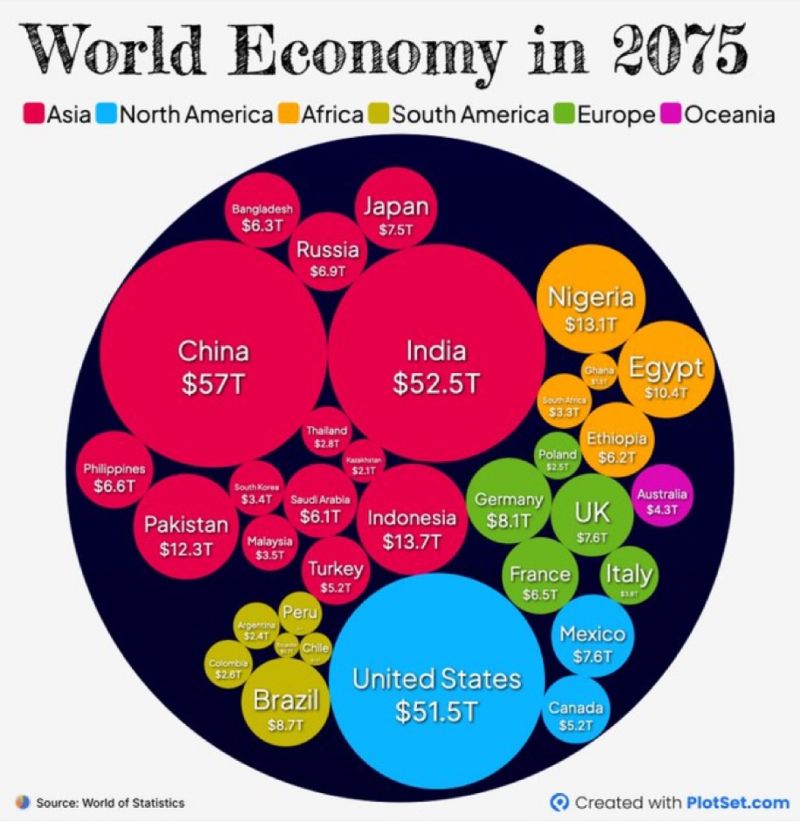
World’s biggest economies in 2075, projected by Goldman Sachs

1

According to a recent report by Goldman Sachs, the world’s economic landscape will undergo significant changes by 2075. The report predicts that the global GDP will grow by more than four times, reaching $280 trillion, and that the share of emerging markets will increase from 40% to 75%.

The report also forecasts the ranking of the top 10 economies by nominal GDP in 2075, based on factors such as demographics, productivity, investment, trade, and technology. Here are the main highlights of the projection:

China will remain the largest economy in the world, with a GDP of $80 trillion, accounting for 29% of the global output. China’s growth will be driven by its large population, high savings rate, and technological innovation.

India will overtake the US as the second-largest economy, with a GDP of $66 trillion, representing 24% of the world’s GDP. India’s growth will be fueled by its young and growing workforce, rising urbanization, and digital transformation.

The US will slip to the third place, with a GDP of $34 trillion, or 12% of the global GDP. The US will face challenges such as aging population, fiscal deficit, and geopolitical tensions.

Indonesia will emerge as the fourth-largest economy, with a GDP of $10.5 trillion, or 4% of the world’s output. Indonesia’s growth will be supported by its large and youthful population, abundant natural resources, and strategic location.

Brazil will rank fifth, with a GDP of $8.5 trillion, or 3% of the global output. Brazil’s growth will be boosted by its rich agricultural and mineral resources, diversified industrial base, and expanding consumer market.

Nigeria will climb to the sixth place, with a GDP of $7.5 trillion, or 3% of the world’s GDP. Nigeria’s growth will be driven by its huge population, abundant oil and gas reserves, and improving governance and infrastructure.

Russia will fall to the seventh place, with a GDP of $7 trillion, or 2.5% of the global output. Russia’s growth will be constrained by its declining population, low productivity, and dependence on energy exports.

Japan will drop to the eighth place, with a GDP of $6.5 trillion, or 2% of the world’s GDP. Japan’s growth will be hampered by its aging population, low birth rate, and high public debt.

Mexico will rise to the ninth place, with a GDP of $6 trillion, or 2% of the world’s output. Mexico’s growth will be aided by its proximity to the US market, diversified economy, and competitive manufacturing sector.

Germany will slide to the tenth place, with a GDP of $5.5 trillion, or 2% of the world’s output. Germany’s growth will be limited by its shrinking population, high labor costs, and trade uncertainties.

The report concludes that the world will witness a shift in economic power from the advanced economies to the emerging markets in the next five decades. It also warns that this transition will pose significant challenges and opportunities for policymakers, businesses, and investors around the world.

Some of the challenges for policymakers are:

How to ensure fair and inclusive growth across different regions and countries.

How to balance environmental sustainability and economic development.

How to foster innovation and competitiveness in a rapidly changing global market.

How to manage geopolitical risks and conflicts arising from diverging interests and values.

How to cope with social and political changes resulting from demographic shifts and cultural diversity.

Some of the opportunities for policymakers are:

How to leverage the potential of emerging markets as new sources of demand and supply.

How to enhance regional and global cooperation and integration for mutual benefit.

How to promote human capital development and social welfare for all.

How to harness technological advances and digitalization for productivity and efficiency.

How to create resilient and adaptable institutions and policies for long-term stability.

A Great Insights here

Goldman Sachs’ future projections of the world’s largest economies by 2075 indicate a significant reshaping of the global economic landscape. The rapid ascendance of emerging economies such as India, Indonesia, Nigeria, and Pakistan underscores the potential of these nations, propelled by large youthful populations, improving education, and rapid urbanization.

China is predicted to rise as the world’s largest economy, signifying the enduring success of its unique economic model. India is also projected to leap ahead, underpinned by progress in innovation and technology, rising capital investment, and favorable demographics.

Meanwhile, the United States, though forecasted to nearly double its current economy of $26.5 trillion to around $51.5 trillion, is expected to fall behind China and India. This reflects a shift of economic clout towards Asia, but also highlights an impending challenge: an escalating U.S. National Debt projected to reach 250% of its GDP by 2075, resulting in a staggering total debt nearing $125 trillion.

The emergence of Indonesia and Nigeria among the top five economies underscores the vast potential of these countries, given their strategic location, abundant natural resources, and significant population size. Similarly, the inclusion of Pakistan and Egypt in the top ten illustrates expected robust growth in the MENA and South Asian regions.

Contrastingly, established economic powerhouses such as Germany, UK, Japan, and France appear to be slipping down the ranks, reflecting the ongoing shifts in global economic dynamics. This decline may be due to an aging population, stagnating productivity, and challenges in innovation.

In Latin America, Brazil continues its dominance, but the rise of Mexico is noteworthy. Africa also sees increased representation with Nigeria, Egypt, and Ethiopia signaling potential growth and development across the continent.

These projections depict the emergence of a new world order, where developing nations could play a more substantial role in the global economy. Yet, it’s crucial to remember these are only predictions, and actual outcomes may differ due to factors like political stability, global climate change, technological advances, and unforeseen economic shifts.

Caroline Ellison Testifies Against Sam Bankman Fried in ongoing Trial, amid $USDC Being launched on Polygon Network

0

In a shocking revelation, Caroline Ellison, the former CEO of Alameda Research, admitted that she was involved in a fraud scheme orchestrated by her ex-boyfriend and former colleague, Sam Bankman-Fried, the founder of FTX exchange. Ellison testified in court that Bankman-Fried pressured her to manipulate the trading volume and liquidity of Alameda Research, a leading cryptocurrency trading firm, to inflate its valuation and attract more investors. Ellison said that she complied with Bankman-Fried’s demands out of fear and love, but later realized that she was being used and abused by him.

She decided to cooperate with the authorities and expose the fraud, hoping to clear her name and reputation. Bankman-Fried, who is also the CEO of FTX exchange, one of the largest cryptocurrency exchanges in the world, has denied any wrongdoing and accused Ellison of lying and defaming him.

SBF claimed that Ellison acted on her own and that he had no knowledge or involvement in the fraud. The trial is expected to last for several weeks and could have major implications for the cryptocurrency industry, as Alameda Research and FTX exchange are among the most influential and powerful players in the market.

FTX and its bankrupt founder SBF, has filed lawsuits against several law firms and attorneys for allegedly facilitating a fraudulent scheme that cost him $200 million. According to the complaint, Bankman-Fried was tricked into lending $200 million worth of crypto assets to Alameda Research, a trading firm he also founded, under the pretext of a margin call.

However, the lawsuit claims that the margin call was a sham, and that the defendants used the borrowed funds to engage in market manipulation and insider trading. The complaint also alleges that the defendants breached their fiduciary duties, committed legal malpractice, and violated various securities laws.

Bankman-Fried is seeking to recover the $200 million he lent to Alameda, as well as punitive damages and attorney fees. He is also asking the court to appoint a receiver to take control of Alameda’s assets and operations, and to conduct a forensic audit of its trading activities. Bankman-Fried claims that he has been unable to access or verify Alameda’s financial records, and that he suspects that the firm is insolvent or close to insolvency.

The lawsuit names several law firms and attorneys as defendants, including Perkins Coie LLP, Cooley LLP, Fenwick & West LLP, Baker Botts LLP, and Paul Hastings LLP. The complaint accuses them of conspiring with Alameda’s principals and employees to orchestrate the fraudulent scheme, and of providing false or misleading legal advice to Bankman-Fried. The lawsuit also alleges that some of the defendants had conflicts of interest, as they represented both Bankman-Fried and Alameda in various transactions and disputes.

Bankman-Fried is one of the most prominent figures in the crypto industry, with a net worth of over $10 billion. He founded FTX in 2019 and has since grown it into one of the largest and most innovative crypto exchanges in the world. He is also known for his philanthropic efforts, having pledged to donate at least half of his wealth to charity. He has been vocal about the need for more regulation and transparency in the crypto space and has expressed support for the recent efforts by the U.S. Securities and Exchange Commission (SEC) to crack down on fraud and misconduct.

$USDC, the world’s leading digital dollar stablecoin, has been launched on Polygon, a scalable and secure layer-2 platform for Ethereum. This is a major milestone for both projects, as it will enable users to access the benefits of fast, low-cost and secure transactions with $USDC on Polygon.

$USDC is a fully backed, regulated and transparent stablecoin that maintains a 1:1 peg to the US dollar. It is issued by Circle, a leading fintech company that provides payment and treasury infrastructure for the digital economy. $USDC is widely used across DeFi, crypto exchanges, payments and other use cases, with over $30 billion in circulation and more than $700 billion in on-chain transactions.

Polygon is a protocol and framework for building and connecting Ethereum-compatible blockchain networks. It offers a solution for Ethereum’s scalability and cost issues, by providing a multi-chain system that supports various scaling approaches such as Plasma, ZK-rollups and Optimistic rollups. Polygon is compatible with the Ethereum mainnet, which means that users can seamlessly transfer assets and use applications across both networks.

By launching $USDC on Polygon, they are opening up new possibilities for users to interact with DeFi protocols, NFT platforms, gaming dapps and other innovative projects on Polygon. Users can now enjoy fast and cheap transactions with $USDC, without compromising on security or decentralization. Users can also bridge their $USDC from Ethereum to Polygon using the official Polygon bridge, which is simple and user-friendly.

Nigerian Fintech, Moniepoint, Makes CB Insights Fintech 100 List For the Second Year in A Row

0

Moniepoint, a Nigerian Fintech company that offers payments, banking, and operations solutions for businesses in emerging markets, has debuted on the CB Insight Fintech 100 ranking for the second year in a row.

CB Insight is regarded by top industry analysts as the most trusted source for technology market insight. The market intelligence platform analyzes data points on venture capital, startups, patents, partnerships, and tech news.

On its latest top 100 Fintech ranking list, it contains a mix of companies at different stages from maturity, product development, and funding.

These companies were chosen based on factors, including equity funding, news sentiment analysis, investor profiles, R&D activity, business relationships, competitive landscape, market potential, proprietary Mosaic scores, and tech novelty.

Reacting to its ranking on CB Insights Fintech’s top 100 ranking of Fintech companies for 2023, Group CEO of Moniepoint Inc., Tosin Eniolorunda expressed excitement while stating that the Fintech startup has continued to show commitment to offering remarkable financial services for customers.

In his words,

“We are honored to be recognized by CB Insights as one of the top 100 fintech companies of 2023. This listing validates our Unwavering commitment to powering dreams and driving financial happiness for everyone.

“It is also a strong reflection of our momentum in terms of growth, innovation, and making a real difference in the marketplace. Our team has worked tirelessly to deliver innovative solutions that empower individuals and businesses across Africa with accessible, efficient, and secure digital financial services. This recognition is a testament to our efforts in enhancing financial inclusion and transforming the lives of millions across the continent.”

Moniepoint inclusion on CB Insights Fintech 100 List for the Second year in a row doesn’t come as a surprise, as the Fintech startup has continued to show commitment towards enhancing and providing seamless financial services for customers.

The Fintech startup has continued to actively expand its network of point-of-sale (PoS) terminals across Nigeria. This expansion aims to bring digital financial services to underserved and remote areas, contributing to improved financial inclusion in the country.

The company has established partnerships with various financial institutions, including banks, to facilitate seamless transactions through its PoS network. These collaborations have enabled Moniepoint to offer a wide range of financial services.

In a bid to make it easy for users to access and manage their funds through their extensive network of agents and PoS terminals, Moniepoint integrated with digital wallets and mobile money platforms.

In Nigeria’s competitive Fintech landscape, Moniepoint remains one of the top key players, competing with other fintech companies offering similar services like Opay, Palmpay, and several others.

The growth of Moniepoint has contributed to Nigeria’s economic development by facilitating financial transactions, promoting digital payments, and supporting small businesses.