DD
MM
YYYY

PAGES

DD
MM
YYYY

spot_img

PAGES

Home Blog Page 3847

Circle Recommends Tweaks to EU’s Proposed Crypto Guidelines

0

Circle, a leading global financial technology firm and the principal operator of the USD Coin (USDC) stablecoin, has published a blog post in response to the European Commission’s proposed Markets in Crypto-Assets (MiCA) regulation. In the post, Circle outlines its views on how the MiCA framework can be improved to foster innovation and inclusion in the crypto sector, while ensuring consumer protection and financial stability.

The European Union (EU) has been working on a comprehensive framework for regulating cryptocurrencies and other digital assets. The proposed regulation, known as the Markets in Crypto-Assets Regulation (MiCA), aims to provide legal clarity and consumer protection for crypto-asset issuers, service providers and users.

Circle welcomes the MiCA proposal as a positive step towards creating a harmonized and comprehensive regulatory regime for crypto assets in the EU. Circle also commends the Commission for recognizing the potential of stablecoins to enhance cross-border payments, financial inclusion, and economic growth. However, Circle also identifies some areas where the MiCA proposal could be revised or clarified to better reflect the realities and opportunities of the crypto industry.

The MiCA proposal should adopt a more nuanced and risk-based approach to classifying crypto-assets, rather than relying on a binary distinction between asset-referenced tokens (ARTs) and e-money tokens (EMTs). Circle argues that this distinction is too rigid and does not capture the diversity and innovation of stablecoin models. For instance, Circle suggests that USDC, which is backed by US dollars held in reserve accounts at regulated financial institutions, should not be considered an ART, as it does not pose the same risks as other types of stablecoins that are backed by more volatile or complex assets.

The MiCA proposal should allow for more flexibility and proportionality in applying the prudential and governance requirements for stablecoin issuers. Circle contends that some of the requirements, such as having a minimum capital of 5 million euros, maintaining a 1:1 reserve ratio at all times, and obtaining prior authorization from a competent authority, are too stringent and may create barriers to entry and innovation for smaller or newer players.

Circle proposes that these requirements should be tailored to the specific characteristics and risks of each stablecoin, taking into account factors such as the nature and quality of the underlying assets, the governance and audit mechanisms, and the market size and reach of the stablecoin.

The MiCA proposal should clarify the scope and applicability of the anti-money laundering (AML) and counter-terrorism financing (CTF) obligations for stablecoin issuers and service providers. Circle notes that some of the provisions in the MiCA proposal seem to overlap or conflict with existing AML/CTF regulations in the EU, such as the Fifth Anti-Money Laundering Directive (5AMLD) and the Sixth Anti-Money Laundering Directive (6AMLD). Circle urges the Commission to harmonize and streamline the AML/CTF rules for crypto-assets, and to ensure that they are consistent with international standards and best practices.

MiCA covers a wide range of topics, such as:

Defining different types of crypto-assets, such as utility tokens, asset-referenced tokens and e-money tokens.

Establishing rules for issuing and offering crypto assets to the public, such as disclosure requirements, whitepapers and prospectuses.

Setting standards for crypto-asset service providers, such as custodians, exchanges and trading platforms, including licensing, governance, capital and operational requirements.

Introducing a passporting system that allows crypto-asset service providers to operate across the EU with a single authorization.

Harmonizing the supervision and enforcement of crypto-asset activities among national competent authorities and the European Banking Authority.

Enhancing consumer protection and market integrity by imposing anti-money laundering, anti-fraud and market abuse rules on crypto-asset activities.

Addressing the risks and opportunities of stablecoins, especially those with a global reach, by imposing additional requirements on their issuers and service providers.

MiCA is expected to enter into force in 2024, after being adopted by the European Parliament and the Council of the EU. It will have a significant impact on the crypto-asset industry in Europe and beyond, as it will create a common legal framework that will foster innovation, competition and growth. Circle concludes by reaffirming its commitment to working with regulators, policymakers, and industry stakeholders in Europe and around the world to advance a balanced and forward-looking regulatory framework for crypto assets. Circle also invites feedback and dialogue from the crypto community on its suggestions for improving the MiCA proposal.


Labour Party, PDP Reject PEPT’s Judgment Upholding Tinubu’s Victory, Vow to Appeal

0

The Labour Party (LP) has expressed its disapproval of the Presidential Election Petition Tribunal’s decision, which dismissed the petitions filed by its candidate, Peter Obi, challenging the victory of President Bola Tinubu in the February 25 presidential elections.

The PEPT had on Wednesday, quashed all charges filed by the LP and other political parties, challenging Tinubu’s victory. But the LP said in a statement on Wednesday that it rejects the rulings as they did not serve justice or reflect the law and the desires of the people.

“The Labour Party watched with dismay and trepidation the dismissal of petitions by the five-man panel of the Presidential Election Petition Court led by Justice Haruna Tsammani today and we reject the outcome of the judgment in its entirety because justice was not served and it did not reflect the law and the desire of the people,” Obiora Ifoh, national publicity secretary of the LP, said in the statement.

“Nigerians were witnesses to the electoral robbery that took place on February 25, 2023, which was globally condemned but the Tribunal in its wisdom refused to accept the obvious.

“What is at stake is democracy and we will not relent until the people’s will prevail.

“We salute the doggedness of our team of lawyers who fearlessly exposed the wrath in our system. We can only weep for democracy in Nigeria but we refuse to give up on Nigeria.

“Details of the party’s position will be presented after consultation with our lawyers after the Certified True Copy of the judgment is made available to us.”

The Independent National Electoral Commission (INEC) declared Tinubu the winner of the presidential election and Atiku Abubakar of the Peoples Democratic Party (PDP) and Obi the second and third runners-up respectively.

However, both the LP and the PDP filed petitions in March challenging the outcome of the presidential poll.

In their final written address dated July 20, the petitioners reiterated their claim that both Tinubu and Vice President Kashim Shettima were not eligible to participate in the election.

The petitioners had contended that Tinubu’s ineligibility stemmed from the forfeiture of $460,000 in the US and his inability to secure 25 percent of the votes cast in the Federal Capital Territory (FCT).

The petitioners also challenged the outcome of the election on the grounds of fraud and electoral malpractices, which they said the INEC had connived with the ruling All Progressive Congress (APC) to perpetrate to rig the election.

The PDP also rejected the judgment, vowing to approach the Supreme Court. The party’s team of lawyers led by Chief Chris Uche said their client only got a judgment from the court and not justice.

“Judgment has just been delivered but we have not received justice. Luckily, the Constitution has given us the right to go on appeal.

“This is the court of first instance. We still have the right to go on appeal to the Supreme Court and you see, this is a struggle that is not just for our client, but for the Constitution of this country, for the rule of law and democracy.

“We were expecting an outcome that will improve, encourage the use of technology to enhance election management, to enhance transparency, to enhance accountability, so that Nigerians will believe in democracy.

“So that Nigerians can come out in their masses like they did, to vote. We don’t want Nigerians to be discouraged.

“There are certain things and principle of law that he knows that we need to explore and we strongly believe that when we get to the Supreme Court, it will have the opportunity to review a number of things that have been said here today.

“We have the instruction of our client to go to the Supreme Court. So, we have asked for the records. We have asked for the judgment. We are going to apply for the transmission of the records because we have a very limited time to push this.

“So, the struggle continues and as it is said, it is not over until it is over,” the lawyer said.

Many Nigerians agree with the LP and the PDP that the ruling of PEPT is a miscarriage of justice.

However, expressing their lack of trust in the Nigerian judicial system, many have preempted the parties’ decision to appeal the judgments, saying it would likely yield the same result.

Fantom (FTM) and Decentraland (MANA) Slide, Everlodge’s (ELDG) Price Rises 60% In A Month

0

Recently, cryptocurrency traders from Fantom (FTM) and Decentraland (MANA) have found their new interest – Everlodge (ELDG). Still in its sizzling presale phase, Everlodge is already generating significant buzz within the crypto community, enticing traders with the promise of unmatched opportunities within the trillion-dollar real estate sector. Let’s take a closer look at these three cryptocurrencies to understand why traders are seeking out Everlodge.

Join the Everlodge presale and win a luxury holiday to the Maldives

Everlodge (ELDG): Where Luxurious Real Estate Meets NFTs

At the convergence of luxury real estate and cutting-edge blockchain technology lies Everlodge. This novel platform provides a revolutionary take on fractionalized property ownership, wrapped in the familiar embrace of Non-Fungible Tokens (NFTs).

Fantom traders, accustomed to the network’s high throughput and scalability, find Everlodge’s efficient ecosystem to be a natural progression. The platform’s emphasis on seamless, transparent transactions mirrors the best features of the Fantom network.

On the other hand, Decentraland participants, who have reveled in the thrill of virtual property acquisitions, are drawn to Everlodge’s blend of digital and physical reality. Here, they can transition from purely virtual estates in Decentraland to a fractional stake in a sun-kissed Maldivian villa or a chic Parisian apartment.

With its presale underway, ELDG tokens are available for $0.01 during the first phase. Fantom and Decentraland traders, with their keen senses for lucrative ventures, are taking pole positions. They recognize the potential of ELDG not just as a transactional token but as an entry ticket to a world of opulence and myriad investment benefits.

As the presale temperatures soar, the Everlodge vision is clearer than ever for these traders: an ensemble of luxury, innovation, and profits. Analysts are singing from the same hymn sheet, with predictions of a $1.00 ELDG token in the near future.

The Fantom (FTM) Bridge Breach: Millions Lost and Trust Shaken

From its pinnacle at $3.48, Fantom’s trajectory has plummeted dramatically by 94%, settling at a mere $0.20 today. The initial excitement over Fantom’s innovative DAG-based system has waned, with investors growing increasingly skeptical of its prolonged bearish trend.

The concerning descent below the $0.30 support level added fuel to Fantom’s downward spiral, resulting in a swift 30% drop within just a month. Its recent plunge beneath the $0.20 support suggests the potential continuation of this bearish trend.

Further denting its reputation was a recent breach on the Multichain Fantom bridge, leading to the theft of millions in assets. The incident, which the Fantom CEO acknowledged as a significant blow, has raised eyebrows in the broader crypto community.

With these unfolding events, a considerable portion of Fantom investors have turned their attention to the Everlodge project. As Fantom’s TVL diminishes by a whopping 90% this year, Everlodge emerges as a glimmer of optimism for those in pursuit of lucrative returns.

Decentraland (MANA): From Virtual Landscapes to Everlodge (ELDG)’s Tangible Estates

Decentraland merges the realms of virtual reality and blockchain, enabling users to not just engage but also innovate, transact, and discover. Decentraland represents a fusion of digital and tangible economies, offering ventures beyond the scope of conventional gaming.

Central to this immersive platform is MANA, Decentraland’s inherent digital currency. MANA facilitates myriad transactions within Decentraland’s expansive universe, enabling users to purchase virtual real estate and various other goods and services.

Though giants like Apple are rumored to be eyeing a virtual presence within Decentraland, MANA’s valuation has slumped 95% from its zenith last year to a current price of $0.30. Analysts point to the breach of a descending triangle that could spell further losses in the short term.

The next support levels appear to be in the $0.10 to $0.20 range. This backdrop has prompted some steadfast believers of the metaverse, who initially rallied behind Decentraland, to gravitate towards the real-world land-backed NFTs of Everlodge.

Find out more about the Everlodge (ELDG) Presale

Website: https://www.everlodge.io/

Telegram: https://t.me/everlodge

How the Popularity of Cryptocurrency is Growing in the Online Casino Industry?

0

Today’s consumers are progressive, so they are constantly searching for easy and simplified gaming opportunities. When it comes to the gambling industry, players want access to quality services with premium payment methods. Many gamblers opt for cryptocurrency as a payment method for a secure and anonymous option for deposits and withdrawals. Top-rated online casinos offer cryptocurrency methods to simplify the payment process, including Bitcoin, Litecoin, Ethereum, DogeCoin, and more.

Over the years, blockchain has reached new heights and continues to grow as a payment method for online casino gamers. Several factors play a role in the adoption of crypto within the wagering industry. Read on to understand how the emerging payment options are shaping the ways global gambling companies do business.

How does Crypto work with Online Gambling?

As a digital asset, cryptocurrency is an essential way many players deposit and withdraw funds at an online casino. A peer-to-peer network known as blockchain technology allows players to complete transactions. The technology monitors, verifies, and records all transactions. Players can utilize an anonymous and secure payment method via crypto to easily play slots, table games, and video poker.

Anyone with cryptocurrency can place bets with crypto coins stored in a digital wallet. Crypto gambling works the same way as real money gaming. You make a deposit and use the currency to play games.

Secure and Anonymous Transactions

One of the main reasons that crypto is becoming more popular among the gambling crowd is the security and anonymity of the payment method. Gamblers are always concerned about security when placing a real money bet online. Cryptocurrency is a game changer because it is a trustworthy transaction solution.

Decentralized technology offers secure and irreversible transactions. The payment process is anonymous, with no banking details required. Valuable data like personal information is secure from online threats or scams as you transfer funds to wagering sites.

Cryptocurrency also uses quality security methods and encrypts your transactions with a public and private key. Sensitive information remains confidential, so online criminals are unable to access your data or hack your identity.

Quick and Convenient Transactions

Cryptocurrency is gaining in popularity as it is flexible and convenient for transactions. There is no identity verification process with this type of payment. You can enter an email address and start playing online casino games after your payment is complete.

With no wait time, the funds are in your account instantly. You can begin playing games in seconds. With payouts, you should receive your winnings in a crypto wallet within two hours or less, which is also minimal compared to other methods.

Overall, bettors enjoy the quicker payments made with cryptocurrency to instantly play games or receive a payout in the shortest time possible.

As cryptocurrency continues to be a popular payment choice, we should see more online casinos adding the payment option to their banking methods. Most sites start with Bitcoin and Bitcoin Cash and then add more options like Litecoin and Ethereum. In the coming year, it will be interesting to see how cryptocurrency expands in the gaming industry and if players continue to have more options for deposit and withdrawal at online casino sites.

A historical Odyssey of Artificial Intelligence (AI)

0

Even though Artificial Intelligence only became a sensation recently, its history goes way back. The seeds of AI were sown in the 1950s when scientists began envisioning machines that could simulate human intelligence. There were pioneers like Alan Turing and John McCarthy who laid the foundation, leading to the development of the first AI program, the Logic Theorist, in 1956. This marked the beginning of the “Dartmouth workshop” and the term “Artificial Intelligence.”

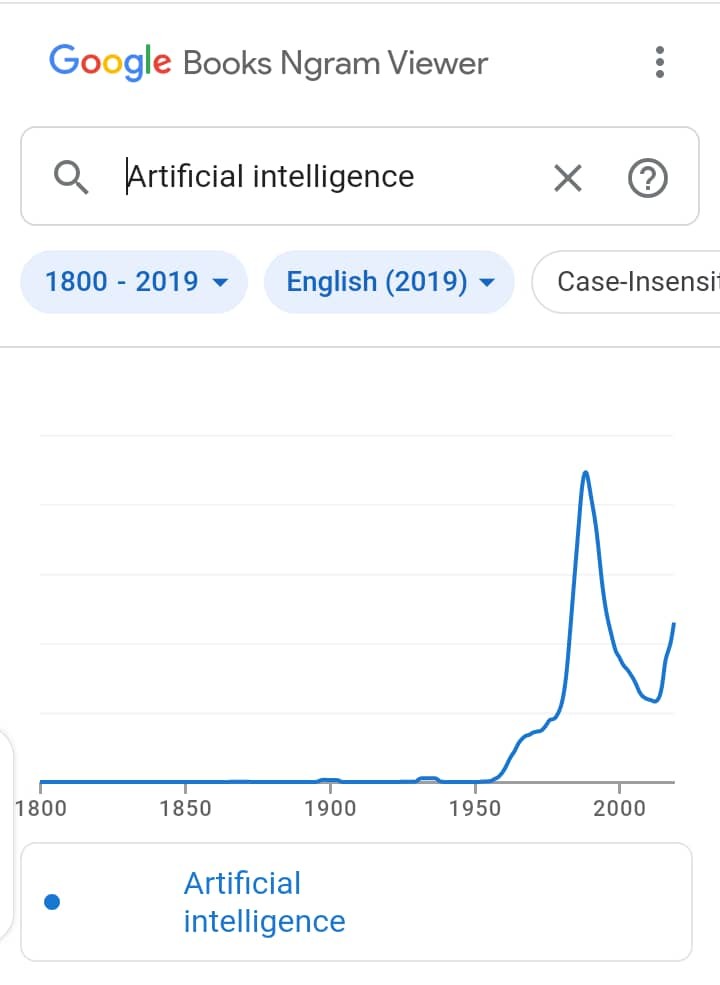
If you look at this image, you can see the trend in using the word and its popularity. It started gradually in the 1950s and peaked in the 1990s before dropping for about a decade. And now, it is on the rise again.

The journey was not without hurdles. There was a long winter period in the development of AI during the 1970s and 1980s, a period of reduced funding and optimism due to unmet expectations. However, breakthroughs in the 1990s, like IBM’s Deep Blue defeating chess grandmaster Garry Kasparov, rekindled interest. The 21st century saw rapid advancements driven by increased computing power, big data, and innovative algorithms. And it was at this point that AI made its way into many high-end conversations.

Some of the AI’s Multifaceted Impact

Healthcare: In the healthcare sector, AI is revolutionizing diagnostics, treatment, and drug discovery. AI algorithms analyze medical images with unprecedented accuracy, assisting doctors in identifying diseases like cancer in their early stages. Personalized medicine is becoming a reality as AI interprets genetic information to tailor treatments. Moreover, AI-enabled robots already assist in surgeries, enhancing precision and reducing risks.

Finance: AI is reshaping the financial landscape by analyzing vast data to make swift and accurate predictions. Algorithmic trading uses AI to execute trades at optimal times, minimizing risks and maximizing returns. I am sure most people have heard of those who use AI-enabled BOTs to trade the financial markets.

Fraud detection systems also identify unusual transaction patterns, safeguarding financial institutions and customers. AI-powered robo-advisors offer investment advice to individuals, democratizing access to financial expertise.

Transportation: The automotive industry is at the forefront of AI-driven innovation with self-driving cars. AI processes real-time data from sensors and cameras to navigate roads, predict pedestrian behavior, and avoid collisions. Beyond cars, AI optimizes traffic flow in intelligent cities, reducing congestion and emissions. The transportation sector is on the cusp of a transformative revolution, promising safer and more efficient mobility.

Entertainment: AI is also doing its bit in the entertainment landscape, influencing everything from content creation to user experience. Streaming services already employ AI to recommend personalized content, enhancing user engagement. Creative industries use AI algorithms to compose music, generate art, and even write stories. With more improvement, we will get to the point where it becomes nearly impossible to distinguish music and stories written by AI. Video games also utilize AI for dynamic gameplay and lifelike characters, enhancing immersion.

What lies ahead?

The current AI landscape is characterized by machine learning, a subset of AI that empowers computers to learn from data. Deep learning, a subfield of machine learning, utilizes neural networks inspired by the human brain’s structure. These networks analyze vast datasets to recognize patterns, enabling tasks like image recognition and natural language processing. Explaining it for a 10-year-old, you may say that deep learning mimics how the brain works.

The future of AI holds exciting possibilities. Quantum computing could usher in an era of unprecedented computational power, revolutionizing AI capabilities. AI-driven advancements in medicine might lead to more accurate disease predictions and personalized treatments. Enhanced natural language processing could also bridge language barriers and foster global communication. As we pointed out in previous posts, we must not forget the ethical considerations that should accompany this rapid development.

The evolution of artificial intelligence has been nothing short of remarkable. From its humble beginnings as a theoretical concept, AI has become an integral part of various industries, leaving an indelible mark on society. Healthcare, finance, transportation, and entertainment have all witnessed the transformative power of AI. As we navigate the complexities of AI’s impact, it’s essential to approach its development with ethical considerations at the forefront.

The journey of AI is a testament to human ingenuity and innovation, and the path ahead promises a future where the boundaries of what’s possible continue to expand.