DD
MM
YYYY

PAGES

DD
MM
YYYY

spot_img

PAGES

Home Blog Page 3878

With the suspension of board and management of 3 banks, watch how Nigeria stock exchange reacts tomorrow

1

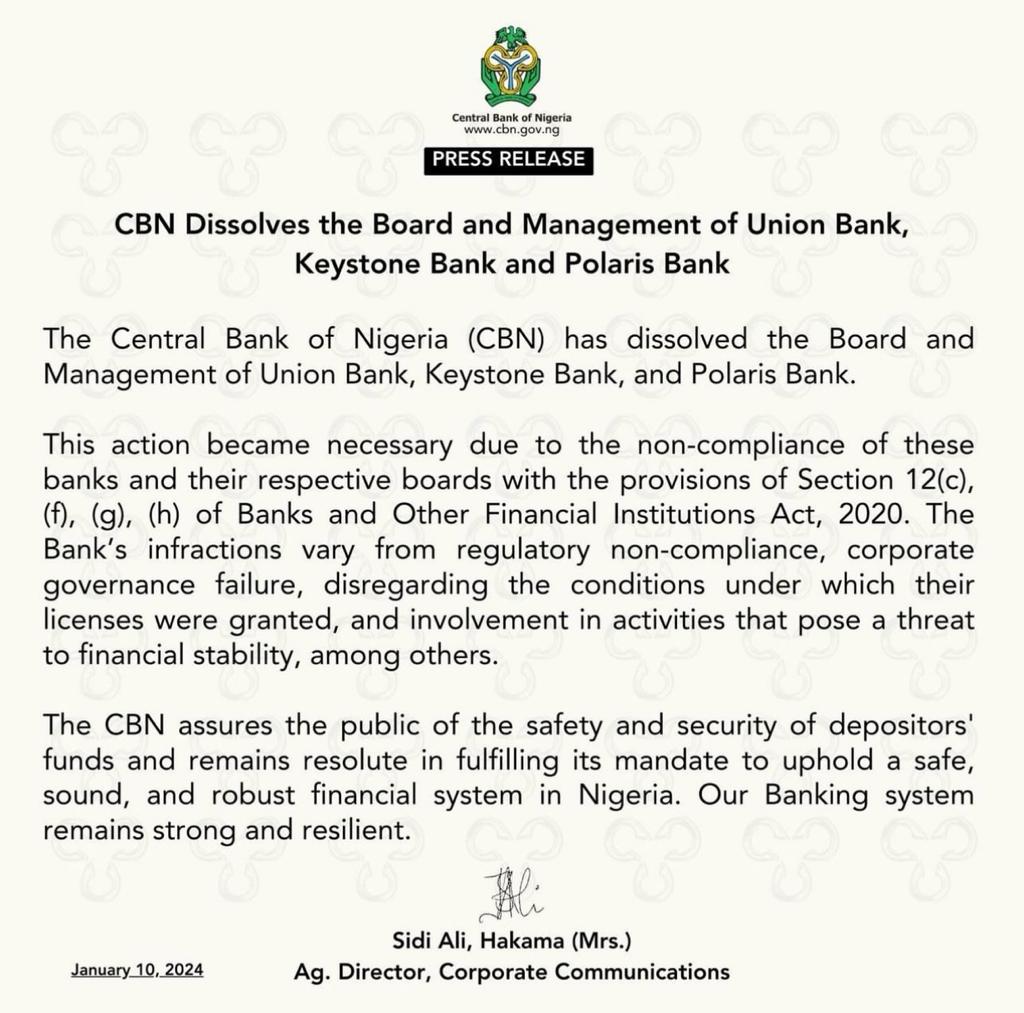
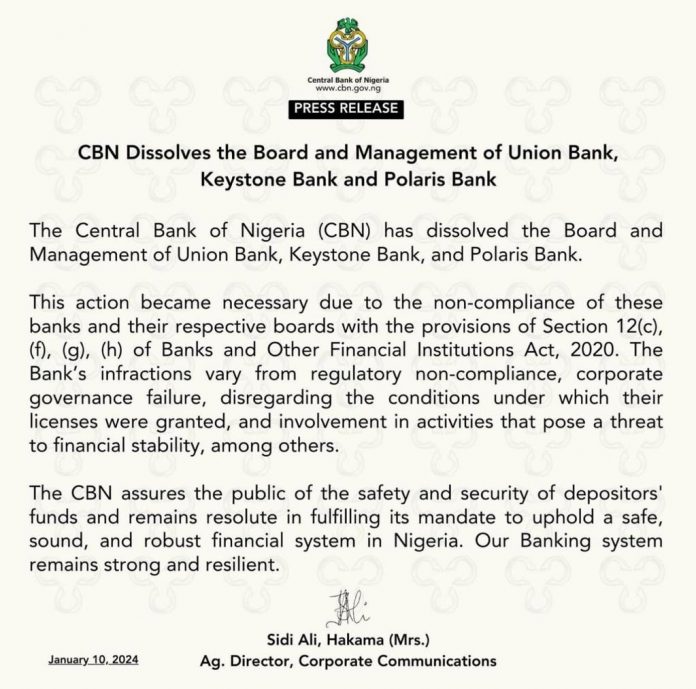
What would you be looking for in the Nigerian stock exchange tomorrow? I will be looking at how the market will react to the hammer on Union, Keystone, and Polaris banks, with the apex bank suspension of their board and management teams. 

Understand that this is not just about these three banks. The notice released when Dangote Group headquarters was searched indicated that more than 50 companies are under the microscope. 

This does imply that more actions are coming. So, are we at a time when investors will begin to pay attention in our information-immune stock exchange where no news makes any impact?

Ladies and Gentlemen, be vigilant because what happened to Savannah Bank and Bank PHB remains evergreen. Those two banks disappeared within minutes. In short, they dissolved as Nigeria happened on them, and with our poor property rights regime, investors lost everything. Platinum Capital was my broker; it did not even have time to email us before it went dead as everything happened within 6 hours! 

So, do not underestimate the current action in your risk model. Before I cause panic, depositors are not in my equation; my focus here is the investing public, not depositors of banks.

How Nigerian police circumvent the justice system with the holding charge tactic.

0
Nigeria police continues to struggle to maintain peace

The provisions of sections 293-299 of the Administration of Criminal Justice Act, 2015, (ACJA), created a serious problem which could be seen to have undermined the constitutional provisions of section 35; the problem it created is that it tends to give an open cheque to Magistrates courts to entertain holding charges, order the remand or issue the remand warrant to law enforcement agencies against suspects without trial. The law enforcement agencies have serially exploited this thereby making a joke on the constitutional provisions of personal liberty and suspects’ right to bail. 

It has been in the spirit of the Constitution that nobody should be denied his personal liberty under any circumstance, including an accused person but law enforcement agencies have adopted this mischievous tactic to circumvent the constitutional provision of the protection of the liberties of an accused person is through this practice of remand warrant or holding charge. 

Remanding a suspect in custody is just a careful way the law enforcement agencies use to deny a suspect his right to bail. The word remand simply means to recommit (an accused person) to custody after a preliminary examination or to return to custody pending trial or for further detention. Holding charges on the other hand is done when a charge is filed against a suspect for a minor offense to keep the suspect in custody while the prosecutors gather more evidence and prepare more serious charges. It is simply a temporary charge so as to keep the person in detention before the real charges are filed.

Mind you that the provisions of section 35 of the Constitution are unwavering as the umbrella that protects the liberties of individuals; be it an innocent person or an accused person. 

Subsection 1 of section 35 provided as follows; (1)  Every person shall be entitled to his personal liberty and no person shall be deprived of such liberty save in some cases and in accordance with a procedure permitted by law, as outlined in 1(a) to (f).

Subsequently, subsection 4 provided thus; Any person who is arrested or detained in accordance with subsection (1) (c) of this section shall be brought before a court of law within a reasonable time. By the wide interpretation of this section 35(4(1c), a reasonable time has been held to be no later than 48 hours. This is to say that the law enforcement agency must not detain a suspect not later than 48 hours without releasing him on bail or charging him to court but with the mischievous practise of “holding charge” or remand warrant, a law enforcement agent can decide to get a remand warrant from the magistrate court and detain a suspect longer than 48 hours. 

Despite the fact that the court has consistently frowned against this practice of holding charges in a plethora of cases, law enforcement agencies still engage in the practice. In the case of Olawoye V. C.O.P. (2006), 2 NWLR the Court of Appeal authoritatively stated that the arraignment before a Magistrate Court in a case where the magistrate court lacks jurisdiction is tantamount to a holding charge and it is unconstitutional and illegal. Also In the case of Enwere v. C.O.P., it was held that “holding charge” is unknown to Nigeria Law and an accused person detained thereunder is entitled to be released on bail within a reasonable time before trial. A similar position was held by the court in the case of SHAGARI V. CO.P. (2007) 5 NWLR where it held that “holding charge is unknown to Nigerian law and any person or an accused person detained thereunder, is entitled to be released on bail within a reasonable time before trial”.

I, therefore, expect law enforcement agencies, going forward to know that the Constitution of the Federal Republic of Nigeria in section 35 frowns at the practice of holding charge and therefore being a superior law invalidates and renders nullity the provisions of sections 293-299 the Administration of Criminal Justice Act, 2015, (ACJA) which has presumptuously given the room for this mischief. 

Nigeria Dissolves Board and Management of Polaris, Union and Keystone Banks

0

I read it and contested that it was a rumour. But with this evidence, it is indeed true. Yes, the Central Bank of Nigeria has dissolved the boards and management teams of Union, Keystone and Polaris banks (and in extension Titan bank since it swallowed Union Bank). This is simply unprecedented and another big asterisk on Buhari’s stewardship of Nigeria’s economy.  For three banks to get this hammer in one day is a big statement in the land.

Good People, if you are looking for the most fearful person in Nigeria right now, I have a cheat sheet for you: Special Investigator Jim Obazee who wrote the report. It does seem like his report will take many people to early retirement and some to [you fill the space].

I will always vote for Nigeria’s progress and I do hope this helps.

Alleged Financial Mismanagement Rocks Nigeria’s Central Bank as Investigator’s Report Exposes High-Level Fraud

Mercari to accept Bitcoin payments in Japan

0

Mercari, the popular online marketplace in Japan, has announced that it will start accepting Bitcoin payments for its services. This is a major milestone for the adoption of cryptocurrency in the country, as Mercari is one of the largest and most widely used platforms for buying and selling goods online.

Mercari’s decision to accept Bitcoin comes after the Japanese government recognized Bitcoin as a legal form of payment in 2017 and introduced regulations to protect consumers and prevent money laundering. Since then, more than 200,000 stores in Japan have started accepting Bitcoin, and the number is expected to grow as more people become aware of the benefits of using digital currency.

Mercari’s CEO, Shintaro Yamada, said that the company wants to offer more options and convenience to its users, and that Bitcoin is a natural fit for its business model. He said that Mercari’s mission is to create value in a global marketplace where anyone can buy and sell anything, and that Bitcoin can help achieve that goal by enabling fast, secure, and low-cost transactions across borders.

Mercari will use BitFlyer, one of the largest and most trusted cryptocurrency exchanges in Japan, to process its Bitcoin payments. Users will be able to choose Bitcoin as a payment option when they check out on Mercari’s website or app, and scan a QR code to complete the transaction. The amount of Bitcoin will be calculated based on the current exchange rate at the time of purchase. Mercari will then convert the Bitcoin to Japanese yen and transfer it to the seller’s account.

Mercari said that it will launch its Bitcoin payment service in the first half of 2024, and that it will initially be available for selected categories of goods, such as electronics, fashion, and books. The company said that it plans to expand the service to more categories and regions in the future, and that it hopes to attract more customers and sellers who are interested in using cryptocurrency.

Mercari’s announcement has been met with positive reactions from both the crypto community and the general public in Japan. Many users have expressed their excitement and support for Mercari’s move, saying that it will make online shopping more convenient and fun. Some users have also said that they will start using Mercari more often because of its Bitcoin payment option.

Mercari is not the only online platform that accepts Bitcoin in Japan. Other notable examples include Rakuten, Japan’s largest e-commerce company, which allows users to pay with Bitcoin on its online mall, travel site, and mobile app; DMM.com, a major online entertainment and media company, which accepts Bitcoin for its digital content and services; and GMO Internet, a leading internet service provider, which offers Bitcoin as a salary option for its employees.

Japan is widely regarded as one of the most progressive and friendly countries for cryptocurrency in the world. The country has a vibrant and active crypto scene, with many startups, investors, developers, and enthusiasts who are driving innovation and adoption. Japan also hosts some of the largest and most influential crypto events, such as the Tokyo Blockchain Week and the Japan Blockchain Conference.

Mercari’s decision to accept Bitcoin is a significant step forward for the crypto industry in Japan, and a sign of confidence in the future of digital currency. By embracing Bitcoin, Mercari is not only offering more value and choice to its users, but also contributing to the growth and development of the crypto ecosystem in Japan.

Ethereum core devs Chart an Ambitious 2024 as Crypto Market Diverges between Altcoins and BTC

0

Ethereum, the second-largest cryptocurrency by market capitalization, has been undergoing a series of upgrades and innovations in the past few years. The most notable ones are the transition from proof-of-work to proof-of-stake consensus mechanism, the implementation of sharding and rollups to improve scalability and efficiency, and the introduction of new features and standards to enhance interoperability and usability.

However, the Ethereum core developers are not resting on their laurels. They have a bold vision for the future of the network, and they are working hard to make it a reality. We will introduce you to two of the most influential and active core devs in the Ethereum community: Dencun and Pralectra. We will also explore their plans and projects for 2024, which promise to bring Ethereum to new heights of innovation and adoption.

Dencun: The mastermind behind EIP-1559 and EIP-3675

Dencun is a pseudonymous developer who has been contributing to Ethereum since 2017. He is best known for proposing and leading the development of two of the most impactful Ethereum Improvement Proposals (EIPs) in recent history: EIP-1559 and EIP-3675.

EIP-1559, which was activated in August 2021, introduced a new fee mechanism that dynamically adjusts the gas price based on network demand and burns a portion of the fees, creating a deflationary pressure on ETH supply. EIP-3675, which was implemented in December 2021, finalized the transition from proof-of-work to proof-of-stake by merging the Ethereum mainnet with the Beacon Chain, the backbone of the new consensus protocol.

Both EIPs have been widely praised by the Ethereum community for improving the security, sustainability, and user experience of the network. They have also boosted the value proposition of ETH as an asset, as evidenced by its strong performance in the market.

Dencun is not done yet. He is currently working on several projects that aim to further enhance Ethereum’s capabilities and competitiveness. One of them is EIP-4488, which proposes to reduce the gas cost of call data, the data that is passed to smart contracts when they are executed. This would lower the barriers for developers and users to deploy and interact with complex applications on Ethereum, such as decentralized exchanges, lending platforms, gaming dapps, and more.

Another project that Dencun is involved in is EIP-6484, which suggests introducing a new opcode called BASEFEE that would allow smart contracts to access the current base fee of the network. This would enable new possibilities for fee management and optimization, such as fee abstraction, fee delegation, fee rebates, and more.

Pralectra: The pioneer of zk-SNARKs and zk-rollups

Pralectra is another pseudonymous developer who has been working on Ethereum since 2018. She is a leading expert and innovator in the field of zero-knowledge proofs (ZKPs), a cryptographic technique that allows users to prove that they know some information without revealing it.

Pralectra has been instrumental in bringing ZKPs to Ethereum, both at the protocol and application levels. She is one of the main contributors to EIP-1962, which added support for various ZKP primitives to the Ethereum virtual machine (EVM), enabling developers to use them in their smart contracts. She is also one of the co-founders and core developers of ZKSync, one of the most popular and advanced zk-rollup solutions on Ethereum.

ZKSync is a layer-2 scaling platform that uses ZKPs to compress and verify transactions off-chain, while maintaining security guarantees from the mainnet. ZKSync can process thousands of transactions per second with minimal fees and latency, while supporting smart contracts, token transfers, NFTs, and more.

Pralectra is constantly pushing the boundaries of ZKPs and zk-rollups on Ethereum. She is currently working on ZKSync 2.0, which aims to bring full EVM compatibility and programmability to zk-rollups, allowing any existing or future dapp to run on ZKSync with zero friction or compromise. She is also working on ZKPorter, a new scaling technique that combines zk-rollups with data availability sampling, resulting in an exponential increase in throughput and a significant decrease in cost.

ZKSync 2.0 and ZKPorter are expected to launch in 2024, marking a new era of scalability and privacy for Ethereum.

Dencun and Pralectra are just two examples of the many talented and dedicated core developers who are making Ethereum better every day. They represent the ethos and vision of Ethereum: a decentralized, open-source, community-driven platform that strives for innovation and excellence.

As we enter 2024, we are excited to see what Dencun, Pralectra, and the rest of the Ethereum core devs will bring to the table. We are confident that they will continue to surprise and delight us with their groundbreaking ideas and implementations. We are proud to support and celebrate their work, and we invite you to join us in following their progress and achievements.

Cryptocurrency market is experiencing a significant divergence between Bitcoin and Altcoins

Meanwhile, the cryptocurrency market is experiencing a significant divergence between Bitcoin and altcoins. While Bitcoin is holding its price below $50,000, most altcoins are dumping hard, losing value against both the US dollar and BTC. What is causing this phenomenon and what does it mean for investors?

One possible explanation is that Bitcoin is attracting more institutional and corporate demand, as evidenced by the recent purchases of MicroStrategy, Tesla and Square. These entities are buying large amounts of Bitcoin as a hedge against inflation and currency devaluation, and they are not interested in speculating on altcoins. This creates a strong support for Bitcoin’s price, while reducing the liquidity and demand for altcoins.

Some examples of altcoins that have suffered from this trend are Ethereum, which dropped from over $4,000 to below $3,000 in May, Cardano, which lost more than 50% of its value in the same month, and Dogecoin, which plunged from over $0.7 to below $0.3 after Elon Musk’s appearance on Saturday Night Live in 2021.

Another possible explanation is that Bitcoin is benefiting from its network effects and its status as the most secure and decentralized cryptocurrency. As the regulatory environment becomes more uncertain and hostile, especially in countries like China and India, investors may prefer to stick with the proven leader of the crypto space, rather than risk their funds on less established and more vulnerable projects. This creates a positive feedback loop for Bitcoin’s price, while increasing the volatility and risk for altcoins.

Some examples of altcoins that have faced regulatory challenges are Binance Coin, which was banned by several financial authorities around the world, Ripple, which is involved in a lawsuit with the US Securities and Exchange Commission, and Tether, which is under investigation for its reserve claims.

A third possible explanation is that Bitcoin is undergoing a consolidation phase, after reaching a new all-time high of over $60,000 in March 2021. During this period, traders may take profits from their Bitcoin positions and rotate them into altcoins, hoping to catch the next wave of growth.

However, this strategy may backfire if Bitcoin resumes its uptrend and breaks out of its current range. This creates a temporary boost for altcoins’ price, while exposing them to a potential reversal and sell-off. Some examples of altcoins that have benefited from this rotation are Polygon, which surged from $0.03 to over $2 in May, Solana, which increased from $13 to over $40 in the same month, and Uniswap, which reached a new all-time high of over $40 in May 2022.

Regardless of the explanation, the divergence between Bitcoin and altcoins is a clear sign of the maturation and differentiation of the cryptocurrency market. Investors need to be aware of the different factors that affect each coin’s performance and adjust their portfolios accordingly.

While diversification is still advisable, it may not be enough to protect against the risks of holding altcoins in a bearish environment. Investors may need to adopt a more active and selective approach, focusing on quality projects with strong fundamentals, innovation and adoption.