DD
MM
YYYY

PAGES

DD
MM
YYYY

spot_img

PAGES

Home Blog Page 39

The Best Altcoins to Buy in 2026 for Massive Gains: BlockDAG, Dogecoin, Tron, and Solana!

0

The landscape of electronic cash evolves at a lightning pace. Every 24 hours, fresh ventures debut while veteran projects pivot to stay compatible with modern tech. Since the marketplace is packed with options, identifying which tokens deserve your attention is a tough task. You cannot simply select a random asset and expect a win; you must examine its internal mechanics and the real value they bring.

This review looks at the four heavy hitters dominating the scene in 2026: BlockDAG, Dogecoin, Tron, and Solana. Each brings a specific edge, ranging from rapid processing to massive social followings. Grasping these unique traits will help you pick the best fit for your portfolio. Here is a look at the best altcoins to buy right now.

1. BlockDAG: New Tier 1 Trading Giant Entry at $0.0000016

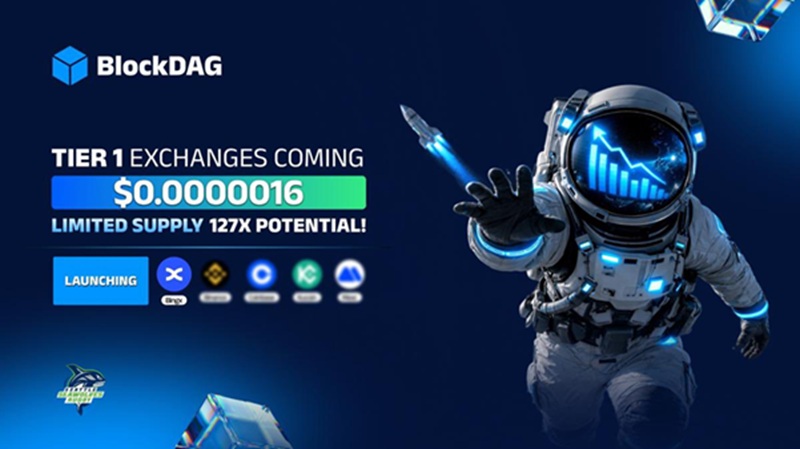
A huge transition is occurring in the crypto space as BlockDAG (BDAG) readies for its debut on the BingX Tier 1 exchange on April 16. This event is a game-changer because it pushes the project onto a giant international platform with immense trading activity.

The momentum continues after that; three additional Tier 1 platforms are scheduled to go live next week. This swift growth indicates the project is jumping from its infancy directly into the premier league, making it way simpler for global traders to jump on board.

The team is also shipping tangible tools that users can utilize today. Smart Wallet access is already functional, and the subsequent distribution for Batch 4 kicks off on April 27. Even more thrilling is the debut Casino Demo arriving in only two weeks, giving everyone a sneak peek at how the tech functions in a live setting.
Right now, a brief window exists to buy at the new $0.0000016 price before the huge wave of interest from these exchange debuts begins to push the valuation up.

With the BingX start just a few days away, analysts are highlighting a massive 127x potential for early backers. This is the last chance to grab a position at a tiny entry cost before the public crowd moves in and the remaining tokens sell out.

With the looming BingX platform arrival, the low $0.0000016 entry point, and 127x ROI potential for early movers, every metric indicates that BlockDAG is the best altcoin to buy today as it begins its most powerful expansion period yet.

2. Dogecoin: Rapid Transfers via Starlink Space Tech

First built as a fun parody of Bitcoin, Dogecoin has turned into a permanent powerhouse in the virtual currency world. By 2026, its usefulness has grown through the GigaWallet initiative, which allows shops to take the token for goods more simply. It also employs RadioDoge tech to permit swaps in far-flung locations via satellite, bypassing the necessity for a standard web connection.

Though it started as a joke, its high cash flow and huge fan base keep it practical for daily spending. People often track its social media buzz and its use on major tech sites. For folks hunting for the best altcoins to buy today, Dogecoin remains a prime case of how collective spirit can power a working payment network.

3. Tron: Rapid Platform for International Applications

Tron is a high-velocity network built to support media content and various decentralized tools. It is famous for being incredibly quick and having nearly no gas costs, which is the reason many users utilize it to move stablecoins like USDT.

As the ecosystem expands, it keeps pulling in creators who wish to code apps without expensive overhead. Due to this high traffic, it is often noted among the best altcoins to buy today for fans of open finance.
Still, skeptics frequently mention that Tron has more central control than other networks. This implies a tiny circle of individuals has significant power over the system, which might bother participants who want a more inclusive and open-source environment.

4. Solana: Fast Network for Software Builders

Solana is frequently dubbed a major rival to Ethereum because it can handle thousands of swaps every single moment. It is the top choice for digital art and quick trading because it is much more affordable and snappier than most other choices.

With recent upgrades like Firedancer, the system has become much steadier and more dependable for large corporate players. Its capacity to manage huge amounts of data makes it a top pick for the best altcoins to buy today in the high-utility bracket.

Despite these wins, Solana has a past of network stalls where the whole machine stopped running for a while. If these tech bugs return, it could damage user confidence and cause the market value to fall without warning.

Final Thoughts

Picking the right digital asset in 2026 needs a mix of steady reliability and high-profit potential. While Dogecoin, Tron, and Solana provide firm systems and specific use cases, they all have certain threats that buyers must check closely. Still, for those looking for the top market winner, BlockDAG is in a category by itself.

With its debut on the BingX Tier 1 exchange going live on April 16 and three more Tier 1 debuts arriving next week, the drive is powerful. Currently valued at just $0.0000016 with a giant 127x potential, it provides a unique entry before the crowd pushes prices up.

With the fresh Smart Wallet features and the upcoming Casino Demo, BlockDAG is clearly the leader among the best altcoins to buy today, providing the best route for those wanting to stay ahead of the pack.

Disney to Cut 1,000 Jobs in Push For Agile And Tech-Driven Workforce

0

American multinational mass media and entertainment conglomerate Disney has announced plans to eliminate approximately 1,000 positions as part of a broader effort to streamline operations and adapt to the rapidly evolving media landscape.

The decision was communicated in an internal email sent to employees on April 14, 2026. In his message, the company’s new chief executive, Josh D’Amaro, emphasized the need for structural adjustments to maintain Disney’s competitive edge.

X Officially Launches Cashtags Feature, Starting with Canada and U.S. Users

0

X has officially launched its new Cashtags feature today for iPhone users in the US and Canada. Cashtags build on the existing $ticker system but make it smart and interactive: When you search for or post a cashtag like $AAPL, $BTC, or even a crypto contract address, X automatically suggests the matching stock or crypto token so you pick the exact asset.

Tapping any Cashtag in a post or search shows: Related posts and conversations about that specific asset. Real-time price charts (candlestick-style) and live market data. Everything stays inside the X app — no need to switch to another platform like Yahoo Finance, TradingView, or a crypto exchange. Rolling out now on iOS/iPhone only, limited to users in the United States and Canada. Assets supported: Stocks and cryptocurrencies including smaller tokens via contract addresses.

Canadian users see a Trade button on Cashtag pages. This links directly to Wealthsimple; a popular Canadian brokerage for seamless in-app trading without leaving X. X itself isn’t acting as the broker — it’s providing the data layer and integration. Nikita Bier X’s Head of Product, emphasized that billions of dollars are allocated every day based on what people see on their timeline.

This is positioned as the first step in X’s push to become the top destination for finance and crypto discussions, combining social chatter with live market data. Financial conversations on X have always moved markets. Cashtags aim to reduce confusion like multiple tokens with similar tickers and keep users engaged longer by embedding useful data directly in the feed. Android and broader international rollout details haven’t been announced yet — this appears to be an initial iOS test in North America.

Real-time price charts + related posts appear instantly when tapping a $Cashtag (stocks or crypto, including contract addresses). No more switching between X, TradingView, or exchange apps. Reduced confusion: Smart matching prevents mix-ups between similar tickers or tokens. Trade button on Cashtag pages links directly to Wealthsimple for seamless in-app trading (X itself doesn’t execute trades — it’s a discovery layer).

Users expect it to clean up the timeline by reducing ambiguity and bot-driven slop around tickers. Billions in daily allocations are already influenced by X chatter; now price data sits right next to the conversation, potentially accelerating reactions to news or hype. Traders and investors may spend more time on X, blending social discovery with live market data.

Support for contract addresses could spotlight smaller tokens, driving attention and possibly volume to assets discussed on the platform. Positions X as a central hub for finance and crypto, combining news, sentiment, and data. Only iOS in North America for now; broader rollout (Android, web, international) expected later. Wealthsimple pilot shows X’s strategy of integrating with external brokers rather than becoming one. Higher trading volumes for assets trending on X, especially in Canada via the pilot.

More institutional and retail overlap as professional-grade data becomes native to the feed. Possible reduction in off-platform tool usage for quick checks. The launch is seen as a data + discovery upgrade rather than full trading execution. It strengthens X’s role in financial conversations while keeping actual trades with partners. Early reactions on X are positive and hype-driven, with many testing it immediately on popular tickers like $BTC. If you’re in the US or Canada on iPhone, check your app for the update and try tapping a $CASHTAG to see it in action.

Bitcoin Community Discussing BIP 361 Titled; Post Quantum Migration and Legacy Signature Sunset

0

A draft BIP-361 titled “Post Quantum Migration and Legacy Signature Sunset” was published on Bitcoin’s BIP repository on GitHub. It was co-authored by several contributors in the Bitcoin quantum security space, including Jameson Lopp, Casa co-founder and others.

Bitcoin’s original cryptography primarily ECDSA over the secp256k1 curve is vulnerable to future quantum computers via Shor’s algorithm, which could theoretically derive private keys from public keys. The biggest risk applies to early addresses especially Pay-to-Public-Key or P2PK outputs from 2009–2011, where the public key is directly exposed on the blockchain.

Modern addresses like P2PKH, P2SH, Bech32 only reveal the public key when spending, reducing but not eliminating the risk for unspent outputs. Estimates suggest roughly 1.7 million BTC sometimes cited as high as part of ~6–7 million BTC total vulnerable supply sit in these legacy formats. This includes: The ~1.1 million BTC widely attributed to Satoshi Nakamoto’s early mining wallets (valued at around $74–75 billion at current prices).

Other dormant OG wallets from the 2010–2011 era. If a cryptographically relevant quantum computer (CRQC) emerges, an attacker could potentially steal these funds by cracking the exposed public keys. Recent discussions including a Google quantum research paper have highlighted timelines as potentially tightening toward the late 2020s in worst-case scenarios, though practical threats remain years away.

It builds directly on BIP-360 which introduced a new quantum-resistant output type called Pay-to-Merkle-Root or P2MR. BIP-361 outlines a three-phase sunset migration via a soft fork to incentivize moving funds to quantum-safe formats while eventually deprecating legacy signatures.

Phase A; triggered ~160,000 blocks /~3 years after activation: Prohibit new sends to legacy quantum-vulnerable addresses. All new transactions must use quantum-resistant types. Phase B ~5 years after activation, or 2 years after Phase A in some descriptions: Legacy ECDSA/Schnorr signatures become invalid on the network.

Any unmigrated funds in vulnerable addresses are effectively frozen permanently unspendable. Phase C: Introduce a mechanism allowing some owners to prove ownership and recover frozen funds without exposing keys broadly. The goal is proactive defense: Prevent a quantum heist that could flood the market with stolen coins, erode trust, or destabilize Bitcoin.

Proponents frame it as turning quantum security into a private incentive for holders to migrate.

The proposal is already sparking debate: Seen as responsible forward-planning by quantum security experts. Doing nothing risks catastrophic theft; freezing protects the network’s integrity long-term. Critics call it authoritarian, a violation of Bitcoin’s immutability and don’t trust, verify ethos. Freezing coins especially Satoshi’s touches on sacred principles like property rights and decentralization.

Some worry it could lead to chain splits, forced migrations with high fees or custody risks, or precedent for other interventions. Others argue the quantum timeline doesn’t yet justify such drastic steps. BIP-361 is still a draft—it would require broad consensus, testing, and activation likely via soft fork signaling like previous upgrades.

Not all vulnerable coins would be affected equally; coins in addresses without exposed public keys are safer until spent. This fits into broader ongoing work on post-quantum cryptography for Bitcoin. The network has time to deliberate, but the discussion is heating up as quantum hardware advances.

Oracle’s Bloom Energy Deal Delivers Instant Windfall and Secures a Critical Edge in the AI Infrastructure Race

0

As the artificial intelligence boom expands beyond chips and software into the physical infrastructure that powers large-scale computing, Oracle has moved decisively to strengthen its position, turning a strategic energy partnership into both an immediate financial gain and a long-term operational advantage. It has expanded its agreement with Bloom Energy, giving the software giant faster access to electricity for its rapidly growing AI data centers.

This has instantly lifted the value of its recently issued equity warrant by hundreds of millions of dollars.

The development has significantly highlighted the next battleground in the AI arms race: power. With hyperscalers and enterprise cloud providers racing to deploy ever larger AI clusters, access to dependable electricity has become as strategically important as GPUs, semiconductors, and cloud software platforms.

Under the expanded agreement announced Monday, Bloom Energy will supply Oracle with up to 2.8 gigawatts of fuel-cell capacity to support the buildout of its AI and cloud computing infrastructure across the United States. An initial 1.2 gigawatts has already been contracted, with deployment underway and continuing into next year.

That is an unusually large commitment for a single corporate customer and signals Oracle’s intention to compete at the hyperscale end of the AI infrastructure market. To put the number in perspective, 2.8 gigawatts is utility-scale capacity, sufficient under normal usage assumptions to support millions of homes. For Oracle, it translates into a dedicated energy backbone for data centers designed to handle dense AI workloads, including model training, inference, and enterprise cloud services.

The market immediately recognized the scale and importance of the agreement. Bloom Energy shares surged roughly 15% after the announcement, lifting the stock to near $203 and sharply increasing the value of a warrant issued to Oracle just days earlier. That warrant, granted on Thursday under terms previously disclosed in October, gives Oracle the right to purchase up to 3.53 million Bloom shares at $113.28 each, representing a total investment of about $400 million.

At Monday’s post-announcement price, that creates an unrealized paper gain of approximately $316 million for Oracle. The financial upside, however, is only part of the story.

This is not a passive investment. The warrant structure strategically aligns Oracle’s capital deployment with Bloom’s commercial performance, effectively allowing Oracle to benefit financially from the very infrastructure supplier it is relying on to power its AI expansion.

Practically, Oracle is monetizing its own energy demand. That logic becomes clearer when viewed against the growing electricity bottleneck confronting the technology sector. Traditional grid connections for large data centers can take years, particularly in key U.S. markets where transmission capacity is already constrained. Bloom’s fuel-cell systems, by contrast, can be deployed on-site far more quickly, allowing customers to bypass lengthy utility timelines and reduce execution risk.

Bloom said its systems can be rolled out “much faster than traditional power options, helping customers get electricity sooner and lower project risks.”

This speed-to-power advantage is increasingly critical because AI workloads require high-density, uninterrupted electricity with minimal latency risk. Waiting years for grid upgrades is commercially impractical for companies trying to meet explosive customer demand in cloud computing and AI services.

Oracle’s own language underscores this urgency.

“By rapidly deploying Bloom’s reliable, efficient fuel cell energy, we are quickly meeting the demands of our customers across the United States,” said Mahesh Thiagarajan, executive vice president, Oracle Cloud Infrastructure.

That statement goes to the heart of the investment thesis. The company is not merely buying electricity. It is buying deployment speed and a competitive advantage.

This also helps explain why Oracle’s stock had already rallied sharply before the Bloom announcement. Shares rose nearly 13% in regular trading on Monday as investors rotated back into software and AI-related names that had been heavily sold earlier in the year. Even after the rally, Oracle remains down significantly year to date, which suggests investors are beginning to reprice its AI strategy after months of skepticism.

The deal also cements Bloom’s transformation from a clean-energy story into an AI infrastructure play.

The company has become one of the biggest beneficiaries of the data-center power boom as developers seek alternatives to conventional grid power. Its fuel cells generate electricity through chemical reactions rather than combustion, making them a cleaner and more flexible option, with byproducts that can include water and heat depending on the fuel source.

This shift in market perception has been dramatic. Bloom’s market capitalization has now moved above $50 billion, and the stock has more than doubled this year, fueled by investor belief that AI infrastructure spending will continue to drive outsized demand.

The broader insight here is that the AI boom is rapidly broadening beyond semiconductors and software. The first phase centered on chipmakers such as NVIDIA Corporation and cloud platforms. The next phase is increasingly about the industrial ecosystem required to support those systems, including electricity generation, cooling, networking, and physical data-center capacity.

Oracle’s reported decision to raise more than $100 billion in debt to fund its AI data-center expansion makes the Bloom partnership even more consequential. Securing long-term, modular power capacity reduces one of the largest operational risks tied to that capital-intensive strategy.

In that sense, the immediate $316 million paper gain may be the least important outcome. The more meaningful value lies in securing the energy infrastructure required to compete in the next stage of the AI race.