
DD
MM
YYYY

PAGES

DD
MM
YYYY

spot_img

PAGES

Home Blog Page 3950

Is X (Twitter) actually fighting for Free Speech as X files a lawsuit against Media Matters?

0

In a shocking development, X Corp owner, Elon Musk announced that it will be filing a thermonuclear lawsuit against Media Matters, a media watchdog group that has been critical of X Corp’s business practices and environmental impact. The lawsuit, which seeks $10 billion in damages, accuses Media Matters of defamation, libel, slander, and conspiracy to harm X Corp’s reputation and market share.
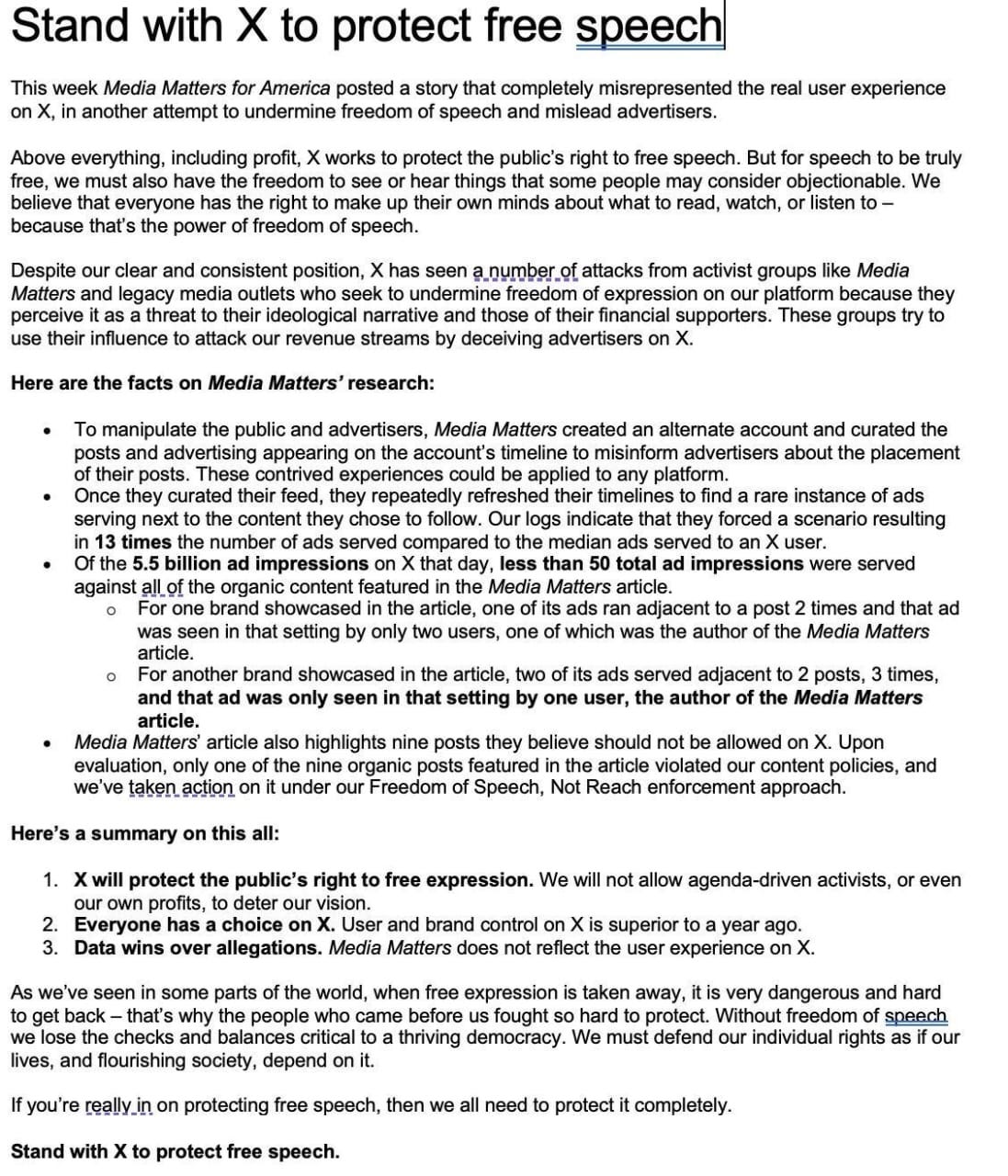
Mr. Musk, said in a press conference that Media Matters has been spreading “false and malicious” information about X Corp which tends to subject advertisers from participating in X advertisement and that the lawsuit is necessary to protect X Corp’s rights and interests. He said that Media Matters has been “waging a relentless and coordinated campaign of lies and smears” against X Corp, and that the lawsuit will expose their “hidden agenda and ulterior motives”.

Media Matters’ president, Ms. Y, responded to the lawsuit in a statement, saying that it is a “baseless and desperate attempt” by X Corp to silence and intimidate Media Matters. She said that Media Matters stands by its reporting and analysis of X Corp, and that the lawsuit is a “clear violation of the First Amendment and the public’s right to know”. She said that Media Matters will not back down from its mission of holding X Corp accountable for its actions and impact on society.

The lawsuit is expected to be filed in the U.S. District Court for the District of Columbia next week. Legal experts say that the lawsuit is unprecedented in its scope and magnitude, and that it could have far-reaching implications for the media industry and the public discourse. Some observers have also questioned the use of the term “thermonuclear” to describe the lawsuit, saying that it is hyperbolic and inflammatory.

Is X/Twitter actually fighting for free speech?

Twitter is one of the most popular social media platforms in the world, with over 300 million active users. It is also a platform that has been frequently accused of censoring or suppressing certain voices, especially those that are critical of its policies, its executives, or its political allies.

In recent years, Twitter has banned, suspended, or restricted the accounts of many prominent figures, such as former US President Donald Trump, WikiLeaks founder Julian Assange, journalist Glenn Greenwald, and activist Tommy Robinson.

Twitter has also been criticized for applying inconsistent or arbitrary rules to different users, such as allowing some world leaders to post inflammatory or violent messages, while cracking down on others for expressing dissenting opinions.

Twitter has defended its actions by claiming that it is committed to protecting free speech and fostering a healthy public conversation. It has argued that it has the right and the responsibility to enforce its own terms of service, which prohibit hate speech, harassment, threats, and other forms of abuse. It has also claimed that it is transparent and accountable about its decisions, and that it provides users with the opportunity to appeal or challenge them.

But is Twitter really fighting for free speech, or is it using its power to silence or manipulate certain voices? This is a question that has been debated by many experts, activists, and users, who have different perspectives on what free speech means and how it should be protected online. Some argue that Twitter is a private company that can set its own rules and moderate its own platform as it sees fit.

They contend that Twitter is not obligated to provide a platform for anyone who violates its policies or harms its community. They also point out that Twitter is not the only option for online expression, and that users who are unhappy with Twitter can switch to other platforms or create their own.

Others argue that Twitter is a public utility that has a social and moral duty to respect and uphold free speech as a fundamental human right. They contend that Twitter has become a dominant and influential source of information and communication, and that it has a significant impact on public opinion, democracy, and social movements.

They also point out that Twitter often benefits from legal protections and public subsidies that grant it immunity from liability or regulation. They claim that Twitter should not be allowed to arbitrarily censor or suppress certain voices, especially those that challenge the status quo or expose wrongdoing.

The debate over Twitter and free speech is not likely to be resolved anytime soon. It is a complex and nuanced issue that involves legal, ethical, political, and technological factors. It also reflects the broader challenges and opportunities of living in a digital age, where information is abundant but not always reliable, where communication is global but not always inclusive, and where power is concentrated but not always accountable.

CoinShares, Valkyrie’s ETF, Tokens Market Performance, Boyaa Game Company to Acquire $90m Worth in BTC, ETH

0

CoinShares, a leading digital asset investment firm, has announced that it has entered into a strategic partnership with Valkyrie Investments, a US-based company that offers various exchange-traded products (ETPs) in the crypto space. As part of the deal, CoinShares has secured an option to acquire Valkyrie’s ETF unit, which is currently awaiting approval from the US Securities and Exchange Commission (SEC) to launch a bitcoin ETF.

The partnership aims to leverage CoinShares’ expertise in the European ETP market, where it has over $5 billion in assets under management, and Valkyrie’s experience in the US market, where it has filed for several innovative crypto ETPs, including a bitcoin futures ETF, a bitcoin mining ETF, and a decentralized finance (DeFi) ETF. The two firms will collaborate on product development, distribution, and marketing across both regions.

CoinShares CEO Jean-Marie Mognetti said: “We are thrilled to partner with Valkyrie, a company that shares our vision of bringing innovative and accessible investment products to investors around the world. We believe that the US market is ripe for growth in the crypto ETP space, and we are excited to have the option to acquire Valkyrie’s ETF unit, which has a strong track record of filing for cutting-edge products and navigating the complex regulatory landscape.”

Valkyrie CEO Leah Wald said: “CoinShares is a pioneer and a leader in the crypto ETP industry, and we are honored to join forces with them. We have been impressed by their product offerings, their regulatory compliance, and their commitment to investor education and protection. We look forward to working together to bring more innovation and value to our clients and the broader crypto ecosystem.”

Avalanche’s AVAX and Near’s NEAR Market Performance

The past week has been a bullish one for the cryptocurrency market, with several coins regaining new highs. Among them, two projects stand out for their impressive performance: Avalanche and Near Protocol. Both of them are smart contract platforms that aim to offer scalability, security and interoperability for decentralized applications. In this blog post, we will take a closer look at what drove their prices up and what are their main features and advantages.

Avalanche is a blockchain network that uses a novel consensus mechanism called Snowman, which allows for fast and low-cost transactions. It also supports multiple virtual machines, including the Ethereum Virtual Machine (EVM), which means that it is compatible with existing Ethereum applications and tools. Avalanche claims to be able to process over 4,500 transactions per second, compared to Ethereum’s 15-30. It also has a native token called AVAX, which is used for paying fees, securing the network and participating in governance.

Near Protocol is another blockchain network that leverages sharding to achieve high scalability and low latency. It also uses a proof-of-stake (PoS) consensus algorithm that rewards validators for securing the network. Near Protocol supports cross-chain communication and interoperability with other blockchains, such as Ethereum and Polkadot. It also has a native token called NEAR, which is used for paying fees, staking and governance.

Both Avalanche and Near Protocol have seen a surge in demand and adoption in the past week, thanks to several factors. One of them is the launch of new decentralized applications (DApps) and decentralized exchanges (DEXs) on their platforms, such as Trader Joe on Avalanche and Aurora on Near Protocol. These DApps offer users access to various financial services, such as lending, borrowing, swapping and farming, with lower fees and faster transactions than on Ethereum.

Another factor is the integration of their tokens with major centralized exchanges (CEXs) and wallets, such as Coinbase, Binance and Ledger. This increases the liquidity and accessibility of their tokens, as well as their exposure to new users and investors. Moreover, both projects have announced partnerships and collaborations with other prominent players in the crypto space, such as Chainlink, Graph Protocol and SushiSwap, which enhance their functionality and utility.

As a result of these developments, both AVAX and NEAR have experienced significant price appreciation in the past week. According to CoinGecko, AVAX has increased by 67% in the past seven days. Similarly, NEAR has increased by 62% in the past seven days, on November 18. Both tokens are among the top 20 cryptocurrencies by market capitalization, with AVAX ranking 11th and NEAR ranking 18th at the time of writing.

The outlook for both projects remains positive, as they continue to innovate and attract more users and developers to their ecosystems. They also benefit from the overall bullish sentiment in the crypto market, driven by factors such as institutional adoption, regulatory clarity and technological innovation. However, they also face challenges and risks, such as competition from other smart contract platforms, regulatory uncertainty and market volatility. Therefore, investors should do their own research and exercise caution before investing in any cryptocurrency.

Boyaa Game Company to acquire $90 million worth in Bitcoin and Ethereum

Boyaa, the leading board and card game company in China, announced that it will invest $90 million in Bitcoin and Ethereum, two of the most popular cryptocurrencies in the world. The company said that this move is part of its strategic plan to diversify its assets and explore new opportunities in the digital economy.

Boyaa, which was founded in 2004, has developed and published more than 100 online games, including Texas Hold’em Poker, Mahjong, Chess, and Dominoes. The company has over 600 million registered users and operates in more than 10 countries and regions. Boyaa is also listed on the Hong Kong Stock Exchange since 2013.

According to Boyaa’s CEO, Mr. Zhang Wei, the decision to invest in Bitcoin and Ethereum was based on careful research and analysis of the cryptocurrency market. He said that Bitcoin and Ethereum have shown strong growth potential and resilience in the past few years, despite the volatility and regulatory challenges. He also said that Boyaa believes that cryptocurrencies will play a key role in the future of finance, gaming, and entertainment.

Mr. Zhang added that Boyaa will allocate $50 million to Bitcoin and $40 million to Ethereum, and that the company will use its own funds to purchase the cryptocurrencies through a reputable platform. He said that Boyaa will hold the cryptocurrencies for a long-term period and will not sell them unless there is a significant change in the market conditions or the company’s strategy.

Boyaa’s announcement has attracted a lot of attention and praise from the cryptocurrency community, as well as from its own users and partners. Many analysts have commented that Boyaa’s investment in Bitcoin and Ethereum is a smart and bold move that will enhance its competitiveness and innovation. They also said that Boyaa’s investment will boost the confidence and adoption of cryptocurrencies in China and beyond.

China’s largest board and card game company, Boyaa, has recently announced its financial results for the third quarter of 2023. The company reported a revenue of 1.2 billion yuan, a 15% increase from the same period last year. The net profit was 320 million yuan, a 20% increase from the same period last year. The company attributed its growth to the strong performance of its flagship products, such as Texas Hold’em Poker, Mahjong, and Chess.

Boyaa also revealed its plans to expand its overseas markets, especially in Southeast Asia and Europe, where it has established partnerships with local game publishers and platforms. Boyaa’s CEO, Li Wei, said that the company is confident in its future prospects and will continue to invest in research and development, marketing, and user acquisition. He also said that the company is exploring new opportunities in emerging fields, such as blockchain, artificial intelligence, and cloud gaming.

China has been at the forefront of blockchain development and adoption, with its central bank digital currency (CBDC) project, the digital yuan, being one of the most advanced in the world. However, China’s stance on cryptocurrencies has been less favorable, as the country has banned crypto exchanges and mining activities in recent years.

Despite these restrictions, there is still a growing demand for crypto custody services in China, as institutional and retail investors seek to access the global crypto market and diversify their portfolios. Crypto custody refers to the safekeeping and management of digital assets, such as Bitcoin, Ethereum, and other tokens, by a third-party service provider.

Crypto custody is essential for the security and liquidity of digital assets, as it reduces the risk of theft, loss, or hacking that may occur when users store their own private keys. Crypto custody also enables users to access various financial services, such as lending, borrowing, staking, and trading, that are offered by decentralized platforms or centralized intermediaries.

However, crypto custody is not without its challenges, especially in China. The regulatory environment is uncertain and evolving, as the authorities seek to balance innovation and risk management. The technical standards and best practices are still developing, as the industry matures and adapts to new technologies and protocols. The market competition is fierce and fragmented, as both domestic and foreign players vie for a share of the lucrative and growing market.

Rich Communication Services Support coming to iPhone in 2024

0

Apple has finally confirmed that it will bring Rich Communication Services (RCS) to its iPhone devices in 2024. This is a long-awaited move that will enable iPhone users to enjoy enhanced messaging features such as group chats, read receipts, high-quality media sharing, and more.

One of the features that Android users have been enjoying for a while is RCS, or Rich Communication Services. This is a protocol that allows for more advanced messaging capabilities, such as group chats, read receipts, stickers, and media sharing. However, Apple has not shown much interest in adopting RCS for its iOS devices, instead focusing on its own proprietary iMessage service.

RCS is a new standard for messaging that aims to replace the outdated and limited SMS and MMS protocols. RCS offers a more interactive and engaging way of communicating with friends, family, and businesses. RCS also supports end-to-end encryption, which ensures the privacy and security of the messages.

RCS has been widely adopted by Android devices, as Google has been pushing for its implementation since 2016. Google has also developed its own messaging app, Google Messages, which uses RCS as the default protocol when available. According to Statista, as of October 2021, Google Messages had over one billion downloads on the Google Play Store.

However, Apple has not shown any interest in supporting RCS on its devices. Instead, Apple relies on its own proprietary messaging service, iMessage, which is exclusive to iOS and macOS users. iMessage also offers many of the features that RCS does, such as group chats, read receipts, typing indicators, high-quality media sharing, stickers, emojis, and more. iMessage also supports end-to-end encryption, which means that only the sender and the receiver can read the messages, and not Apple or third parties.

So why was Apple so reluctant to embrace RCS? There are several possible reasons:

Apple wants to maintain its competitive edge over Android devices. iMessage is one of the main reasons why many people choose to buy an iPhone or a Mac, as it allows them to communicate seamlessly with other Apple users. iMessage also creates a sense of exclusivity and loyalty among Apple users, as they can enjoy features that are not available to Android users. By supporting RCS, Apple would lose some of its advantages over Android devices, as RCS would enable cross-platform communication with similar features.

Apple wants to protect its privacy reputation. Apple has been positioning itself as a champion of user privacy and security, especially in contrast to Google and Facebook, which rely on user data for advertising purposes. Apple has introduced several measures to enhance user privacy and security, such as App Tracking Transparency, Privacy Labels, iCloud Private Relay, and more.

By supporting RCS, Apple would have to rely on carriers or third parties to handle the messages, which could compromise user privacy and security. Although RCS supports end-to-end encryption, it is not mandatory or universal yet. Some carriers or regions may not implement it or may require access to user data for legal or regulatory reasons.

Apple wants to avoid technical challenges and complexities. Supporting RCS would require Apple to integrate its devices with different carriers and regions that may have different standards and implementations of RCS. This could create technical challenges and complexities for Apple, such as compatibility issues, performance issues, reliability issues, etc. Apple may also have to deal with regulatory or legal issues that may arise from supporting RCS in different markets. For example, some countries may ban or restrict the use of encryption or certain features of RCS.

Apple wants to wait for a better alternative. RCS is still a relatively new and evolving standard that may not meet all of Apple’s expectations or requirements. For example, RCS does not support advanced features that iMessage does, such as Animoji, Emoji, Tap back reactions, Message effects, etc. RCS also does not support seamless integration with other Apple services or apps, such as Siri, FaceTime, Wallet, etc. Apple may prefer to wait for a better alternative that can offer more benefits or advantages than RCS.

Apple’s announcement comes after years of speculation and pressure from the industry and consumers. Apple has been reluctant to adopt RCS, preferring to focus on its own iMessage service, which offers similar features but only works between Apple devices. However, as more and more Android devices support RCS, Apple has realized the need to join the bandwagon and offer a seamless messaging experience across platforms.

Apple said that it will roll out RCS support to iPhone users through a software update in the first quarter of 2024. The update will also include compatibility with Google’s Chat app, which is the main RCS client for Android devices. This means that iPhone and Android users will be able to message each other using RCS without any additional apps or settings.

What is the difference between RCS and SMS, and why is Apple so reluctant to embrace RCS?

RCS is a new standard for text messaging that aims to replace the outdated and limited SMS and MMS protocols. SMS, or Short Message Service, is the most common way of sending text messages, but it has many limitations, such as:

It can only send up to 160 characters per message. It does not support group chats, read receipts, typing indicators, or other features that are common in popular messaging apps. It does not support high-quality media sharing, such as photos, videos, audio, or documents. It does not support end-to-end encryption, which means that the messages can be read by the carriers or third parties.

MMS, or Multimedia Messaging Service, is an extension of SMS that allows sending media files, such as photos or videos, but it also has many limitations, such as:

It can only send up to 300 KB per message. It does not support group chats, read receipts, typing indicators, or other features that are common in popular messaging apps. It does not support high-quality media sharing, such as photos, videos, audio, or documents. It does not support end-to-end encryption, which means that the messages can be read by the carriers or third parties.

RCS offers many features that are common in popular messaging apps, such as:

It can send unlimited characters per message. It supports group chats, read receipts, typing indicators, and more. It supports high-quality media sharing, such as photos, videos, audio, documents, stickers, emojis, and more. It supports end-to-end encryption, which means that only the sender and the receiver can read the messages, and not the carriers or third parties.

Apple’s decision to embrace RCS is a welcome news for the messaging industry and consumers alike. It will bring more innovation and competition to the market, as well as more convenience and fun to the users. RCS is expected to become the universal standard for messaging in the near future, and Apple’s participation will accelerate its adoption and development.

Cassie v Diddy; Learning About Out Of Court Settlement

0

The news that Casandra Elizabeth Ventura Aka Cassie was taking her ex-partner, Sean “P Diddy” Combs to court over the allegation of sexual abuse was the highlight of this week. Due to the celebrity status of the persons involved it appeared that the whole world was/is interested in the case to see and know what comes of it but to the utmost dismay of folks we got another news yesterday that the parties involved have settled out of court and will no longer be dragging themselves to both the traditional court and before the court of public opinion. 

Someone reached out to me to ask me about the possibility of withdrawing a matter that had already been filed from the court for the parties involved to go and settle the matter amongst themselves. This is very much possible and it is well acknowledged by our laws even in Nigeria; it is called “out-of-court settlement” and it is sometimes even advised by the court that the parties before the court should consider this method. 

Out-of-Court-Settlement is a form of alternative dispute resolution (ADR) whereby a matter that has been filed in court is put on hold by the court and time is given to the parties for them to go and negotiate amongst themselves and arrive at a settlement. The parties involved make this request to the court to pend the matter for them to go and explore the avenue of settling amongst themselves and for them to come back later to update the court within a fixed time if they have agreed on a settlement or if they have not; if they have arrived at a settlement, they will have to file another document known as notice/ terms settlement in the court where the matter is pending thereby adopting the terms of settlement in court for the terms to officially become the decision of the court and for the matter to come to an end but if they were unable to arrive at a settlement amongst themselves they will inform the court that they were unable to arrive at a settlement, therefore, the matter should proceed in the court.

Once the terms of the settlement are signed by the parties involved, it becomes binding to everyone and it becomes officially binding when the court has adopted the terms of settlement as its judgment and no party is allowed to renege from the agreed terms of settlement. 

This settlement out-of-court method of ADR is oftentimes utilized by big companies that are open for share subscription from the general public. Due to the well-known fact that lawsuits and scandals affect stock performance in the stock exchange market, most companies when involved in lawsuits instead of rolling the dice to see the possible outcome from the court would rather quickly hush the matter and settle the matter out of court to make the whole thing go away as quickly as possible. 

I (personally) have utilized this avenue in some of my cases. We utilized it last year when I represented Sabinus (Mr Funny) as his lawyer and we had to sue a big corporation for trademark infringement; the company had to reach out to us through their lawyers and ask us that they do not want the matter to proceed in court since it was clear that they did infringe on our trademark; they requested for out of court settlement and we tabled before them our demands; once our demands were met and we reached a compromise and we signed the terms of settlement and filed same in court notifying the court that we have settled the matter amongst ourselves and therefore will not be proceeding with the suit any longer; the court adopted the terms of settlement we filed as it judgment and we put the matter to rest. (Some information about the case is online, you can read it up there). 

Settlement out of court is well recognized and it is always advisable that conflicting parties should explore it unless the matter is a matter that the court must sit on like divorce proceedings and some criminal prosecutions. 

The Path to Green Tech Around the World

0

In recent times, the concept of Green Tech has gained some prominence. This is more so in countries trying to establish their reputation as an excellent place to start a tech business. The idea of Green Tech stems from the sense of responsibility that as the world becomes increasingly reliant on technology; we must begin to consider the industry’s environmental impact on our environment.

While it is fantastic to harp on the need for tech skills, talents, funding, and mentoring networks that will drive the advancement of the industry, we must begin to ask how the advancement of this industry may negatively or positively affect our environment and our health. That is the whole idea of green tech – tech that is human and nature-friendly.

So, how can tech contribute to a more sustainable future? or at least not stand in the way of a more sustainable future?

Defining what to do with E-Waste and Critical Minerals

Electronic waste, commonly known as e-waste, is a growing concern in the tech industry. You discard your old gadgets – phones, laptops, PCs, and other accessories – without concern about where it ends up. With the rapid turnover of devices and gadgets, a significant amount of electronic waste ends up in landfills, releasing harmful toxins and contributing to environmental degradation.

If we want to go the path of green tech, we must prioritize reducing e-waste through responsible disposal and recycling programs.

Moreover, the extraction and use of critical minerals in tech devices have far-reaching ecological consequences. These minerals are, more often than not, sourced through environmentally destructive practices, leading to deforestation, habitat destruction, and water pollution.

To mitigate these issues, a shift towards sustainable sourcing of critical minerals used in the tech industry is essential. This involves exploring alternatives, investing in recycling technologies, and reusing these minerals whenever possible. By adopting these strategies, the tech industry can significantly reduce its environmental footprint.

Devising A Strategy to Recycle and Reuse Raw Materials and Products

One effective approach to greening the tech industry is implementing a comprehensive strategy for recycling and reusing raw materials and products. If tech companies are charged to develop such a strategy internally, we would be one step closer to a green economy.

The “circular economy” model is gaining traction, emphasizing the importance of extending the life cycle of tech products. This involves designing devices for easy disassembling and recycling, reducing waste, and conserving resources.

For instance, in the UK, where I am, the government could collaborate with tech companies to establish robust recycling and refurbishing programs. One of the many ways to do this is to offer incentives to both manufacturers and consumers for recycling and reusing devices. Such a move can significantly reduce its environmental impact and promote a sustainable tech ecosystem in the UK. Of course, this can be modified and adapted in other countries, too, based on their peculiar features.

Reducing Dependence on Imports

The UK’s reliance on importing many tech components and devices contributes to its carbon footprint through transportation emissions. To make tech greener, the UK must strengthen its domestic tech manufacturing capabilities. This not only reduces the environmental impact associated with shipping but also bolsters the country’s economic resilience.

The government can incentivize domestic tech manufacturing by providing tax breaks grants, and supporting research and development initiatives. By fostering a robust tech manufacturing sector, the UK can reduce import dependence and enhance its tech sustainability efforts.

Digitizing the Grid to Reduce Costs

The energy grid plays a critical role in powering the tech industry. If a country can successfully digitize the grid, things become more efficient, and overall, it can also help reduce the cost of achieving net-zero emissions. With a smarter, more interconnected grid, energy can be distributed more efficiently, reducing waste and lowering carbon emissions.

The UK, like many other nations, has set ambitious targets for achieving net-zero emissions. According to a 2021 study, digitizing the grid could save the UK up to £16.7 billion annually on its journey to net zero. This cost reduction can be channeled into further green initiatives and technology development.

And more…

A lot can be done in alignment with the Green Tech initiative, but first, there needs to be a will to move in this direction. Biodiversity reporting is also an emerging field where technology can play a pivotal role. As global awareness of the importance of biodiversity grows, governments and corporations are under increasing pressure to measure and report their impacts on nature. The UK can secure a first-mover advantage in biodiversity reporting by developing innovative tech solutions.

The responsibility does not fall solely on the tech industry. Governments, regulatory bodies, and consumers all play a vital role in driving change. Investing in research and development for biodiversity monitoring technologies, the UK can become a global leader in this vital area. There is big room for collaboration between the government, tech companies, researchers, and environmental organizations

But it is urgent and necessary that we start now to pave the way for a more sustainable and prosperous future for the UK and the world.