DD
MM
YYYY

PAGES

DD
MM
YYYY

spot_img

PAGES

Home Blog Page 4168

The most searched FTSE 100 UK Stocks in 2023 so far

0

The FTSE 100 index is one of the most widely followed indicators of the performance of the UK stock market. It tracks the share prices of the 100 largest companies listed on the London Stock Exchange, representing about 80% of the total market capitalization. The index is updated every 15 seconds and is often used as a benchmark for investors, fund managers and analysts.

But which FTSE 100 stocks have attracted the most attention from online users in 2023 so far? Using data from Google Trends, we have compiled a list of the top 10 most searched FTSE 100 stocks in the first nine months of the year. Here are some of the highlights:

Unilever (ULVR) was the most searched FTSE 100 stock, with an average monthly search volume of 165,000. The consumer goods giant, which owns brands such as Dove, Ben & Jerry’s and Lipton, reported strong growth in emerging markets and e-commerce sales in its half-year results. However, it also faced challenges from rising commodity costs and currency headwinds.

AstraZeneca (AZN) ranked second, with an average monthly search volume of 135,000. The pharmaceutical company was in the spotlight for its role in developing and distributing one of the main Covid-19 vaccines, which has been administered to more than a billion people worldwide. AstraZeneca also announced several positive developments in its pipeline of new drugs, such as Lynparza for ovarian cancer and Forxiga for heart failure.

BP (BP) came third, with an average monthly search volume of 110,000. The oil and gas major benefited from the recovery in oil prices, which reached their highest levels since 2014. BP also made progress in its transition to a low-carbon energy company, with investments in renewable projects such as offshore wind farms and solar plants.

Tesco (TSCO) was fourth, with an average monthly search volume of 90,000. The supermarket chain delivered a solid performance in its core UK and Ireland markets, despite facing increased competition from online rivals and discounters. Tesco also completed the sale of its businesses in Thailand and Malaysia, returning £5 billion to shareholders.

GlaxoSmithKline (GSK) rounded out the top five, with an average monthly search volume of 74,000. The healthcare group announced plans to split into two separate companies by mid-2022: one focused on pharmaceuticals and vaccines, and the other on consumer healthcare products. GlaxoSmithKline also reported positive results from its trials of a new Covid-19 antibody treatment and a malaria vaccine.

BAE Systems (BA.) tops the list for the most searched FTSE 100 stock of 2023, with an average of 961,349 monthly searches in the UK. The aerospace and defense company’s stock are the most searched stock in cities such as Glasgow (27,080 average monthly searches) and Edinburgh (24,827 average monthly searches). BAE Systems was the most searched stock in 20 out of the 58 surveyed UK locales.

JD Sports (JD.) is the most searched FTSE 100 stock in 2023, with 736,440 average monthly UK searches. The apparel retailer was the most searched stock in 28 out of the 58 surveyed UK locales, with it being the most searched for cities such as Birmingham (67,606 average monthly searches), Liverpool (35,911 average monthly searches), and Manchester (30,345 average monthly searches).

Lloyds Banking Group (LLOY) has the most searched FTSE 100 stock in 2023, with 378,949 average monthly searches. The bank is the most searched in seven of the 58 surveyed UK locales, featuring in cities such as Swansea (6,631 average monthly searches), York (4,686 average monthly searches), and Chester (3,900 average monthly searches).

With 239,976 average monthly searches, SSE Plc (SSE) is the most searched FTSE 100 stock in 2023. The energy company was the most searched stock in Dundee, with 7,530 average monthly searches, and Inverness, with 6,455 average monthly searches.

BT (BT. A) ranks as the most searched FTSE 100 stock in 2023, with 165,640 average monthly searches, while International Consolidated Airlines (IAG) ranks seventh, with 140,374 average monthly searches. International Consolidated Airlines was the second most searched stock in Bath, while BT was the third most searched stock in Canterbury.

Barclays (BARC) and Rolls-Royce Holdings (RR.) round out the top 10 most searched FTSE 100 stocks in 2023, with 125,900, 116,523, and 92,121 average monthly searches respectively. Rolls-Royce Holdings was also the most searched stock in Derby, with 12,590 average monthly searches.

Simon Jones, CEO of Investing Reviews, said, “It is always useful to know which stocks are generating interest, as it may provide insight into which stocks may experience higher trading volumes and price swings.

BAE Systems has the most searched FTSE 100 stock in 2023 and is the most searched stock in 20 out of 58 of the surveyed UK locales. This stands to reason, as BAE Systems’ stock has experienced a large increase in price since the Russian invasion of Ukraine, which began in February 2022. This is due to BAE Systems being one of the UK’s primary defense companies, who have also produced a large part of the equipment the UK has given to Ukraine in military aid.”

The Future of Tokenized Media

0

Tokenized media is a term that refers to the use of blockchain technology and smart contracts to create, distribute and monetize digital content. Tokenized media enables creators to have more control, ownership and transparency over their work, as well as to access new revenue streams and audiences. Tokenized media also empowers consumers to become more involved, informed and rewarded for their engagement with the content they consume.

Tokenized media is not a new concept, but it has gained more attention and traction in recent years, especially with the rise of non-fungible tokens (NFTs). NFTs are unique digital assets that can represent anything from art, music, videos, games, collectibles, etc. NFTs can be minted, bought, sold and traded on various platforms using cryptocurrencies. NFTs can also be embedded with smart contracts that define the rules and rights of the asset, such as royalties, usage, access, etc.

One of the main benefits of tokenized media is that it can create a more direct and fair relationship between creators and consumers. Creators can leverage tokenized media to bypass intermediaries, such as publishers, platforms, distributors, etc., that often take a large cut of their revenue and limit their creative freedom.

Creators can also use tokenized media to incentivize and reward their fans for supporting their work, such as by offering exclusive content, perks, voting rights, etc. Consumers can benefit from tokenized media by having more choice, variety and quality of content, as well as by being able to participate in the creation and governance of the content they enjoy.

Another benefit of tokenized media is that it can foster a more vibrant and diverse media ecosystem. Tokenized media can lower the barriers to entry and increase the opportunities for new and emerging creators to showcase their talent and reach their audience.

Tokenized media can also enable more experimentation, innovation and collaboration among creators, as well as more cross-pollination and discovery among consumers. Tokenized media can also promote more social impact and positive change by supporting causes, movements and communities that are underrepresented or marginalized in the mainstream media.

Tokenized media is not without its challenges and limitations, however. Tokenized media still faces technical, legal and regulatory hurdles that need to be overcome before it can achieve mass adoption and acceptance. Tokenized media also requires a high level of digital literacy and awareness among both creators and consumers, as well as a strong sense of ethics and responsibility. Tokenized media also poses some risks and threats to the existing media industry and society at large, such as piracy, fraud, censorship, manipulation, etc.

What are some examples of tokenized media? There are many examples of tokenized media across different genres and formats. For instance, some artists have used NFTs to sell their digital artworks for millions of dollars, such as Beeple, who sold a collage of 5000 images for $69 million at Christie’s auction house. Some musicians have used NFTs to release their albums or songs with special features or benefits for their fans, such as Kings of Leon, who launched their album “When You See Yourself” as an NFT with exclusive artwork and concert tickets.

Some filmmakers have used NFTs to fund or distribute their movies or documentaries with more creative control or audience participation, such as Alex Winter, who crowdfunded his documentary “Trust Machine: The Story of Blockchain” with NFTs that gave backers access to behind-the-scenes footage and interviews. Some gamers have used NFTs to create or play immersive virtual worlds or experiences with unique digital items or characters, such as CryptoKitties, which are collectible and breed able digital cats that have different traits and values.

Tokenized media is not a panacea or a silver bullet for the problems and issues that plague the current media landscape. However, tokenized media is a promising and exciting development that has the potential to transform the way we create, consume and interact with digital content.

Tokenized media is not only a technological innovation but also a cultural phenomenon that reflects the changing values and expectations of the new generation of creators and consumers. Tokenized media is not just a trend or a fad but a vision and a movement that aims to democratize, decentralize and diversify the future of media.

Unveiling the Dialectical Dance: Nigerian Newspapers’ Response to 5 Years of Narcotics Prevalence

0

Between 2016 and 2020, Nigeria witnessed a concerning rise in the use of narcotics, particularly among the youth. As this societal challenge unfolded, Nigerian newspapers such as The Punch, The Guardian, and Vanguard stepped into the role of informers, shedding light on the growing issue and its deep-seated implications. This piece embarks on a journey through their response, weaving a narrative of the lessons learned and engaging in a dialectical exploration of the potential implications for the future in the ongoing struggle against drug abuse in Nigeria.

A Five-Year Chronicle

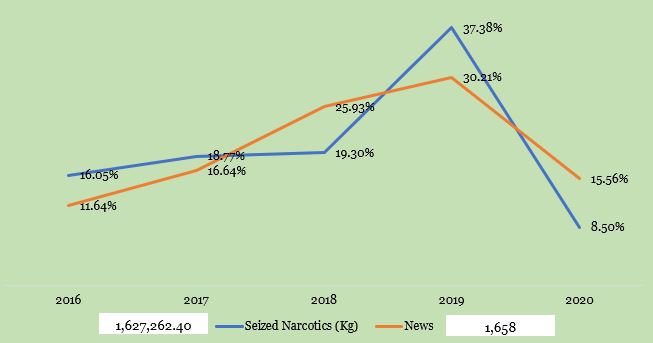
From 2016 to 2020, Nigerian newspapers etched a compelling narrative of Nigeria’s struggle against narcotics. The narrative unfolds as a story of two protagonists – the percentage of seized narcotics and the percentage of media attention directed toward this escalating problem. 2016 marked the beginning of our narrative. Even before a substantial increase in drug seizures, the media was already actively addressing the narcotics issue. This suggests that drug abuse was already a subject of concern for both the public and the media, setting the stage for heightened awareness.

As we venture into 2017, both the percentage of seized narcotics and media coverage surged, indicating a growing awareness and concern regarding the issue. The moral panic surrounding drug abuse was slowly gaining momentum, with the media playing a pivotal role in its dissemination. 2018 emerged as a turning point in our narrative. This year saw a significant surge in media coverage, outpacing the percentage of seized narcotics. This disproportionality hinted at a heightened emotional response to the problem, signifying the “hostility” stage of the moral panic. Society was becoming increasingly alarmed about the consequences of drug abuse.

The year 2019 witnessed a substantial increase in both seized narcotics and news coverage. The media’s extensive coverage indicated that the country was deep into the “disproportionality” stage, with a focus on enforcement and control. A noticeable intensification in the fight against narcotics was underway. Despite a decrease in the percentage of seized narcotics in 2020, news coverage remained relatively high. This disproportionality suggested a continued concern and response to the issue, emphasizing the persistence of the moral panic surrounding drug abuse.

Exhibit 1: Dialectical relationship between the volume of seized narcotics (kg) and newspapers response

Source: United Nations Office on Drugs and Crime, 2016-2020; Infoprations Analysis, 2023

Lessons Learned

The response of Nigerian newspapers to the narcotics issue over the past five years has offered several valuable insights through the dialectical lens. Firstly, the media has played a pivotal role in raising awareness and shaping public perception about drug abuse. This aligns with the dialectical notion of the media as both the narrator of the story and a character within it, actively influencing the narrative.

Secondly, the data reveals a dialectical tension between the two protagonists: the percentage of seized narcotics and the media’s attention to the issue. This dialectical relationship signifies a push and pull, as increasing media coverage both influences and is influenced by the severity of the problem. The disproportionality can potentially lead to stricter laws, increased law enforcement efforts, and more aggressive approaches to tackling the problem. Lastly, the persistence of media coverage, even when actual drug seizures fluctuated, reflects a dialectical tension between the ongoing concern and the tangible measures taken. This dynamic suggests that the moral panic was ongoing. The media continued to play a significant role in discussing and addressing the consequences of drug abuse.

Future Implications

The dialectical framework, rooted in the lessons learned, provides a unique perspective on the potential implications for the future stemming from Nigerian newspapers’ response to narcotics. The moral panic ignited and fueled by extensive media coverage, may lead to changes in policies and regulations regarding drug abuse. This dialectical tension between public concern and policy reform could result in stricter enforcement and control measures, aimed at curbing the drug trade and its associated consequences.

The persistent media focus on drug abuse is likely to raise public awareness further. This dialectical relationship between media influence and public response could lead to an increased emphasis on prevention and education programs in schools and communities. Moreover, the continuous societal awareness generated by media coverage might prompt a more significant investment in addiction treatment and rehabilitation facilities. This dialectical balance between the growing need for treatment and public awareness could ensure that individuals grappling with substance use disorders have improved access to effective treatment options.

Collaboration between public and private organizations and non-governmental organizations may create a dialectical synergy, strengthening the support network for individuals affected by drug abuse. This collaboration, while rooted in necessity, could significantly enhance the effectiveness of interventions. The increased media attention might encourage the establishment of a comprehensive system for collecting and analyzing data related to drug abuse. This data-driven approach, underpinned by the dialectical tension between data and policy, can guide policy development and resource allocation.

As the nature of drug abuse evolves, policymakers and managers need to continually monitor and adjust their approaches. This dialectical dynamic, characterized by the ever-shifting nature of the problem and society’s response, demands flexibility and adaptability to address the changing challenges posed by drug abuse. The dialectical approach, woven into the fabric of Nigerian newspapers’ response to narcotics, offers a profound understanding of the past, present, and future. It underscores the dynamic relationship between media coverage and societal response, shaped by the ongoing moral panic.

Nigerian newspapers have played a pivotal role in addressing the narcotics issue over the past five years. The dialectical tension between the severity of the problem and media influence has significant implications for Nigeria’s future response to drug abuse. Balancing enforcement with recovery support, focusing on education and prevention, and maintaining an adaptive approach to changing circumstances will be key to effectively addressing the issue.

Company Formation – The Right and Capacity To Register A Company In Nigeria

0
CAC

Corporate Law :- Company Formation in Nigeria – The Right & Capacity To Form a Company

This article will be looking at the foundational topic of company formation in Nigeria under the Companies and Allied Matters Act (CAMA), particularly the subtopics of :-

– The Right to Form a Company in Nigeria

– Limitations on alternative corporate bodies to companies

– The capacity of individuals to form a company

– Regulations following the different types of companies in Nigeria

The Right To Form a Company

The CAMA provides that:-

– As from the commencement of this Act, any two or more persons may form and incorporate a company by complying with the requirements of this Act in respect of registration of the company.

– Notwithstanding the provision mentioned above, one person may form and incorporate a private company by complying with the requirements of this Act in respect of private companies.

-A company may not be formed or incorporated for an unlawful purpose.

Limitations on Alternative Associations To Companies Exceeding 20 Members

Regarding this subject, the act provides that :-

– No association, or partnership consisting of more than 20 persons shall be formed for the purpose of carrying on any business for profit or gain by the association, or partnership, or by the individual members thereof, unless it is registered as a company under this Act, or is formed in pursuance of some other enactments in force in Nigeria.

– Nothing in this provision shall apply to the following exceptions—

(a) any co-operative society registered under the provisions of any enactment in force in Nigeria ; or

(b) any partnership for the purpose of carrying on practice—

(i) as legal practitioners, by persons each of whom is a legal practitioner or

(ii) as accountants by persons each of whom is entitled by law to practise as an accountant.

– If at any time the number of members of an association or partnership exceeds 20 in contravention of this section and it carries on business for more than 14 days while the contravention continues, each person who is a member of the company, association or partnership during the time it so carries on business is liable to a fine as prescribed by the Commission for every day during which the default continues

Capacity of Individuals To Form a Company

The act provides that an individual shall not join in the formationof a company under this Act if he is—

(a) less than 18 years of age ;

(b) of unsound mind and has been so found by a court in Nigeria or elsewhere;

(c) an undischarged bankrupt ; or

(d) disqualified under sections 281 and 283 of this Act from being a director of a company.

– A person shall not be disqualified under subsection (1) (a), if two other persons not disqualified under that subsection have subscribed to the memorandum.

-A corporate body in liquidation shall not join in the formation of a company under this Act.

– Subject to the provisions of any enactment regulating the rights and capacity of aliens to undertake or participate in trade or business, an alien or a foreign company may join in forming a company

Regulations Following Types of Companies

Private Companies

– A private company is one which is stated in its memorandum of associationt be a private company.

– Subject to the provisions of its articles, a private company may restrict the transfer of its shares and also provide that—

(a) the company shall not, without the consent of all its members, sell assets having a value of more than 50% of the total value of the company’s assets ;

(b) a member shall not sell that member’s shares in the company to a non-member without first offering those shares to existing members ; and

(c) a member, or a group of members acting together, shall not sell or agree to sell more than 50% of the shares in the company to a person who is not then a member, unless that non-member has offered to buy all the existing members’ interests on the same terms.

– The total number of members of a private company shall not exceed 50, not including persons who are bona fide in the employment of the company,or were, while in that employment and have continued after the determination of that employment, to be members of the company.

– Where two or more persons hold one or more shares in a company jointly, they shall, for the purpose of the act, be treated as a single member.

-A private company shall not, unless authorised by law, invite the public to:

(a) subscribe for any share or debenture of the company ; or

(b) deposit money for fixed periods or payable at call, whether or not bearing interest

Public Companies

 -Any company other than a private company shall be a public company and its memorandum of association shall state that it is a public company.

Unlimited Companies

-An unlimited company shall be registered with a share capital not below the minimum issued share capital permitted under section 27 (2) (a) of this act.

Companies limited by Guarantee

– Where a company is to be formed for the promotion of commerce art, science, religion, sports, culture, education, research, charity or rother similar objects, and the income and property of the company are to be  solely applied towards the promotion of its objects and no portion thereof is to be paid or transferred directly or indirectly to the members of the company except as permitted by this Act, the company shall not be registered as a company limited by shares, but may be registered as a company limited by guarantee.

Trezor unveils new Crypto Hardware Wallets and Backup Solution, Gauntlet to Deprecate Mai on Aave as Stablecoin Depegs

0

Trezor, one of the leading providers of crypto hardware wallets, has announced the launch of two new products: the Trezor Model T2 and the Trezor Backup Card. These products aim to offer enhanced security, usability and convenience for crypto users.

The Trezor Model T2 is the successor of the popular Trezor Model T, which was released in 2018. The new device features a larger touchscreen, a faster processor, a USB-C port and a redesigned interface. The Trezor Model T2 supports over 1,600 cryptocurrencies and tokens, including Bitcoin, Ethereum, Litecoin, Cardano, Binance Coin and more. It also allows users to access decentralized applications (DApps) and decentralized exchanges (DEXs) directly from the device.

The Trezor Backup Card is a novel solution for storing the recovery seed of the hardware wallet. The recovery seed is a set of 12 or 24 words that can be used to restore the wallet in case of loss, theft or damage. The Trezor Backup Card is a credit card-sized device that uses QR codes to store the recovery seed in an encrypted and tamper-proof way.

Users can scan the QR codes with the Trezor app or any compatible QR code scanner to access their recovery seed. The Trezor Backup Card is water-resistant, fire-resistant and shock-resistant, making it a durable and convenient alternative to paper or metal backups.

The Trezor Model T2 and the Trezor Backup Card are expected to be available for pre-order in November 2023, with shipping starting in December 2023. The price of the Trezor Model T2 is $199, while the price of the Trezor Backup Card is $49. Users who purchase both products together will receive a 10% discount.

Trezor claims that these new products will offer users a higher level of security and convenience for managing their crypto assets. According to the company’s website, “Trezor is more than just a hardware wallet. It is your gateway to the decentralized web.”

Elliptic finds apparent Russian connection in laundering of FTX stolen funds.

Elliptic, a blockchain analytics firm, has published a report that claims to have traced some of the funds stolen from the FTX crypto exchange in November 2022 to a Russian entity. The report says that about $10 million worth of Bitcoin and Ethereum were transferred from the hacker’s wallet to a service that offers anonymous transactions and swaps between different cryptocurrencies.

The service, which Elliptic did not name, is allegedly operated by a Russian individual or group, based on the analysis of the domain registration and web hosting information. Elliptic says that this service may have been used to launder the stolen funds and obscure their origin.

FTX, one of the largest crypto exchanges in the world, suffered a security breach on November 15, 2022, that resulted in the loss of about $150 million worth of various cryptocurrencies. The exchange said that it was able to recover most of the funds within hours, thanks to its internal security measures and the cooperation of other exchanges and blockchain platforms. However, some of the funds remained unaccounted for and were presumably in the hands of the hacker or hackers.

Elliptic’s report sheds some light on the possible destination of some of the missing funds, but it also raises more questions about the identity and motive of the attacker. The report suggests that the hacker may have been targeting FTX specifically, rather than randomly exploiting a vulnerability.

The report also notes that the hacker did not attempt to sell or cash out the stolen funds immediately, but rather waited for several weeks before moving them to the anonymous service. This could indicate that the hacker was either confident that they could evade detection or that they had a specific plan for using or disposing of the funds.

Elliptic says that it will continue to monitor the movement of the stolen funds and share its findings with law enforcement and FTX. The firm also urges crypto users and exchanges to be vigilant and report any suspicious transactions or activities to prevent further losses or damage.

Gauntlet to Deprecate Mai on Aave as Stablecoin Depegs

Gauntlet, a platform for risk management and governance of decentralized protocols, has proposed to deprecate Mai (formerly Matic) as a stablecoin on Aave, one of the leading lending platforms in DeFi. The reason for this proposal is that Mai has lost its peg to the US dollar and is currently trading at around $0.72, according to CoinGecko.

Mai is a synthetic stablecoin that is collateralized by Polygon’s native token, MATIC. It was launched in May 2021 by QiDao, a protocol that allows users to borrow stablecoins against their crypto assets without selling them. Mai was initially pegged to the US dollar at a 1:1 ratio, but due to various factors, such as market volatility, liquidity issues, and governance disputes, it has deviated significantly from its target price.

Gauntlet argues that this deviation poses a risk to the Aave protocol and its users, as it affects the health factor of the borrowers and the liquidation incentives of the lenders. The health factor is a metric that measures the solvency of a borrower based on their collateral value and debt value. If the health factor falls below a certain threshold, the borrower can be liquidated by the lenders, who can claim a portion of their collateral at a discount.

According to Gauntlet, the current situation of Mai creates a negative feedback loop that exacerbates its depegging. As Mai’s price drops, the borrowers’ health factor decreases, making them more vulnerable to liquidation. This in turn creates more selling pressure on Mai, as borrowers try to repay their debt or reduce their exposure. Moreover, the lenders have less incentive to liquidate the borrowers, as they would receive Mai tokens that are worth less than their face value. This reduces the demand for Mai and lowers its price further.

To address this issue, Gauntlet proposes to deprecate Mai on Aave, meaning that it would no longer be available as a borrowing or lending asset. This would effectively freeze the existing positions of Mai on Aave and prevent new ones from being created. Gauntlet claims that this would protect the Aave protocol from potential losses and reduce the systemic risk in DeFi.

Gauntlet’s proposal is currently under discussion on Aave’s governance forum and has received mixed reactions from the community. Some users support the proposal and agree that Mai is too risky to be supported on Aave. Others oppose the proposal and argue that it would harm the existing Mai users and damage the reputation of Aave as an open and inclusive platform. Some users also suggest alternative solutions, such as adjusting the risk parameters of Mai, creating a migration path for Mai users, or introducing a new synthetic stablecoin that is more robust and reliable.

The final decision on whether to deprecate Mai on Aave will depend on the outcome of the governance vote, which is expected to take place in the near future. The vote will require a quorum of at least 10% of the total AAVE tokens staked in the protocol and a majority of at least 50% of the votes cast. The vote will also be subject to a time lock of 48 hours before it can be executed.

Mai’s depegging is not an isolated incident in DeFi, as several other stablecoins have faced similar challenges in maintaining their pegs in recent months. These include Iron Finance’s IRON and TITAN tokens, which suffered a massive collapse in June 2021; Terra’s UST token, which experienced high volatility and slippage in September 2021; and OlympusDAO’s OHM token, which has been fluctuating around its target price of $1 since its launch in March 2021.

These events highlight the trade-offs and risks involved in creating and using synthetic stablecoins in DeFi. While synthetic stablecoins offer some advantages over fiat-backed or crypto-backed stablecoins, such as lower fees, higher capital efficiency, and greater composability, they also rely on complex mechanisms and assumptions that may not hold up in all market conditions. Therefore, users should exercise caution and due diligence when interacting with these assets and be prepared for potential losses or disruptions.