DD
MM
YYYY

PAGES

DD
MM
YYYY

spot_img

PAGES

Home Blog Page 4175

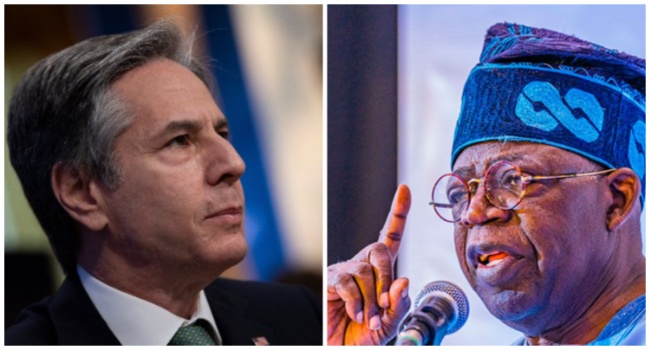
US Secretary of State, Blinken, Pledges Support for Tinubu towards a Sustained US-Nigerian Partnership Relationship

0

United States Secretary of state, Anthony Blinken reiterates the US continued commitment to further strengthening the US-Nigeria relationship with the incoming administration in Nigeria.

During a telephone conversation on Tuesday, the US Secretary of State, Antony Blinken and Nigeria’s President-Elect, Asiwaju Bola Ahmed Tinubu stressed on taking the existing partnership relationship between the two countries to the next level.

Spokesperson to the US secretary of State. Matthew Miller, said the Secretary noted that the U.S.-Nigeria partnership is built on shared interests and strong people-to-people ties and that those links should continue to strengthen under President-elect Tinubu’s tenure.

Miller further stated that Secretary Blinken and President-elect Tinubu discussed the importance of inclusive leadership that represents all Nigerians.

They also spoke about the continued comprehensive security cooperation, and reforms to support economic growth.

On his part, President-elect Bola Ahmed Tinubu promised to hit the ground running and unify the country upon his assumption of office on May 29.

He further pledged to work to ensure continued positive relations with the United States.

Tinubu’s spokesman, Tunde Rahman, noted that the president-elect said his immediate priorities would be to deliver institutional reforms and development programs to deepen democratic institutions and bring help to poor and vulnerable Nigerians.

He also expressed his determination to strengthen Nigeria’s democracy and faithfully serve the people as their president.

President-elect Tinubu recalled being granted asylum by the US when he was forced on exile during his struggle for the restoration of democracy in Nigeria, and, while reaffirming his democratic bona fides, expressed his absolute belief that the result of the elections, which he clearly won, reflected the will of the Nigerian people.

He further urged the US to factor in Nigeria’s important place in Africa and provide needed assistance in the areas of security and economic investment in order for the nation to lead the way and be a shining example to the rest of the continent.

Both President-elect Tinubu and Secretary Blinken  promise to keep the channels of communication open, whilst maintaining a strong relationship between the two nations.

Trading Bitcoin in Nigeria

0

Bitcoin trading in Nigeria is a popular and lucrative activity for many people in the country. Nigeria has the highest percentage of cryptocurrency users in the world, according to a 2020 survey by Statista. The reasons for this include the devaluation of the naira, the high inflation rate, and the lack of trust in traditional financial institutions.

However, trading Bitcoin in Nigeria also comes with some challenges and risks. The Central Bank of Nigeria (CBN) has banned banks and other financial institutions from facilitating cryptocurrency transactions, making it harder for traders to access fiat currency. The CBN has also warned the public about the volatility and security issues of cryptocurrencies and advised them to exercise caution but with new Blockchain frameworks from the Nigerian government we hope to see changes in the long run.

Mass Blockchain Adoption in Nigeria

Although cryptocurrency-related articles often dominate the news, it’s important to remember that the underlying blockchain technology has implementations that reach far wider.

This has been highlighted with the recent press release from the Federal Ministry of Communications and Digital Economy of Nigeria which states that the government intends to implement blockchain solutions throughout the country.

When such a significant economic power adopts blockchain en-masse it should indicate the validity of the technology and may prompt others to follow in its footsteps – which in this case includes a significant focus on regulation.

Bitcoin transactions are recorded on a public ledger called the blockchain, which ensures transparency and security. Bitcoin trading in Nigeria involves buying and selling bitcoins on various platforms, such as exchanges, peer-to-peer platforms, or online brokers.

Some of the advantages of bitcoin trading in Nigeria are:

High returns: Bitcoin has experienced significant price fluctuations over the years, which create opportunities for traders to profit from market movements. Bitcoin trading in Nigeria can generate high returns for traders who have the skills and strategies to analyze the market and execute trades accordingly.

Low fees: Bitcoin transactions are generally cheaper than traditional payment methods, such as bank transfers or credit cards. Bitcoin trading in Nigeria can save traders money on fees and commissions, especially when dealing with international transactions.

Financial inclusion and Innovation: Bitcoin is accessible to anyone with an internet connection and a compatible device, such as a smartphone or a computer. Bitcoin trading in Nigeria can empower people who are unbanked or underbanked, by giving them access to a global financial system and alternative sources of income.

There are two main ways to trade Bitcoin in Nigeria: through a cryptocurrency exchange or through a contract for difference (CFD) broker. A cryptocurrency exchange allows traders to buy and sell Bitcoin directly with naira or other cryptocurrencies and store them in a digital wallet. A CFD broker allows traders to speculate on the price movements of Bitcoin without owning or storing it, using leverage and margin.

Some of the most popular cryptocurrency exchanges in Nigeria are Luno, NairaEx, and Binance, which offer various payment methods, fees, and features. Some of the most popular CFD brokers that accept Nigerian traders are HotForex, Plus500, and Avatrade, which offer various trading platforms, tools, and regulations.

Trading Bitcoin in Nigeria can be a profitable venture for those who have the knowledge, skills, and discipline to do it successfully. However, traders should also be aware of the potential pitfalls and scams that may arise in this emerging market.

NERC Bars DisCos from Billing Disconnected Customers, Gives Standard for Customer Management

0

The Nigerian Electricity Regulatory Commission (NERC) has barred the Electricity Distribution Companies (DisCos) from billing already disconnected customers.

The ban which is contained in a March 2023 document entitled ‘’Customer Protection Regulation 2023’’ presented by the NERC chairman, Sanusi Garba, seeks to correct the problem of crazy billing which has been a source pain to customers, especially the unmetered customers.

‘’It is prevalent in the Nigerian Electricity supply industry for DisCos to keep billing disconnected customers even when they did not use power as a result of disconnection. The act has continued to lead to protest and litigation against the DisCos by aggrieved customers.’’ The Nation disclosed this in its report.

In the NERC’s document, the commission said that DisCos can only bill disconnected customers when they are reconnected.

‘’Whenever a supply address has been disconnected for non-payment and a bill has been produced representing consumption at the time of disconnection, the Distribution company shall not bill any additional charges in respect of that supply address until after it has reconnected electricity supply to the address’’ Sanusi Garba said.

The document also noted that, during a billing period, a customer may be given a supplementary bill by a DisCo under special circumstances such as when there is a need to amend an earlier bill where a customer made a request for correction.

In Mr Garba words: ‘’’While a review referred to in subsection (1) is ongoing, the customer shall pay an amount equal to the average amount of the customer’s bill at the current supply address over the period of twelve months, the amount shall equal average amount of the customer’s bills for the period that he has been a customer at the supply address.”

Regarding Credit Management System, NERC ordered every DisCO to prepare a credit management policy which can be filed with the commission for approval

NERC noted that where it is established that a Disco has not complied with its approved methodology for billing unmetered customers, the company shall refund the excess charges to the customers at the next billing circle.

The regulator also directed that if a DisCo is notified by a customer during working hours that electricity supply to his premises had gone off, an authorized official from the DisCO should visit the customer’s premises within 24 hours to determine the cause of the problem.
It is said where the cause of the outage was failure or defect with DisCo’s equipment such as fuse, the fuse shall be replaced within 24 hours of notification’’

UBS, Credit Suisse And the Lesson on the Anti-Hill

2

In the Igbo Nation, the elders will say that “a bird that flew from the ground only to perch on an ant-hill is still very much on the ground.” Hahaha. That leads me to the revelation that UBS, which rescued Credit Suisse just a few weeks ago, with limited due diligence, will take a $17 billion hit from the takeover. Yes, you rescued a bank and you lost $17 billion just because you did.  Indeed, you hope you may not need rescuing in years!

“UBS, in a Tuesday filing to the U.S. Securities and Exchange Commission, told investors it had less than four days to conduct due diligence given the “emergency circumstances. It estimated a hit of about $17 billion from the takeover.” Indeed, you took over a bank and now will waste $17 billion for doing that because politicians pressured you to do that. Trial lawyers are already gathering and a class action suit is waiting.  Modern capitalism: privatize gains, socialize losses.

UBS felt pushed to rescue Credit Suisse “in a deal it did not want,” reports Reuters, citing a U.S. Securities and Exchange Commission regulatory filing. The major Swiss bank said that due to “emergency circumstances,” it barely had four days to conduct due diligence on its smaller Swiss rival. Triggered by a series of bank failures in the U.S., Credit Suisse almost collapsed in March after a rush of “spooked” clients suddenly withdrew their money from the lender. UBS estimates it will take a $17 billion hit from the takeover.

Hype on Meme Coins is Declining due to frequent Rugpulls

1

Meme coins are cryptocurrencies that are inspired by internet memes and jokes. They often have no specific use cases or underlying utility, but they attract crypto enthusiasts for their fun aspect and their high volatility. Some of the most popular memecoins are Dogecoin (DOGE), Shiba Inu (SHIB), BabyDoge (BDOGE) and SafeMoon (SAFEMOON), recently PEPE, AiDoge, Wikicat, DTG, BOB and et al. Memecoins can be very profitable for investors who buy them early and sell them at their peak. However, they can also be very risky and prone to scams known as rugpulls.

Rug pulls are a serious problem in the memecoin space, as they erode trust and confidence in the sector. According to a recent report by CipherTrace, a blockchain analytics firm, rug pulls accounted for 99% of all crypto frauds in 2023, totaling $2.1 billion in losses. The report also identified over 1,000 memecoins that were potential rugs or had already been rug pulled.

However, not all memecoins are created equal. Some of them are scams that aim to deceive investors and take their money. These scams are known as rugs or rugs pulls, and they happen when the developers or the owners of a memecoin withdraw all the liquidity from the market, leaving investors with worthless tokens that they cannot sell.

The increasing frequency and magnitude of rug pulls have dampened the hype around memecoins, as investors become more cautious and selective about which projects they support. Many memecoin enthusiasts have learned to do their own research and look for signs of legitimacy and transparency before investing in a new project. Some of these signs include:

The contract of the memecoin is verified on Etherscan or BscScan.

The liquidity of the memecoin is locked on a reputable platform such as Unicrypt or DxSale.

The team behind the memecoin is public and has a clear vision and roadmap.

The memecoin has a website, a Twitter account, a medium blog and other social media presence.

The memecoin has both buys and sells on DEXs such as Uniswap or PancakeSwap and DEXScreener.

While these indicators are not foolproof, they can help investors avoid some of the most obvious scams and reduce their risk exposure. Additionally, some memecoin projects are trying to differentiate themselves from the crowd by adding functionality or integrating new technologies such as AI or NFTs.

For example, SnailBrook is a memecoin that aims to unite all memecoins into a single ecosystem that revolves around equal opportunities and social justice. It also plans to leverage AI technology to create a decentralized governance system and a meme generator.

Memecoins are still a vibrant and dynamic part of the crypto space, but they are not immune to challenges and threats. Rug pulls have tarnished their reputation and reduced their appeal to many investors.

However, some memecoin projects are striving to overcome these obstacles and deliver value and innovation to their communities. The future of memecoins may depend on their ability to adapt and evolve in a fast-changing environment.

Tips on avoiding rugpulls on Memecoins

Do your own research. Before buying any memecoin, make sure you understand what it is, who is behind it, what is its purpose, and how it works. Check the official website, social media accounts, whitepaper, roadmap, and audit reports. Look for signs of legitimacy, such as a clear vision, a competent team, a strong community, and a fair token distribution.

Be wary of red flags. Some indicators of a potential rugpull are: anonymous or unknown developers, pre-mined or pre-sale tokens, lack of liquidity or locked liquidity, unrealistic promises or guarantees, excessive hype or shilling, low market cap or volume, and sudden price spikes or dumps.

Use reputable platforms and wallets. Only buy memecoins from trusted exchanges or decentralized platforms that have proper security measures and customer support. Avoid sketchy websites or apps that ask for your private keys or personal information. Store your memecoins in secure wallets that you control, such as hardware wallets or software wallets with backup and recovery options.

Take profits and set stop-losses. Don’t be greedy or emotional. If you make a profit from a memecoin trade, take some off the table and lock in your gains. If the price goes down, set a limit on how much you are willing to lose and sell before it’s too late. Don’t hold on to a losing coin hoping for a miracle.

Diversify your portfolio. Don’t put all your eggs in one basket. Invest only what you can afford to lose and spread your risk across different types of assets, such as Bitcoin, Ethereum, stablecoins, and other altcoins. Don’t chase after every new memecoin that pops up on social media or Telegram groups. Be selective and cautious.