DD
MM
YYYY

PAGES

DD
MM
YYYY

spot_img

PAGES

Home Blog Page 4179

CMC Data Shows Women lead Men on Successful Stock Market Trades

0

New data from a leading trading platform has revealed that women made a considerably higher percentage of successful stock market trades compared to men in the first quarter of 2023.

The quarterly data report from CMC Markets has revealed fascinating insights into the trading activities of its users, including trading success based on gender and location, and which stocks were the most popular among the public.

The figures reveal that between 1 January and 31 March 2023, out of all users who ended up making a profit in the quarter, 70% of trades made by women were successful, compared to 62% of trades made by men.
The data also reveals interesting regional differences, with traders in Wales recording the highest percentage of successful trades during the quarter. In total, people in Wales had 69% successful trades, compared to 67% for people in England, 66% for people in Northern Ireland, and 62% for people in Scotland.

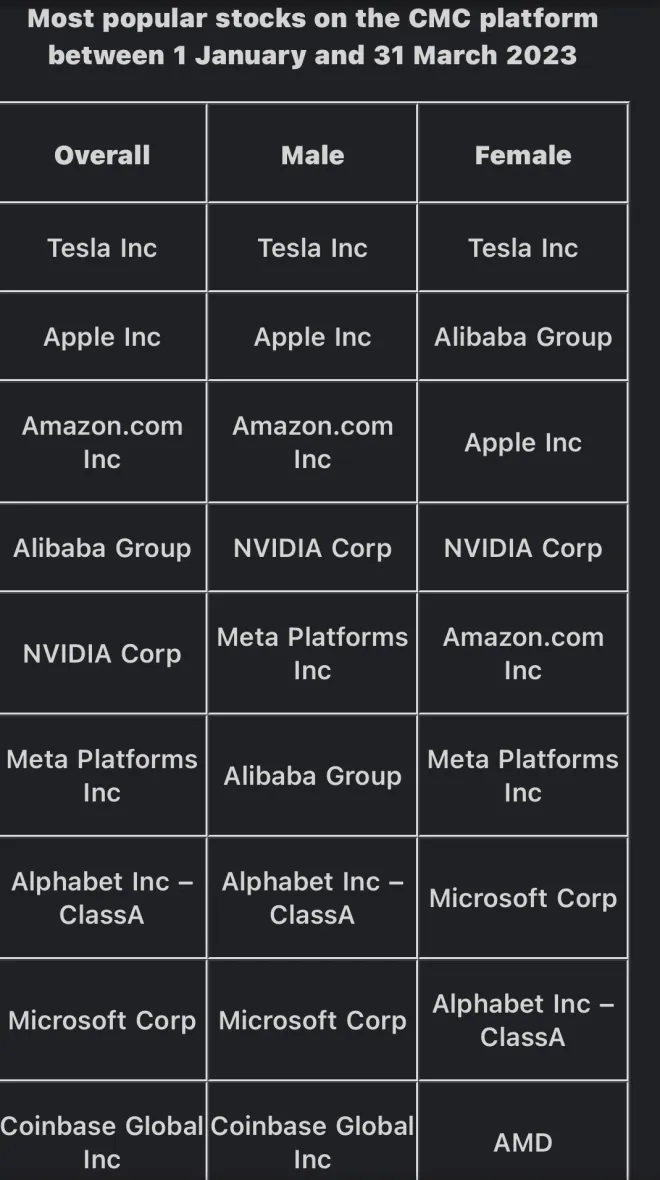
The study also reveals the most popular shares on the CMC Platform, with Tesla Inc topping the list overall, and for both male and female traders. Apple Inc was the second most popular overall and for men, whereas women’s second most popular stock was Alibaba. In third place overall and for men is Amazon.com Inc, while for women it’s Apple Inc.

Overall, the top ten most popular stocks are broadly similar within each category – the only differences in male and female stock preferences come in their ninth and tenth most popular stocks. Men were more interested in Coinbase Global Inc and Credit Suisse, whereas women showed a preference for semiconductor company AMD, and electric car manufacturer NIO Inc.

Commenting on the figures, Michael Hewson, Chief Market Analyst at CMC Markets, said:

What’s interesting here is that we’re not seeing a lot of variation across the demographic groups. It’s mostly the same ten companies in a slightly different order with Tesla number one throughout. It has always been this way – human beings are herd-like creatures.

The top ten is totally dominated by tech companies. Everyone thinks that the problems humans face will be solved by tech, and they want a part of that.

Over the last 15 years we’ve seen these tech stocks rise consistently, but the last year has seen the value of a lot of the big tech companies fall. I think that was an overdue correction. A problem with the herd mentality can be the creation of bubbles.

So many people can pile into the same stock that it becomes overvalued, and if everyone gets out at the same time that can cause problems. It’s like being on a small boat. If everyone moves to one side at once, it’ll capsize.”

The data also revealed the day during the quarter that most daily trades were made, with 13 March topping the list. Silicon Valley Bank’s (SVB) UK arm was sold to HSBC for £1 on that day as around 260,000 trades were made – double the daily average on the platform.

The second biggest day for daily trades was just a few days before on 10 March, when US regulators took control of SVB and shut it down. The third biggest day also came in the same month, when on 15 March worries of a bank run spread, and Credit Suisse announced it would borrow up to 50 billion Swiss francs from the Swiss National Bank.

Michael Hewson, Chief Market Analyst at CMC Markets commented: “At the end of every quarter there’s a little bit of a rebalance. People have a look back at how their portfolios have done, and this quarter also marks the end of the tax year, which also increases end of quarter flows. But even so this March was a particularly busy month.

“When things like this happen people start thinking back to 2008, and no one wants to be caught out again like that. For a lot of people, 15 years ago still feels fairly recent. But one of the things about the last 15 years is that markets have generally tended to go up. So there’s also a whole new generation of traders who have never seen a bear market. And they’ve been conditioned to buy the dip because central banks have always been there – there’s been low rates, plenty of liquidity. Inflation has been very benign for a long time.”

Now we have an inflation problem and central banks want to get on top of that. At the end of March they put rates up again and they will continue to do that until something else breaks. When you’ve been conditioned to low interest rates, it’s very difficult to shake out of that mindset. But as we go through the rest of this decade, we will find that there will be a slow adjustment to that new reality.


Avoiding The AI Trap of Building for NONE

2

Good People,  if the soup is watery, the elders will dent the garri before dipping it into it. The wisdom of that Igbo proverb is clear: if every business idea has AI in it, a simple way to evaluate the thesis and value proposition of ideas is to “abstract” out the AI component.  In the last two weeks, more and more business plans we’ve received at Tekedia Capital have “AI” as a component.

Amazing, we admire the energy. But AI will not obfuscate inherent challenges in electricity and data systems in many African industries.  Tell us what you plan to do before “AI will magically…”

At Tekedia Capital, we do not fund technologies just for the sake of having fancy things. We fund products which solve customer frictions. Sure, technologies are key components to create those products, but we are unalloyed and untethered to technology; our commitment is to products!

In our category-king equations, there is no tech at the top level:

Great Company = Awesome Product + Superior Execution

Innovation = Invention + Commercialization

Products and innovations will win empires; let’s know what you are building. Interestingly, unless you have the data, any talk of AI in my village in Abia State is a distraction. Yes, where is the data?

To close, let me drop a famous Igbo proverb:  the free range chicken  will always look up when drinking water because what kills it always comes from the sky (the hawk).  Many entrepreneurs have failed because they’re merely building technologies instead of solving problems which customers have! Yes, they lose focus, distracted, only to be consumed by market forces (the hawks in markets)!

ChatGPT’s success has led to a mushrooming cottage industry of AI startups. But even as some investors charge ahead to capitalize on the AI gold rush, others are starting to hold back. The sheer speed and scale with which the industry is progressing daily makes it hard to place sound bets, they say. Some also caution against what they say has become a freewheeling ecosystem, with some firms putting their money behind companies without so much as a business plan, and valuations reaching tens of millions of dollars. Read more here.

Comment on Feed

Comment 1: To avoid falling into the AI Trap of Building for NONE, businesses should begin by gaining a clear understanding of the customer problem they aim to solve. Once this is established, they can explore how AI can be utilized to address the issue effectively. However, it is crucial for businesses to remain realistic concerning the capabilities of AI, which is a powerful tool but not a one-size-fits-all solution. Moreover, AI is a complex technology that requires time and effort to develop and deploy AI-powered products or services. Therefore, patience is vital, and businesses must allow ample time for AI to mature.

How Hilda Baci Becomes an ANT

0

It is no longer news that Hilda Effiong Bassey has surpassed India’s Rewa Lata Tondon, who cooked meals for 87 hours and 45 minutes, with her “longest cooking marathon by an individual” of over 100 hours. At least on different media platforms and in physical settings across the world, people have celebrated her and are still appreciating her efforts. But according to our analyst, many people have not heard of how Nigerian netizens on Twitter have turned her into an ANT, which they have been cliquing with their sting messages with the intention of capturing socioeconomic and political benefits from.

In this piece, our analyst uses actor-network theory (ANT), which proposes that both human and non-human actors form networks that shape social reality, to critically assess several tweets that used her name to achieve the stated benefits. According to our analysis, a number of the tweets had topics that were not connected with the cooking competition. For instance, some businesses leveraged her competition for the promotion of their goods and services, while some tweets were embedded with various political issues as well as ideologies. While businesses seem to use her competition to construct expected value identities for their brands, our analyst discovered that netizens with an interest in expressing political views and their ideological orientations directly and indirectly constructed positive identities for the political actors they supported and negative identities for the actors they did not.

Hybrid Identity Construction

ANT suggests that actors in a network are interconnected and mutually construct each other’s identities. In the context of the tweets, the unrelated topics and the people and organisations mentioned within them suggest a contribution to the hybrid identity construction of those actors. For example, Bola Ahmed Tinubu is mentioned alongside Hilda Baci’s name in some tweets, creating a hybrid identity for both. This suggests that Senator Bola Ahmed Tinubu is in support of Hilda Baci’s achievement, and Hilda Baci is seen as connected to Tinubu’s political sphere. This hybrid identity construction is formed through the network of associations created within the tweets.

Non-Human Actor Influence

ANT emphasises the agency of non-human actors in shaping social reality. In the tweets, non-human actors include hashtags, emojis, and pictures that were used to construct the identities of the people and organisations mentioned. For instance, the users who employed #PrayForBnxn or #BBTitians aimed at shaping the identities of the individuals associated with the hashtags. The inclusion of these non-human actors aligns the mentioned individuals with specific communities or interests, potentially influencing how they are perceived and constructing their identity within those contexts.

Translation and Mediation

According to ANT, actors translate and mediate between different elements within a network, influencing the meanings and relationships between them. In the context of the tweets, the users serve as mediators by linking unrelated topics and individuals through their mentions. By mentioning Hilda Baci alongside unrelated topics or individuals, the users engage in a process of translation. They create connections and associations between these elements, which can potentially influence how people perceive the identities of the mentioned individuals and organisations. This translation and mediation shape the narrative and context in which these actors are positioned.

Our analyst notes that the use of ANT provides an opportunity to know how Nigerians through Twitter have constructed identities that enliven brands and demonstrate how the medium could be used for reenacting socio-political issues for collective deliberation while celebrating ‘a collective achievement.’

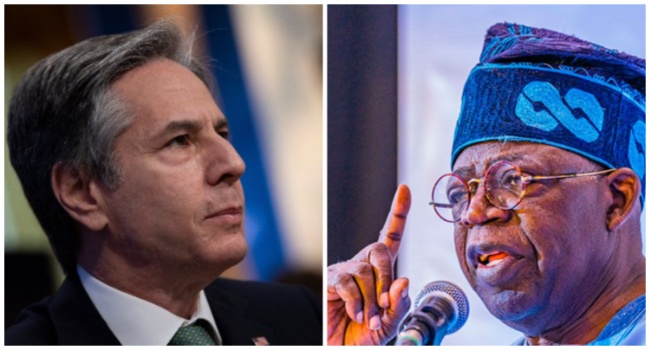
US Secretary of State, Blinken, Pledges Support for Tinubu towards a Sustained US-Nigerian Partnership Relationship

0

United States Secretary of state, Anthony Blinken reiterates the US continued commitment to further strengthening the US-Nigeria relationship with the incoming administration in Nigeria.

During a telephone conversation on Tuesday, the US Secretary of State, Antony Blinken and Nigeria’s President-Elect, Asiwaju Bola Ahmed Tinubu stressed on taking the existing partnership relationship between the two countries to the next level.

Spokesperson to the US secretary of State. Matthew Miller, said the Secretary noted that the U.S.-Nigeria partnership is built on shared interests and strong people-to-people ties and that those links should continue to strengthen under President-elect Tinubu’s tenure.

Miller further stated that Secretary Blinken and President-elect Tinubu discussed the importance of inclusive leadership that represents all Nigerians.

They also spoke about the continued comprehensive security cooperation, and reforms to support economic growth.

On his part, President-elect Bola Ahmed Tinubu promised to hit the ground running and unify the country upon his assumption of office on May 29.

He further pledged to work to ensure continued positive relations with the United States.

Tinubu’s spokesman, Tunde Rahman, noted that the president-elect said his immediate priorities would be to deliver institutional reforms and development programs to deepen democratic institutions and bring help to poor and vulnerable Nigerians.

He also expressed his determination to strengthen Nigeria’s democracy and faithfully serve the people as their president.

President-elect Tinubu recalled being granted asylum by the US when he was forced on exile during his struggle for the restoration of democracy in Nigeria, and, while reaffirming his democratic bona fides, expressed his absolute belief that the result of the elections, which he clearly won, reflected the will of the Nigerian people.

He further urged the US to factor in Nigeria’s important place in Africa and provide needed assistance in the areas of security and economic investment in order for the nation to lead the way and be a shining example to the rest of the continent.

Both President-elect Tinubu and Secretary Blinken  promise to keep the channels of communication open, whilst maintaining a strong relationship between the two nations.

Trading Bitcoin in Nigeria

0

Bitcoin trading in Nigeria is a popular and lucrative activity for many people in the country. Nigeria has the highest percentage of cryptocurrency users in the world, according to a 2020 survey by Statista. The reasons for this include the devaluation of the naira, the high inflation rate, and the lack of trust in traditional financial institutions.

However, trading Bitcoin in Nigeria also comes with some challenges and risks. The Central Bank of Nigeria (CBN) has banned banks and other financial institutions from facilitating cryptocurrency transactions, making it harder for traders to access fiat currency. The CBN has also warned the public about the volatility and security issues of cryptocurrencies and advised them to exercise caution but with new Blockchain frameworks from the Nigerian government we hope to see changes in the long run.

Mass Blockchain Adoption in Nigeria

Although cryptocurrency-related articles often dominate the news, it’s important to remember that the underlying blockchain technology has implementations that reach far wider.

This has been highlighted with the recent press release from the Federal Ministry of Communications and Digital Economy of Nigeria which states that the government intends to implement blockchain solutions throughout the country.

When such a significant economic power adopts blockchain en-masse it should indicate the validity of the technology and may prompt others to follow in its footsteps – which in this case includes a significant focus on regulation.

Bitcoin transactions are recorded on a public ledger called the blockchain, which ensures transparency and security. Bitcoin trading in Nigeria involves buying and selling bitcoins on various platforms, such as exchanges, peer-to-peer platforms, or online brokers.

Some of the advantages of bitcoin trading in Nigeria are:

High returns: Bitcoin has experienced significant price fluctuations over the years, which create opportunities for traders to profit from market movements. Bitcoin trading in Nigeria can generate high returns for traders who have the skills and strategies to analyze the market and execute trades accordingly.

Low fees: Bitcoin transactions are generally cheaper than traditional payment methods, such as bank transfers or credit cards. Bitcoin trading in Nigeria can save traders money on fees and commissions, especially when dealing with international transactions.

Financial inclusion and Innovation: Bitcoin is accessible to anyone with an internet connection and a compatible device, such as a smartphone or a computer. Bitcoin trading in Nigeria can empower people who are unbanked or underbanked, by giving them access to a global financial system and alternative sources of income.

There are two main ways to trade Bitcoin in Nigeria: through a cryptocurrency exchange or through a contract for difference (CFD) broker. A cryptocurrency exchange allows traders to buy and sell Bitcoin directly with naira or other cryptocurrencies and store them in a digital wallet. A CFD broker allows traders to speculate on the price movements of Bitcoin without owning or storing it, using leverage and margin.

Some of the most popular cryptocurrency exchanges in Nigeria are Luno, NairaEx, and Binance, which offer various payment methods, fees, and features. Some of the most popular CFD brokers that accept Nigerian traders are HotForex, Plus500, and Avatrade, which offer various trading platforms, tools, and regulations.

Trading Bitcoin in Nigeria can be a profitable venture for those who have the knowledge, skills, and discipline to do it successfully. However, traders should also be aware of the potential pitfalls and scams that may arise in this emerging market.