DD
MM
YYYY

PAGES

DD
MM
YYYY

spot_img

PAGES

Home Blog Page 4182

Crypto stocks rally despite tech-heavy indexes slipping lower

0

The cryptocurrency market has been on a tear lately, defying the downward trend of the broader tech sector. While the Nasdaq Composite and the S&P 500 tech index have both dropped by more than 5% in the past month, the total market capitalization of all cryptocurrencies has surged by over 20%, reaching a new all-time high of $2.8 trillion. What is driving this divergence? There are several factors that could explain the resilience of crypto stocks amid the tech sell-off. Here are some of the main ones:

Regulatory clarity: The crypto industry has been waiting for clear and consistent rules from regulators around the world, especially in the US, where the Securities and Exchange Commission (SEC) has been cracking down on some crypto projects and platforms. However, in recent weeks, there have been some positive developments that have boosted investor confidence.

For instance, the SEC approved the first Bitcoin futures exchange-traded fund (ETF), opening the door for more institutional adoption. Moreover, the SEC chair Gary Gensler has signaled a more constructive approach to crypto regulation, saying that he wants to “promote innovation” and “protect investors”.

Innovation and adoption: The crypto space is constantly evolving and innovating, offering new products and services that attract more users and investors. One of the most notable examples is the rise of decentralized finance (DeFi), which allows people to lend, borrow, trade, and earn interest on their crypto assets without intermediaries.

Crypto stocks are stocks of companies that are involved in the cryptocurrency industry or have exposure to digital assets such as Bitcoin, Ethereum, and other altcoins. Investing in crypto stocks can be a way to gain exposure to the growing crypto market without having to buy and store cryptocurrencies directly. However, crypto stocks are also subject to high volatility and regulatory uncertainty, as the crypto market is still evolving and facing many challenges.

DeFi has grown exponentially in the past year, reaching over $250 billion in total value locked (TVL). Another example is the emergence of non-fungible tokens (NFTs), which are unique digital assets that represent anything from art to music to sports memorabilia. NFTs have exploded in popularity and value, creating a new market for creators and collectors.

Network effects and scarcity: The crypto market is also benefiting from the network effects and scarcity of some of its leading assets, especially Bitcoin and Ethereum. Bitcoin, as the first and most widely adopted cryptocurrency, has a limited supply of 21 million coins, which makes it a hedge against inflation and currency devaluation.

Ethereum, as the second largest and most versatile cryptocurrency, powers most of the DeFi and NFT platforms, creating a high demand for its native token, ether. Both Bitcoin and Ethereum have seen their prices soar to new highs in recent weeks, pulling up the rest of the crypto market with them.

The outlook for crypto stocks remains bullish, as more investors and institutions recognize the potential and value of this emerging asset class. However, there are also risks and challenges that could derail the rally, such as regulatory uncertainty, security breaches, technical glitches, and market volatility. Therefore, investors should do their own research and due diligence before investing in any crypto stock or asset.
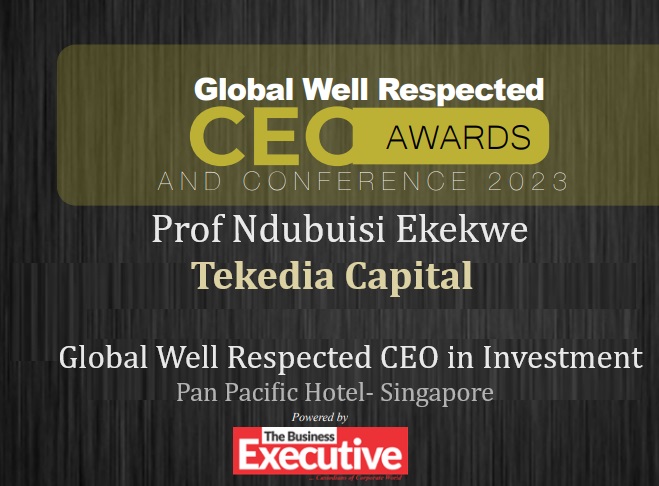
Tekedia Capital Chairman, Ndubuisi Ekekwe, Honoured as “Global Well Respected CEO in Investment”.

0

One of the good things about business is that the more you love it, the more you get rewards in it, and the more you wake up with an unalloyed optimistic exuberance that the rays of sun, the songs of nightingales, the beats of the crickets, and the cracking noise of the city cars, will bring the next growth opportunities. And that works even if you are a village boy (lol). Yes, they will discover you and they will celebrate you.

Good People, I want to celebrate because in the Igbo Nation, you need to kill just one leopard to be called a killer of leopardS (note the “s”). And on that premise, it is all the way to Singapore as they award yours truly a “Global Well Respected CEO in Investment”.

At Tekedia Capital, the mission remains: to discover innovators who fix market frictions, and support them with capital, to restore the dignity of man and woman, through entrepreneurial capitalism!


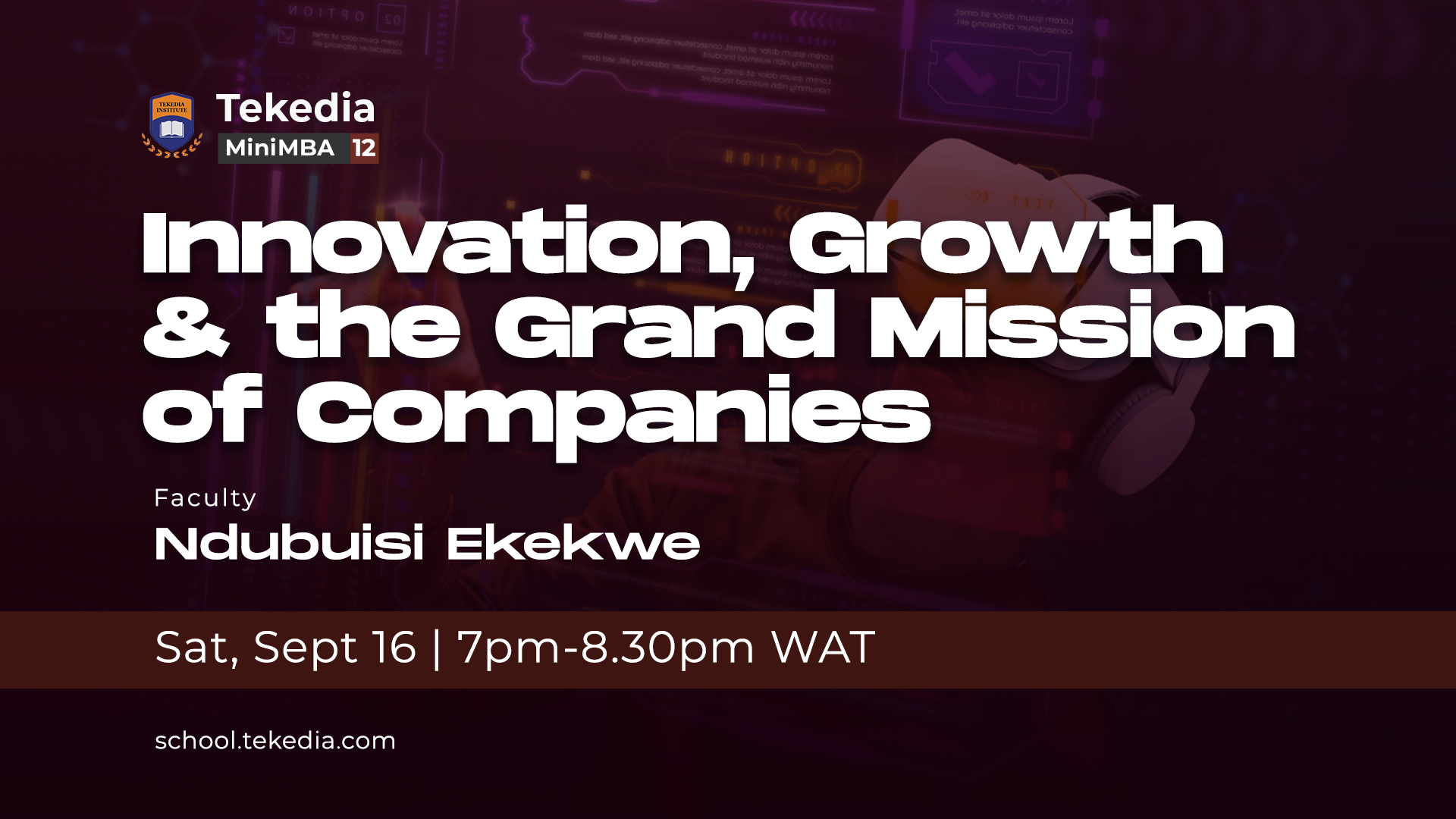
Join Us Tomorrow for The First LECTURE of this Edition of Tekedia Mini-MBA

0
Innovation, Growth and the Grand Mission of Companies

Tekedia Mini-MBA Academic Festival has started. Our first LIVE lecture will happen tomorrow and I will speak on Innovation, Growth and the Grand Mission of Companies. During the class, I will explain the fundamental reason why we have companies, and why WE THE PEOPLE have to be trained, to work, towards helping companies to fulfill their missions.

Generally, market systems are imperfect, and there means we need to remove the perturbations. In this lecture, we will see how market challenges connect to opportunities and the missions of companies, and how accumulating and improving capabilities by and for workers enable business growth, by deepening the capacity to utilize factors of production more efficiently.

The People. The Processes. The Tools. When they are optimized, great things happen in firms. The reward of fixing market frictions is REVENUE. Why not join here 

Understanding the Greater Bay Initiatives

0

The Guangdong-Hong Kong-Macao Greater Bay Area (GBA) is a mega-city region that consists of two Special Administrative Regions (SARs) of Hong Kong and Macao, and nine cities in Guangdong province: Guangzhou, Shenzhen, Zhuhai, Foshan, Dongguan, Zhongshan, Jiangmen, Huizhou, and Zhaoqing. The GBA has a population of over 71 million people. It is one of the most dynamic and prosperous regions in China and the world, with a GDP of US$1.68 trillion in 2019, ranking 11th globally.

The Greater Bay Area (GBA) is a regional development plan that aims to integrate Hong Kong, Macau and nine cities in Guangdong province into an economic and innovation hub. The plan was first proposed by China’s central government in 2017 and has since attracted global attention and investment.

The GBA covers a total area of 56,000 square kilometers and has a population of over 70 million people. It is one of the most dynamic and prosperous regions in China, accounting for 12% of the country’s GDP and 37% of its exports in 2019. The GBA also boasts a high level of innovation, with more than 60,000 patents granted and over 100,000 scientific papers published in the same year.

The GBA plan aims to leverage the complementary strengths and synergies of the 11 cities, while respecting their different systems, cultures and laws. The plan envisions four key roles for the GBA:

An international innovation and technology hub that fosters collaboration among universities, research institutes, enterprises and governments.

A globally competitive modern industrial system that supports advanced manufacturing, emerging industries and green development.

A world-class city cluster that enhances connectivity, livability and sustainability.

A showcase of in-depth cooperation between the mainland and Hong Kong and Macau.

To achieve these goals, the GBA plan outlines several strategic measures, such as:

Improving the infrastructure network that links the 11 cities by land, sea and air.

Enhancing the flow of people, goods, capital and information within the GBA.

Promoting the coordinated development of industries and markets across the GBA.

Strengthening the protection of the environment and natural resources.

Deepening the cultural and social integration of the GBA.

The GBA plan offers immense opportunities for businesses, investors, professionals and residents in the region. It also presents challenges, such as balancing the different needs and interests of the stakeholders, ensuring fair competition and cooperation, and addressing the social and environmental issues that arise from rapid urbanization.

The GBA is envisioned as an integrated economic area that aims to take a leading role globally by 2035. The Chinese central government released the Outline Development Plan for the GBA in February 2019, which sets out the key strategies and policy measures for developing the region. The plan supports Hong Kong in consolidating and enhancing its status as an international financial, transportation and trade center, as well as an international aviation hub.

It also encourages Hong Kong to develop its innovation and technology industries, establish itself as a center for international legal and dispute resolution services in the Asia-Pacific region, and expand its cultural and creative industries.

The plan also respects the differences between the two SARs and the mainland cities in terms of their legal systems, economic development models, social systems and customs. It upholds the principle of “one country, two systems” and safeguards the high degree of autonomy of Hong Kong and Macao under the Basic Law. It emphasizes that Hong Kong and Macao should leverage their own strengths and complement each other with the mainland cities to achieve mutual benefits and win-win outcomes.

The GBA offers immense opportunities for Hong Kong and Macao to deepen their cooperation with the mainland cities, especially in areas such as infrastructure connectivity, innovation and technology, financial services, ecological conservation, cultural exchange, youth development and social welfare. The GBA also provides a platform for Hong Kong and Macao to participate in the Belt and Road Initiative and enhance their international connections and networks.

The development of the GBA is not only beneficial for the economic growth and social progress of the region, but also conducive for maintaining the long-term prosperity and stability of Hong Kong and Macao. The GBA will enable Hong Kong and Macao to better integrate into the national development strategy, while preserving their unique characteristics and advantages. The GBA will also foster a sense of belonging and identity among the people of the region, as well as a shared vision for the future.

The GBA plan is a long-term vision that requires joint efforts from all parties involved. It is also a dynamic process that adapts to changing circumstances and needs. The success of the GBA plan depends on the active participation and support of the people in the region, as well as the collaboration and communication with the international community.

The GBA plan is an ambitious and complex project that will shape the future of China and the world. It is a topic that deserves more attention and discussion from all stakeholders. In this post, we have provided a brief introduction to the GBA plan and its implications. We hope that this will spark your interest and curiosity to learn more about this important initiative.

Lagos Leads Other States As Headline Inflation Hits 25.80% in August 2023

0

Nigeria’s inflation experienced a notable surge in August, reaching 25.80%, which is 1.72% higher than the previous month’s figure of 24.08%. This was revealed in the latest Consumer Price Index (CPI) report for August 2023 released by the National Bureau of Statistics (NBS).

This substantial increase can be attributed to the effects of removing petrol subsidies and the devaluation of the official exchange rate, both of which had an impact on consumer prices. Additionally, month-on-month inflation also saw an increase, rising to 3.18% during the review month, up from 2.89% in the preceding month.

Other factors attributed to the increase include housing, food, and electricity.

“In terms of contribution to the year-on-year inflation, Food and non-alcoholic beverages (13.36%) contributed the most, followed by housing water, electricity, gas and other fuel (4.32%), and clothing and footwear (1.97%),” the NBS said.

“On a year-on-year basis, in August 2023, the Urban inflation rate was 27.69%, this was 6.73% points higher compared to the 20.95% recorded in August 2022. The Rural inflation rate stood at 24.10%, representing a 3.98% points increase compared to the 20.12% recorded in August 2022,” the agency added.

Food inflation reached one of its highest rates, surging to 29.34% in August 2023. This marks a substantial increase of 2.35% points compared to the previous month’s rate of 26.98% and is notably 6.22% points higher than the rate recorded in the same period of 2022, which was 23.12%.

On a month-on-month basis, the Food inflation rate for August 2023 stood at 3.87%, indicating a 0.41% point increase when compared to the rate recorded in July 2023, which was 3.45%.

The average annual rate of Food inflation for the twelve months ending in August 2023, when compared to the previous twelve-month average, was 25.01%. This represents a significant increase of 5.99% points from the average annual rate of change recorded in August 2022, which was 19.02%.

The rise in Food inflation on a year-on-year basis can be attributed to increases in the prices of various food items, including Oil and fat, Bread and cereals, Fish, Fruit, Meat, Vegetables and Potatoes, Yam and other Tubers, Vegetable, and Milk, Cheese, and Eggs. These factors collectively contributed to the observed increase in food prices.

Talking about ‘All items less farm produce’, which excludes the prices of volatile agricultural produce, the NBS said it stood at 21.15% in August 2023 on a year-on-year basis; up by 0.67% when compared to the 20.47% recorded in July 2023.

“On a month-on-month basis, the Core Inflation rate was 2.18% in August 2023. It stood at 2.11% in July 2023, up by 0.07%.

“The average twelve-month annual inflation rate was 19.18% for the twelve months ending August 2023; this was 4.38% points higher than the 14.80% recorded in August 2022.

“The highest increases were recorded in prices of Passenger Transport by Air, Passenger Transport by Road, Medical Services, Vehicle Spare parts, Maintenance, and repair of personal transport equipment etc,” it said.

When it comes to state inflation, Lagos leads other states with the highest rate, while Sokoto holds the lowest rate.

“In August 2023, all items inflation rate on a year-on-year basis was highest in Kogi (31.50%), Lagos (29.17%), and Rivers (29.06%), while Sokoto (20.91%), Borno (21.77%) and Nasarawa (22.25%) recorded the slowest rise in headline inflation on a year-on-year basis,” the NBS said.

Food inflation on a year-on-year basis exhibited significant regional variation. The highest food inflation rates were observed in Kogi at 38.84%, followed by Lagos at 36.04%, and Kwara at 35.33%.

Conversely, the slowest rise in food inflation on a year-on-year basis was recorded in Sokoto at 20.09%, Nasarawa at 24.35%, and Jigawa at 24.53%. These regions experienced comparatively lower increases in food prices during the specified period.