DD
MM
YYYY

PAGES

DD
MM
YYYY

spot_img

PAGES

Home Blog Page 4234

Orbeon Protocol (ORBN) Could Overtake Polkadot (DOT) And Avalanche (AVAX) After Listing On Uniswap

0

The Cryptocurrency space, as resilient as ever, continues to promise financial inclusion and decentralization of finance in recent times despite the downtrend being experienced. The industry has shown positive changes and upsets with new project introductions. The unique nature of the cryptocurrency space creates room for regular disruptions here and there. Polkadot and Avalanche are the ones whose positions seem threatened by the listing of the Orbeon Protocol on Uniswap.

>>BUY ORBEON TOKENS HERE<<

Polkadot (DOT) is the foundation for Web3

Polkadot (DOT) was created to offer a groundwork aimed at the decentralized internet of blockchains which is today known as Web3. It offers a foundation that supports a decentralized web run by its users, thereby simplifying the creation of new services, institutions and applications.

Polkadot (DOT) is a shared multichain network, which implies it can process several transactions on many chains in parallel (The parachain phenomenon). This unique ability to process many transactions in parallel increases scalability.

The native token of Polkadot is known as the DOT, has experienced a 1.19% over the past 24 hours at a price of $6.52. It is ranked eleventh on Coinmarketcap and has a 24 hr trading volume of $206,640,788. DOT’s circulating supply is 1,173,201,116 DOT coins and has a live market capitalization of $7,667,419,275. Its market dominance stands at 0.64%. Polkadot’s uniqueness and performance data hold huge promise for investors.

>>BUY ORBEON TOKENS HERE<<

Avalanche (AVAX) rivals Ethereum as the most popular Smart Contracts

The Avalanche (AVAX) is a layer 1 blockchain that acts as a platform for custom blockchain networks and decentralized applications. It is a major competitor to Ethereum seeking to dislodge Ethereum as the most widely used blockchain for smart contracts. Avalanche (AVAX) aims to use its unique architecture to unseat Ethereum by supporting more transaction output of as much as 6,500 transactions for every second without conceding scalability.

Its unique architecture comprises the C-chain, X-chain and P-chain. Every chain has a different purpose- a radical departure from Bitcoin and Ethereum approach which is getting all nodes to validate every transaction.

The Avalanche’s primary coin (token) is known as the AVAX which has a market price of $18.16, currently with a 24-hour trading volume of $195,721,416. In the past 24 hours, Avalanche (AVAX) has increased by 5.98%. It is rated as number 16 on Coinmarketcap with a market cap of $5,944,155,671 and a circulating supply of 326,000,170 AVAX coins.

>>BUY ORBEON TOKENS HERE<<

Orbeon Protocol (ORBN)’s Listing on Uniswap will change the status Quo

Orbeon Protocol (ORBN), recently launched, is among the first cryptocurrency crowd-funding platforms which enable users to partly invest in a few of the most exciting and promising businesses at their early stages.  Orbeon Protocol will enable start-ups to raise financial resources and involve their community by providing reward and equity-based NFTs. Every investment opportunity shall be minted into a Non-fungible Token (NFT) and fractionalized, supporting any investor to back and invest in products or brands they believe in, beginning from at least one dollar.

With its listing on Uniswap, Orbeon Protocol (ORBN) is up by a whopping 45.33% with a current price of $0.194189 and a 24-hr trading volume of $ 54,301.65. Orbeon Protocol’s primary token is the ORBN coin, with a maximum supply of 888,000,000 ORBN coins and presently ranked No. 4030 on Coinmarketcap. Its current market cap stands at $117,259,303. From the stats and uniqueness of the project, Orbeon Protocol (ORBN) is set to unseat other decentralized projects, such as Polkadot and Avalanche after its listing on Uniswap.

Find Out More About The Orbeon Protocol

Website: https://orbeonprotocol.com/

Telegram: https://t.me/OrbeonProtocol

Uniswap: https://app.uniswap.org/#/swap

Twitter: https://twitter.com/OrbeonProtocol

Audiences in the Age of Media and Content Fragmentation

0
A woman looks at a NFT by Mad Dog Jones titled "SHIFT//" during a media preview on June 4, 2021, at Sotheby's for the Natively Digital: A Curated NFT Sale Online Auction to take place June 10, 2021. - They are technology enthusiasts on the hunt for opportunities in the Wild West market surrounding NFTs: the popular certified digital objects that have spawned a new generation of collectors convinced of their huge potential. (Photo by TIMOTHY A. CLARY / AFP) / RESTRICTED TO EDITORIAL USE - MANDATORY MENTION OF THE ARTIST UPON PUBLICATION - TO ILLUSTRATE THE EVENT AS SPECIFIED IN THE CAPTION

The emergence of various new technologies has transformed many ways of carrying out tasks or activities at the micro, meso, and macro levels across ages, gender, race, and other demographics. As technology developers continue to develop new features that improve users’ experiences, content producers who use media content driven technologies face the challenge of finding better ways to use the features for the development and dissemination of tailored messages. Audiences, on the other hand, are unsure of how to use the features as producers gain a better understanding of how to use them. In this piece, our analyst examines some academic studies and draws conclusions that may be useful to producers and prosumers (audiences who produce and consume content at the same time).

Ytre-Arne & Das (2018) An agenda in the interest of audiences: Facing the challenges of intrusive media technologies

The scholars submit that as the new technologies keep evolving from different perspectives towards meeting the needs of humanity, which also keep changing every day, researching the use of the technologies has also remained challenging. Audiences are in a serious dilemma as it becomes difficult to find appropriate ways of using and benefiting from intrusive media technologies. On the other hand, media researchers with a particular interest in audience analysis are in a critical situation where they need to think like journalists, who use who, what, where, when, why, and how when writing news. Though the 5Ws and H is an age-long approach for news writing, it is a method that aligns with the dynamism of technologies that people are being exposed to every day. The scholars argue that since new technologies emerge from the surveillance and correlation of people’s needs by the developers, using critical research approaches for understanding audiences in relation to the technologies they use without necessarily neglecting peculiar socioeconomic, political, and power relations is essential for helping them escape various impeding challenges or problems for getting appropriate benefits from the emerging technologies.

These submissions emerged from the outcomes of research conducted by a research network consortium with an interest in finding appropriate directions for researching audiences as social media and other emerging technologies proliferate with a growing concern about big data, which is being aggregated and commodified. In this regard, audience researchers are in the best position, through their research outcomes, to let the technology users know the implications of their digital traces and always remind technology capitalists about the need for sustained ethical conduct regarding users’ privacy and personal data protection. The scholars conclude that some audiences in the age of the Internet are invisible, but this does not mean that audience researchers should not explore identity, communality, resistance, and politics that matter most to audiences using different approaches.

Das (2017) audiences: a decade of transformations – reflections from the CEDAR network on emerging directions in audience analysis

A decade of technological transformation that shaped the direction of audience analysis was explored by the scholar. The reflections from a research network were used to pinpoint how audiences experienced a fragmented media environment due to the different waves of the new media. The scholar posits that new media with unique features usually shapes how audiences use and interact with the new technologies. This has really called for different ways of interpreting and/or engaging with the content developed from using the features. As audiences struggle with the best ways to use the new technologies, the scholar posits that emerging categories of texts, readers, and interpretive work are changing the way audiences should be studied as both physical and digitally mediated spheres become more fragmented.

Therefore, there is a need to theorise the audience using different theoretical assumptions or propositions because of the dynamism of the audience and the texts (printed and non-printed) they are consuming in different forms and contexts on a daily basis. This is premised on the fact that readers or audiences are no longer traditional or linear while using and benefiting from the new technologies. Rather, they are now hyper-readers or audiences as the technologies evolve in different patterns in order to meet their needs effectively. The theorization should be done with total consideration of different genealogies of the technologies as well as key moments of audience participation because audience analysis has reached a newer, more unknown, but very significant phase. For instance, with emerging technologies and their disruptive features, audience appropriation of the technologies is unstable at micro, meso, and macro levels. This has really pushed the frontier of contemporary audience research to the de-westernisation of how audience research is being conducted. In other words, audience analysis should be conducted with a peculiaristic approach and not a universalistic one, which solely considers the perspectives of the global north’s researchers or scholars.

Litt & Hargittai (2016) The imagined audience on social network sites

The main argument is that social network sites have enabled people to communicate with diverse audiences, but users are unable to separate abstract imagined audience from targeted imagined audience. Specifically, the scholars use empirical data from a mixed research method to explore how SNS users determine their abstract and targeted imagined audiences, with the objective being that users post without knowing who is likely to read or access their post [abstract imagined audience], while the targeted imagined audience occurs when users have specific persons from their social and professional networks in mind. The scholars argue that fragmented features of social network sites can be problematic for users as they have to move from one feature to another without getting the right audience for their messages. Examples of this include reshare, retweet, and other algorithms-driven features. However, offline interactions are more persistent, searchable, archivable, and shareable due to no technological facilitated challenges.

These nuances motivate the scholars to explore the imagined audience on social network sites using follow-up interviews and observations of participants’ posts, as well as four diary surveys sent via email for determining the composition and characteristics of the two classifications of the imagined audience. The findings show that users often imagined broad, abstract, and targeted audiences, ranging from personal ties to professional ties, communal ties, and/or phantasmal ties. These audiences were homogeneous and made up of people’s friends and family. However, users’ imaginations fluctuated when posting, even though the potential audience did not change frequently. These findings led to the conclusion that more research is required to gain a better understanding of why and how users manage their privacy, as well as how they cope with thinking about the two audience classifications.

Jensen (2019) The double hermeneutics of audience research

The scholar dissociates himself from the idea that audiences are passive in the age of digital media. Instead, he argues that the digital media have actually shaped how audience researchers should see the users of the emerging technologies. This is premised on the fact that users are “prosumers” or “produsage”. In this context, they produce and, at the same time, consume. Therefore, exploring the interplay between changing media environments and changing conceptions of audiences with a particular reference to how the tripod (meta) of communicating on digital media is essential for interpreting and reinterpreting the audience’s linear and non-linear relationship with the media in any communicative event

Doing this requires the consideration of double hermeneutics and reception analysis. Double hermeneutics is a mechanism that interprets a lived reality that has already been interpreted by the sender and receivers of media. Reception analysis is a reaction to uses-and-gratifications studies and wider intellectual and public debates in which audiences are assigned new kinds and degrees of agency as co-creators of culture and society. It anticipates the understanding of the Internet as a medium that would empower audiences beyond the interpretation of media interfaces, and the phenomenon of Web 2.0 is a first attempt to come to terms with a reconfigured media environment.

To properly understand the double hermeneutics as communicative practice in the context of audience research, the scholar argues that reception analysis that combines social contexts with the users’ ability to decode messages is highly desirable. This will help in determining how communication and culture serve to orient both human agency and social structuration. On a concluding note, the scholar sees audience’s interpretation of media and audience research reinterpretation as a double-edged sword needed for meaningful engagement of media professionals, policymakers, and other practitioners with audiences in the digital media environment.

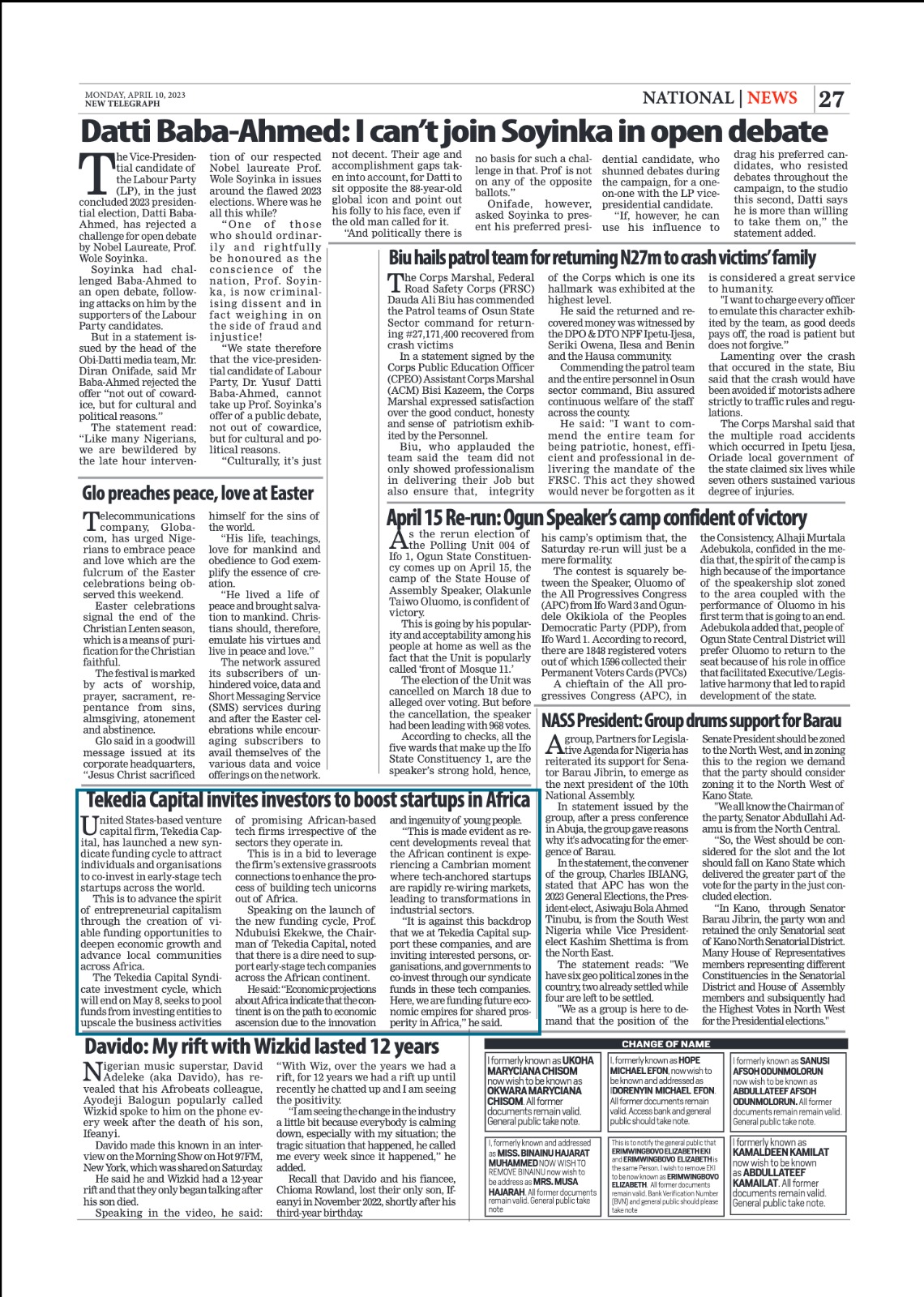
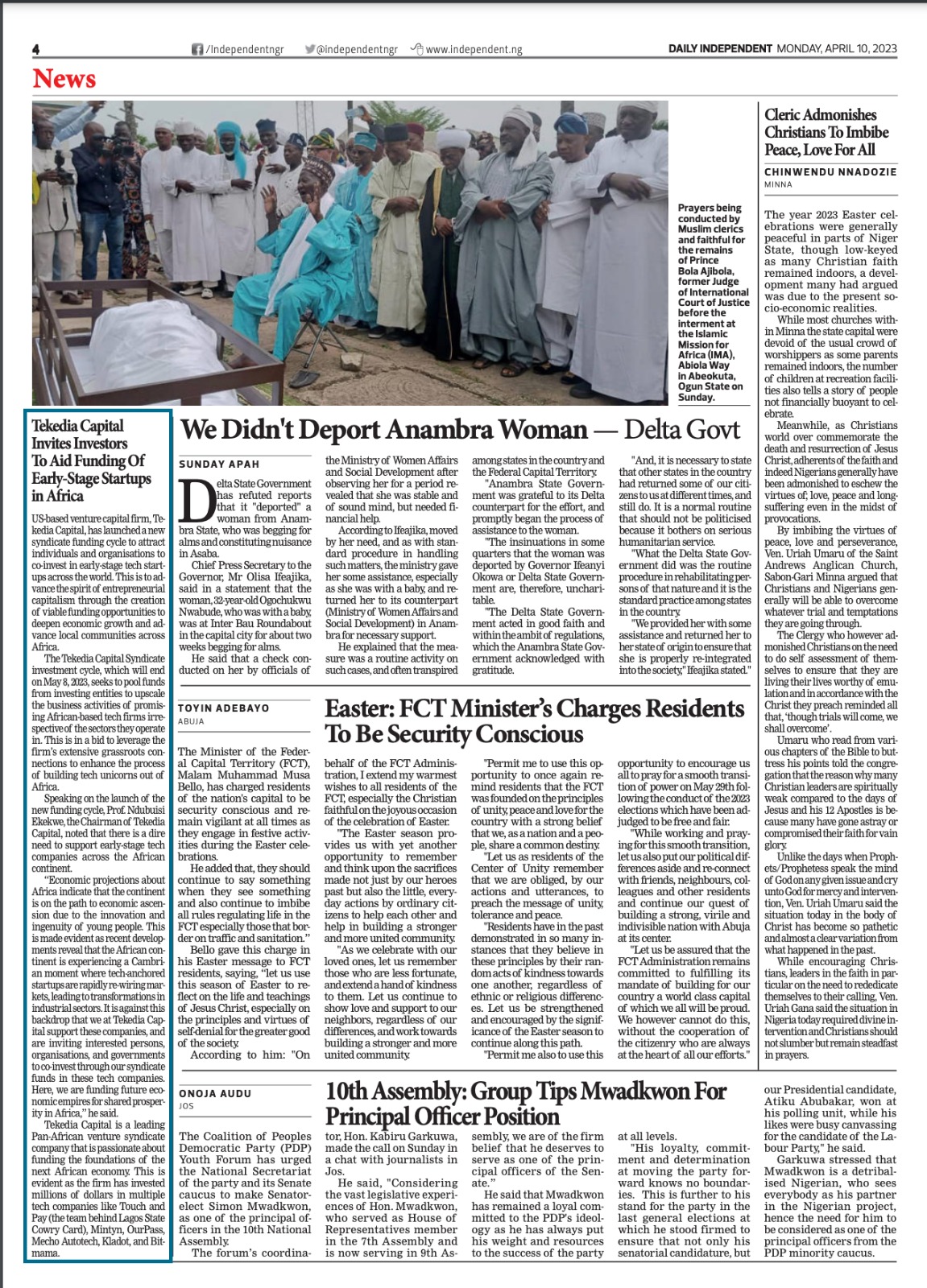
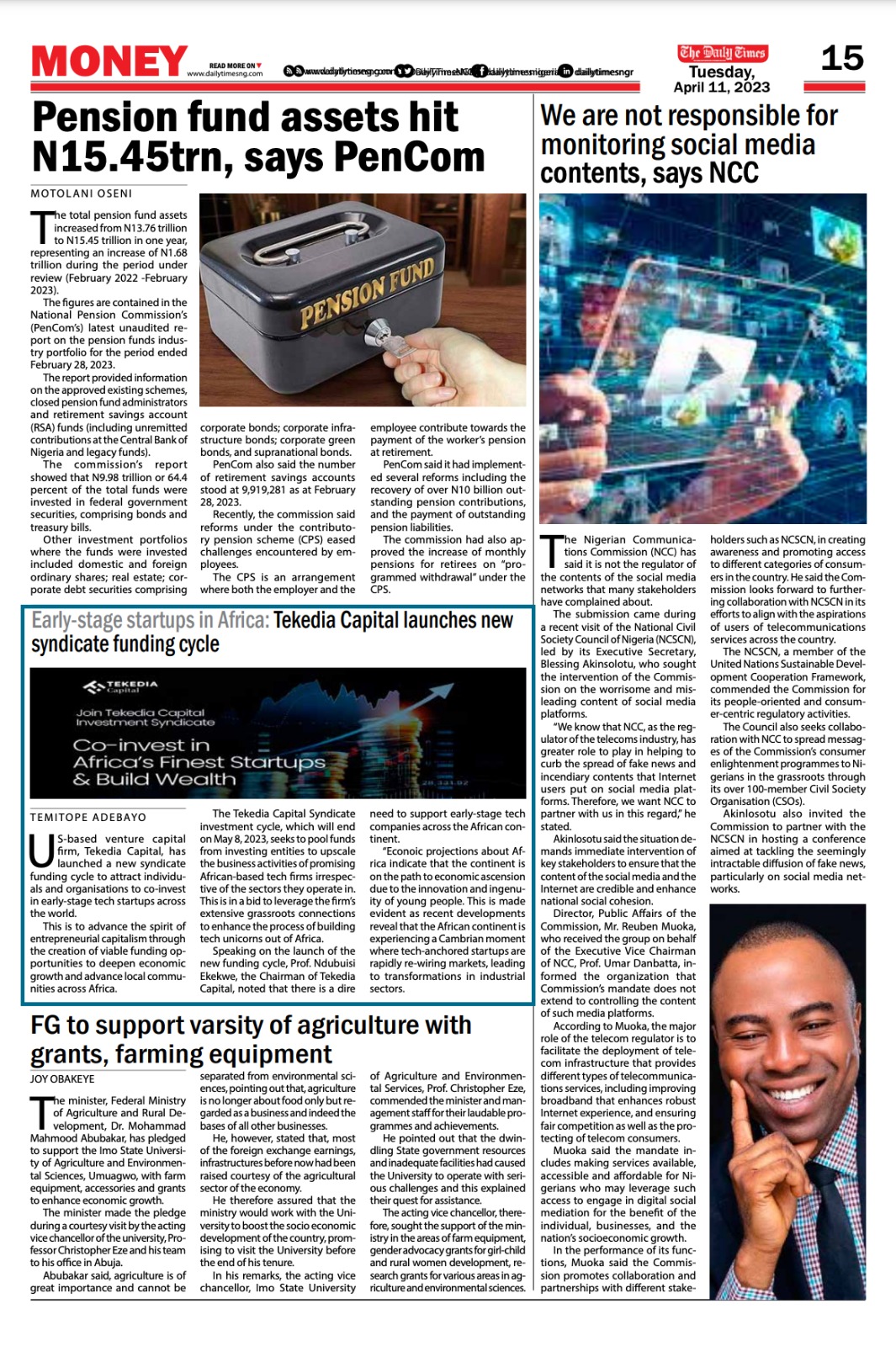
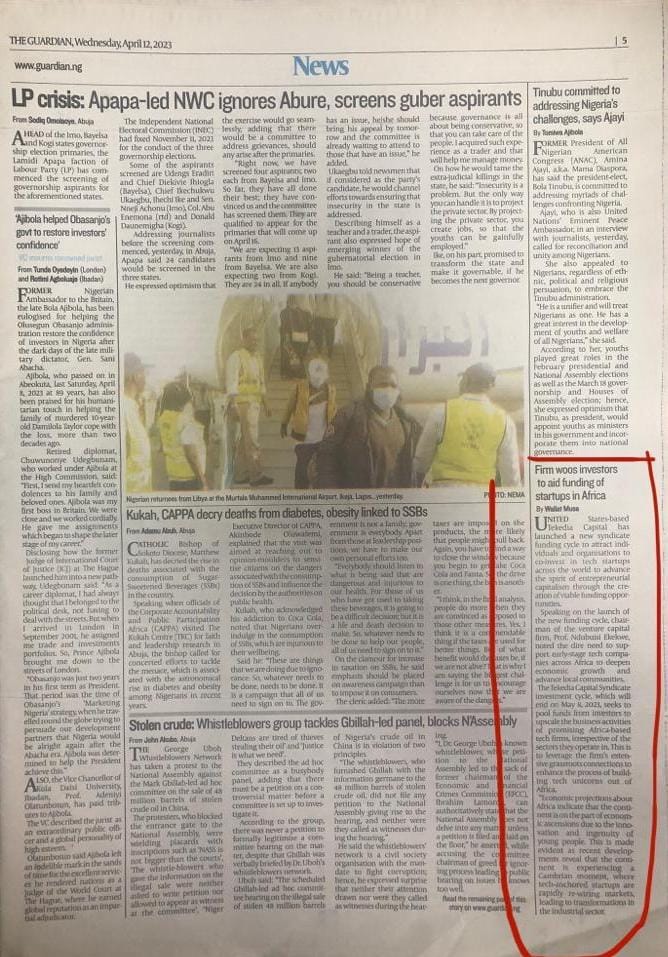
Tekedia Capital in the News – Guardian, BusinessDay, Leadership, The Nation, etc

0

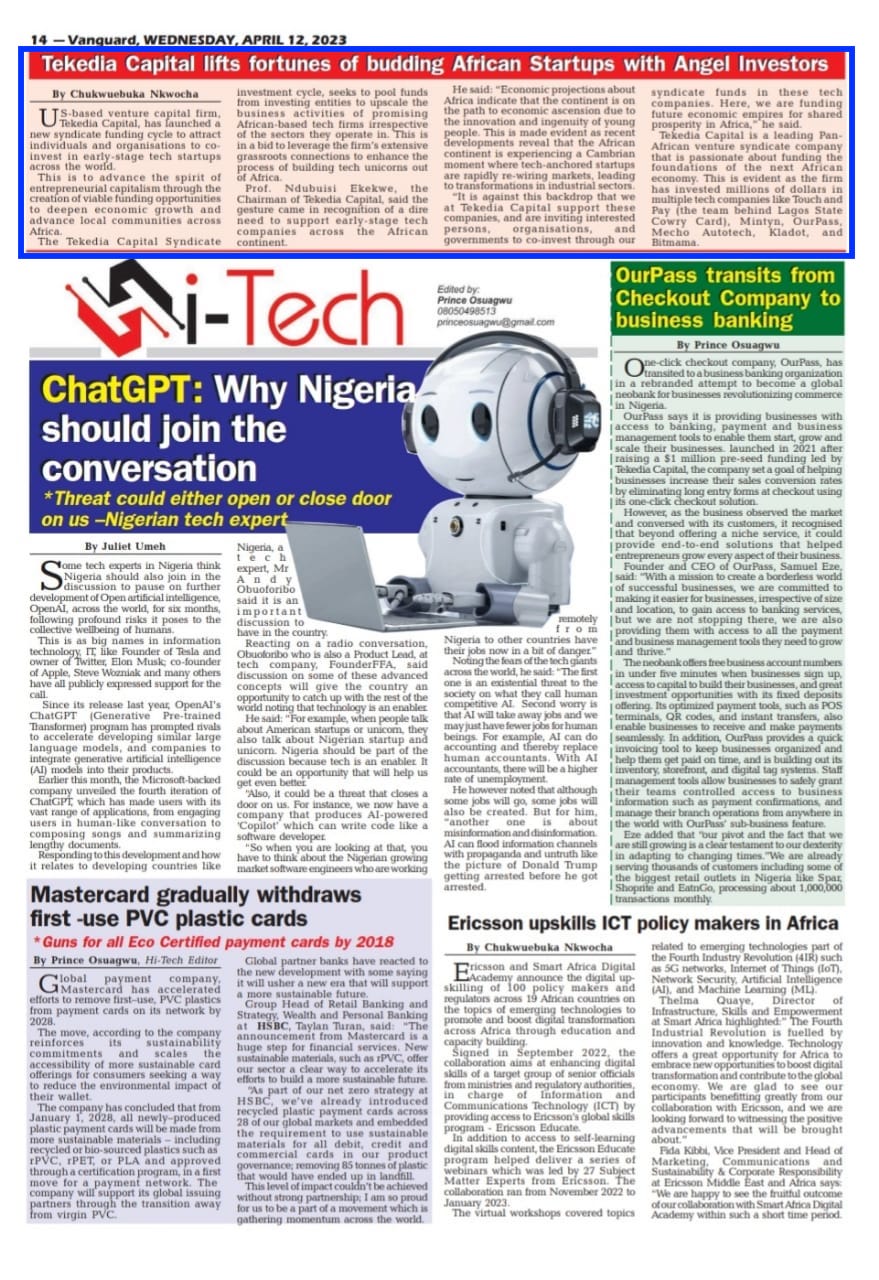
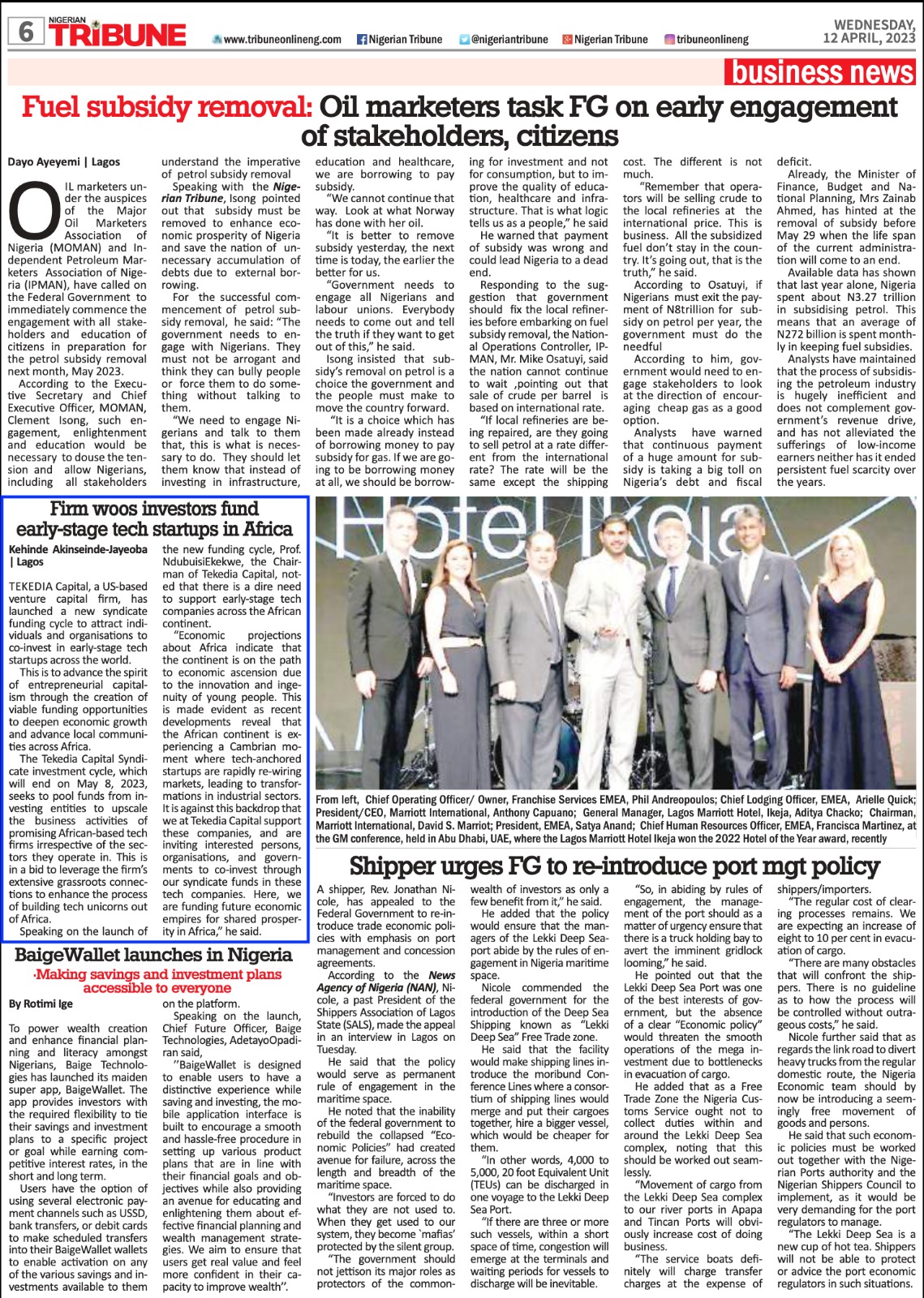
Tekedia Capital is in the news in many newspapers this season as we begin a new investment cycle here.

Tekedia Capital invests in technology-anchored early stage startups and companies. Our opportunity antenna and grassroot connections with innovators enable us to see patterns as they develop.  We invite you to partner with us as we nurture and build category-king companies in Africa and beyond, and in the process advance citizens, communities and nations. At Tekedia Capital, we fund the foundations of the NEXT African economy.

BusinessDay
BusinessDay

The Nation: Tekedia Capital seeks investors for startups in Africa


Independent: Tekedia Capital Invites Investors To Aid Funding Of Early-stage Startups In Africa


New Telegraph: Tekedia Capital invites investors to boost startups in Africa


Leadership: Tekedia Capital Provides Platform To Fund Tech Startups


Daily Independent

Daily Times
Daily Times

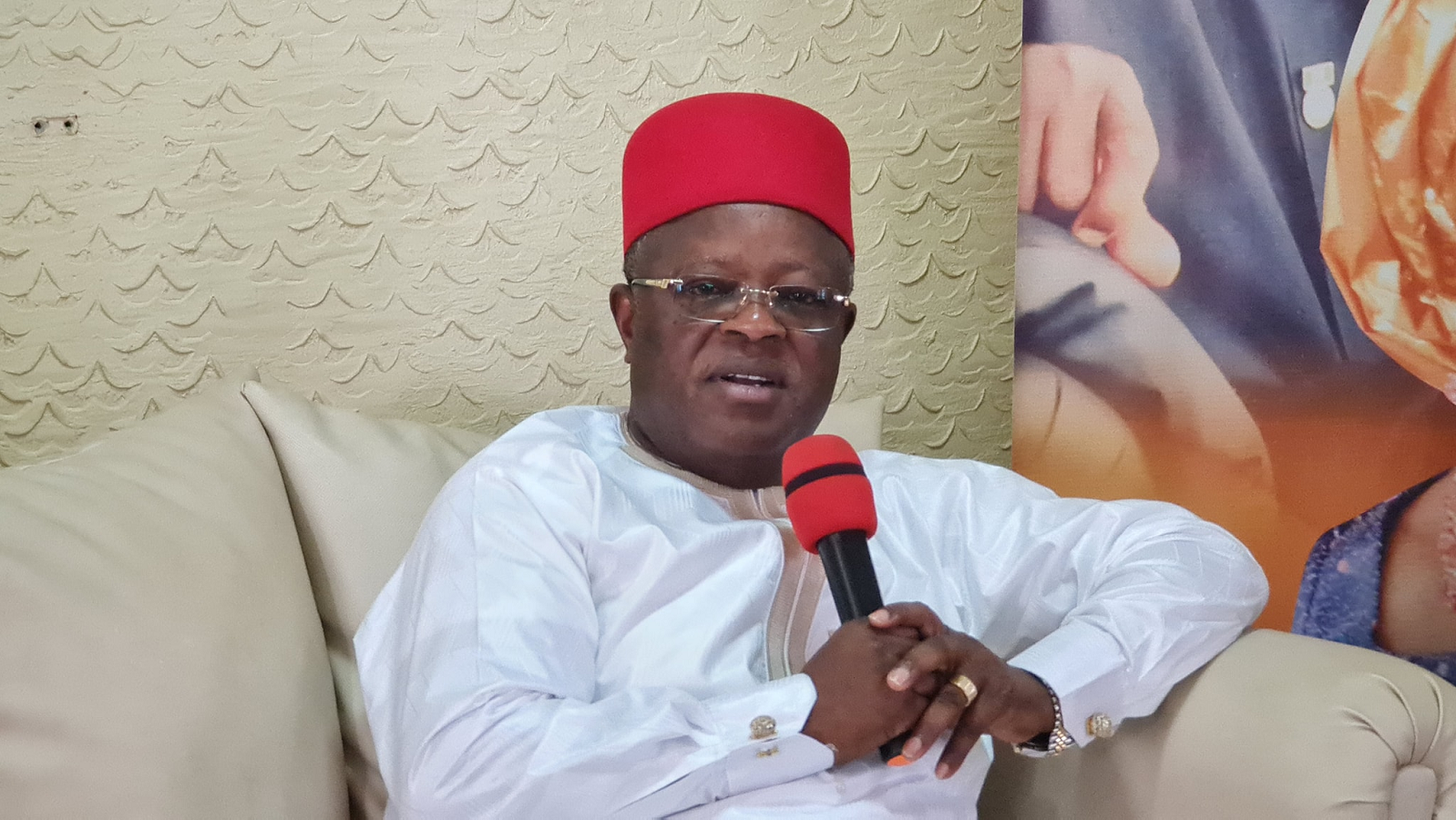
Street lights will not attract investors or create jobs in Ebonyi state

11

I flew into Abakaliki last night after so many years that I haven’t visited the state and the first thing that welcomed me was the multi-colour paints on the city walls and roadsides, the fancy street lights and numerous flyovers both completed and uncompleted inside the city centre. 

Paradoxically, I can count how many private vehicles drove past us within the city; but everywhere is filled with tricycles (Keke Napep) and I was forced to ask myself the reasons for building multiple flyovers in a city with zero traffic like Abakaliki. 

Common sense should have told those in charge that flyovers are needed and of high importance in only highly congested cities so as to decongest traffic gridlock. There has never been traffic gridlock on any road in Abakaliki so I will ask the state government what is and will be the use of the flyovers they built. I guess for aesthetics and beauty purposes. A project as capital intensive as such should not be engaged just for aesthetics and decorations. All the flyovers built are just a waste of money; a gigantic sum of money that should rather be invested in other ventures that would have created long-term sustainable jobs for the Ebonyi residents. 

No serious businessman or investor will relocate to invest in a city just because of the city’s aesthetics; paints or street lights.

Again, the airport that was just built in the state is another waste of scarce resources. Enugu airport is just about 45 mins away from Abakaliki city; the Enugu airport has been serving Ebonyi residents and visitors and could still serve. Every state, especially a state like Ebonyi, must not own an airport, it is not a “show off” project. Millions of dollars were spent on that project and I can predict that the airport will go bankrupt and will be abandoned soon just like the Benue’s due to low patronage.

The state government should have asked themselves before embarking on such a project about how many business persons or visitors visit the state daily to warrant an airport to be built. 

I expected the Ebonyi state government to know that for every project undertaken by a government, there is an opportunity cost for it which was abandoned and that’s why before embarking and wasting money on a project, the government should ask the hard question; “is the project really necessary at this point”? 

For any flyover built, there are schools which ought to be built or renovated which were sacrificed as an opportunity cost to erect a flyover. For every airport built, there is money which ought to be pumped into an educational subsidy to subsidize the cost of university education in the state; Ebonyi state university is one of the most expensive state-owned universities in Nigeria and for a state like Ebonyi which is the state in southern Nigeria that tops the rank of educational less developed states, the state should have prioritized instead on subsidizing the cost of tertiary education to encourage education amongst the indigenes and also investing in projects that will attract industries that will create more jobs. 

What the state government like Ebonyi should consider now is the creation of long term and sustainable jobs, inviting and attracting investors through different incentives like stable and low-cost electricity, tax abatement/ reduction and building of more schools and subsidizing the cost of education in state-owned institutions to encourage education.

Building flyovers, and airports and spending millions of dollars painting the city walls just for decoration and aesthetics are just so unnecessary (at this point) and will never attract investors or create long-term jobs.


Happy Easter!

0

Happy Easter and let me wish everyone a Happy Resurrection Day. Resurrection brings a new life and I am praying that your career, family, etc  will experience the power of His resurrection. As we say in the Scripture Union, His resurrection will resolve any challenge. Good People,  grace infinite because He’s Risen. Happy Easter from my family to yours.