DD
MM
YYYY

PAGES

DD
MM
YYYY

spot_img

PAGES

Home Blog Page 4366

The CBN Tenure Review of Executive Directors, Non-Executive Directors of Deposit Money Banks in Nigeria

0

The Central Bank of Nigeria on the 24th of February , 2023 carried out a regulatory review of requirements governing the tenure of executive management & non-executive directors of Deposit Money Banks (DMBs) & Financial Holding Companies (FHCs) as contained in the Code of Corporate Governance for Banks & Discount Houses.

This review was carried out with the aim of improving on governance practices and standards within the banking and financial sector in Nigeria.

This article will be looking at the notable provisions on this regulatory review which are as follows :-

Executive Directors

– The tenure of Executive Directors (EDs), Deputy Managing Directors (Deputy MDs) & Managing Directors shall be in accordance with the terms of their engagement approved by the board of directors of banks, subject to a maximum tenure of 10 years.

– Where an executive who is a DMD becomes the MD or Chief Executive Officer of a bank or any other DMB before the end of his maximum tenure, the cumulative tenure of such an executive shall not exceed a period of 12 years. 

– The cumulative tenure of an executive director who becomes a DMD of a bank shall not exceed 10 years.

– Executive Directors, DMDs & MDs who exit from the board of a bank either upon or prior to the expiration of their maximum tenure of 12 years (calculated as 3 terms of 4 years each) shall serve out a cooling off period of 1(One) year before being eligible for appointment as a non-executive directors to the board of directors.

– The cumulative tenure limit of EDs/DMDs, & MDs across the banking industry is 20 years.

Non-Executive Directors

– Non-Executive Directors (NEDs) who exit from the board of directors of a bank either upon or prior to the expiration of their maximum tenures which is 12 years (calculated as 3 terms of 4 years each) shall serve out a cooling off period of 1 year before being eligible for appointment to the board of directors of any other DMB.

– The cumulative tenure limit for NEDs across the banking industry is also 20 years.

The CBN Guidelines on Financial Shared Services Agreements in Nigeria

0

The Central Bank of Nigeria on the 26th of May, 2021, introduced its guidelines for shared service arrangements aimed at streamlining the activities of institutions engaged in shared services and transfer pricing.

This article will thus be looking at the following topics :-

– The applicability scope of these guidelines.

– The objectives of these guidelines.

– The general principles behind the CBN Guidelines.

– The approved shared services under the Guidelines.

– Provisions of the Guidelines on governance requirements.

– Some of the important component requirements of a Shared Services Agreement.

What is the applicability scope of the guidelines?

The CBN Guidelines on Shared Services Agreements are applicable to :-

– Commercial Banks

– Merchant Banks

– Financial Holding Companies

– Other Financial Institutions (OFIs) like bureau de change

– Payment Service Banks (PSBs)

– Other  payment services as licensed by the CBN

What are the objectives of the guidelines?

The objectives of the CBN guidelines are :-

– Laying out a defined set of supervisory expectations in respect of shared services arrangements between a parent company and its subsidiaries.

– Ensuring that the fees received or paid reflect the services rendered, taking into account the assets used & the risks assumed.

– To ensure that Financial Institutions (FIs) comply with extant transfer pricing regulations in Nigeria. 

– To reduce operational costs of benefiting institutions.

What are the general principles behind the CBN Guidelines?

FIs are expected to establish policies and procedures aimed at ensuring shared services are conducted at a distance. 

Moreso, FIs are expected to submit their shared service policies as approved by their management boards to the CBN , these policies expected to at the minimum;

– State in detail, the services to be shared.

– Indicate how the services would be shared, including the roles and responsibilities of the parties involved.

– Indicate the methodology for pricing shared services, including standards for timely settlement.

– Specify the governance structure for reporting exceptions to policy.

– Be reviewed annually.?

What are the types of services approved for sharing under the Guidelines?

Under the CBN Guidelines, an FI may with the approval of the CBN, enter into shared services agreements with its parent company in respect of :-

– Human Resources (HR) services

– Risk Management services

– Internal Control services

– Compliance services

– Marketing & Corporate Communications

– Legal services

– Information & Communication technology

– Facilities (office accommodation including electricity, security and cleaning services)

These services are approved provided that the recipient entity does not have the expertise & capacity to carry these services. Also, any other service provided outside the services mentioned above shall not be charged to the recipient (?).

What are the provisions of the Guidelines on governance?

Under the Guidelines, it is the responsibility of the board of the relevant FI to ensure that:-

– Approved shared services agreements are in line with extant laws and regulations .

– The FIs have institutions have appropriate governance structure and policies in place for shared services agreements.

What are the required validating components of a shared service agreement under the CBN Guidelines?

A shared services agreement shall be executed between a recipient company and the provider company and at the minimum should include:-

– A Commencement clause.

– Scope of services.

– An Applicable costing methods clause.

– A Compensation & Cost sharing clause.

– A reporting and timing of payments clause.

– A clause on access to employees and information.

– A confidentiality clause.

– An Indemnification clause.

– A Compliance clause

Winning Beyond Technology, Expanding Innovation Nexus in Firms

1

Most times, we think of innovation as all about technology. I have a message: you can innovate across many domains, including technology, pricing, business model, etc. As I noted in Harvard Business Review (here), as I examined the Intel microprocessor business, I posited that the marketing team which came up with the sticker “Intel Inside” must have contributed as much as the team which wired the transistors.

Indeed, before the “Intel Inside” campaign, the competition was about processors and their specifications. But when Intel unveiled the campaign, shaping the perceptions, it found new markets and created a new basis of competition, leaving behind AMD and other competitors. Yes, the tech was there, but the branding made a huge difference, as Intel won the PC age.

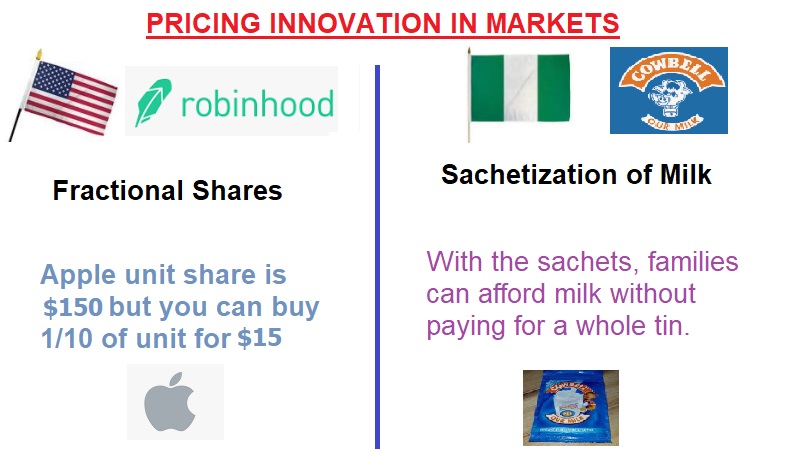
Who came up with the idea to package milk in sachets in Nigeria? Who did the same thing in detergent, knocking Omo and Elephant brands out of their positions? Cowbell offered an alternative in the dairy universe, and Ariel bulldozed itself into the detergent game. Indeed, just repackaging products in small units unlocked new opportunities.

My summary: innovation goes beyond tech. Your pricing innovation can unlock new growth opportunities. Think beyond technology and win.

A Major Nigeria’s Economic Challenge

4

I attended a private event and provided this perspective after a question. Question: “What do you think is Nigeria’s major problem now?”

Ndubuisi: “One of Nigeria’s major problems used to be that the public sector could not attract and retain its best talent, losing the finest to the private sector, with banking, oil & gas, telecoms, and recently VC-backed startups, dominating.  Today, the challenge has evolved that Nigeria – both the private and the public sectors – cannot retain its young people. 

“This poses an existential economic threat to the nation…. Across many sectors, by 5 years, the nation could have a severe gap, at top leadership, as middle managers continue to relocate to the UK, Canada, Australia and US. The healthcare sector in rural areas is largely fading. Even in tech, the executive pipeline is drying up as most tech leaders are leaving the nation.

“I have a file here where I track leading venture-funded startups in Nigeria. My data shows that most of the top 5% startups are hiring foreigners at senior leadership…”

Comment on Feed

Comment 1: Our major economic problem is poor policy design and implementation, Corruption which has dampened local and international investment, nepotism that put wrong people as drivers of vital sectors of the economy, poor infrastructure, low level of capital and technology adoption in businesses. We have a high non productive population which needs to be equipped with the right tools. If we can put right people in right places in all sectors of the economy, reduce corruption maximally, we will start to experience phenomenal growth.

Comment 2: Perhaps, why Nigeria’s problem for the time being appears to be unsolvable is because it’s foundational. Moreover, since it benefits the political elite class who can positively reconstruct this defect at their behest, they’re willing to draw blood and die maintaining the status quo.

Comment 3: It’s such a shame that most of the politicians have failed to see things in the way we see it. If this brain drain syndrome continues, I’m afraid it might be the beginning of the end for us.

ACADEMIC INSIGHTS: My Response to Olivier’s Radical Construction of “People” in the Face of Ukraine Invasion

0
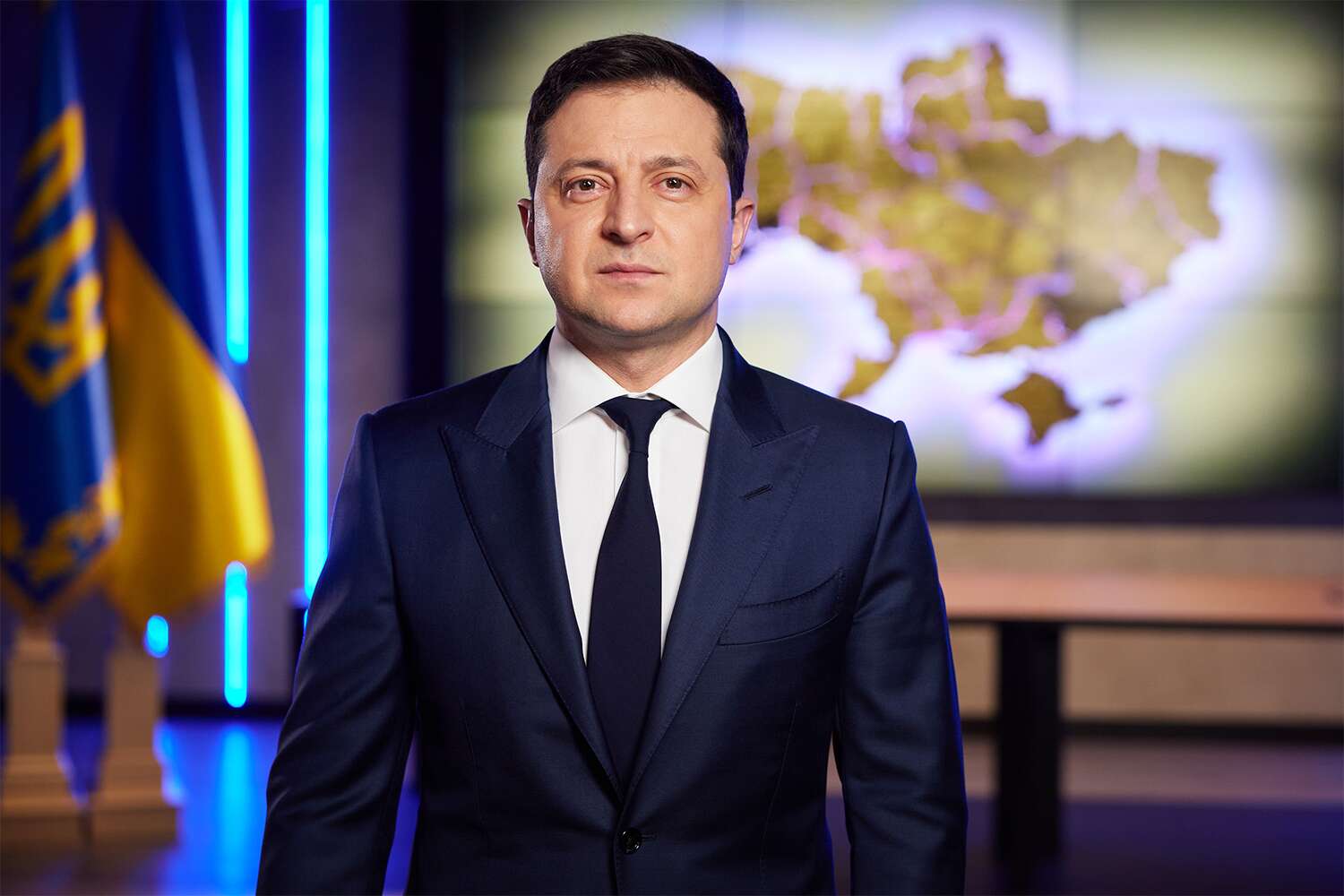
KIEV, UKRAINE - FEBRUARY 22: (----EDITORIAL USE ONLY â MANDATORY CREDIT - "UKRAINIAN PRESIDENCY / HANDOUT" - NO MARKETING NO ADVERTISING CAMPAIGNS - DISTRIBUTED AS A SERVICE TO CLIENTS----) Ukrainian President Volodymyr Zelensky addresses the nation after Russiaâs decision to recognize the Donetsk and Luhansk regions as independent states, on February 22, 2022, in Kiev, Ukraine. (Photo by Ukrainian Presidency / Handout/Anadolu Agency via Getty Images)

Since the invasion of Ukraine by Russia on February 24, 2022, many Ukrainians have died and their property has been destroyed. On the side of Russia, a number of soldiers have also died in the main escalation of the Russo-Ukrainian War, which started in 2014. Different narratives from both parties and their allies have continued to follow the invasion and define it in various ways, using various discourses. Laurent Olivier, the Chief Heritage Curator at the National Archeology Museum of Saint-Germain-en-Laye, France, is one of the academics who have expressed their feelings about the invasion. Olivier recently wrote and published a letter on Academia.edu, an online academic platform that allows academics to upload and share their research works.

The letter is full of positive and negative feelings of pain, sorrow, fear and determination expected from the people of both countries. In this analysis, I would like to respond to the ways Olivier expresses these feelings by identifying how he contests and constructs people on both sides in order to reveal his ideological interactions and the radical contingency of the identified ideologies, as well as the discourses he articulates and disarticulates (Prasad, 2020).

Olivier uses the Russian and Ukrainian people as nodal points for establishing his political hegemony, populism, anti-essentialism, essentialism, structuralism and social hegemony ideologies and radically constructing them (the Russians and Ukrainians) towards making fixed meanings for his invasion, domination, powerlessness, motivational, friendship and collaboration, choice and consequence and demonisation discourses. This aligns with the view of Jørgensen & Phillips (2002), while referring to Laclau & Mouffe (1985), that a nodal point is a privileged sign around which the other signs are ordered; the other signs acquire their meaning from their relationship to the nodal point.

At the beginning of the letter, Olivier interpellates ordinary Russians with political hegemony and populism ideologies, positioning them within social and political fields, before making Russian creators and thinkers as ideological subjects as well, while articulating friendship and collaboration, motivational, choice and consequence, and demonization discourses. Olivier’s movement from one ideology to another reveals his intention of being radical about constructing and contesting “the people” by developing floating signifiers at some point in establishing his discourses and establishing fixed signifiers at another point.

This suggests possible antagonisms that emerge through the radical contingency of discourse (Howarth, Standring & Huntly, 2020) to discern the social, political and ideological logics that Olivier uses to create linkages between different discursive struggles and demands from the Russian people towards rescuing their soldiers as well as Ukrainians who are being killed unjustly (Howarth et al., 2020) through the needless invasion of Ukrainian territory.

Olivier’s political hegemony ideology starts manifesting in the first sentence, “A war of invasion is fought in your name in Ukraine,” where Russians are positioned as ideological subjects and hailed as being part of the soldiers being used for killing powerless Ukrainians. By saying “it is easy to see that the millions of people who are fleeing to save their lives are not your enemies: they are ordinary people—families, women with children,” Olivier infuses domination discourse with powerlessness discourse with the intention of making Russian people, who are his ideological subjects, think about the ordinary Ukrainians who are being subjected to inhuman treatments by the Russian soldiers.

The hailing is further substantiated with his populism ideology, in my view, when he says that “it is clear as well that the bombs and shells which are falling down on the Ukrainian cities are killing the same kind of people: these families haven’t done anything to deserve to die or have someone killed.” In this regard, ordinary Russians need to deploy their inner capacities to save Ukrainians.

Not only the Ukrainians, “And your own people who have been sent there as soldiers, and who are killed as well in this war don’t deserve to die for this.” At this point, Olivier articulates motivational discourse within populism ideology with the intention of making ordinary Russians see their political leaders as anti-ordinary Ukrainians, as well as subjecting their relatives, family members and colleagues (soldiers) to unnecessary death.

With the invasion of Ukraine, Olivier further diffuses the essentialism ideology of Russian political leadership through his anti-essentialism stance, arguing that Russian people do not have enemies in Europe despite the political leaders’ hegemony ideology towards Ukraine. While explaining his anti-essentialism, Oliver aptly positions Russians who have travelled to different parts of Europe, attending academic events and teaching, as his ideological subjects who need to be the vanguards for ending the invasion (Althusser, 2014).

This, in my opinion, is a positive identity construction aimed at attracting the attention of scientists. However, the introduction of essentialism ideology in the midst of political hegemony and populism ideologies, while furthering the articulation of motivational discourse by encouraging scientists to be vanguards, creates multiple identities for the scientists. It positions them as possible subjects who would be used by Russian political leaders to rebuild Ukraine in order to further Russia’s political hegemony. Following Laclau & Mouffe’s (1985) view, I would like to argue that having the ideology (essentialism) and interpellating the scientists further with populism ideology do not have a necessary relation to each other (p. 105). In other words, the scientists are between the undecidable structure and Olivier’s decision to consider them political subjects (Laclau, 1990).

The undecidability and the struggle with the continued articulation of motivational discourse based on the earlier meanings reemerge when Olivier further interpellates the scientists with his structuralism and populism ideologies using inclusionary and exclusionary approaches for articulating choice and consequence discourses. Olivier says, “Today, the issue is not about choosing a camp against another one: Russia against Europe, or Europe against Russia.

The challenge you are facing is much more simple and harder: it is to know what kind of person you are choosing to be and what kind of people you are choosing to belong to. This choice is yours; you have to know that we don’t judge you.” This statement is inherent in the principles of structuralism. Olivier consciously or unconsciously positions the scientists into two camps and expects them to choose where they want to belong if, truly, they want to rescue the Ukrainians and their people from the invasion.

His inability to determine where to position the scientists in the motivational and choice discourses is further compounded (Laclau, 1990) when he says, “But the consequences of your choice are huge and long-lasting—for yourselves and your descendant.” Demonization of the scientists emerges when Olivier constructively leverages his experience with one of the old German people, who says “the most terrible thing was not fighting…” and is reinforced by Olivier while saying “don’t become the zombies of the 21st century; stay with us.” This is a means of hailing the scientists with populism ideology.

“All over, in any places, we just saw, in everyone’s eyes, fear, aversion and disgust for what we were. It was just unbearable. And today, I still see these eyes, everywhere. I am haunted by these people, he said; I am still alive, but I have died there.” This further attenuates the scientists he wants to be the vanguards for saving the Ukrainians and their people and it reproduces his essentialism as well as social hegemony ideologies.

Overall, the ways in which Olivier contests and constructs his demands that ordinary Russians and scientists come to the aid of Ukrainians and Russian soldiers are waved into a chain of equivalence that later results in demonising the same people whom he considered social and ideological subjects by dividing them into different camps and viewing them as political subjects.