DD
MM
YYYY

PAGES

DD
MM
YYYY

spot_img

PAGES

Home Blog Page 4427

The Power of Social Media  Verified Badges and Marketplace Club Memberships

1

Two cases:

Case A: Company A’s chief marketing officer has to make a decision on how to spend a company’s advertising budget. Here are the two shortlisted companies, presented by her analysts. Company #A1 has 10 million verified and 40 million non-verified users. Company #A2 has 1 million verified and 70 non-verified users. Other indicators are similar.

Case B: Company B’s Head of Partnership has received two proposals from two companies, and each has offered final terms. The company can only pick one company due to its near-term production capacity. Company #B1 has a marketplace membership club where users pay to shop with associated benefits (like Amazon Prime) and is asking for 20% discount from Company B; total paid members are 20 million per annum. Company #B2 does not have any membership club but claims it reaches 30 million shoppers yearly, and is asking for 25% discount from Company B. Any item unsold is returned to Company B in both scenarios.

As we discuss Facebook’s decision to ask users to pay for verified badges, if you are the chief marketing officer, what would you do for Case A? Indeed, which one is a better deal to spend your ad money on?

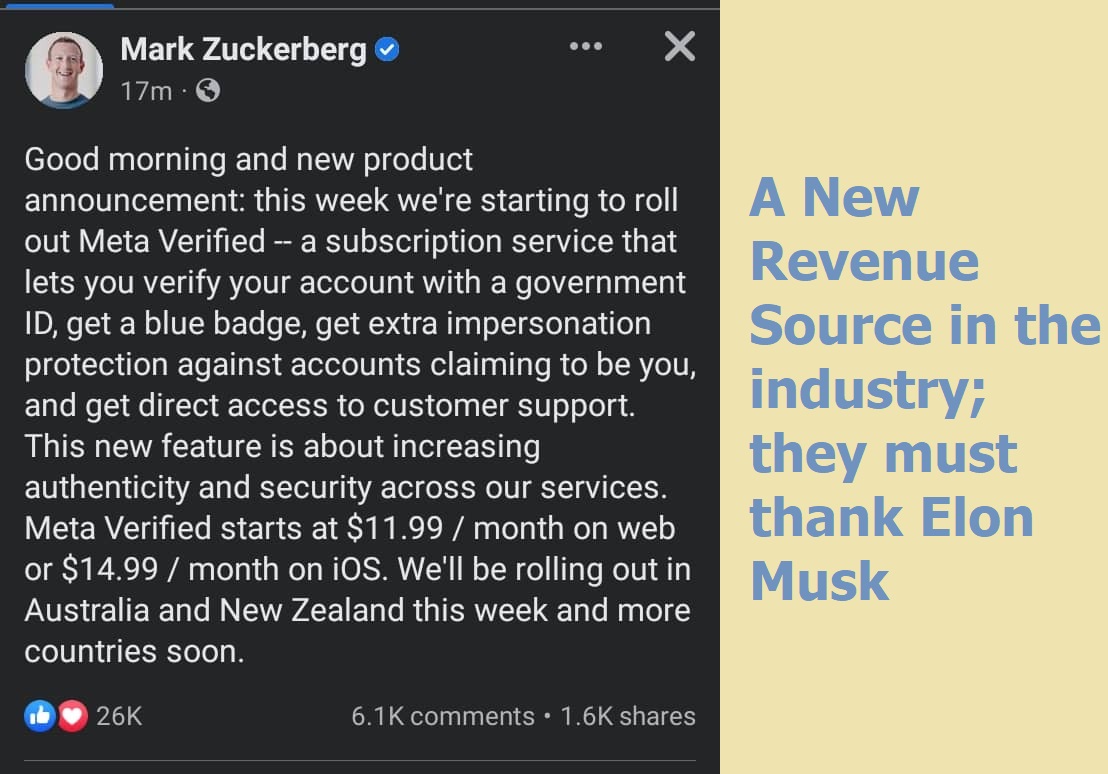
I wrote about this when Elon Musk pioneered it, noting that it would be a good feature for Meta (Facebook parent company) and LinkedIn. Today, it has been adopted: “‘Meta Verified’ will give you a blue badge along with several other benefits, including increased visibility, protection against impersonation, priority customer support, and more” for $12/month.

For Case B, what would be your call considering that any unsold item is coming back and you’re unlikely to sell it.

In the WhatsApp Group sub-categories, discuss with others. During Tekedia Live on Saturday, we will spend a short time on this, and will examine the implications as we focus on this week’s module of Business Model and Strategy.

Note: Any variable or factor not included is assumed to be similar to Companies A1 and A2 and should be treated as non-factors. The same applies to Companies B1 and B2. What that means is this: they have similar credit rating, payment history, return ratios, etc. The only factors to consider for these distinct cases are those noted and their direct implied implications.

Source: extracted from Tekedia Mini-MBA  courseware

Comment on Feed

Comment 1: A1 and B1. This sounds like we even try to do these things with Facebook ads when creating audiences and targeting. (e.g Engage shoppers and look-alike audiences.)
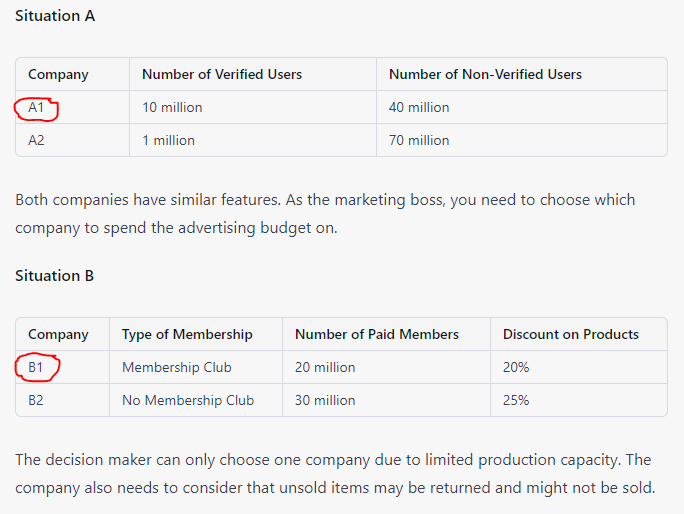
Comment 2: For Case A the advertising budget would go to Company hashtagA1 – it has 10 million verified and 40 million non-verified users, and the verified users are more likely to be genuine, active users who are more dedicated and interested in the company’s products or services. Also, having higher number of non-verified users may not necessarily translate into more ‘customers’.

For Case B I would partner with Company hashtagB1. Although having a smaller reach, its customer base is more committed with 20 million paid members. The committed members of the membership club could potentially increase odds that they will make purchases as they have already invested in the service. Also the 20% discount can be used as an incentive to retain those customers and hopefully attract new ones through time.

Great exercise Prof.

Comment 3: With the info given and given that every other indicators are similar for Case A, I am under the assumption that company A1 and company A2 have the same advertising budget.
For the same level of advertising budget, the better deal for case 1 would be company A2 for these reasons:
Non-verified users make up 0.07% of verified user compared to 400% for company A1. A2 has smaller target audience who are able and willing to pay for membership and make for lesser advertising stress and spending. The marketing agency gets to make more profit from company A2. This is when compared to running an advertising campaign for company A1 which has larger audience who may likely be unwilling to pay to be verified users and therefore require more thoughtful and high impact strategy which would be relatively more costly.

This is all assuming both companies are operating under similar budgets.

For Case B: A partnership with B1 is considered the best option compared to B2 for these reasons:
While B1 has only 20million members per annum compared to the 30million shoppers claimed by B2, those 20million are certain, so are the revenue per annum, unlike B2. Also, their discount rate of 20% seems more favorable.

My Response: great insight. Would your call on Case A change if the CMO works in Company A. In other works, there is no advertising agency. In other words, there is no middleman, referring to your “The marketing agency gets to make more profit from company A2.”

Also, for Case A, is there a consideration that being verified provides a small level of “certainty” (i.e. they are real accounts, not bots)? Thanks for the contribution.

Comment 4Case A = #A1 has 50 million users ( 10 million verified users and 40 million non-verified users)

#A2 has 1,000,070 users (1 million verified users and 70 non verified users).

As a Chief Marketing Officer, I would ask my non verified users to verify their accounts by promising them some perks( for every verified account, the user gets 1$ bonus)

After I’ve got the users to verify their accounts. I would spend on users with more subscriptions.

Company #A1 is a better company to spend on because they have more subscribers/ users.

For Case B =

#B1 has a verified members with a credible platform .

#B2 doesn’t have a verified members and their claims are based on assumptions.

As the Head of Partnership for Company B, I would rather work with Company #B1 because of its production capacity, quality and credible products. “When you have a quality product, it reduces the risk of returning items back to the company .”

Comment 5: For case A, I will go with #A1 because 25% of the company’s users are verified. I’m certain that my products will be shown to at least 10 million persons.
For case B, I will go with #B1, 20 million verified shoppers is better than unverifiable 30 million shoppers. Besides, #B1 requests for a small discount compared to #B2.

Kenya’s Safaricom on The Verge of Launching Mobile Money Services in Ethiopia

0

Kenyan mobile network operator Safaricom, is currently on the verge of launching its mobile money services in Ethiopia, four months after its license was approved by the Ethiopian government.

According to Safaricom’s CEO Aanwar Soussa, he disclosed that the startup is currently finalizing plans to launch operations by April 2023.

In his words, “We are finalizing our commercial and technical readiness, and we expect to launch operations within the upcoming financial year.

Our growth trajectory is even more exciting for us as we look forward to offering financial services through M-PESA. With a population of approximately 120 million people and financial inclusion at about 35%, 57% mobile penetration, and annual inward remittance of about $4.2 billion, Ethiopia offers a great opportunity to grow the business to the Kenya level in 10 years.”

Last October, Kenyan mobile money operator Safaricom was granted approval by the Ethiopian government to launch M-pesa in the country.

During the national launch of Safaricom Telecommunications Ethiopia (STE) in Ethiopia’s capital Addis Ababa, the country’s Finance Minister, Mr. Ahmed Shide, disclosed that the mobile money platform had received approval to roll out its services across the country.

He further noted  that Safaricom would be allowed to acquire permits of operation and license for M-Pesa services from the central bank following the approval. The license permits Safaricom to operate in the country for 15 years, it will also operate under its original name in offering mobile money services.

Launched on the 6th of March 2007 by Vodafone’s Kenyan associate, Safaricom, M-PESA is Africa’s leading mobile money service with more than 604,000 active agents operating across Egypt, Tanzania, Ghana, the Democratic Republic of Congo (DRC), Egypt, Kenya, Lesotho, and Mozambique.

A decade after its launch, M-Pesa has expanded to 10 countries, boasts 29.5 million active users and processes up to 614 million transactions per month.

M-PESA is a Safaricom product that allows users to transfer money using a mobile phone. Kenya is the first country in the world to use this service, which is offered in partnership between Safaricom and Vodafone. M-PESA is available to the public, even if they do not have a bank account or card.

The mobile money services provide more than 51 million customers across seven countries in Africa with a safe, secure and affordable way to send and receive money, top-up airtime, make bill payments, receive salaries, get short-term loans and much more.

M-Pesa is also lauded for its social value, offering opportunities for SMEs, and playing a significant role in helping the underbanked. The platform has directly transformed households as it evolved from a basic SIM card-based money transfer application into a fully-fledged financial service, offering loans and savings in conjunction with local banks, plus merchant payments services.

IMF Calls For CBN’s Autonomy and Act Review Amidst Crises Due to Naira Redesign

0

The International Monetary Fund (IMF) has called for a review of the Central Bank of Nigeria Act 2007 to enhance the bank’s autonomy and governance considering emerging problems and controversies around the Naira redesign policy of the Nigerian apex bank .

In a recent report of the IMF entitled ‘Nigeria: 2022 Article IV Consultation-Press Release; Staff Report; and Statement by the Executive Director for Nigeria released on its website, the CBN’s autonomy has been said to have been disputed due to the CBN’s naira redesign policy.

It is observed that the integrity and autonomy of the CBN needs to be reconsidered as some states’ governors challenge and issue counter-directives on the CBN’s pronouncement on the legal status of the old 1000, and 500 naira notes which is said to be in contrast with the subsisting ruling of the supreme court.

The IMF, in its article, stressed the importance of maintaining the CBN’s autonomy to make price stability its primary objective. The International financial institution also urged the CBN to abide by international standards by publishing its annual financial statements, and pruning government officials’ presence on its apex board and committees.

According to legit.ng, the IMF also recommended modernizing the CBN Act 2007, strengthening the CBN’s autonomy, safeguarding the independence and tenure of central bank officials, and phasing out some quasi-fiscal activities that may worsen financial repression and weaken the CBN’s price stability mandate.

The IMF article reads in part: “The CBN Act should be updated to make price stability the main goal, improve the bank’s independence by decreasing the number of government officials on the board and committees, and protecting the tenure of central bank officials. Legal changes should establish independent oversight, including a non-executive board and independent audit committee.

“Financial autonomy should be safeguarded through clear statutory limits on credit to government and prohibition of quasi-fiscal operations and developmental lending activities, which need to be phased out.”

‘Meta Verified’ – A New Revenue Source for Facebook Parent Company; they must thank Elon Musk

1

I wrote about this when Elon Musk pioneered it, noting that it would be a good feature for Meta (Facebook parent company) and LinkedIn. Today, it has been adopted: “‘Meta Verified’ will give you a blue badge along with several other benefits, including increased visibility, protection against impersonation, priority customer support, and more” for $12/month.

Meta’s testing paid verification for Instagram and Facebook for $11.99 per month on web and $14.99 per month on mobile. In an update on Instagram, CEO Mark Zuckerberg announced having a “Meta Verified” account will grant users a verified badge, increased visibility, prioritized customer support, and more. The feature’s rolling out to Australia and New Zealand this week and will arrive in more countries “soon.”

“This week we’re starting to roll out Meta Verified — a subscription service that lets you verify your account with a government ID, get a blue badge, get extra impersonation protection against accounts claiming to be you, and get direct access to customer support,” Zuckerberg writes. “This new feature is about increasing authenticity and security across our services.”

For years, nobody wanted to do this until the boldest entrepreneur in our generation, Elon Musk, did it, and it is going to become an industry standard henceforth. I am waiting for the LinkedIn one as that is the only one I will pay for; I will put it under business expense since LinkedIn is my CNN, NTA, BBC, NYTimes, Economist, etc combined for business and professional visibility.

Anything that will stop people writing “are you Ndubuisi Ekekwe” even though he/she is chatting with Ndubuisi Ekekwe right there. Hopefully, when LinkedIn does that, that question will disappear and we can build more trust to advance entrepreneurial capitalism.

This is a new revenue source for Meta. I can assure you that most times, we overestimate how customers will react. Those people paying at Twitter are still there because they get more than $20/month for that visibility.

Welcome to Internet Utility 2.0 where you will pay for the privilege of feeding aggregators with data and raw materials which they use to make money. Of course, you also get value in return.

Comment on Feed

Comment 1: Ndubuisi Ekekwe Prof.. Your prediction of business innovation is becoming so prevalent now, its getting to the point it is starting to look ‘ordinary’.

The normalization of showcasing this skill on LinkedIn has moved the bar for self declared ‘thought leaders’ ‘visionaries’ and ‘influencers’

Many of them have just taken an aggressive approach to network building on here, but their content is thin, unoriginal, formulaic, lacks a commitment of opinion, repetitive ( I could go on) and above all, uninspiring.

Show them the way, please. ?

Comment 2: Elon Musk is not just a technocrat but also a business mogul.

He’s currently considering a business model in which public influencers can earn from part of advert revenue.

Comment 3: Elon Musk is on a league of his own, those who taunt him obviously don’t fully understand what that guy embodies, he’s not just bold but also visionary. If Twitter gets 20 million people to pay for blue tick, $2 billion could be within reach per annum, yet for years Twitter was languishing in the hands of people who knew nothing about running a profitable enterprise, rather it was turned into an ideological battlefield, incapable of bringing meaningful returns.

For all the beatings Mark has taken over the last few years, finally the man Musk has shown him the light, a new revenue stream is here.

This verified badge model will also help aggregators negotiate better deals from advertisers, unlike before where anything goes, if a platform can boast of 30 million verified accounts, you atleast know that there are 30 million people capable of paying for something, it’s a better benchmark than what was previously obtainable.

Musk has transformed social media revenue model.

My Response: “This verified badge model will also help aggregators negotiate better deals from advertisers, unlike before where anything goes, if a platform can boast of 30 million verified accounts, you atleast know that there are 30 million people capable of paying for something, it’s a better benchmark than what was previously obtainable.” – very revealing. Amazon Prime number is an x-factor when it negotiates with vendors. Who do you deal with? The company where 100m+ pay to shop or the one that does not even know if people will come tomorrow.

Kaduna State Government Orders State’s Ministries and Agencies to Ensure Continued Acceptance of Old Naira Notes By Their Collection Agents

0

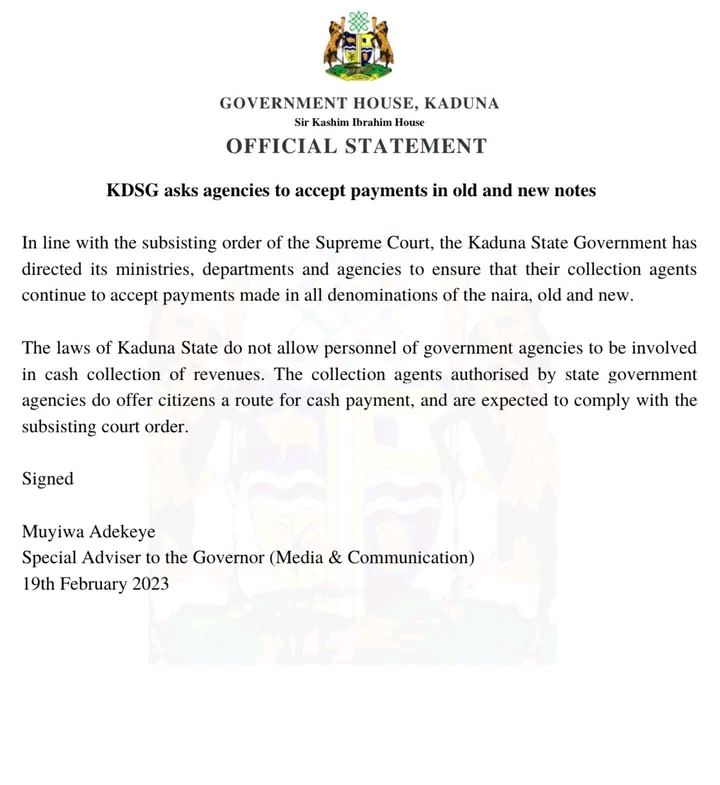
The Kaduna State Government has ordered all agencies, department and ministries within the state to ensure that their collection agents continue to accept payments made in all denominations of the naira, old and new congruent to the subsisting ruling of the Supreme Court on Wednesday that the old 200, 500 and 1000 Naira notes shall remain a legal tender pending the determination of the suit brought before it against the Federal Government and the CBN.

According to a statement by the State Government dated 19th February 2023 and signed by the Special Adviser to the Governor on Media and Communications, all the Government authorized collection agents within the state which offer the citizens a route for cash payment are expected to comply with the subsisting order of the supreme court. The Statement reads as follows:

“In line with the subsisting order of the supreme court, the Kaduna State Government has directed its ministries, departments and agencies to ensure that their collection agents continue to accept payments made in all denominations of the naira, old and new.

“The laws of Kaduna State do not allow personnel of government agencies to be involved in cash collection of revenues. The collection agents authorized by State government agencies do offer citizens a route for cash payment, and are expected to comply with subsisting court order.”

Recall that on February 16, the Governor of Kaduna State, Mallam Nasir El-Rufai, had in a media address implored Kaduna State citizens to continue to use their old naira notes along side the new notes without any fear while he assured that all the old and new notes shall remain in use as legal tender in Kaduna State until the Supreme Court determines otherwise. This is despite the declaration of the old 500 and 1000 Naira notes as obsolete by the President, Muhammadu Buhari .

Some of the citizens and residents of Kaduna State had also expressed pessimism and skepticism about the posture of the State Government, especially with the awareness that the CBN and the major Commercial banks in the state will not be collecting the old notes from them.