
DD
MM
YYYY

PAGES

DD
MM
YYYY

spot_img

PAGES

Home Blog Page 4432

Zoom Announces Plan to Trim Workforce by 15% to Navigate The Uncertain Economy

0

American communications technology company headquartered in San Jose California, Zoom, has revealed plans to trim 15% of its workforce which is about 1,300 workers as it plans to navigate the current economic downturn.

The company’s CEO Eric Yuan via a blog post disclosed that the business during the peak of the pandemic hired too many staff to support the quick rise of users on the platform and their evolving needs.

He noted that the firm made a mistake by failing to thoroughly analyze team members or assess if it was growing sustainably towards the highest priorities. With the current uncertain global economy, the company was left with no option but to trim its workforce.

Commenting on Zoom’s decision to layoff some members of its workforce, he wrote;

Over the past few years, Zoom has become an indispensable source of connection for businesses and individuals as well as a globally recognized brand. Whether you have been at Zoom since the beginning or joined us more recently, you’ve played an important role in our evolution, and that makes today’s announcement particularly difficult.

We have made the tough but necessary decision to reduce our team by approximately 15% and say goodbye to around 1,300 hardworking, talented colleagues. I know this is a difficult message to hear, and certainly not one I ever wanted to deliver.”

Yuan, who took the blame for the company’s current unfriendly condition, disclosed that each organization across Zoom will be impacted by the layoffs, noting that a single departure was not taken lightly.

By showing accountability not just in words but actions, the CEO further revealed his decision to slash his salary for the coming fiscal year by 98% and forgo his FY23 corporate bonus.

Also, members of his executive leadership team will reduce their base salaries by 20% for the coming fiscal year while also forfeiting the FY23 corporate bonuses.

Meanwhile, laid-off full-time employees in the U.S. will be offered the following support;

  • Up to 16 weeks’ salary and healthcare coverage
  • Payment of your earned FY’23 annual bonus based on company performance
  • RSU and stock option vesting for 6 months for US employees and through August 9, 2023, for non-US employees.
  • Outplacement services that include 1:1 coaching, workshops, networking groups, and more  

Also, support for Zoom employees outside the U.S. will be similar and will take into account local laws.

Zoom’s revenue surged 326% year-over-year, to $2.65 billion, in the 12 months through Jan. 31, 2021, due to strong demand from consumers and remote workers. The company’s net income increased by a factor of more than 50 in the same time frame. But as workers began returning to offices, the company revenue gradually began to decline.

In a bid to keep the company afloat and maintain revenue growth, last November, Zoom rolled out a new set of email and calendar features along with an artificial intelligence assistant called the Virtual Agent to its platform, to enhance users’ experience.

Reconciliation or Divorce: Atiku versus Tinubu’s Views on Neoliberalism

0

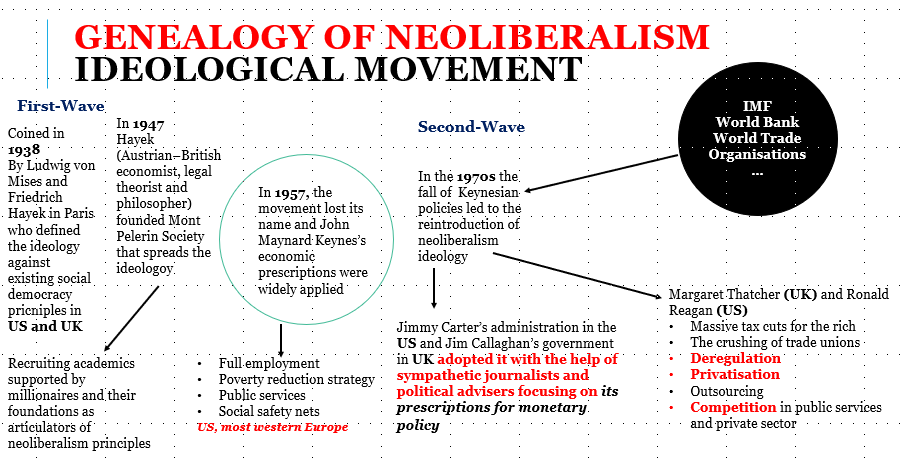
Nigerians have less than 20 days to choose one out of over 10 presidential candidates. The candidates, their political parties and their supporters have been marketing and promoting different agendas since September 28, 2022. The candidates have been at various places, telling citizens that they all have what it takes to lead Nigeria and provide much-needed public goods between 2023 and 2027. They have hailed people and are still hailing people with their different promises that aim at elevating the socioeconomic status of individuals and the political status of the country regionally and internationally. Most of the time, they made citizens the subjects of their promises and ideological orientations, with few understanding the implications of being the subjects.

Our analyst examines the neoliberalism agenda of two of the three leading candidates in this piece by paying attention to their previous utterances on the agenda. Senator Bola Ahmed Tinubu of the All Progressives Congress and Alhaji Atiku Abubakar of the People’s Democratic Party are not minors when it comes to discussing national politics. They have been political leaders at various levels and members of various committees. They are business owners who understand how the private sector works in addition to understanding existing nuances in the public sector. Therefore, they cannot be seen as political contestants who do not know the implications of promoting specific political and social ideologies. For instance, as a political and economic ideology, neoliberalism emphasises the importance of free markets, individual freedom, and minimal government intervention. Before the 2023 presidential election campaign, the two candidates have hailed Nigerians with the ideology at various stages of their political careers and contributions to national discourse. Our checks reveal, however, that one of the candidates appears to have disassociated himself from the ideology in recent campaign activities.

Source: Infoprations Analysis, 2023

“If you see the amount of work the government has to do in this country, like building and rebuilding our ports, constructing our railway lines, building our highways – let me borrow Dokpesi’s word – it is a ‘humongous’ amount of money that you require. You know that the government doesn’t have it,” he said. “I would rather concession most of this to the private sector and give them tax breaks. They invest, recover their money and we will have development, progress, jobs, and prosperity,” the presidential candidate of the PDP said during one of his recent political outings. He further said his privatization plan is not to render people jobless but to ensure effective governance.

According to him, privatisation would help get the comatose but money-guzzling refiners into productive hands and ultimately ensure that Nigeria becomes a chemical refining hub. Atiku argued that the private sector suffers when it is not productive. Therefore, the one way to kickstart its productivity is by privatizing assets that aren’t productive.

In 2021, in a statement titled ‘Privatisation of Refineries and Other Assets: Better Late Than Never,’ and reported by a national online medium, Alhaji Atiku called for transparency in the process of privatising the assets. Alhaji Atiku noted that the privatisation of public assets which he once championed and was scorned for by the All Progressives Congress-led administration is now being embraced by the same administration. According to our check, Alhaji Atiku advised the Federal Government to embrace privatisation in 2015. Two years later, Professor Yemi Osinbajo, while acting as President, reported that no fewer than 142 public enterprises had been privatised since the inception of the National Council on Privatisation (NCP).

Alhaji Atiku appears to be far from alone in hailing Nigerians with the ideology. Our checks reveal that some of his political supporters and members of the parties from which he has run are very interested in his idea of ensuring market deregulation and the sale of dormant public assets. The spokesperson of Atiku/Okowa Campaign Organization recently highlighted how the privatisation plan for the refineries would benefit Nigeria.

While some Nigerians believe that privatising public companies has benefits, they believe that Alhaji Atiku Abubakar will likely repeat his approach as Vice President and Chairman of the Privatisation Committee. As a result, many non-state actors, including labour unions, students, and public affairs analysts, are opposed to reintroducing the agenda if he is elected president. Senator Bola Ahmed Tinubu recently hinted that Alhaji Atiku would sell national assets to the highest bidder and then flee with the proceeds.

However, numerous checks reveal that Senator Bola Ahmed Tinubu cannot be exonerated from politicians who hail Nigerians with the ideology. In 2019, he urged the Federal Government to revisit power sector privatisation. When he was governor of Lagos State between 1999 and 2007, he tried to sell the State Water Corporation, but it was stopped after a civil society protest.

Why Google Search Business Model Will Evolve As AI Chatbot Rises [video]

2

Google Search is an aggregator.  It has a great dinner table where merchants and advertisers want a nice seat. They pay money, bidding in a digital auction, so that Google can give them a prominent position. Simply, when users come to Google and search for something of interest, sometimes, Google will show them links already paid for, and souped by the advertisers and merchants. When users click those links, Google makes money!

This symbiotic relationship has existed since Google invented its algorithm. But over the next few quarters, the business model must evolve.

Recall that when a merchant or an owner of a website hires a Search Engine Optimization Engineer, that person is doing everything to make it easier for Google to discover the  merchant’s website. In other words, it works to make Google’s business model easier since it needs to find those websites (the raw materials) for it to create value for users or web surfers. The merchant of course celebrates because when many people discover and find it, it can make sales and grow its mission.

Google can afford to allow surfers to use its search products for free because those clicks pay the bills. But today, with the rise of ChatGPT, and a possible Google response, named Bard, the old business model may be expiring.

The New Playbook

When users type something of interest on Google, Google will show links where they can find that information. But for ChatGPT, it does not show links, rather, it parses data from the web, and gives a decent summary. Simply, ChatGPT serves the meal while Google sends users to go grocery shopping. That grocery shopping means you have to buy the items, and then come and make the food for the meal. How many people want to go grocery shopping when there is a ready-made meal, which can match on quality and value, what the personally cooked meal will produce? Not many!

This is where it gets interesting: if Google’s Bard follows ChatGPT and provides summaries with no links, Google will be unable to make money via links. So, what would be the option to make money? Subscription.

In other words, the future of Google Search business model will be anchored on subscription. ChatGPT Plus has already alerted the world that very soon, that “free” knowledge has to be paid for.  I expect Google to launch Google Bard+ which we have to pay for when the sponsored links are made to “disappear” a little more.

Of course, Google can also just expand its search result and also add links, making it possible that it can provide great summaries to users while also offering the ability to sell links, to sustain its business model. But over time, we can have that as a subscription  baked into other Google products which people already pay for.

The Challenge from Microsoft

Google has to fight this battle vigorously since Microsoft is working to revamp Bing with a new DNA coming from ChatGPT.

Microsoft has significantly upped the stakes in the tech world’s ongoing race to reinvent and reinvigorate internet search engines with AI technology. The company announced Tuesday that it is integrating OpenAI’s next generation large language model into its search engine Bing, a version that is even more powerful than ChatGPT, which has captivated the internet since it was launched 10 weeks ago. The parent company of LinkedIn developed a proprietary way of working with the next-gen tech, calling its new model Prometheus.

Microsoft will also launch a new version of its Edge browser, which will incorporate the new AI features into its sidebar. Google unveiled Bard, its own AI chatbot, on Monday.

[…]

“AI will fundamentally change every software category, starting with the largest category of all – search,” said Satya Nadella, Chairman and CEO, Microsoft. “Today, we’re launching Bing and Edge powered by AI copilot and chat, to help people get more from search and the web.”

A LinkedIn user provided a summary of the Microsoft event as follows:

?Satya acknowledged, “the race is on”

?Bing will still link to web results and aim to drive traffic to websites

?Microsoft says the freshness of results is going to be shocking

?Bing will have an expanded search box for up to 1,000 characters

?No clear answer about how much it costs to run a query in search vs. AI chatbot

?No extra cost for users, the AI features are free

?Bing aims to fact-check AI answers with search results

?Apparently, Bing also uses Prometheus (a next-gen LLM) for its search algorithm and claims relevance has gone through the roof

?”40% of the time, people click on search links and click back immediately”

?Ads will remain in search results

?Edge will be able to read and summarize PDFs you open with the browser

?Microsoft plans to integrate with all browsers – will Chrome open it up or use Google’s model?

All Together

Google Search is an aggregator, orchestrating relationships between users and merchants. This symbiotic relationship has existed since Google invented its algorithm. But over the next few quarters, the business model must evolve. In this piece with an accompanying video, I explain that over time, we will expect Google to offer search via subscription, bundled with other Google products, for its best search+ product. It is very clear: if Google provides the answers and people do not need to click links a lot (the revenue source), subscription becomes an option to protect revenue.

Binance is Donating $100 in BNB to Users Affected by the recent 7.7 Earthquake in Turkey

0

Following the tragic earthquake disaster in Southern Turkey, the world’s leading Digital Asset management brand, Binance has announced it will give away $100 in its native token $BNB each to its Turkish Users, Changpeng Zhao, CEO at Binance stated on microblogging platform Twitter “Time to take care of our users.” This charity donation from Binance is a total around $5 million or 94,000,000 TRY.

The recent earthquakes in Turkey have had a devastating impact on so many people and communities. We hope that our efforts will bring some relief to those affected. We are also calling on our industry peers to once again come together to offer support in these times of crisis.

However, Global crypto exchanges, including Binance, Bitfinex, Huobi and Bitget, are looking for ways to help those affected by two devastating earthquakes that struck Turkey and Syria on Monday.

Additionally, Turkish rockstar Haluk Levent teamed up with local charitable organization Ahbap to set up a crypto wallet to accept donations from the crypto community, which has raised over $1,000,000.

Many NFT projects and NFT artists notably Rachel Wood, Council member at SuperRare is donating $10,000 to Syria and Turkey through NFT mint proceeds on Manifold as a result of the recent tragic happenings in both countries.

In a different twist, Co-founder of Verse reports has been hacked for $4M in a hotel lobby during a meeting with alleged investors. Funds stolen from their Trust Wallet. This haunting incident serves as a reminder to always be vigilant with crypto safety

Data from Etherscan shows that some crypto scammers are targeting users with a new trick that allows them to confirm a transaction from the victim’s wallet, but without having the victim’s private key.

The attack can only be performed for transactions of 0 value. However, it may cause some users to accidentally send tokens to the attacker as a result of cutting and pasting from a hijacked transaction history.

Blockchain security firm SlowMist discovered the new technique in December and revealed it in a blog post. Since then, both SafePal and Etherscan have adopted mitigation techniques to limit its effect on users, but some users may still be unaware of its existence.

Read Press Statements from Binance

In response to the devastation caused by the recent earthquake in Turkey, Binance will airdrop BNB worth USD $100 to all Binance users identified to be living in the regions most affected by the tragedy.

Identification of the users will be based on Proof of Address (POA) completed before Feb 6th in 10 cities where the earthquake has had significant impact, including: Kahramanmara?, Kilis, Diyarbak?r, Adana, Osmaniye, Gaziantep, ?anl?urfa, Ad?yaman, Malatya and Hatay.

While the POA method has its limitations and inaccuracies, it is the best method we have available for us to locate potentially impacted users. We estimate the total donations will be around $5 million USD (or 94,000,000 TRY).

In the aftermath of natural disasters, people often lose access to traditional banking at the exact moment when extra funds are needed to help cover medical supplies, food and other essential needs.

Crypto transfers are now increasingly being used to deliver financial aid to disaster victims as they provide fast, low-cost, borderless and transparent transactions.

Binance Charity has also launched a public donation address for anyone to donate. For everything we receive on this address, we will convert to TRY and give it to an authorized NGO to help people in need. Donations to the Emergency Earthquake Appeal will be accepted in BTC, ETH, BNB, BUSD, XRP.

Binance founder and CEO CZ said: “The recent earthquakes in Turkey have had a devastating impact on so many people and communities. We hope that our efforts will bring some relief to those affected. We are also calling on our industry peers to once again come together to offer support in these times of crisis.”

Our team is doing their part to ensure that Turkish Binancians and their families are safe and sound and are providing whatever assistance is required. In these difficult times, Binance stands by our users and we will continue to work on additional ways to help our community in Turkey.

Make Sure You’re Not Losing Privacy Online By Following These Steps

0
phone device

In this digital age, our online privacy is under constant threat from data breaches and cyber-attacks. As a result, it’s essential that we take steps to ensure our information remains safe and secure. It’s important to be mindful of the ways in which our personal information can be accessed, shared, and used without our consent. Here are some steps that you can take to make sure your privacy is not lost online.

1. VPN

A virtual private network (VPN) is a great way to protect your online data and browsing activity. VPNs encrypt incoming and outgoing traffic, making it difficult for snoopers or hackers to access your private data. For example, if you are looking at a VPN for Buffalo, you can set the VPN to connect to a server located in Buffalo. This will mask your real IP address and route your web traffic through the Buffalo server, providing you with additional privacy and security. Additionally, many VPN providers offer additional features such as identity protection and malware blocking. It’s important to research the features of each provider before signing up.

2. Use Secure Passwords and Two-Factor Authentication

When creating passwords, make sure to use a combination of letters, numbers, and symbols. Never reuse the same password for multiple accounts and try to avoid using any personal information like your name or address. All of this can help protect you against scammers who are trying to guess your passwords. Additionally, enabling two-factor authentication (also known as 2FA) is a great way to improve the security of your online accounts. 2FA adds an extra layer of protection by requiring you to confirm your identity with a code that is sent to your phone or email when you attempt to log in.

3. Check Your Privacy Settings

Many sites, apps, and services provide options to adjust your privacy settings. It’s important to familiarize yourself with the terms of service and privacy policy of any website you use. They should explain what data is being collected about you, how it will be used, and who has access. Make sure that you understand exactly which settings are available to protect yourself from unwanted tracking or surveillance. There may also be additional features and tools provided in the form of browser extensions or other software that offer more detailed control over what data is visible to third parties. Be aware of these features and make sure they are enabled when possible.

4. Delete Unnecessary Data

Unnecessary data can be difficult to identify and can contain personal information. Delete any documents or photos that you no longer need and make sure to empty the trash or recycle bin afterward. If you are unsure whether the data has sensitive information on it, delete it anyway—it’s always better to be safe than sorry. Also, delete any old accounts or profiles that you no longer use; if the site does not allow deletion, consider disabling the account. Additionally, keep in mind that sites such as Google and Facebook store data about you based on your past searches, so periodically delete this information.

5. Beware of Public Wi-Fi Networks

When you’re connected to a public Wi-Fi network, all of your data can be vulnerable to interception by hackers. As such, it is important to avoid sending sensitive information over public networks. If you must do so, ensure that any websites are secured with HTTPS encryption and use a Virtual Private Network (VPN) if possible. Avoid logging into accounts or accessing files while connected to an unsecured network as they may be compromised.  Additionally, always make sure your device’s firewall is enabled when connecting to public Wi-Fi networks. This will help protect against malicious attacks and unauthorized access.

6. Monitor Your Credit and Bank Accounts Regularly

It’s important to stay vigilant and monitor your credit report regularly. You should also keep an eye on your bank accounts for any suspicious activity or charges. Make sure that you recognize every transaction, and if something is off or doesn’t look right, report it immediately. Additionally, be sure to sign up for two-factor authentication whenever possible—it’s a great way to add another layer of security to your online accounts. Also, when creating passwords, make sure they are unique and difficult to guess.

Securing your online privacy is essential to keeping yourself and your data safe. By following these steps, you can help ensure that your information stays private and secure. Always be sure to check the terms of service and privacy policy of any website or app before using them, and make sure to take advantage of the available security features when possible. With these tips in mind, you can stay safe online!