DD
MM
YYYY

PAGES

DD
MM
YYYY

spot_img

PAGES

Home Blog Page 4529

American Lawmaker Describes Short-Form Video Platform TikTok as an “Addictive Drug”

0

United States House of reps member and incoming chairman of a new house select committee on China, Mike Gallagher, has described TikTok as a “destructive and addictive drug” being given to Americans by the Chinese government.

Mike likened TikTok to “Fentanyl”, a drug often used illicitly as a recreational drug, which is sometimes mixed with heroin, cocaine, and the likes.

While speaking about the short-form video platform in an interview, he said, “TikTok is highly addictive and destructive and we’re seeing troubling data about the corrosive impact of constant social media use, particularly on young men and women here in America, and also because it effectively goes back to the Chinese Communist Party.”

He further disclosed that the U.S government took the right step to ban the app on the devices of lawmakers, and he feels the ban should be extended nationally.

Recall that on December 27, 2022, the U.S. House Administration Arm banned TikTok from all House of Representatives-managed devices, citing high-security risk issues.

The decision follows other moves by states and lawmakers to curtail the use of TikTok by government officials.

The U.S lawmakers described the app as posing a huge security risk to users and also to the country. They have so far expressed concern about the possibility that the Chinese military could demand the private data of American TikTok users for intelligence operations.

Recall that on December 26, 2022, Tiktok’s parent company Bytedance reportedly fired four of its employees over the improper assessment of U.S journalists’ personal data on the platform.

In a report released, the employees accessed the IP addresses of two U.S based reporters via their TikTok accounts, one of which is a staff at BuzzFeed news and the other one a staff at the financial times.

Since 2020, the short-form video platform has been negotiating with the US government on a potential deal to resolve the national security threat, urging that the app should remain available to US users.

Unfortunately, the plea has been followed with widespread apathy and criticism, which has led to an apparent lack of progress in its talks with the US government.

The U.S house of representatives has continued to push for the app to be banned from government devices and potentially more broadly.

In addition to an earlier decision by the Congress prohibiting the installation of TikTok on government-owned devices,19 states have at least partially blocked the app from state-managed devices,
US Congress May Introduce More Social Media Regulation Bills in 2023

0

The United States is likely going to introduce tighter regulations for social media companies in 2023, as concerns continue to arise over accelerating antitrust issues.

In 2022, both states and the Congress enacted laws targeting social media companies. TikTok and Meta were at the center of antitrust probes that have spilled into the New Year. Lawmakers, Rep. Mike Gallagher (R-Wis.) and Sen. Amy Klobuchar (D-Minn.), said the social media scrutiny, particularly on TikTok, is expected to continue in 2023.

TikTok has been on the radar of the US authorities mainly due to its ties to Beijing. Late last year, a number of states passed laws prohibiting the use of the short-form video app by state employees or on government-issued devices. The step, which the federal government has also taken, was deemed necessary because of the growing perception that TikTok poses a national security threat.

On NBC’s “Meet the Press” on Sunday, Gallagher compared TikTok to “digital fentanyl.” He said he views the app as dangerous, describing it as “destructive.”

“It’s highly addictive and destructive. We’re seeing troubling data about the corrosive impact of constant social media use, particularly on young men and women here in America,” he said.

The growing apathy toward TikTok was notable last month in the swift passage of a bipartisan bill banning the use of the app on government phones by the Congress.

TikTok has recorded intimidating growth over the past few years, seeing more than 1 billion users per month. The company has repeatedly denied any involvement with the Chinese government as it currently has no database in China, but that has not in any way mitigate the US government’s concern that users’ data could be accessed by the Chinese Communist Party.

On the other hand, Meta’s Facebook got a full dose of scrutiny in 2021 following the leaked documents by its former product manager, Frances Haugen, which accused the social media company of choosing profit of morality.

The leaked documents revealed Facebook’s internal response to a series of issues. The issues include exemptions for high-profile users, impacts on youth, the effects of its 2018 algorithm changes, weaknesses in the response to human trafficking and drug cartels and vaccine misinformation, among other things.

Meta’s CEO Mark Zuckerberg had to testify before Congress following the whistleblower’s claims.

Haugen, who was also on “Meet the Press” said the US is far behind when it comes to social media regulation.

“This is like we’re back in 1965, we don’t have seatbelt laws yet,” she said. Haugen added that social media platforms like TikTok, Facebook, Twitter and YouTube operate using similar algorithms, and that regulators should push for more transparency about how they work as a first step.

Meta’s other social media platform, Instagram, was also accused in 2021 of harming kids. The flurry of antitrust issues involving Big Tech prompted a bipartisan bill called “American Choice and Innovation Online Act.” The bill aims to curtail the influence of social media companies, but it failed to pass last year.

However, a new legislation may surface this year to tackle most of the concerns.

Before You Waste Money on that Social Media Influencer

3

Before you waste that money on a social media influencer, ask yourself one question: is my product transactional in nature? In this context, a transactional product is one where users can visit a website/app, and transact businesses, and every aspect is concluded right there. An example is using an app to pay for a digital product; when paid and product downloaded, everyone is happy.

A non-transactional product is one where concluding the “influencing process” activates a long term contract. An example is purchasing an insurance policy. As a business owner, if you use an influencer for a non-transactional product, and you have not invested too deeply in your brand, you are wasting your money.

Indeed, in Nigeria, influencers have no capacity to transfer their powers to get people to buy that insurance policy when the users do not trust the policy provider. In other words, many influencers will struggle to sell an insurance policy on social media if users do not have confidence in the insurance company. But for a transactional product, users will not mind as the risk is bounded on time, and recovery is faster in hours, or worst days.

As you allocate your marketing budget in 2023, put your thinking cap on the effervescence of most influencer marketing. Yes, we do not want you to waste money. Of course, as you allocate your resources, make sure your products are aligned with the community that person is influencing.  Spending money to reach a community which is being influenced on clean shaves when your product helps to grow mustaches may not be financially prudent.

I invite you to spend time in Tekedia Institute. We make businesses and professionals better by educating on common sense constructs. In the next edition, starting Feb 6, 2023, I will teach a new course called “The NEP Framework – Discovering and Listening to Customers.” Register here https://school.tekedia.com/course/mmba10/ for N90,000 or $170.

Comment on Feed

Comment 1: Prof., thank you for sharing this. When considering whether to employ social media influencers for marketing, businesses must consider the nature of their product. Transactional products, such as digital downloads or e-commerce transactions, may be more suitable for influencer marketing because the transaction is quick and the risk is low. Non-transactional services, such as insurance policies, may require longer-term engagement and trust-building with potential clients, which may be more difficult to achieve through influencer marketing alone. As a result, it is critical for businesses to carefully consider their marketing strategies and make the best use of their resources.

Leading Digital Crypto Asset Bitcoin Lost More Than 60% in 2022

0

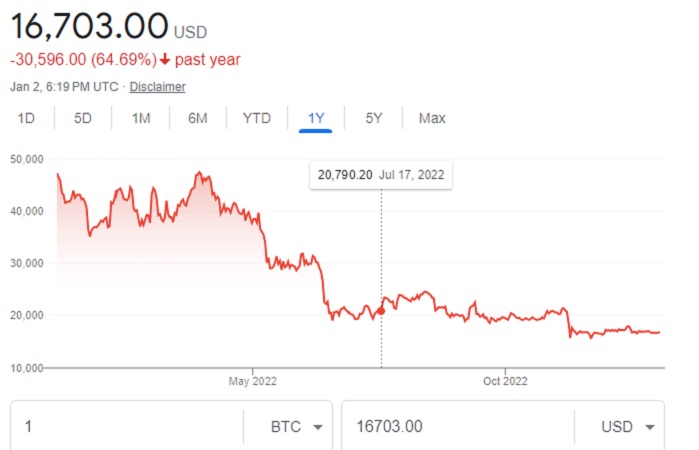
Recent reports disclose that the leading digital crypto asset Bitcoin lost more than 60% in 2022.

The report revealed that this is the second-worst annual performance on record for Bitcoin, and only its third down year ever.

The digital asset which once reached an all-time high of $68,789 in November 2021, has seen its price massively decline, as it is currently trading at $16,721. In the first month of 2022, Bitcoin started on a positive note, which saw it nearly twice as valuable as it was in January 2021.

This was followed by several predictions from analysts stating that the crypto asset could hit $100,000 or more before the end of 2022.

Unfortunately, it was short-lived as before the end of the first month of 2022, it lost nearly all the previous yearly gains, dropping to $33,000.

However, some factors were responsible for the massive decline in crypto prices, as one major factor is the implosion of crypto exchange platform FTX, which filed for chapter 11 bankruptcy on November 11, as well as core scientific, one the largest publicly traded crypto mining companies, which filed for bankruptcy on December 21.

Bitcoin’s price already went far lower than it was at the start of the year, which saw it take another downturn, dropping by over 25% in less than a week. This solidified 2022 as one of the worst years crypto had ever seen.

All of these shattered investors’ confidence as the ripple effects of the company’s collapse continued to spread throughout the crypto industry.

According to James Royal, a principal reporter at Bankrate, he disclosed that “many Americans are coming to realize that cryptocurrency is just a speculative mania and the industry is rife with crooks.”

To that point, about 60% of Americans now believe investing in digital currency is highly risky, up from 45% in 2021. Overall, the crypto market has lost a little over $2 trillion in 2022 and popular digital coins such as bitcoin and Ethereum have fallen far below their 2021 highs.

Also, the US Federal Reserve increased interest rates (as was the case in many countries worldwide), which was catastrophic for both the traditional and crypto markets.

2022’s recurring interest rate hikes pushed investors to opt for saver options as an alternative to cryptocurrencies.

As a result, the demand for cryptos took a sharp downturn, and prices soon followed. This affected just about every cryptocurrency in the market, fueling a further price drop.

While it is currently trading at an all-time low of $16,800, more than 60% down year-to-date (YTD) questions surrounding the cryptocurrency’s future continue to arise. Some investors are positive that the prices of cryptocurrency will surge, while several others feel this might be the end of crypto.

Netflix to Lose Further 200,000 UK Customers in 2023 – Analysts Predict

0
London, UK - August 01, 2018: The buttons of Spotify, Podcasts, Netflix, WhatsApp and Music on the screen of an iPhone.

As the streak of issues constituting economic headwinds continue to pile up, compounding its revenue crisis, Netflix is expected to record further downturn in 2023 in the UK.

Netflix’s UK consumers are battling with increasing cost of living, forcing them to cut down on expenses that have inadvertently impacted the streaming platform’s revenue. The company introduced ad-supported cheaper service last year, following massive drop in its subscribers’ base, but it’s taken time to win over consumers.

Netflix recorded a loss of about 500,000 subscribers last year, and is expected to lose further 200,000 in 2023 as the UK economy struggles. This is also as it takes on the rising influence of new competitors such as Disney+, which has amassed market-leading growth of 1.4 million subscribers since it was launched in the UK in early 2020. The company is expected to have 6 million subscribers this year in the UK.

Netflix started making changes early this year, including cutting the workforce. In April, when the world’s largest streaming service announced ad-supported service, it had already lost millions of subscribers globally.

It launched the ad-supported subscription in the UK and other markets in November, at the cost of £4.99 a month, which is £2 less than its current cheapest option. With increasingly declining revenue, the company also announced that it’s canceling its password-sharing service feature.

However, the changes, which were geared toward acceleration of its subscriber’s growth, did not yield immediate positive results due to global economic strains, which very much affected the UK that was hit with about 11% inflation – a four-decade record.

“The company, which has cut staff and become more disciplined with its $17bn (£14bn) annual content budget after earlier this year reporting its first global subscriber declines in a decade, will have seen its UK user base drop from 14.2 million to 13.7 million this year,” research firm Ampere Analysis said.

Netflix recorded a loss of 200,000 subscribers in the first quarter of 2022, its first in a decade. It is said to be the only major streamer to have lost subscribers in 2022. The streamer is the UK’s most popular service. But in 2021, the company gained only 800,000 subscribers, its lowest since launching in the UK in 2012, as consumers approached “peak Netflix”, per a report by the Guardian.

However, Netflix had an uptick in subscription last year. The company saw 2.4 million subscriber’s growth in the third quarter of 2022, beating projection. The growth was attributed to series such as Dahmer and Stranger Things 4, per Guardian.

“Given the wider economic pressures the UK is facing I’m not expecting Netflix to go back to growth in 2023,” says Richard Broughton, director at Ampere Analysis. “Our base assumption is Netflix moves back into growth with the UK economy, which is likely to be 2024.”

Given the slow recovery of the UK economy, Netflix growth is expected to experience longer recovery. The streaming service is forecast to lose about 200,000 UK subscribers in 2023, and Prime Video is set to contract by about 100,000, according to the Guardian.

But besides the UK’s economic headwinds, competition from other streaming service providers is another challenge to Netflix. Disney+ is predicted to continue to show strong growth, adding an expected 1.4 million new customers this year. The newest UK entrant, Paramount+ has rapidly amassed about 3 million users with contents such as Star Trek, Strange New Worlds, Yellowstone, Halo and Top Gun 2.

However, Netflix is expected to see an increase in revenue as a result of advertising. Ad-supported service is expected to increase the rate of new subscriber growth over the medium term.

Ampere estimates that the ad strategy will eventually pay off by boosting Netflix subscriber numbers 4% more by 2027 – 255 million global subscribers compared with 246 million – than would have been achieved sticking to its previous strategy, per the Guardian.

While Netflix’s revenue from subscription is expected to drop to $36 billion, the company is forecast to bring in $43bn in total revenues, with ad revenue growth of $7 billion in 2027.

“It is difficult for a business of the scale Netflix has reached in many markets to grow. It has hit a ceiling on price this year. When Netflix raises subscription prices now there is a lot of churn; there never used to be. Ultimately, the new ad tier will help the company to recapture more price sensitive consumers,” says Broughton.