DD
MM
YYYY

PAGES

DD
MM
YYYY

spot_img

PAGES

Home Blog Page 454

Trump Administration Cancels $13bn in Clean Energy Subsidies, Drawing Fire Over U.S. Retreat From Renewables

0

The U.S. Department of Energy on Wednesday said it intends to cancel more than $13 billion in funds that had been pledged under the Biden administration to support wind, solar, battery development, and electric vehicles.

The announcement, made by Energy Secretary Chris Wright at a press conference in New York, underscores the Trump administration’s sharp pivot away from renewable subsidies in favor of maximizing oil and gas output, which has already reached record levels since Trump’s return to office in January.

“By returning these funds to the American taxpayer, the Trump administration is affirming its commitment to advancing more affordable, reliable, and secure American energy and being more responsible stewards of taxpayer dollars,” the department said in a statement.

The decision comes just a day after President Donald Trump told world leaders at the United Nations General Assembly that climate change was “the greatest con job” in history, a declaration that doubled down on his long-standing skepticism of international environmental initiatives and multilateral agreements.

California Governor Gavin Newsom swiftly condemned the move, warning that the U.S. was ceding ground to global competitors. “(Chinese) President Xi, I don’t know what else he’s got to applaud. … I think he’s going to give (President Donald) Trump a bear hug when he arrives,” Newsom said during an appearance at a New York Times climate event.

He stressed that California, which has some of the most ambitious clean energy and emissions targets in the world, could see its progress undermined by Washington’s retreat.

The Department of Energy has not disclosed which specific programs will lose funding, raising uncertainty among states and private companies that had already begun planning projects under Biden-era commitments.

The cancellation lands at a time when the renewable sector has been outpacing other parts of the U.S. economy. Jobs in wind, solar, and other clean technologies grew three times faster than the overall U.S. workforce in 2024, according to a study by advocacy group E2. Analysts warn that Trump’s reversal could stall or even reverse that growth, with ripple effects across supply chains and investment flows.

Wright defended the administration’s stance, arguing that climate change has been “wildly exaggerated” into the world’s greatest threat, spurring “massive amounts of spending with very little positive impact.” He added that he has no plans to attend the UN climate talks in Brazil later this year, though he said he remains open to “conversations with people who see things differently.”

However, the political optics extend beyond domestic debate. With Trump expected to meet Chinese President Xi Jinping in the coming weeks, analysts say the funding reversal hands Beijing an opportunity to cement its global dominance in clean energy technologies, from solar panels to batteries—sectors where Chinese firms already control a commanding share of production.

China and the European Union are moving in the opposite direction of the U.S. — scaling up clean-energy capacity and investment at a pace. The International Energy Agency and Reuters reporting show China investing very large sums in renewables (hundreds of billions annually) and accelerating wind and solar rollouts, while the EU is set to add record renewable capacity this year, driven by policy support and grid upgrades.

Those programs are underpinning manufacturing and supply chains that global companies now rely on. The U.S. rollback, therefore, risks leaving American firms and workers behind in factories and markets where scale and manufacturing leadership matter.

For many industry leaders, the shift raises questions not just about jobs and investment, but about the future of U.S. competitiveness in a global energy transition that is accelerating even as Washington retreats.

Industry leaders say cancelling funds will depress private investment plans that had banked on federal support. At a basic level, capital allocators respond to policy clarity and scale — long-term, predictable incentives that reduce technology risk.

China’s enormous state-guided build-out and the EU’s coordinated market signals are already pulling supply chains, factory capacity, and R&D spending toward those regions. That creates a self-reinforcing advantage: as China and Europe scale up, their firms lower costs and gain market share, making it harder for U.S. suppliers to compete later.

Global clean-technology markets are entering a scale-up phase where first-mover industrial advantage matters. Capacity additions in China and the EU are already reshaping price curves for panels, wind turbines, and battery cells. The U.S. decision to rescind pledged funds, therefore, comes at a moment when predictable public backing is often the tipping point for major factory builds.


US Judge Gives Preliminary Approval to $1.4bn Anthropic Copyright Settlement — What it Means for AI and Creative Industries

0

A federal judge in California on Thursday granted preliminary approval to a landmark class-action settlement brought by a group of authors against Anthropic over the company’s use of their works to train generative AI systems.

U.S. District Judge William Alsup described the proposed deal as fair during Thursday’s hearing; he had earlier paused the settlement and asked the parties to answer additional questions before moving forward.

The approved deal — reported by multiple outlets as roughly $1.4 billion — is the first major settlement among a string of high-profile suits targeting AI developers for using copyrighted material without authorization. Plaintiffs in related cases have sued other major AI players, including OpenAI, Microsoft, and Meta, and the Anthropic settlement will be watched closely as a potential template for resolving claims brought by authors, publishers, and other rights holders.

Judge Alsup initially declined to approve the settlement at an earlier hearing and asked the parties to address concerns about notice, fairness, and the mechanics of how class members would be identified and paid. After those issues were addressed, he said the revised deal met the standards for preliminary approval and signaled the case will move to the next phase — class notice and a future fairness hearing.

The background story: how we got here

Since generative AI systems broke into public view, authors, news organizations, recording labels, and other rightsholders have filed dozens of legal actions alleging that companies trained large language models and other generative systems on copyrighted text, images, or music without licenses.

Courts across multiple jurisdictions have been grappling with novel questions about whether this use is covered by fair use or constitutes infringement, and how liability should attach when large datasets are scraped at scale. Several prominent suits — including consolidated cases against OpenAI and Microsoft and publisher and author actions — remain active.

A resonance with older copyright battles

The current disputes echo prior technology-era copyright fights. Two useful precedents illustrate the range of outcomes courts have produced in the past: the litigation over peer-to-peer music sharing (e.g., Napster) produced decisive liability rulings against intermediaries that facilitated unauthorized copying, while the Google Books litigation ultimately found broad fair-use protection for Google’s scanning and indexing program (a decision the courts affirmed).

Those earlier fights shaped industry responses — enforcement, negotiation, and, in some cases, collective licensing mechanisms — and they provide legal and commercial patterns that could recur in the AI era.

Why authors sued Anthropic specifically

At the core of the Anthropic claims was the allegation that the company used copyrighted books and other works as training data without consent. Plaintiffs argued not only that their works were used without payment, but in some filings, they also alleged problematic sourcing methods for certain datasets. Courts have therefore been asked not only whether training is lawful, but whether data acquisition practices cross additional lines (for example, by using pirate or mirror sites). Those factual allegations were a key component of the pressure that produced settlement negotiations.

Why this settlement matters — practical and legal implications

The size and scope of the Anthropic settlement give publishers, authors, labels, and other creators a real commercial remedy short of protracted litigation. For rights holders, settlements can deliver cash, notification, and (often) changes to industry practice. For AI companies, a settlement offers predictability and avoids uncertain, expensive trials that could impose larger damages or injunctions. The Anthropic deal, therefore, creates a strong incentive for other defendants and plaintiffs to consider negotiated resolutions.

The ruling is expected to spur changes to data-acquisition and curation practices. Hence, companies are likely going to tighten how they source training material, documenting provenance more rigorously and shifting toward licensed datasets and contractual relationships with publishers, aggregators, or dedicated data-providers. Some firms may buy large-scale licenses; others may build curated public-domain corpora or rely on opt-in models. These shifts raise the cost of model development and could slow some research that depended on wide-open scraping.

Additionally, the settlement strengthens incentives for collective or industry arrangements (analogous to music industry licensing bodies) that supply cleared training data to model builders under standard terms. Such a marketplace could reduce transactional friction and provide revenue streams to creators, but it will require negotiation over rates, usage rights, and notice/attribution rules. The Google Books precedent shows how complex and drawn-out such arrangements can be.

A large, public settlement will intensify calls in legislatures and regulatory bodies to update copyright and AI laws — from clearer safe-harbors for model training to mandatory transparency and dataset-reporting rules. Policymakers now face pressure from both creators seeking protection and tech companies seeking clarity and scale. Expect proposals for mandatory dataset registries, stronger takedown or opt-out mechanisms for trained works, and perhaps new compensation formats for text and media used in training.

Other plaintiffs may be more likely to press for settlement leverage; defendants who believe they have stronger legal defenses may fight on to try to set favorable precedents. The Anthropic deal does not resolve open questions about fair use for training models; courts will still confront those statutory issues in other cases and appeals. Nor does a settlement erase fact-specific disputes — for example, whether scraping from a pirate archive is materially different from using legitimately licensed content.

With preliminary approval, the settlement process normally moves into a notification phase. Class members (authors and possibly their estates/publishers, depending on the settlement’s class definition) should receive notices explaining eligibility, how to file claims, and the timetable for objecting or opting out. Courts often require robust outreach measures in mass-class settlements to ensure lesser-known creators are informed; Judge Alsup had previously flagged that concern, which the parties revised in response.

Overall, Anthropic’s settlement signals that at least some AI firms will choose to pay and negotiate rather than litigate through landmark trials with unpredictable outcomes. At the same time, because many suits remain pending against other large providers, the industry could see a mix of settlements and precedent-setting rulings emerging concurrently — a legal and commercial landscape that will evolve over the next 18–36 months.

Even so, the settlement does not settle the underlying legal doctrines about fair use and training; those questions will continue to work their way through courts and legislatures while the market reorganizes around clearer licensing channels and transparency norms.

BUA’s Abdul Samad Rabiu Projects Naira Strengthening to N1,300–N1,400 by End of 2025, Cites Bold Reforms

0

Nigeria’s naira could strengthen significantly against the U.S. dollar by the end of 2025, according to BUA Group Chairman Abdul Samad Rabiu, who expressed rare optimism about the economy after a closed-door meeting with President Bola Ahmed Tinubu at the Aso Villa on Wednesday.

“The exchange rate has continued to improve. Naira is trading below N1,500 today, and I’m confident it will strengthen even further. I expect that the rate should come down to maybe N1,300 to N1,400 before the end of the year. This is something we should all celebrate,” Rabiu said.

The billionaire industrialist tied his forecast to ongoing fiscal reforms, improved market confidence, and reduced reliance on Central Bank of Nigeria (CBN) interventions, arguing that businesses now access foreign exchange more freely through global banking channels, including ATMs and credit cards abroad.

Rabiu also pointed to a softening of food prices as evidence that reforms are trickling down to households. Earlier this year, BUA said it slashed the price of a 50kg bag of rice from over N100,000 to N50,000, triggering what he described as a broader trend of price corrections.

“Products such as flour, pasta, macaroni, semolina, and others that we produce have seen significant price reductions from what they were last year,” he noted.

He credited the Tinubu administration’s duty waivers on key food imports for helping stabilize costs and domestic supply chains, saying, “We must acknowledge and appreciate His Excellency for these waivers. They have contributed greatly in making this possible.”

The BUA chairman stressed that the reforms are beginning to instill confidence among businesses, framing them as “bold” and “decisive” steps, laying the foundation for long-term growth.

“There are bold reforms and decisive policies creating the foundation for a stronger economy, a more stable currency, and a better future for businesses and Nigerians alike,” Rabiu said.

Global Institutions More Cautious

Rabiu’s upbeat projection stands in contrast to more guarded assessments from rating agencies and global lenders. The International Monetary Fund (IMF) has repeatedly warned that Nigeria’s foreign exchange market remains fragile, stressing that currency stability cannot be sustained without higher non-oil revenues, improved fiscal discipline, and stronger reserves. The World Bank has similarly flagged risks tied to low oil production, heavy debt servicing, and ongoing structural bottlenecks, cautioning that reforms, though positive, are not yet sufficient to anchor lasting stability in the naira.

Credit rating agencies have echoed this concern. Moody’s and Fitch both noted earlier this year that while recent measures by the Tinubu administration—including subsidy removals and exchange rate liberalization—have improved transparency, Nigeria’s external vulnerabilities remain high. Fitch said the naira’s recent rally is “vulnerable to reversal” if foreign inflows do not rise substantially.

Analysts Link Gains to Global Trends

Some economists argue that the naira’s recent appreciation is tied less to local reforms and more to global monetary conditions and U.S. fiscal uncertainty.

“Recent disinflationary trends, and more importantly, the easing in the U.S. market, have afforded some room for the CBN to ease off the brakes. As rates decline in the U.S., the risk premium generally becomes lower,” said financial analyst Abdulrauf Bello.

“Additionally, the USD is under pressure due to the current state of the U.S. fiscal deficit and ongoing trade disputes between the U.S. and its trading partners,” Bello added, referencing trade tensions that have escalated under President Donald Trump’s tariff policies.

Against this backdrop, there is concern that if the dollar regains strength, the naira’s fragile recovery could quickly reverse. The Trump administration is already facing legal challenges over the legality of its tariff regime, a development that has injected volatility into global markets. A ruling against the U.S. government could trigger unpredictable shifts in trade flows and currency values.

Currency Still Under Pressure

Despite Rabiu’s optimism, data from the CBN shows the naira remains under pressure. On Thursday, it closed at N1,493.99/$1 in the official market. In the parallel market, it slipped further to about N1,521.5/$1, widening the gap with the official rate.

The projection of a recovery to N1,300–N1,400 per dollar by year’s end, therefore, represents a bold bet on both domestic reforms and global tailwinds aligning—a scenario that, while possible, remains uncertain.

Live Casinos vs. Traditional Online Casinos: Which Offers Better Player Experience?

0

For years, the debate centered on whether online casinos could ever match the thrill of visiting a brick-and-mortar venue. That question has since evolved. Today, the focus is on comparing two distinct online formats: traditional online casinos and their newer alternative, live casinos. While both cater to mobile-first consumer habits and digital entertainment trends, each delivers a distinct player experience. Let’s explore their differences here.

1. Authenticity & Immersion

Live casinos provide an experience that mimics the ambience of a traditional brick-and-mortar casino. The presence of real dealers, physical cards, and roulette wheels being streamed in real time enhances trust and creates an authentic atmosphere. Players often feel more engaged because they can observe the dealer’s actions, which adds transparency. This immersion makes the gaming session more entertaining and often reduces skepticism about fairness since everything is happening live.

Conversely, traditional online casinos rely heavily on digital interfaces and Random Number Generators (RNGs). While the graphics and animations can be polished, they rarely replicate the excitement of real casino activity. Players are essentially interacting with software, which may feel impersonal and mechanical. For some, this lack of physical elements makes the games feel less trustworthy or less thrilling, though it appeals to those who prefer simplicity and efficiency over atmosphere.

2. Speed & Pace of Play

In live casinos, the pace of the game is dictated by human dealers. Each round includes time for bets to be placed, cards to be dealt, and outcomes to be resolved, making the gameplay naturally slower. This pacing can feel more relaxed and closer to an in-person experience. Among operators, FanDuel Casino particularly enhances this live experience with exclusive live dealer studios and branded tables, which reduce wait times at busy tables while preserving the authentic rhythm of live play.

By contrast, traditional online casinos are designed for efficiency. Because everything is automated, players can instantly place bets and receive outcomes within seconds, cycling through multiple rounds very quickly. This fast pace is ideal for those who prefer action-packed sessions and want to maximize the number of games they play in a short time. However, the speed can also feel overwhelming to casual players who prefer a more deliberate, leisurely pace.

3. Social Interaction & Community

A major appeal of live casinos is the social dimension. Players can chat with the dealer and sometimes even other participants, recreating the sense of camaraderie that exists at real casino tables. The presence of human interaction adds personality and warmth, making players feel like part of a community rather than isolated individuals behind a screen. This social aspect often increases engagement and retention.

In traditional online casinos, social interaction is minimal or nonexistent. Most games are designed for solo play, where the user interacts only with the interface. While some platforms have introduced chat rooms, leaderboards, or shared jackpots to foster a sense of community, the experience still feels largely individual. For players who value focus and privacy, this solitude can be appealing, but for others, it may feel lonely or lacking in atmosphere compared to live dealer setups.

4. Variety, Availability & Flexibility

Live casinos are bound by physical limitations. Each table requires a dedicated dealer and setup, which restricts the number of games and variants available at a given time. This also means that availability may be limited, and some tables could be full, forcing players to wait. The game library typically focuses on classics like blackjack, roulette, and baccarat, rather than offering niche variations or new experimental formats.

In traditional online casinos, the possibilities are much broader. Developers can create countless variations of a single game without being constrained by physical resources. Players have access to hundreds of casino games and hybrids at any time, often with customizable stakes and features. The digital environment is designed for convenience and constant access, ensuring that players can always find something to play instantly. This flexibility is a massive draw for those who like variety and novelty.

5. Reliability, Latency & Technical Requirements

Since live casinos depend on high-quality video streaming, a stable and fast internet connection is essential. Any lag, buffering, or drop in video quality can disrupt the immersion and frustrate players. There’s also the potential for synchronization issues between the live dealer’s actions and the betting interface, which can cause confusion. For players without strong connectivity, this technical demand can become a barrier to enjoyment.

Traditional online casinos are much more forgiving in terms of technology. Since the games rely on lightweight animations and RNG software, they run smoothly on weaker internet connections and older devices. This reliability makes them accessible to a broader audience, especially players in regions where high-speed internet isn’t consistently available. The reduced risk of interruptions ensures smoother gameplay, though it comes at the cost of a less dynamic, real-world feel.

Which Offers Better Player Experience?

The answer ultimately depends on what each player values most. Live casinos are ideal for those who enjoy authenticity, human interaction, and a slower, more immersive pace that mirrors the atmosphere of real-world play. Traditional online casinos, by contrast, suit players who prefer speed, variety, and convenience with instant results. Ultimately, the “better” experience comes down to personal preference and the style of play that feels most rewarding.

Solana Price Prediction: SOL to $300 as ETF Hopes Rise, While Little Pepe (LILPEPE) Gathers Momentum for Top 20 Market Cap

0

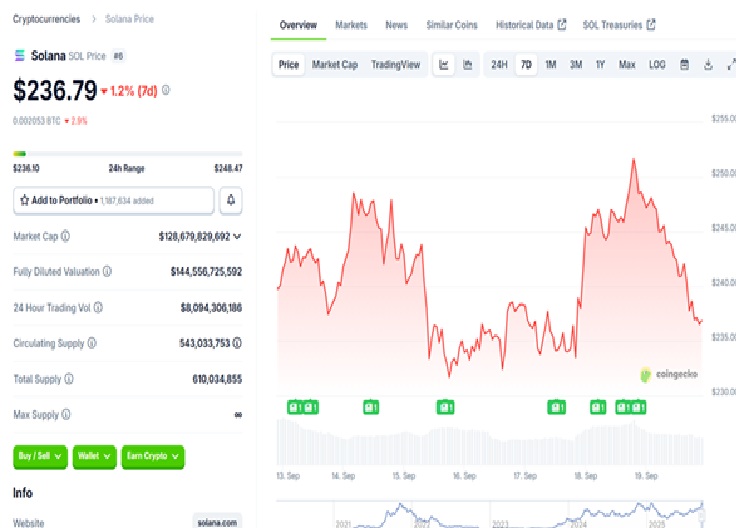
Solana (SOL) is gaining momentum as significant breakthroughs in the cryptocurrency space occur. While gaining momentum, Little Pepe (LILPEPE) aims to enter the top 20 by market size. SOL is on track for $300, and LILPEPE is a meme coin to watch in 2025 due to strong pushes on both sides.

Solana’s Bright Future: $300 Price Goal Amid ETF Hopes and Big Changes

Solana (SOL) has been performing exceptionally well, remaining in the top 10 cryptocurrencies by market capitalization. With several good things coming up, Solana is set to climb higher. Experts believe SOL could reach $300, thanks to key market developments.

SEC clearance of Grayscale’s multi-crypto fund, which contains Solana, is critical for Solana. This is acceptable because it adheres to crypto ETF guidelines and enables large investors to purchase Solana, potentially boosting its price. Solana, in a huge investment fund, may attract more significant players, strengthening it. Additionally, Solmate has launched a $300 million Solana fund in the UAE, backed by Ark Invest. This fund plans to establish a staking setup and expand Solana’s presence in the Middle East, demonstrating that major investors are increasingly confident in Solana. This strategic move is expected to help spread Solana globally and boost its value. Finally, Forward Industries filed a $4 billion stock program to build its Solana fund. This suggests that significant investors are betting on Solana’s future, which is expected to raise the price. With all these factors in play, Solana is well-positioned to reach $300 soon, particularly with rising interest from major investors and network growth driving it forward.

Little Pepe (LILPEPE): Building Speed for a Top 20 Market Cap

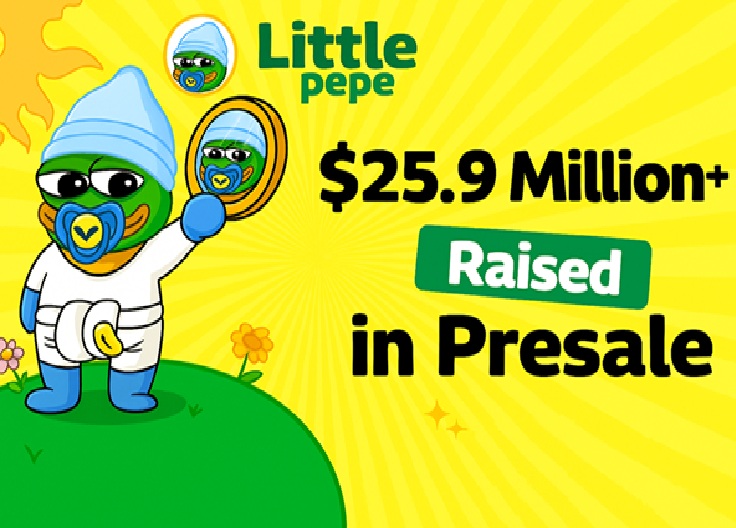
While Solana continues to experience rapid growth from major investors, Little Pepe (LILPEPE) is forging its own path to success. This new meme coin is gaining attention for its strong presale results, with $25.9 million raised and 15.9  billion tokens sold to date. Although it’s relatively new, LILPEPE is poised for significant success in the years ahead. A highlight of Little Pepe is its team. LILPEPE has about 41,000 holdings and 30,000 Telegram users. Community-driven projects generally succeed, and the LILPEPE community is keen to grow the coin. Meme coins need this support to generate demand and value. LILPEPE’s token scarcity makes it an appealing investment. Buyers rush for LILPEPE presale tokens due to huge demand. After the presale, the token’s limited quantity will raise its price on open markets. Incredible giveaways have also boosted LILPEPE’s popularity. The $777,000 giveaway awards 10 winners with $77,000 in tokens, ensuring everyone participates. These gifts make people have fun and keep them interested, accelerating coin circulation. Due to its limited supply and demand, strong community support, and large giveaways, LILPEPE is expected to soon burst into the top 20 market cap. Its rapid growth could surpass XRP in 2025, making it a coin to monitor. ? Get your tokens now at littlepepe.com

Solana and Little Pepe: The Future of Crypto?

Both Solana (SOL) and Little Pepe (LILPEPE) have demonstrated impressive speed in the market, but each is taking a distinct growth path. Here’s how each coin shines: Significant investor support, network enhancements, and the introduction of ETF products power Solana’s road. The future looks promising for SOL, with the CME Group launching futures options and major players backing the coin. The ongoing work in the Middle East and the U.S. set Solana up for more growth, with a $300 goal in sight. Little Pepe, on the other hand, is still early on, but its presale wins, growing group, and short-supply demand make it a formidable player for the future. If it continues to build on its speed, LILPEPE could reach the top 20 market cap, offering huge upside for early buyers.

Conclusion: Solana and Little Pepe—Two Coins to Watch

As Solana (SOL) aims for a $300 price goal, driven by ETF hopes and significant investor adoption, Little Pepe (LILPEPE) is quickly gaining momentum, making it one of the hottest meme coins for 2025. With its strong team, short supply demand, and massive giveaways, LILPEPE is poised to soon shake up the top 20 market cap. XRP is a good long-term investment, but Solana and Little Pepe are expected to surpass it by 2030. In the future, Solana and Little Pepe are worth watching for their impressive scalability and rapid expansion, respectively.


For more information about Little Pepe (LILPEPE) visit the links below:

Website: https://littlepepe.com

Whitepaper: https://littlepepe.com/whitepaper.pdf

Telegram: https://t.me/littlepepetoken

Twitter/X: https://x.com/littlepepetoken