I do not believe in new year resolutions. Yes, it is an illusion to think that switching of a digit from 2022 to 2023 will deliver a new outcome, when you have not investigated, and resolved, to fix and deepen what matters: processes. One of the greatest victories in life is the victory over time, and that time is allocated to all of us, equally (24 hours in a day). Time, even in its limitless form, is the most scarce resource out there. Until you can win over it, via your processes, you cannot resolve your future.
Leave new year resolutions, focus on resolving your daily and weekly non-optimal processes. Buy an exercise book. Every Sunday night, take 10 minutes to list important things you want to get done in that week. Then every night before you go to bed, or if you prefer, early in the morning, list important tasks for the day. As the days go and the week passes, cross-out the completed ones. Keep optimizing those processes, keep improving on how you execute the tasks, and track these two indicators: quality and speed
In most things in the professional domain, those who can deliver high quality outcomes at the shortest time thrive. So, you must keep improving your processes while reducing the time required to execute tasks.
If you blog, how can you take 30 minutes to put that content over 2 hours without loss of quality? If you send a management report, how can you beat the deadline with high quality results, and demonstrate that you are ready for more responsibilities? Those simple resolutions will make the mountain-size new year resolutions irrelevant. Happy new year ahead!
It is not uncommon in Nigerian politics for candidates to be charged in court for various irregularities in their certificates prior to and after winning elections. Many Nigerians are also aware that politicians are winning cases in various courts. In all of these cases, the media has a significant impact on shaping people’s perceptions of the actors and other stakeholders, whether positively or negatively. Of course, the media cannot be told not to construct perceived reality, but it must do so in ways that do not cause unnecessary panic or chaos.
In this piece, our analyst looks at recent news about the ongoing Osun State Election Tribunal. The Tribunal was inaugurated after the former governor, Alhaji Isiaka Gboyega Oyetola, approached it with the claim that there was excessive voting in the state’s 2022 governorship election and that the current governor, Senator Ademola Adeleke, is unqualified to hold the office because he previously forged his secondary school certificates.
According to their editorial philosophies and owners’ interests, Nigerian media have frequently used different frames to report proceedings at the Tribunal, with these allegations serving as the main focus of their reporting. According to our analyst, these reflected in the Tribunal’s recent coverage by Premium Times, The Guardian and The Nation.
Information has it that “Olorunyomi is the co-founder, CEO, and publisher of the Nigerian newspaper Premium Times, which today is one of the most trusted newspapers in Nigeria and a standard for African investigative journalism.” The Guardian was established in 1983 by the entrepreneur Alex Ibru, assisted by Stanley Macebuh, a top journalist with the Daily Times newspapers. For years, the ownership of The Nation has been in secrecy. However, several information indicate that the newspaper is owned by Senator Bola Ahmed Tinubu, former governor of Lagos State.
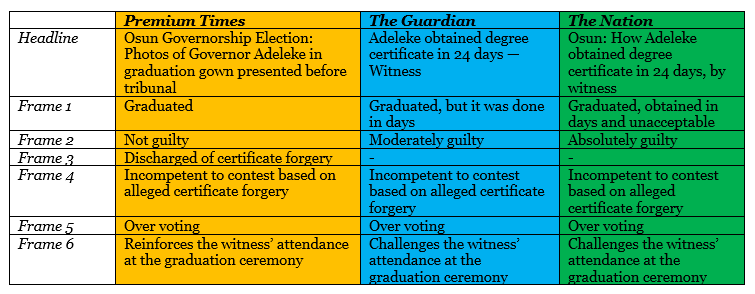
The three newspapers differ and slightly align in their production approach, from the headline to the lead construction. Premium Times employs explicative headlines, whereas The Guardian and The Nation employ judgmental headlines, which have the potential to mislead readers. In other words, the two newspapers use click bait features that are related to information pollution, particularly misinformation (see Exhibit 1).
Premium Times appears to be more neutral than others, according to our analyst, because of its approach to representing the witness, Mr Bunmi Jenyo, and the new governor. For example, while The Guardian and The Nation believe the new governor is guilty of certificate forgery, Premium Times maintains a neutral position by including earlier information from a court that discharged the governor from the certificate forgery case. This is conspicuously absent from reports in The Guardian and The Nation (see Exhibit 1).
Premium Times
Governor Ademola Adeleke on Thursday presented an album of photographs of himself kitted in graduation gown before the Osun State election petition tribunal in Osogbo.
He accompanied the album with academic certificates and transcripts of Atlanta Metropolitan State College and Pen Foster High School which the governor claimed he attended in the United States.
A certified true copy of a judgement of the Appeal Court that discharged Mr Adeleke of an accusation of forgery was also presented before the tribunal.
The academic credentials and court judgement were brought to the tribunal by Bunmi Jenyo, a personal assistant to the governor.
Mr Jenyo appeared as a witness before the tribunal, claiming that the photographs of Mr Adeleke in a graduation gown were taken on the day of his graduation with a diploma on 6 May, 2021.
One of the allegations by the petitioners challenging Mr Adeleke’s victory in the 16 July governorship election is that he forged the academic certificates he presented for the election.
But when cross-examined by Akin Olujimi, SAN, counsel to the petitioners, Mr Jenyo said he attended the graduation ceremony in the U.S. and also took pictures with him at the ceremony.
“I traveled to the United States for the graduation. I arrived at the airport on 6th May, 2021 for the graduation and I have my passport here as evidence,” he said.
“I was part of the people in the photographs taken on the day of the graduation. The second respondent is also in the photograph. I attended the graduation ceremony,” he added.
“I have been a friend to the second petitioner for 10 years. Since our friendship, the second respondent has not been convicted for submitting forged certificates or documents,” he said.
“My duty is to keep his personal documents. He authorised me to come to the court with the documents that I presented.”
After Mr Olujimi said he would reserve his objection on the international passport of the witness as tendered for evidence till final address, the tribunal chairman, Tertsea Kume, admitted his Nigerian passport as exhibit.
Source: Premium Times, The Guardian, The Nation, 2022; Infoprations Analysis, 2022
The Guardian
The Chairman of the Osun State Chieftaincy Affairs Review Committee, Revd. Samuel Bunmi Jenyo, who claimed to be a Personal Assistant to Governor Ademola Adeleke, has said the governor obtained his degree in 24 days. Rev Jenyo said Adeleke obtained his Diploma Certificate in Penn Foster High School on 16th July, 2021 and degree from Atlanta Metropolitan College on 9th of August 2021.
Jenyo made the revelationlast Thursday while testifying before the Justice Tertsea Kume-led tribunal at the resumed hearing of the petition filed by former Governor Adegboyega Oyetola and the All Progressives Congress (APC) against the declaration of Ademola Adeleke as the governor of the state.
Oyetola and the APC are challenging the declaration of Governor Adeleke on two grounds: over-voting and eligibility to run in view of alleged inconsistencies in his certificates.
Rev. Jenyo tendered Adeleke’s certificates, bearing Penn Foster High School and Atlanta Metropolitan State College. He also told the Tribunal during the cross examination that though he has never worked in any of the institutions purported to have been attended by the Governor, part of his responsibility as Adeleke’s Personal Assistant was to keep the governor’s personal documents, thus giving him access to his certificates and academic details. The witness also said that though his International Passport does not show he attended Adeleke’s graduation in US, he submitted that he attended the Graduation ceremony. After the Cross examination, Adeleke’s counsel closed his case.
Subsequently, counsel for PDP, Alex Izinyon, SAN, also opened his case and told the panel that he would not be calling any witness but would be relying on the evidence of the two other respondents. He then tendered some documents and closed his case.
It will be recalled that when Governor Adeleke was contesting in 2018, he claimed to have registered for GCE O’ Level in 1981 but had F9 in English Language and was recorded absent for other subjects. At the time, too, his profile on the website of the National Assembly also indicated that he was a holder of a Diploma Certificate in Criminology from Jacksonville State University (JSU), where he purportedly graduated from in 1986. But upon his return from abroad this year to contest the July Governorship election, the governor claimed that he had a diploma awarded to him mid last year, and that the said certificate qualified him for a B.Sc. in Criminal Justice, from the Atlanta Metropolitan State College in the United States. And he claimed to have obtained the degree barely 24 days after getting the said Diploma certificate (Delayed additional value with guilty frame)
The Nation
THE Chairman of the Osun State Chieftaincy Affairs Review Committee, Reverend Samuel Bunmi Jenyo, who claimed to be Personal Assistant to Governor Adeleke, has said the governor obtained his degree in 24 days. Rev. Jenyo said Adeleke obtained his Diploma Certificate in Penn Foster High School on 16th July, 2021 and degree from Atlanta Metropolitan College on 9th of August 2021. Jenyo made the revelation on Friday while testifying before the Justice Tertsea Kume-led tribunal at the resumed hearing of the petition filed by former Governor Adegboyega Oyetola and the All Progressives Congress (APC) against the declaration of Ademola Adeleke as the governor of the State.
Oyetola and the APC are challenging the declaration of Governor Adeleke on two grounds: over-voting and eligibility to run in view of alleged inconsistencies in his certificates. Rev. Jenyo tendered Adeleke’s certificates, bearing Penn Foster High School and Atlanta Metropolitan State College. He also told the Tribunal during the cross examination that though he has never worked in any of the institutions purported to have been attended by the Governor, part of his responsibility as Adeleke’s Personal Assistant was to keep the governor’s personal documents, thus giving him access to his certificates and academic details.
The witness also said that though his International Passport does not show he attended Adeleke’s graduation in US, he submitted that he attended the Graduation ceremony. After the Cross examination, Adeleke’s counsel closed his case. Subsequently, counsel for PDP, Alex Izinyon (SAN), also opened his case and told the panel that he would not be calling any witness but would be relying on the evidence of the two other respondents. He then tendered some documents and closed his case.
It will be recalled that when Governor Adeleke was contesting in 2018, he claimed to have registered for GCE O’ Level in 1981 but had F9 in English Language and was recorded absent for other subjects. But upon his return from abroad this year to contest the July governorship election, the governor allegedly claimed that he had a diploma awarded to him mid last year, and that the said certificate qualified him for a B.Sc. in Criminal Justice, from the Atlanta Metropolitan State College in the United States. And he claimed to have obtained the degree barely 24 days after getting the said Diploma certificate (Delayed additional value with guilty frame)
The future of monetization with web 3.0 may be questionable, but the majority of web3. 0’s focus is on decentralization. User is at the core; and will be the driving force, be it content, ads, or monetization. Adaption is the need of the hour for businesses.
As of April 2021, the global gaming value exceeded $300 Billion. While a substantial chunk of it is due to the rapid adoption in the recent pandemic and the availability of a plethora of mobile games, gaming is no longer child’s play. A sustainable, long-term monetization strategy can’t just be an afterthought but an essential building block for gaming, media, and entertainment businesses.
It’s 2022, and we are entering a new dimension with bleeding-edge innovations across industry verticals. The line between gaming, the media, and entertainment is getting thinner by the day. Seamlessly integrated experiences may have sounded fancy a couple of years back, but now it’s a bare essential.
We’re about to enter the next generation of seamless connected-tech experiences, thanks to Metaverse. It’s time for content-based enterprises, from small indie studios to large AAA studios and OTT platforms, to reconsider their monetization strategy.
Changpeng Zhao (CZ), founder and CEO of Binance, the world’s largest cryptocurrency exchange, has revealed that his company’s $500 million investment in Twitter was fueled by free speech, monetization potential, and a Web 3.0 future.
While CZ expects significant changes to be undertaken, the investment was made because Binance aims to bring Twitter into Web 3.0. This will include adding cryptocurrency-based payments onto the platform.
Binance plans to create a dedicated team to work on this project with Twitter. CZ adds that the price fluctuations don’t bother his company as they are long-term investors who see things “from a 10, 20, 50, 100-year basis.”
The Current State of Monetization
Monetization in games, media, and entertainment has evolved over the decades. Games were sold as finished products in cartridges and then on physical discs. They used to be one-and-done products for which the customer got the most for their spend.
With the shift towards digital game stores like Steam, Epic, GOG, and others, the monetization landscape saw a transformational shift.
For once, studios and publishers saved a lot of money since they didn’t have to print, package, and transport physical game copies. They could also rely on fixing game bugs and patching them via Over-The-Air updates post-release, and then there’s Downloadable Content. All these had budget constraints and limited the possibilities for smaller players.
However, the paradigm shift in monetization came with mobile games. They brought in a shock and awe effect by leveraging the freemium models and using in-app purchases, in-game ads, and paid games to bypass the ads and paywalls compared to free games.
In media and entertainment, the advent of streaming platforms saw a similar dynamic, and the typical commercials saw a shift. Traditional media houses were left behind with a significant gap as OTTs ruled the roost.
But now, we are about to witness another shift that will affect the current monetization strategies of the gaming, media, and entertainment industries.
We have too many digital game stores and streaming platforms, and the users are starting to feel the pinch. Subscription fatigue is starting to set in, making monetization challenging for businesses.
On top of that, we’re on the verge of a new version of the internet, one where entertainment will be an intertwined concept tag-teamed with gaming. Metaverse will be at the helm, and digital transactions and monetization methods will witness a rapid transformation. Saurabh Tandon, President & Board Member at Affine, recently shared his thoughts on this.
We now have blockchains in the mix, which can change the whole economy of monetization for both creators and businesses. Like it or not, the metaverse might very well become a crucial player in the world economy.
Physical and Virtual Lives will Bridge for a Unified Experience
XR (Extended Reality), an amalgamation of Virtual Reality, Augmented Reality, and mixed reality technologies, will pave the way for our future entertainment content requirements.
So, what does this mean for businesses? Big Tech giants rule with an iron fist, and content moderation is a grey area in the current climate. “With the next generation of the internet, we are looking at decentralization and a leap of technology,” said Christopher Lafayette, Founder, and CEO at Gatherverse, when he recently spoke at a virtual summit.
Advertising has already changed since its inception, and today it’s focused on content creators and consumers. With content creators and influencers, advertising has taken center stage and helps ads find takers among the form of consumers with their large subscriber base.
Non-Fungible Tokens (NFTs) are now trending and are set to be a digital form of payment, letting users buy and trade digital assets. With users creating communities for such a “digital marketplace,” the playing field for monetization is in dire need of an update and can’t rely on traditional practices.
What is the Future of Monetization?
The future of monetization with web 3.0 may be questionable, but the majority of web3.0’s focus is on decentralization. The user is at the core; and will be the driving force, be it content, ads, or monetization. Adaption is the need of the hour for businesses.
Sure, the traditional payment methods will remain. But businesses have to acknowledge the fact that blockchain will be thrown into the mix and change the dynamic of the digital economy. Rafael Brown, CEO and Co-Founder at Symbol Zero, who was a speaker at a recent tech symposium, said, “PC and Mobile gaming have established a monetization economy. As technology changes with time, we need to revisit our assumptions. The need of the hour for blockchain technology is to create sustainable monetization.”
The tech summit brought together more than 20 world leaders from Gaming, Media and Entertainment to participate and unravel the direction we, as humans powered by tech, are headed with web 3.0. With discussions on monetization, metaverse, subscription fatigue, OTT platforms, and many more interesting topics, the virtual event was a hit around the globe.
Affine combines the hyper-convergence of AI, data engineering & cloud with deep industry knowledge in manufacturing, gaming, CPG, and technology. Affine demonstrates thought leadership in all relevant knowledge vectors by investing in research through its highly acknowledged centers of excellence and strong academic relationships with reputable institutions.
Sunflower Land, a PlayAndOwn game on the Polygon Network, is developing a new dynamic profile picture project called Bumpkins.
Sunflower Land is a MetaVerse game where you grow your farm and build your empire. Each NFT in this collection is a pass which enables players access to the game. You can mint a player pass at https://sunflower-land.com.
It is not recommended to purchase someone else’s pass, The live Sunflower Land price today is $0.116589 USD with a 24-hour trading volume of $9,481.03 USD.
The goal of this project is to create a decentralized and community driven MetaVerse style game. This repo includes the front-end game in which users can play and interact with the game on the Polygon Network and off chain data.
The team explained the concept in a Twitch stream on Sept. 2 where the developers talked about the future of Sunflower Land. The first half of the stream focused on the upcoming Goblin War within the game. The second half focused on their new project, that allows players to mint base NFTs that can evolve throughout its lifespan.
The team will be announcing something huge for the future of Sunflower Land and NFT gaming today on Twitch.
The [previous] process [of PFP minting] is pretty static. Once you mint something and its not a super rare item you’re kind of disappointed, Spencer Dezart-Smith said in Sunflower Land’s live stream. “We utilized this idea of NFTs and Semi-Fungible Tokens, and combined this idea where players can control the destiny of their NFTs.
Each item that the base Bumpkins NFT possesses is its own token which the players have ownership over. Ideally, the base NFT can be customized with other tokenized assets, changing its rarity in the process. Trading these NFTs will also move the tokens equipped to the base NFT itself, making the entire project dynamic in nature.
I, think its where the [NFT] community needs to go,” Sunflower Land’s CEO, Adam Hannigan, said on the stream. “We need to move away from projects where there’s an exclusive club. We want everyone in the world to have a Bumpkin.