DD
MM
YYYY

PAGES

DD
MM
YYYY

spot_img

PAGES

Home Blog Page 4684

FTX and Alameda’s Liquidation Plummeting Bitcoin Bull Run

0

Bitcoin Bull Markets are built on FOMO [fear of missing out]. To FOMO into an uptrend, you need to feel you are missing out and strong bearish convictions will make you miss out. Rekt Capital says, Bitcoin bear market bottoms take months to settle.

To illustrate their point about bear market bottoms, Capitulation and Consolidation. Rekt Capital, Shared a long-term Bitcoin chart they first shared back in June. According to the Three Macro Triangles, BTC is now in the Downtrend Acceleration phase in an effort to form a generational bottom.

Bitcoin, is currently trading for $16,663/BTC with a Market Capitalization of $320B at press time, up 5.7% on the week’s trading chart but down 76% from its all-time high of $69,045 reached on November 10, 2021.

BITCOIN FEAR AND GREED

Four years ago, in November of the previous BTC cycle, the price of Bitcoin lost more than 50% in the space of one month, from 12 November to 10 December 2018. The current collapse seems in some ways reminiscent of that of four years ago, except that it is significantly smaller, because the percentage loss is practically half. Moreover, during both previous cycles, the minimum price touched during the post-bubble bear market was 85% lower than the previous all-time high. Should such an eventuality also occur during the current cycle, the minimum price could be $11,500, a level much lower than the $15,500 touched this November.

Therefore, the comparison with past cycles for now seems to indicate that the price of Bitcoin is holding up better this time than in the past. However, it is worth mentioning that in November 2018, the collapse was due to a massive sale of Bitcoin on retail market that caused its value to plummet, while this time, such a massive sale has not occurred. In other words, what caused the collapse is the fear of the collapse of some of the most important infrastructures of the Crypto markets, not the fear that Bitcoin might have problems per se. Therefore, unless the value of the fear and greed index falls further in the coming days, less fear than that which caused collapses greater than the one currently underway in the past seems to be warranted.

According to former Bitcoin.com, and current CEO of blockchain development house Laguna Labs, Stefan Rust, the current collapse of Crypto Markets may finally see ETH’s market capitalization overtake that of BTC.

Rust said:

“Bitcoin seems to be declining faster than Ethereum’s ETH. The latter seems to be holding, and most likely the reason behind that is the fact that ETH is finally fully deflationary. It is burning more than it is a minting. At the same time, ETH transaction volume has grown over yesterday, and the transaction fees are pretty high right now.

Does this mean we are likely to see the first flippening? As we max out the bottom and turn around into a recovery, Ethereum – which is now deflationary – has huge transaction, volume, and developer engagement. And this is across a number of applications and different Protocols. As such, yes: this current Crypto shakeout could finally prompt the fabled flipping when the market capitalization of Ethereum takes over that of Bitcoin. It’s an exciting time.

Wall Street Institutions and Centralized Exchanges are selling people paper Bitcoin, You give them money, they say you own bitcoin, but presumably you don’t. FTX/Alameda Research fiasco alone increased the new supply of Bitcoin by 25% this year by selling people fake paper. Now think of all the other shady brokers doing the same thing. Paper Bitcoincreated by rehypothecation and outright fraud as in the case of fraudulent exchanges like FTX kept Bitcoin price down. FTX alone created 80.000 paper BTC, about 25% of yearly production.

Croesus posted on Twitter, BTC bought by FTX Users goes into Alameda’s hot wallets through a backend script. Alameda sells BTCs in exchange for Alt-coins – Net effect: People who bought BTC on FTX actually had their money used to bid up alt-coins. SBF made it known that one of his goals were to push Crypto through Government regulations. I find it ironic that he may hit that goal unintentionally because of the magnitude of the fraud he orchestrated and the downright mess he has left behind for the Cryptocurrency Industry.

This FTX cascade, is a huge pain for FTX users but an important lesson for all parties, like Regulators, Service providers and Crypto users. This black swan event is supporting the bottoming process of this bear market. Bitcoin and Crypto in general will recover from this catastrophe. If a true “blow-off-top” never transpired to top the bull market, then is “true capitulation” really necessary to bottom the bear market? One might think the shallowing of volatility of a maturing asset would be demonstrated in diminishing returns coupled with diminishing risks.

From LinkedIn: FTX crypto ‘contagion’ worry spreads

Coinbase shares were sinking Friday after analysts downgraded the company’s stock and warned about “contagion risk” following the shock collapse of rival cryptocurrency exchange FTX. Bank of America changed its Coinbase rating from “buy” to “neutral,” saying that while it’s “confident” the company is not “another FTX,” Coinbase will take a hit as investors step back from cryptocurrencies. Analysts at Mizuho Securities also lowered their price target for Coinbase stock, saying the FTX scandal was a sign of a “deteriorating industry.” Coinbase stock is down about 85% year-to-date.

  • Coinbase CEO Brian Armstrong told the Financial Times that he is “just as bullish on crypto as ever.” What happened at FTX, an offshore digital asset group, could “never happen” on the U.S.-listed Coinbase, he added.

  • The lending unit of major crypto unit Genesis halted redemptions following FTX’s collapse, saying withdrawal requests exceeded “current liquidity.”

  • The U.S. House Financial Services Committee will hold a hearing into FTX next month. Some $1 billion of customer funds are reported to have vanished from the exchange, which saw its valuation sink from $32 billion to zero.

Reading Jumia Q3 2022 Report, NIPOST is Key for Nigeria’s B2C ecommerce To Blossom

1

The economy is hitting white collar workers hard as software and broad automation begins a new architectural alignment to redesign the global economy. They have said that software will eat the world. Indeed, it will also save it. But many bad feelings will come along the way. As Amazon, Facebook, etc lay off tens of thousands of workers, we will begin to understand that even the engineers and the super-educated professionals are not protected from the powers of technology. The only strategy will be continuous training/development  so that if one door closes, as another opens, you will be ready.

Amid widespread layoffs in industries including tech, banking and media, some experts predict that white-collar workers will see the worst of a softening labor market. The pandemic triggered companies to “buy more software, deploy more technology” in a bid to become more efficient, pushing out white-collar workers, William Lee, chief economist at the Milken Institute think tank, tells CNN Business. And when it comes to tech, it’s middle managers and engineers who are bearing the brunt of more than a year of over-hiring, according to workplace specialist Andy Challenger.

These changes are also happening across sectors. I have read the Jumia Q3 2022 report. If you read deeper, you will understand that logistics remains a major challenge for Jumia to unlock its real value. Yes, the marginal cost paralysis is at the heart of its market performance in New York.  To deal with that, it plans to trim or suspend some services: Jumia Prime, logistics as a service, etc.

  • Suspend logistics-as-a-service offering in selected geographies: in countries where logistics
    infrastructure is not ready yet to support third-party volumes
  • More disciplined approach to our logistics-as-a-service offering: suspend the service in
    selected countries, ensuring the systems and infrastructure are ready to support third-party volumes
  • Increase customer centricity and improve experience: more user-friendly and engaging UI,
    deeper logistics reach with shorter delivery times, more effective customer-support
  • Fulfillment: scale back on product categories with inefficient delivery economics (grocery in
    selected geographies), renegotiate delivery rates with relevant third-party logistics partners, enhance
    productivity in warehouses

Indeed, Jumia is doing everything to manage logistics better because supply chain/logistics is commerce. You cannot have a great ecommerce business without a solid logistics framework. And what does that mean? The biggest innovation in the B2C ecommerce space in Nigeria will come via a functional postal service. If we have one, we will move into ecommerce 2.0 where value will be created. And that postal service must not be a rain-maker. Yes, it can pick some losses but the new economic activities it can seed, after being taxed, will cover in multiples whatever those losses may be.

Yes, the Nigerian Postal Service (NIPOST) holds the ace to bring that disruptive innovation we expect in B2C ecommerce. Without it showing up, this sector will continue to underperform with losses.

African e-commerce company Jumia reported $50.5 million in revenue for this year’s third quarter with declining operating losses (33%) and increasing gross profit (29%) compared to last year, while active customers and the value of services sold improved marginally. These results come out barely a week after the company’s co-CEOs since 2012 stepped downa move that raised eyebrows in the industry as to the company’s direction.

Comment on Feed

Comment 1: Thanks Prof Ndubuisi Ekekwe for the share. Your point correlated quite well with what Jeff Bezos shared for the success of Amazon at the beginning of their business. A solid government infrastructure i.e. US Postal Service.

That’s the equivalent of our NIPOST. But I tell you, that will need a lot of reengineering for us to turn it around. The system doesn’t seem to be in existence again even though they have prime locations all over the nation.

Comment 2: There has been a lot of conversation around NIPOST capacity and capability. I am also a proponent of revamping the NIPOST footprint to support the ever-growing Nigerian population and last mile deliveries. If NIPOST is not revamped, it will be extremely hard for ecommerce or any form of commerce to take shape in Nigeria. Whatever is going on in delivery space at the moment in Nigeria, is just to stop gap but the levy won’t hold for long. The supply chain and logistics space in Nigeria and Africa by large is still a virgin land for a lot of innovation and technological take over and I believe NIPOST will be a huge benefactor of it all. Prof Ndubuisi Ekekwe second time I will say this in the last 24hrs, flesh and blood have not revealed this to you.

El Salvador President Unperturbed by Recent Crypto Upheaval, Reveals Commitment to Daily Bitcoin Acquisition

0

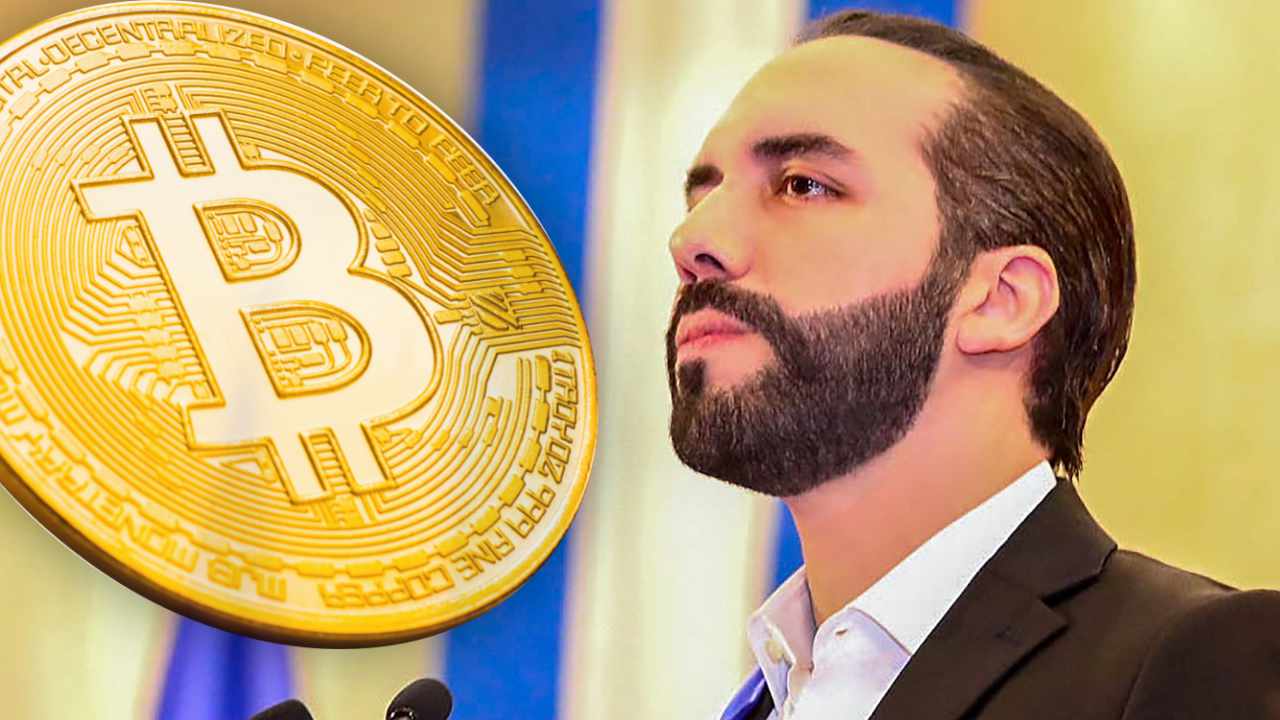
El Salvador President Nayib Bukele seems undeterred by the recent crypto upheaval, as he recently disclosed his commitment to buy one Bitcoin daily, starting from the 18th of November 2022.

“We are buying one #Bitcoin every day starting from tomorrow”, he Tweeted. His statement was seconded by Tron founder Justin Sun who also promised to do the same thing.

Justin tweeted “We echo @nayibukele’s initiative in buying #Bitcoin daily. We will also buy one #Bitcoin every day starting from tomorrow!”

Despite the recent bloodbath witnessed in the crypto sector, El Salvador’s President has disclosed his determination to continue with his Pro-Bitcoin strategy in the country.

Commenting on the recent FTX saga, he said, “FTX is the opposite of Bitcoin. Bitcoin’s protocol was created precisely to prevent Ponzi schemes, bank runs, Enron’s, World Com’s, Bernie Madoff’s, Sam Bankman-Fried’s… bailouts, and wealth reassignments. Some understand it, and some not yet. We’re still early”.

On September 7th, 2021, Nayib Bukele announced his plans to adopt Bitcoin as the country’s legal tender, making it the first country to do so.

This move didn’t sit well with International financial regulators such as the World Bank and the International Monetary Fund (IMF), which considered operating a separate financing deal with El Salvador, noting that the nation’s adoption of Bitcoin could make it vulnerable to money laundering and other illicit financial activities.

However, despite wide criticisms, El Salvadorian President disclosed that such a move was necessitated to bring more Salvadorans into the formal economy and also to free the indebted nation from the hold of the traditional global financial system.

So far, since the adoption of Bitcoin as its legal tender, the Central American country has accumulated about 2,381 BTC. With the recent unfriendly outcome in the crypto sector, reports reveal that the country is down big time on its investment.

After completing one year of Bitcoin adoption, El Salvador’s Bitcoin project seems cold as the market coin price has fallen more than one-fourth in the last one year.

Also, bitcoin’s price decline has increased El Salvador’s financial risk, making it more difficult for them to put together the money to service its 1.6 billion dollar debt that is due in 2023 and 2025.

A monetary economist at the Cato Institute, George Selgin had earlier warned following the country’s adoption of crypto as a legal tender that crypto’s volatility is one of many obstacles to applying it to the country’s national financial system.

He further stated that Bitcoin price swings could challenge the government’s ability to meet conversion needs, noting that if the trust fund is liquidated, taxpayers may be left holding the bag.

I voted YES for Twitter to Reinstate Donald Trump

1

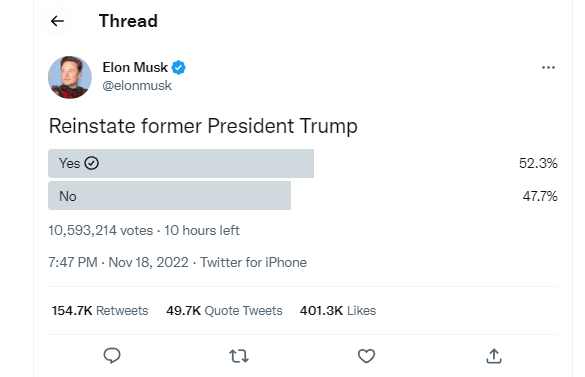
Good People, Donald Trump is not my type of leader, but on this one, I will vote YES for him to return to Twitter: “Elon Musk has opened a poll on Twitter asking users to decide whether former US president Donald Trump should be reinstated nearly two years after he was suspended from the social media platform”.  Indeed, I have got to vote YES for Trump, not typical; I voted against him for the presidency.

When he was kicked out, I wrote that it was not a good call.  Sure, he wrote many unfortunate things, but Trump was not just another Trump around the side of Brooklyn, he was the President of the United States.  Even though he could act like a baby with those name-calling tweets, I thought he deserved a little more accommodation, because he represented a nation and a people, with access to the nuclear arsenal codes.

Sure, you can see it differently – every human must be treated the same way. I can respectfully write that thinking that way is an illusion. When a simple and mere social media can kick out a leader of the free world, you are having a new order in the world, more dangerous than the one Trump was promulgating with his tweets.

Twitter was arrogant and intoxicated with power. When the queen of England died, I wrote that her death reminded me how my mother’s only surviving brother died in London, in the heat of the Biafran war – and till today, no one has clearly explained what happened to Augustine and some of his Igbo pals who perished. Some people (Nigerians) felt offended that I was bringing that up. In other words, they could have kicked me out here because they hated to be reminded of that past.  They did not care about my family pains; their focus was  just them!

Trump feels the media world is against him. Social media is the only way for him to fight back. He does not need to be kicked out. What Twitter needs to do is to moderate him. I voted YES and Elon Musk should bring him back. Of course, Trump might have moved on with his Truth Social. But he needs that opportunity again to make his case on Twitter while we ensure he does not escalate things to break social order.


My vote

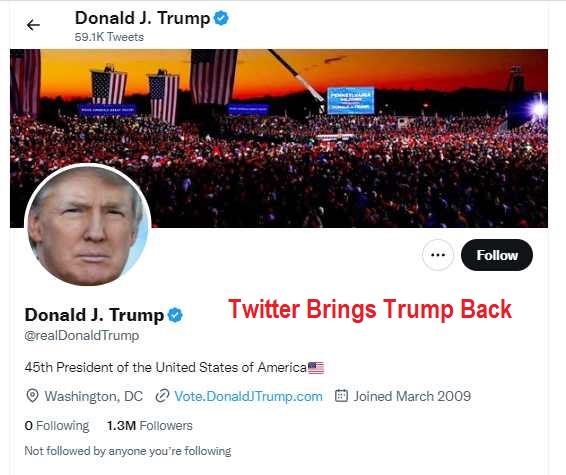
Updated: The decision has been made by Elon Musk: ‘Former US President Donald Trump’s Twitter account has been reinstated on the platform. The account, which Twitter banned following the January 6 attack on the Capitol, was restored after Twitter CEO Elon Musk posted a poll on Twitter on Friday night asking the platform’s users if Trump should be reinstated. “The people have spoken. Trump will be reinstated,” Twitter’s new owner Elon Musk tweeted Saturday night. “Vox Populi, Vox Dei,” Latin for “the voice of the people is the voice of God.’ Yet, I am not sure Trump will like what he will see: 1.4m followers instead of close to 100m he had pre-ban (it is possible depending on Twitter technology for that number to grow as the database is being restored). This is the right call even though I am not a Trump fan.

Comment on this: The poll on whether to bring back Trump or not was conducted on Twitter, and voted by Twitter users, what could be more democratic than that? Imagine eight or ten people making this kind of call for millions of people? If you believe that someone should not have a voice, then we will remove your own voice too, so that you can fully appreciate what it means not to have a voice.

Comment On Feed

Comment 1: I thought you gave up on Twitter, because you did not understand how it worked. What made you go back?

Comment 2:  I do not post. But that does not mean I do not read and use Twitter. My account was not deactivated. You can go to a stadium and watch games even though you have given up playing football.

Comment 3: Ndubuisi Prof with the mass staff walkouts as a backlash to the draconian management shift, and twitter offices locked… now we see a ditching of the platform by principle conscious users in support of the staff….
The real question is will there be enough twitter users around to make a meaningful contribution to the poll?

My Response: No one understands what Musk has in mind. According to him, Twitter is having the highest usage in its history. Daily, CNN, Bloomberg, LinkedIn, etc have something that has to do with Twitter as the major news. Simply, who does not know about Twitter now? I am beginning to think he is creating these “confusions” to cement this product in our minds.

BBC Focus on Africa – Scaling, Algorithmisation and Transformation

0

With the technology boom that began in the early 1980s, the narration of using technologies and surveying people’s behaviour on the basis of reporting events in Africa advanced. The production and distribution of the programme were significantly aided by the introduction of the Internet in 1983. Since that time until the present, the development of intelligent communication devices has improved the skill and capacity of the corporation’s staff in the areas of conducting interviews, recording, and broadcasting the programme using a hybrid approach. The programme is now being distributed using new media, such as social networking sites, podcasts, websites, and other digital media, rather than the redistribution services of the chosen radio channels.

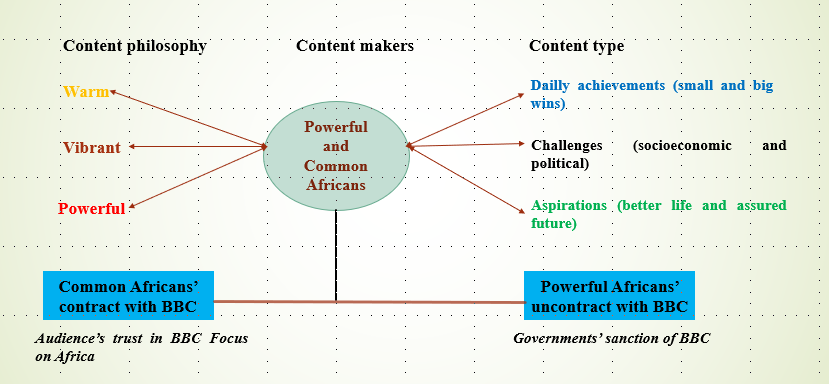
Exhibit 1: Knowledge and power relationship in the context of programme content

Beyond the distribution approach, the programme’s producer, the British Broadcasting Corporation, includes content that is relevant to Africans’ daily socioeconomic and political lives. Specifically, in line with Annette Markham’s position on invention as an apparatus, the BBC captures and secures African gestures, behaviours, opinions, or discourses as content and redistributes them through converged mass communication channels.

Shoshanna Zuboff previously proposed this viewpoint in her work on the age of surveillance capitalism, indicating that doing so requires a contract with ordinary Africans who believe that their continent has never been well managed by political elites and some business leaders. Meanwhile, the contract has not been written or negotiated because the BBC has only performed her expected surveillance and correlational roles in society.

While the contract with ordinary Africans may be driven by the aforementioned factors, the BBC’s use of concrete and emotional language that makes ordinary Africans cringe about their conditions demonstrates that the BBC does not have a contract with powerful Africans, particularly the political elites. When this occurs, ordinary Africans are more likely to trust the programme as well as the Corporation than publicly-owned media organizations. 

Essentially, in my opinion, using concrete and emotional words, as well as reinforcing existing socioeconomic and political issues on the continent, align with Annette Markham’s conditions of possibility and instrumentality for understanding how using an invention can establish knowledge and power relationships.

Zuboff’s contract and uncontract concepts with capitalists help in interrogating knowledge and power relationships that exist after the programme has been broadcast. Foucault helps to historicise the programme and how it is being used as an object to subjectify powerful African political elites, business leaders, and construct daily life experiences of ordinary people. Overall, both scholars’ arguments support the idea that neither humans nor machines have absolute authority. Where one authority ends, another authority begins there, and vice versa for where one authority begins.

Despite the identified issues in the programme production and dissemination. I believe that the producers merely need to tweak or modify the processes of producing and disseminating the programme’s content. It is critical that distribution channels or partners are not solely comprised of private organisations. Public media should also be examined and considered. This will go a long way toward lowering some African governments’ strong opinion of the programme as a natural object of the British government in making Africans perceive them as preventers of sustainable socioeconomic and political progress. 

However, the African governments’ sanction instrument remains unnecessary because having a programme that draws their attention to strategic needs and challenges of people is one of the sacrifices leaders must accept because of the importance of making various locations better for everyone to live and survive.

Historicization of BBC Focus on Africa Transformation

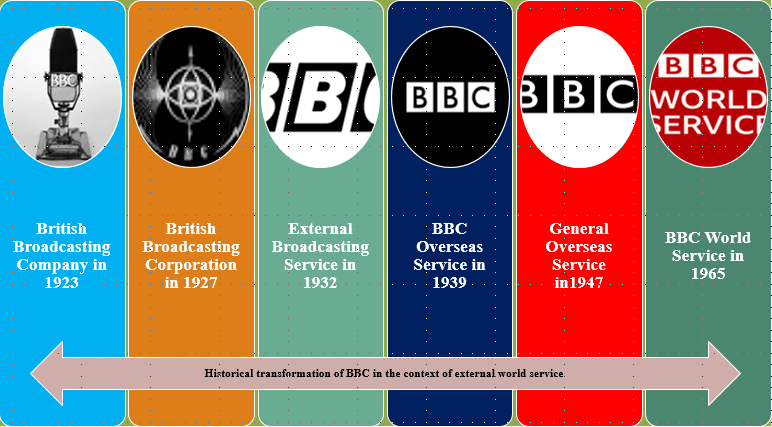
Understanding BBC Focus on Africa requires knowledge of the history of the British Broadcasting Corporation, which produces and distributes the programme to African audiences and others around the world. In 1923, the British Broadcasting Corporation was established as a public organisation with the word “company” in its name. In accordance with the new rules and regulations that governed its operations, it was renamed the British Broadcasting Corporation in 1927. The External Broadcasting Service was established in 1932 with the goal of reaching audiences outside of the United Kingdom. In 1939 and 1947, the service was renamed BBC Overseas Service and General Overseas Service, respectively. It was renamed the BBC World Service in 1965 and still goes by that name today.

Exhibit 1: Historicisation of BBC World Service Evolution

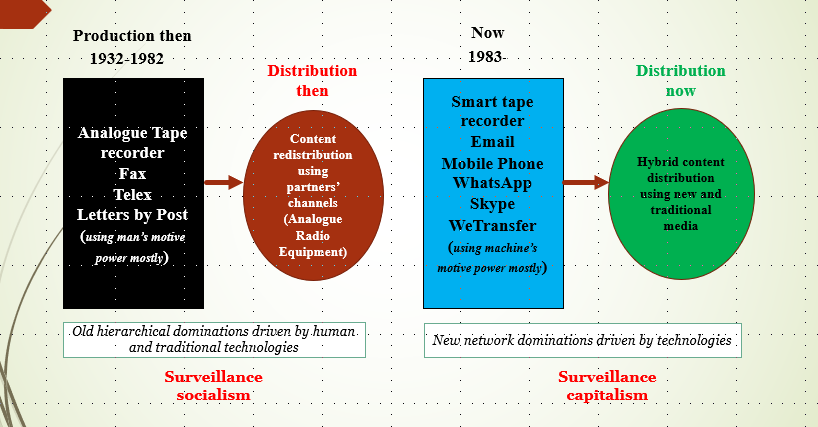
Between 1932 and 1982, the show was primarily produced using less advanced technologies such as tape recorders, fax machines, telex machines, and receiving letters from correspondents in various locations. During the use of these technologies, corporation personnel performed supportive activities aimed at improving the functionality of the technologies. The concept of listening to recorded voices in a tape recorder and transcribing them, for example, is better understood in the context of man’s motive power to machine power. This also applies to the use of faxes, telexes, and letters delivered by postmasters to the producers or the station.

As shown in Exhibit 2, during the early years of the programme, it was also clear that correspondents and presenters had to wait for the producers, who stood in for British Empire authority, before reporting on events under the guise of assisting Africans in holding their leaders responsible for socioeconomic and political difficulties. This, in my opinion, exemplifies surveillance socialism, which is comparable to Shoshanna Zuboff’s conception of the age of surveillance capitalism. When African correspondents and presenters had to wait for final approval before reporting on the events or activities they covered, surveillance socialism specifically emerged.

This indicates that the final means for creating the programme’s content belonged to the British producers. Zuboff explains how individuals and organisations with technological know-how can collect, aggregate, and market the digital traces or footprints of others. In addition, in my opinion, the British Empire and the journalists who covered and presented socioeconomic and political events from various regions defrauded Africans of their control and authority by capitalising on surveillance and correlation roles of the media.

Exhibit 2: Technological place in producing and distributing the programme in the age of surveillance sociocapitalism