DD
MM
YYYY

PAGES

DD
MM
YYYY

spot_img

PAGES

Home Blog Page 4718

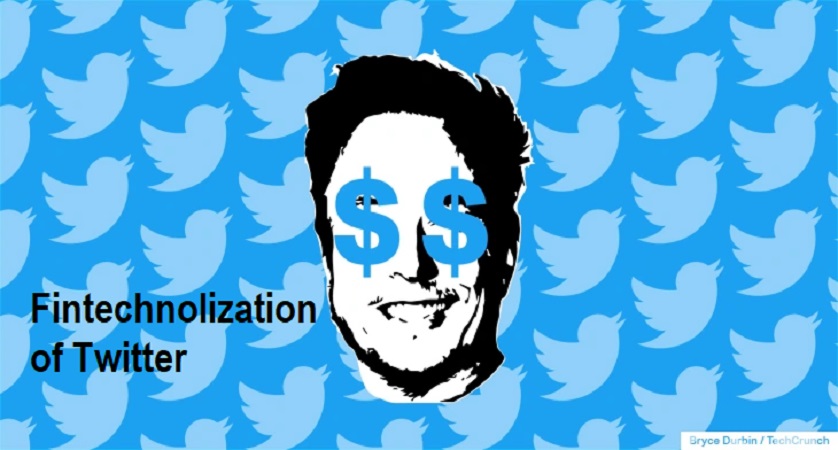
Elon Musk’s Fintechnolization of Twitter

0

Two years ago, I coined the word “fintechnolization” – a construct that every digital platform must have a mature state of offering a fintech solution. I had watched all great digital platforms on how they ended up providing one fintech solution or another, even when they began in an unrelated sector. 

Today, we are learning that Twitter has filed paperwork to become a payment company: “The social media firm has filed paperwork with the Treasury Department that would allow it to process payments”. This is the natural progression for Twitter because it is a digital platform.

Two weeks into his tenure as Twitter CEO, Elon Musk appears to have taken a step toward transforming the platform into an “everything” app. The social media firm has filed paperwork with the Treasury Department that would allow it to process payments, The New York Times reported Wednesday. Musk has long mused about remaking Twitter into an all-purpose app modeled on China’s WeChat — a platform that “includes instant messaging and mobile payments” and “is used by more than a billion people to find news, hail cabs and order food.” (LinkedIn News)

Like the village square, people come together to connect and share. Most times, the operating system is payment since value will be exchanged. There is nothing that makes a digital platform better than fintech because fintech delivers higher valuation multiples. If that enters into the DNA of Twitter, the $44 billion Musk paid may look very cheap in three years. Indeed, some activists will begin to say “why did the government allow him to buy it that cheap?”

But as Twitter goes through fintechnolization, watch what happens in Stripe and PayPal because if Twitter evolves to become like WeChat (the everyday super-app in China) a massive disintermediation may happen. To be the richest man in the world does not happen because of a UN resolution. It happens because you can do many things right and get them to compound. We’re living in the era of Elon of Africa.

Elon Musk detailed his vision for Twitter’s plan to enter the payments market during a livestreamed meeting with Twitter advertisers, hosted on Twitter Spaces on Wednesday. The new Twitter owner suggested that, in the future, users would be able to send money to others on the platform, extract their funds to authenticated bank accounts and, later, perhaps, be offered a high-yield money market account to encourage them to move their cash to Twitter.

The new remarks followed a report this morning by The New York Times which confirmed Twitter last week had filed registration paperwork that would allow it to process payments. The report cited Twitter’s filing with the Treasury Department’s Financial Crimes Enforcement Network (FinCEN), noting that a business would need to register before it could conduct money transfers, exchange currency or cash checks.

In today’s meeting, Musk explained how paid verification, which Twitter is rolling out now with its revamped Twitter Blue subscription, as well as support for a creator ecosystem, could pave the way for a payments system on its platform.

Find ways to sell bricks and blocks, packaged with good wishes

0

As a secondary school kid, I followed a kinsman to buy bricks for his house project in the village. When we got there, the owner of the brick molding business offered us “nzu” (white chalk-like clay) which is a symbol of peace, good fortune and hospitality in Igbo tradition. When new babies are born, villagers typically gather to share “nzu” because something good has happened.

As you rub nzu on your wrist and forehead, the man would wish your project the blessing which nzu symbolizes. He was a master salesman who out-competed other brick-makers, in a largely commoditized business. But look deeper, Mazi Ikea was not selling bricks; he was selling good wishes to young men who visited home to home building projects. Many chose his bricks (blocks) because of the wishes that followed them!

Nzu is a multiplier. When you rub one, people who see you will ask you where you got one. Many will expect you to tell them about a newborn. But here, you are telling them about the wishes of a brick-molder. The man has inserted himself in your mind, well after that transaction has completed.

The intangibles in business have won markets and territories. Find ways to sell bricks and blocks, packaged with good wishes.

Mark Zuckerberg’s Letter to Sacked 11,000 Meta Employees

0
Facebook founder and properties

On Wednesday, Facebook’s parent company Meta announced that it is laying off 11,000 employees, 13% of its workforce, in an unprecedented move to mitigate headwinds.

Facebook is the hardest hit among other tech companies walking through the effects of inflation and the anticipation of recession. The social media company has dropped out of the $1trillion league, falling below $300billion in market capitalization.

Meta’s ordeal has been largely attributed to factors ranging from the dominant rise of short-form video platform TikTok, Apple’s iOS privacy policy that offers users the choice to stop being tracked for targeted ads, and of course, Mark Zuckerberg – the company’s CEO pivot to metaverse.

These factors have pummeled Meta to plummeted revenue, forcing the once one of the largest revenue-generating companies in the world to fire thousands of workers. In his letter to the affected employees, Zuckerberg blamed the situation on his miscalculated belief that the pandemic-induced e-commerce surge will continue way after the pandemic. He said he had wrongly made the decision to increase investment based on that belief.

In the letter, Zuckerberg also outlined steps he plans to take to address the exigencies of the layoff. Read below:

“Today I’m sharing some of the most difficult changes we’ve made in Meta’s history. I’ve decided to reduce the size of our team by about 13% and let more than 11,000 of our talented employees go. We are also taking a number of additional steps to become a leaner and more efficient company by cutting discretionary spending and extending our hiring freeze through Q1.

I want to take accountability for these decisions and for how we got here. I know this is tough for everyone, and I’m especially sorry to those impacted.

How did we get here?

At the start of Covid, the world rapidly moved online and the surge of e-commerce led to outsized revenue growth. Many people predicted this would be a permanent acceleration that would continue even after the pandemic ended. I did too, so I made the decision to significantly increase our investments. Unfortunately, this did not play out the way I expected. Not only has online commerce returned to prior trends, but the macroeconomic downturn, increased competition, and ads signal loss have caused our revenue to be much lower than I’d expected. I got this wrong, and I take responsibility for that.

In this new environment, we need to become more capital efficient. We’ve shifted more of our resources onto a smaller number of high priority growth areas — like our AI discovery engine, our ads and business platforms, and our long-term vision for the metaverse. We’ve cut costs across our business, including scaling back budgets, reducing perks, and shrinking our real estate footprint. We’re restructuring teams to increase our efficiency. But these measures alone won’t bring our expenses in line with our revenue growth, so I’ve also made the hard decision to let people go

How will this work?

There is no good way to do a layoff, but we hope to get all the relevant information to you as quickly as possible and then do whatever we can to support you through this.

Everyone will get an email soon letting you know what this layoff means for you. After that, every affected employee will have the opportunity to speak with someone to get their questions answered and join information sessions.

Some of the details in the US include:

Severance. We will pay 16 weeks of base pay plus two additional weeks for every year of service, with no cap.

PTO. We’ll pay for all remaining PTO time.

RSU vesting. Everyone impacted will receive their November 15, 2022 vesting.

Health insurance. We’ll cover the cost of healthcare for people and their families for six months.

Career services. We’ll provide three months of career support with an external vendor, including early access to unpublished job leads.

Immigration support. I know this is especially difficult if you’re here on a visa. There’s a notice period before termination and some visa grace periods, which means everyone will have time to make plans and work through their immigration status. We have dedicated immigration specialists to help guide you based on what you and your family need.

Outside the US, support will be similar, and we’ll follow up soon with separate processes that take into account local employment laws.

We made the decision to remove access to most Meta systems for people leaving today given the amount of access to sensitive information. But we’re keeping email addresses active throughout the day so everyone can say farewell.

While we’re making reductions in every organization across both Family of Apps and Reality Labs, some teams will be affected more than others. Recruiting will be disproportionately affected since we’re planning to hire fewer people next year. We’re also restructuring our business teams more substantially. This is not a reflection of the great work these groups have done, but what we need going forward. The leaders of each group will schedule time to discuss what this means for your team over the next couple of days.

The teammates who will be leaving us are talented and passionate, and have made an important impact on our company and community. Each of you have helped make Meta a success, and I’m grateful for it. I’m sure you’ll go on to do great work at other places.

What other changes are we making?

I view layoffs as a last resort, so we decided to rein in other sources of cost before letting teammates go. Overall, this will add up to a meaningful cultural shift in how we operate. For example, as we shrink our real estate footprint, we’re transitioning to desk sharing for people who already spend most of their time outside the office. We’ll roll out more cost-cutting changes like this in the coming months.

We’re also extending our hiring freeze through Q1 with a small number of exceptions. I’m going to watch our business performance, operational efficiency, and other macroeconomic factors to determine whether and how much we should resume hiring at that point. This will give us the ability to control our cost structure in the event of a continued economic downturn. It will also put us on a path to achieve a more efficient cost structure than we outlined to investors recently.

I’m currently in the middle of a thorough review of our infrastructure spending. As we build our AI infrastructure, we’re focused on becoming even more efficient with our capacity. Our infrastructure will continue to be an important advantage for Meta, and I believe we can achieve this while spending less.

Fundamentally, we’re making all these changes for two reasons: our revenue outlook is lower than we expected at the beginning of this year, and we want to make sure we’re operating efficiently across both Family of Apps and Reality Labs.

How do we move forward?

This is a sad moment, and there’s no way around that. To those who are leaving, I want to thank you again for everything you’ve put into this place. We would not be where we are today without your hard work, and I’m grateful for your contributions.

To those who are staying, I know this is a difficult time for you too. Not only are we saying goodbye to people we’ve worked closely with, but many of you also feel uncertainty about the future. I want you to know that we’re making these decisions to make sure our future is strong.

I believe we are deeply underestimated as a company today. Billions of people use our services to connect, and our communities keep growing. Our core business is among the most profitable ever built with huge potential ahead. And we’re leading in developing the technology to define the future of social connection and the next computing platform. We do historically important work. I’m confident that if we work efficiently, we’ll come out of this downturn stronger and more resilient than ever.

We’ll share more on how we’ll operate as a streamlined organization to achieve our priorities in the weeks ahead. For now, I’ll say one more time how thankful I am to those of you who are leaving for everything you’ve done to advance our mission.

Mark”

Effective Board Participation & Management at Tekedia Mini-MBA

0

He needs no introduction because he is one of the pillars of the modern financial operating system in Africa, just as the blood and the spinal cord are to the central nervous system. Bolaji Akinboro, co-Founder of Africa’s pioneering fintech giant, Cellulant, will be in class tomorrow to teach “Effective Board Participation & Management “ at Tekedia Mini-MBA. He is now the co-founder of T??r??Net & chairman of Voriancorelli.

Yes, we want you to understand how to serve and be served in the Board! With his friend, Bolaji co-founded Cellulant in 2004 (yes, 2004), and today that company has served our continent. They faced bottlenecks, being pioneers in that nascent industry, but they triumphed. This is a very important course in Tekedia Institute. Zoom link in the Board.

Tekedia Institute >> learn from the best.

(Tekedia Practice, Tekedia Industries, Tekedia Startup Masterclass, etc, learners, request access from Admin).

The Principle of Probable Cause

0

The principle of probable cause has been enshrined in most Constitutions of the world as a way to curtail the excessiveness and abuse of powers of law enforcement agencies, especially, that of police officers.

It has been provided that the privacy of individuals should be respected at all times and their privacy can only be invaded on probable cause or legal reasonable justifications.

This principle is of the effect that it is illegal for a law enforcement agent to randomly stop and search any individual; his person or his property without a probable cause or reasonable justification, if not it will amount to harassment and invasion of privacy which is an infringement on the fundamental right to privacy of the citizen.

The phrase probable cause as a legal principle took its root in the constitution of the United States in the Fourth Amendment, and it provides thus; “The right of the people to be secure in their persons, houses, papers, and effects, against unreasonable searches and seizures, shall not be violated, and no Warrants shall issue, but upon probable cause, supported by Oath or affirmation, and particularly describing the place to be searched, and the persons or things to be seized”.

In Nigeria, the fundamental right to a citizen’s privacy is provided for in S.37 of the constitution of the federal republic of Nigeria, 1999, and it reads thus; The privacy of citizens, their homes, correspondence, telephone conversations, and telegraphic communications is hereby guaranteed and protected.

Subsequently, the Administration of the Criminal Justice Act, 2015 provides that before a search is to be conducted on a person or his property, the law enforcement agencies that intend to carry out this search must first apply to the court for a search warrant, telling the court that they have probable cause or reason to believe that the citizen or his property is involved in a crime hence why they need to conduct the search. If the law enforcement agency fails to successfully show that it has probable cause to carry out the search the court is at liberty to deny granting the search warrant.

Therefore, Probable cause as a legal principle simply means “the reasonable grounds to believe that a particular person has committed a crime or is about to commit a crime to justify conducting a search on him or on his property.

If a police officer cannot show that he has a reasonable ground to believe that a person has committed a crime or is about to commit a crime or is in possession of criminal elements thereby giving that police officer the probable cause or reasonable ground to conduct a search on that individual, that police have committed a crime of encroachment of the fundamental right to privacy of a citizen.