DD
MM
YYYY

PAGES

DD
MM
YYYY

spot_img

PAGES

Home Blog Page 474

GTCO Reports N601 Billion Pre-Tax Profit in H1 2025, Declares N1.00 Interim Dividend

0

Guaranty Trust Holding Company Plc (GTCO) has published its audited half-year results for the period ended June 30, 2025, posting a pre-tax profit of N601 billion, down significantly from the N1 trillion recorded in H1 2024.

Profit after tax came in at N449.01 billion, less than half of the N905.57 billion earned in the corresponding period last year.

The Board nevertheless approved an interim dividend of N1.00 per share, unchanged from H1 2024. Payment will go to shareholders on record as of October 7, 2025.

Earnings Profile: Shift Toward Securities

GTCO’s gross earnings remained above N1 trillion despite the fall in profits, recording N1.073 trillion in H1 2025. The main driver was interest income, which jumped 71% year-on-year to N812.36 billion, expanding its share of gross earnings to 76%, compared with 44% in H1 2024.

Within that, interest income from securities surged 44% to N375 billion, overtaking income from loans and advances, which grew 22% to N299.63 billion. Securities now account for 35% of gross earnings, compared with 27% from loans, a striking shift for a group historically seen as a loan-driven institution.

Geographically, N256 billion of interest income was earned outside Nigeria, highlighting the growing relevance of GTCO’s international operations to its overall performance.

Cost Structure and Margins

Interest expenses rose sharply by 43% year-on-year to N154 billion, largely from customer deposits, which accounted for N147 billion. Yet costs amounted to just 18% of total interest income, preserving a strong spread. This helped push net interest income to N632.24 billion, up nearly 29% from last year.

Impairment charges climbed to N54.97 billion from N47.41 billion a year earlier. The bulk came from Stage 2 loans (N58.89 billion), suggesting increased caution over credits showing early signs of stress. A modest N4.27 billion write-back on Stage 3 loans softened the impact. After provisions, net interest income rose nearly 30% to N577.67 billion, evidence of resilient risk-adjusted performance.

Non-Interest Income

GTCO generated N151.46 billion in fee and commission income, up 33% year-on-year, though with uneven contributions:

  • Electronic banking income fell to N28.61 billion (down 12%).
  • Commission on touch points surged 617% to N24.78 billion.
  • Account maintenance fees climbed 12% to N17.58 billion.

This indicates that while digital channel fees came under pressure, traditional and point-of-service banking delivered a meaningful uplift.

Balance Sheet Strength

Customer deposits grew 19% to N11.878 trillion, accounting for 71% of total assets, which expanded 13% to N16.692 trillion. Loans and advances to customers increased 21% to N3.358 trillion, showing the bank is still expanding credit selectively. Cash and cash equivalents stood at N4.786 trillion, broadly stable.

GTCO shares have gained 63.2% year-to-date, closing at N90 per share on September 23, 2025. Investors appear focused on the group’s strong margins, balance sheet expansion, and steady dividend, rather than the sharp year-on-year earnings decline.

Analyst Outlook: What the Numbers Mean

GTCO’s results reveal a strategic pivot. The heavier reliance on securities income indicates the group may be prioritizing capital preservation and predictable yields over aggressive loan expansion amid economic uncertainties. Securities, often less risky than lending, have cushioned profitability in a challenging credit environment.

The shift, however, raises two questions. First, can GTCO maintain loan book growth at 20.5% without allowing impairment charges to escalate? The increase in Stage 2 provisions suggests early caution signs, though overall credit quality remains contained. Second, can the bank continue to generate above-market spreads when interest costs are rising at over 40% year-on-year?

On the positive side, GTCO’s N1.00 interim dividend underscores confidence in its capital buffers and future cash flow, despite lower profits. This could be interpreted as a bid to reassure investors during an earnings downcycle.

Comparatively, the group remains one of the best-capitalized banks in Nigeria, with its N90 per share valuation supported by robust asset growth and fee-based income expansion. Against peers like Zenith and Access, GTCO’s strategy of tilting toward securities and international operations could reduce earnings volatility, though at the cost of lower headline profits compared to the extraordinary H1 2024.

However, GTCO’s H1 2025 results paint a picture of a bank adapting to tighter economic and credit conditions. Profitability may have fallen by more than half, but the underlying performance — strong net interest income, disciplined cost management, stable impairments, and double-digit balance sheet growth — suggests the group remains resilient.

For investors, the key watchpoints over the next six months will be whether GTCO can sustain loan growth without asset quality deterioration, manage rising funding costs, and continue balancing securities income with core lending. If it succeeds, the stock’s strong rally could find further support, even as the broader sector grapples with macroeconomic headwinds.

CZ’s YZi Labs Considering Opening to Public Investors Amid OG Airdrop Buzz

0

Changpeng “CZ” Zhao’s $10 billion investment firm, YZi Labs formerly Binance Labs, is exploring the possibility of accepting external capital from outside investors and potentially converting into a public-facing investment fund.

This shift would mark a departure from its current family office structure, which primarily manages CZ’s personal fortune alongside funds from early Binance executives like co-founder Yi He.

The move comes amid strong investor interest and a more favorable U.S. regulatory environment under the Trump administration, including outreach from SEC Chair Paul Atkins, who requested a private demo of YZi Labs’ portfolio companies after attending their NYSE event.

Approximately 70% of YZi Labs’ holdings are in digital assets, with investments in over 230 crypto and Web3 projects, including Aptos and Polygon. The firm is expanding into AI, biotech, and robotics, building dedicated teams in these areas.

In 2022, YZi Labs briefly accepted $300 million from external backers but returned most of it to maintain independence. Now, with demand rising, head Ella Zhang indicated the firm is in early discussions but open to evolving into an externally focused vehicle for broader access.

Transitioning to a public fund could introduce stricter compliance, enhanced transparency, and diversified exposure to blockchain innovations, similar to Grayscale’s Bitcoin Trust. However, it might also limit agility in high-risk investments.

OG Labs Airdrop Goes Live And Creating Buzz on CT

The 0G Foundation behind OG Labs, a decentralized AI operating system on a modular Layer 1 blockchain has officially launched its community airdrop for the $OG token, rewarding early contributors ahead of the mainnet and token generation event (TGE).

The airdrop emphasizes decentralization by allocating power to active users, with 56% of the 1 billion total supply reserved for the community including 13% specifically for OG Labs rewards, with 20% unlocking at TGE and the rest vested over 48 months.

Selected Discord role holders, OG Kaito yappers who engaged users on the KaitoAI platform. Holders of One Gravity NFTs. Completers of social quests on platforms like Intract and Galxe are qualified for the airdrop.

Surprisingly, testnet participants are not eligible for this round—rewards for them are expected in future updates tied to mainnet activity. The project has an $88 million Ecosystem Growth Program for builders, including grants and bounties.

$OG is already listed on major exchanges like Binance, Bitget, Gate.io, MEXC, KuCoin, and BingX. Allowing external capital could democratize access to YZi Labs’ portfolio, which spans crypto, AI, biotech, and robotics. This could attract institutional and retail investors seeking exposure to high-growth sectors, particularly Web3 and blockchain.

A public-facing fund might resemble models like Grayscale’s Bitcoin Trust, offering diversified crypto exposure with regulatory oversight, potentially boosting mainstream adoption. Transitioning from a family office to a public fund would likely require stricter compliance with U.S. and global regulations, especially under the SEC’s evolving crypto policies.

This could enhance transparency but increase operational costs and limit high-risk investments. Positive regulatory signals suggest a friendlier environment, potentially easing YZi Labs’ pivot and encouraging other crypto firms to follow.

Accepting outside capital could pressure YZi Labs to prioritize stable, high-return assets over speculative bets, potentially diluting its agility in volatile markets like crypto. Expansion into AI and biotech signals diversification, reducing reliance on digital assets and positioning YZi Labs as a broader tech investor.

Increased investor interest could drive up valuations of YZi Labs’ portfolio companies (e.g., Aptos, Polygon), boosting the broader crypto market. External investors may demand more control or quicker returns, clashing with CZ’s long-term vision.

Implications of OG Labs Airdrop Going Live

Allocating 56% of $OG’s supply to the community with 13% for rewards reinforces OG Labs’ decentralized ethos, incentivizing active ccontributors like Discord users, NFT holders over passive speculators.

Excluding testnet users from this round prioritizes real engagement, potentially setting a precedent for future airdrops to focus on quality contributions. The $88 million Ecosystem Growth Program signals long-term commitment to developers, potentially making OG Labs a hub for decentralized AI innovation.

The airdrop promotes OG Labs’ modular Layer 1 blockchain for AI, which could accelerate adoption of on-chain AI solutions. Success here might validate scalable Web3 infrastructure for AI workloads.

Excluding testnet users risks alienating early adopters, though future rewards may mitigate this. The airdrop aligns with a trend of community-driven token distributions reinforcing decentralization as a core Web3 value.

Success could draw more attention to AI-blockchain convergence, spurring competition and innovation in this niche. Both developments signal growing maturity in the crypto ecosystem: YZi Labs’ potential public fund reflects institutionalization, while OG Labs’ airdrop emphasizes community-driven decentralization.

Tekedia AI Technical Lab Program Will Provide You VPS Server Access for Your AI Agents

0

Good People, here is an update on Tekedia AI Technical lab program. If you’re joining us, don’t worry about the typical hassles of hosting and setup. We’ve already taken care of all that. We’ve purchased a robust VPS server and have partitioned it so that every learner will have their own dedicated space to experiment and build AI agents. While you can certainly bring your own setup, it’s not a requirement. We’ve got you covered.

For those who need a domain name, we will assist you. If you already have one, simply come to class with access to your nameserver settings, and together we’ll handle the rest.

Our program begins on October 4, 2025, and we are thrilled to have dozens of professionals joining us. Just as having a website is now a basic expectation for any serious company, the future demands that every great company has its own AI agents. At Tekedia Institute, our mission is to help you lead your organization into that future. We began as a business school and are now expanding to technical courses.

And remember, no coding is required, and there’s no need to stress over calculus. We’ve built the foundational components and primitives; your job is simply to connect them. If you haven’t yet registered, secure your spot here .

Shiba Inu (SHIB) and Dogecoin (DOGE) Snubbed as Investors Spot Meme Coin With 17827% Growth Prospects

0

Investors are shifting attention from Shiba Inu (SHIB) and Dogecoin (DOGE) to the new meme token, Little Pepe, where early participants have already enjoyed substantial gains. The token’s price is on a strong upward trend, with analysts projecting potential growth of over 17,827%. With presale prices increasing stage by stage and multiple giveaways boosting engagement, Little Pepe is establishing itself as a utility-driven meme coin, while investors are actively securing tokens to avoid missing out on future gains.

Shiba Inu Price Holds Support Amid Resistance

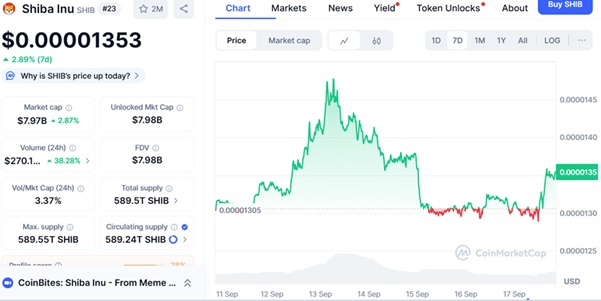
Shiba Inu (SHIB) has shown steady movement over the past week. The token trades at $0.00001353, up 2.89% in seven days. Market data shows a capitalization of $7.97 billion, with 589.24 trillion SHIB already circulating out of its maximum supply. SHIB peaked at nearly $0.0000145 in the second week of September before retreating. It then settled between $0.0000131 and $0.0000133 and then rose to $0.0000135. The $0.0000130 level remains strong support, while $0.0000145 acts as key resistance.

SHIB depends on the adoption drivers, including Shibarium, DeFi integrations, and token burns, to support long-term growth. Short-term movements are still linked to the larger market tendencies, and any further gains may still face resistance at around $0.0000145.

Dogecoin Maintains Momentum Despite Volatility

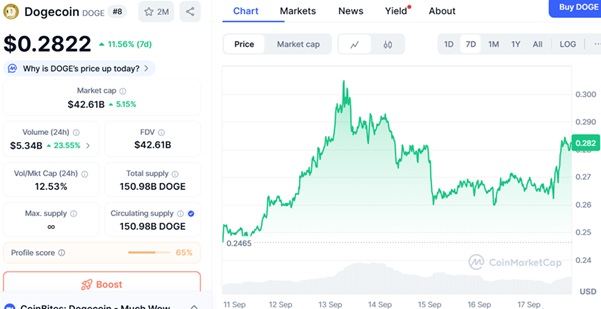
Dogecoin (DOGE) also posted strong gains this week. It is trading at $0.2822, marking an 11.56% rise over seven days. The token reached a peak above $0.30 on September 13 before falling back to a low near $0.26. Buyers later stepped in, driving the price above $0.28 again.

DOGE holds a market capitalization of $42.61 billion, which supports its first U.S.-listed ETFs. The product will allow spot exposure to Dogecoin, making long-term growth reliant on adoption and utility.  Analysts point to the strong support level of $0.26 and the nearest resistance of $0.30. Sustained trading at higher than $0.30 might lead to the potential surge to $0.35, but further volatility is likely to occur because Dogecoin has no real utility.

Little Pepe Presale Captures Market Attention

While SHIB and DOGE retain strong communities, investor attention has shifted to Little Pepe (LILPEPE). The project has its own Layer-2 blockchain, which makes it a meme coin and an infrastructure protocol. Unlike most meme tokens, LILPEPE is an EVM-compatible meme coin with practical utility that integrates scalability, “0% buy and sell tax,” “anti-sniper bot,” and “lightning-fast fees.”

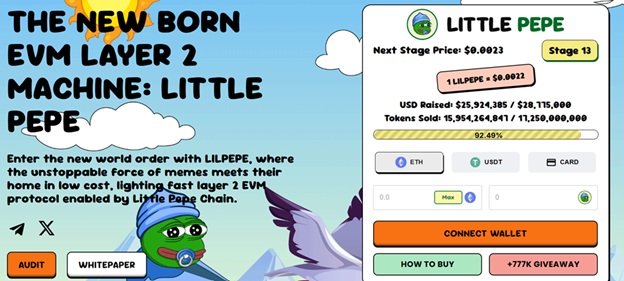
LILPEPE’s early investors have already seen staged pricing benefits. The LILPEPE presale at Stage 13 has raised $25.92 million of its $28.77 million target. At the current stage, tokens sell for $0.0022, with the next stage price set to increase to $0.0023. More than 15.95 billion tokens have already been sold, leaving only about 1.3 billion tokens before the next price rise.

The tokenomics of Little Pepe depict a fixed supply of 100 billion tokens. Distribution will consist of 26.5% to the presale participants, 13.5% to the staking rewards, 10% to the liquidity, 10% to the exchange listing, 30% to the chain reserves, and 10% to marketing. However, no allocation was reserved for team wallets, which emphasizes a community-first strategy.

More importantly, the team runs a $777,000 presale giveaway, where 10 winners will get $77,000 worth of tokens each, with a $100 minimum contribution requirement. A separate Mega Giveaway selects big and random buyers from Stages 12–17 and offers 15+ ETH prizes. Project posts describe these as engagement campaigns that reward presale participation and broaden reach.

Meme Coins Growth Prospects and Market Outlook

The design of Layer-2 by Little Pepe provides fast and cheap transactions, addressing Ethereum’s long-standing concerns with gas fees and scalability. Other opportunities in the project are staking, governance via a DAO, NFT integration and a new meme token launchpad. All these aspects make it more than a speculative meme coin.

Market estimates point to the token’s potential growth, and presale investors are eyeing returns of over 17,827% if adoption momentum continues and exchange listing occurs. Planned listings on decentralized and centralized platforms will be crucial in establishing liquidity and broader access.

In contrast, SHIB and DOGE continue to rely heavily on community momentum and external adoption narratives. As investors search for higher growth potential, Little Pepe stands out by merging meme appeal with blockchain utility.


For More Details About Little PEPE, Visit The Below Link:

Website: https://littlepepe.com

Bitcoin Price Faces Key Test as Bulls Struggle to Hold $112K Amid Market Shake-Up

0

Bitcoin’s price extended losses after slipping below the critical $114,000 level. Bears took control and pushed the asset toward a key support zone at $110,500.

The recent drop in the crypto asset price follows the largest single-day liquidation of long positions this year, signaling growing uncertainty in the market.

The sell-off accelerated as BTC has continued to plunge, now trading at $112,468 as of the time of writing this report. If Bitcoin fails to close above $114,000, a renewed decline toward  $111,750 could occur, with deeper support lying near $110,500.

Massive Liquidations Shake the Market

The crypto market recently experienced a sharp sell-off, with $1.62 billion in long positions liquidated in a single day. According to Glassnode, Bitcoin may now be entering a “late-cycle phase,” historically seen before major market tops.

Data shows that despite bulls defending the $112,000 level, sellers are dominating the market. Heatmaps reveal significant bid liquidity near $107,000, suggesting a potential deeper correction if current supports fail.

Glassnode’s on-chain data highlights similarities between Bitcoin’s current cycle and previous runs (2015–2018 and 2018–2022).

Key observations include: BTC has dropped 9% since reaching its all-time high (ATH) of $124,000. Realized cap growth has slowed to 6% per month, down from 13% during the $100,000 breakout. Profit-taking volumes remain weaker than in past cycle peaks at $70K, $100K, and $122K.

Analyst Michaël van de Poppe identified $111,900 – $113,000 as a short-term demand zone. “If Bitcoin can hold this range, we could see a push toward $114,700 – $116,800, with $115,000 as the key resistance,” he noted. If BTC fails to maintain this area, the next major support lies between $106,000 – $108,000, with a deeper “max buy zone” at $103,000.

Retail Optimism vs. Market Reality

The recent 8% correction has sparked “buy the dip” chatter on social media, reaching its highest level in 25 days.

However, Santiment warns that this surge in optimism may precede further downside, as markets often move opposite to crowd sentiment.

While short-term holders (STHs) have aggressively accumulated 159,098 BTC, offsetting sales from long-term holders, analysts caution against expecting an immediate rebound. Retail traders’ eagerness to call a bottom has historically signaled further market shakeouts before a sustained recovery.

Meanwhile, large investors continue to quietly build their positions. Wallets holding between 10 and 10,000 BTC have accumulated a total of 56,372 coins since August 27. This steady accumulation by big holders often provides a floor for prices, even when retail sentiment wavers.

Data from the Bitcoin Exchange Liquidation Map shows that if $106,127 is breached by the BTC, approximately $12.45 billion worth of long positions will get liquidated, including $44.9 million on Binance, $38.9 million on OKX, and $27.3 million on Bybit.

Bitcoin and Ethereum ETFs Bleed $244 Million

On September 23, both spot Bitcoin and Ethereum ETFs recorded a second straight day of net outflows. Report shows Bitcoin ETFs lost $103.61 million, while Ethereum ETFs saw outflows of $140.75 million.

Bitcoin ETF Breakdown 

Bitcoin ETFs posted a total outflow of $103.61 million. Fidelity’s FBTC led withdrawals at $75.56 million. Ark & 21Shares’ ARKB followed with $27.85 million, and Bitwise’s BITB shed $12.76 million.

Only two products managed to attract inflows. Invesco’s BTCO added $10.02 million, while BlackRock’s IBIT brought in $2.54 million.

Trading activity in Bitcoin ETFs reached $3.16 billion, with total net assets of $147.17 billion, representing about 6.6% of Bitcoin’s market cap. This reflected a decline from the prior day.

Ethereum ETF Breakdown 

Ethereum ETFs recorded heavier outflows at $140.75 million. Fidelity’s FETH led selling pressure with $63.40 million. Grayscale’s ETH fund withdrew $36.37 million, followed by Bitwise’s ETHW at $23.88 million and Grayscale’s ETHE at $17.10 million.

None of the nine Ethereum ETFs reported inflows. Total trading volume dropped to $1.61 billion, while net assets fell to $27.48 billion, equal to 5.45% of Ethereum’s market cap.

Outlook

For Bitcoin to regain momentum, bulls must defend the $112,000 level and push prices above $114,000. Failure to do so could lead to a retest of $107,000, with the risk of even deeper declines if selling pressure intensifies.

As BTC’s cycle shows late-stage characteristics, remain cautious, focusing on key support and resistance zones while preparing for heightened volatility in the weeks ahead.