Join us at Tekedia Mini-MBA or any Tekedia Institute program (excluding advanced diploma programs), and have access to Tekedia Live. Every Saturday at 7-8.30pm WAT, I anchor an amazing business show. I just made public last week’s program titled “Protecting and Growing Wealth During the Era of Inflation and Currency Deterioration”.
We are revamping operating models in Tekedia Institute and many new products are coming. We want this to become a living school. We have all our programs here.
This Saturday on the show, the topic is “Investment Options and Models for Early, Mid and Late Careers”.
I realized that it was being delivered with the usual capacity to be compelling, and with dexterity of language that we have become so accustomed to from an individual we simply call ‘Prof’.
When we look at the piece, we see that it is not an original idea. It is basically a post on time management, and many people have produced work on time management from short quirky ditties all the way back to the Time Study work of Frederick Winslow Taylor and the Motion Study work of Frank and Lillian Gilbreth, which together yielded the concepts of ‘Time and Motion Study’
But when I see ‘The Prof’ wading into a topic that is ‘Red Ocean’, I know this must be something that is close to home, and he thinks – regardless of who has already spoken, it needs revisiting, because not enough people are listening.
I will give you the opening salvo of his post:
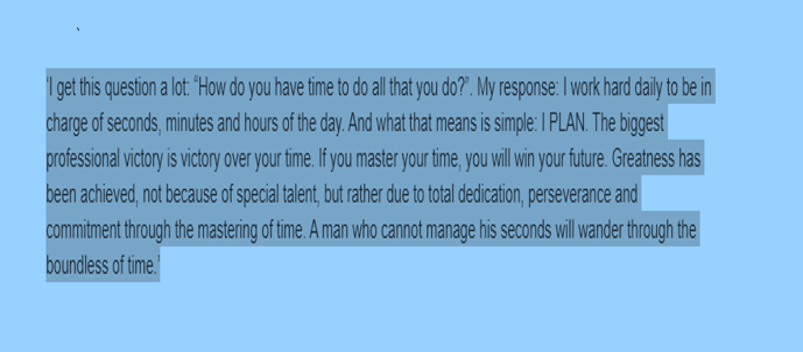
‘I work hard daily to be in charge of seconds, minutes and hours of the day’ -BOOM
‘The biggest professional victory is victory over your time.’ – BOOM
‘If you master your time, you will win your future.’ – BOOM
‘A man who cannot manage his seconds will wander through the boundless of time.’ – BOOM.
Now let me leave that there for a moment, we will come back.
Have you ever visited a site and found it didn’t tell the whole story on one page? You are only barely introduced to the topic and there is a NEXT button that needs clicking…
Dragged out stories over pages and pages of nothingness that go NEXT, NEXT NEXT, are so annoying. Counterproductive too, as the reader will subliminally associate the feeling of annoyance with product advertisement in close proximity.
You click next, and does the story finish there? No! You find that the information given is actually very little and words have been deliberately without substance to create suspense. As you click NEXT, and then NEXT again, you begin to get increasingly more frustrated as the pages continue. Still, you feel you have already invested in the situation, so you continue, each time, hoping the next page will be the final one, to reveal all.
Why do they do this? Well, they get the visitor to scroll through as many pages as possible to get click-through for advertisement revenue. These days of course, I know the engagement model when I see it. I haven’t visited a site using this ploy for several years.
Why? Because they steal your time.
Inefficient display of information that fails to maximise space and serially makes paragraphs from 3 lines and less, introduces scrolling or screen view changes, steals your followers time.
Now there is a new phenomenon on LinkedIn, which is called Carousel. I don’t read a post if it uses the carousel feature. Why?
Because it is inefficient in how it presents information. It gives a very limited amount of information on one screen, and then the reader needs to click to get to a new screen within the carousel. Eyes work faster than fingers do. This is like the difference between having a solid state hard drive (SSD) in a phone, laptop, tablet or PC instead of the older mechanical drives.
Just that one change makes the performance of the device much, much faster.
The LinkedIn Carousel feature works well for displaying a product list but isn’t very time efficient with telling stories.
As content creators, we can help readers to be more efficient by understanding that eyes work faster than hands. This means eliminating as far as possible, the need for the reader to click or scroll.
Lately, I’ve noticed a disturbing trend in posts in LinkedIn. Content creators are treating every line they write as if it deserves its own paragraph. Sometimes they even separate a line with two empty lines. This has the same effect of the web pages with serial need to click ‘NEXT’ and the unnecessary clicking or side swiping for the carrousel feature.
This is STEALING people’s time.
Every line in a post cannot be a BOOM line. When the construct is that every line is a BOOM line, there is no BOOM line! This is just inefficiency introducing more scrolling… increasing the ratio of finger work to eye-work and slowing the reader down. It isn’t about the overall length of your article necessarily. Long and short articles have value in context. It is about making efficient use of space and punching the maximum amount of information into the least amount of space, to reduce clicking, scrolling, and eye travel.
A writing style which gives every line its own paragraph wastes peoples time and yours. All BOOM is NO BOOM
As we look back at Prof. Ekekwe’s piece, we see the huge humility within which four genuine BOOM lines have not even been put on a pedestal to stand alone. Meanwhile other creators are giving BOOM status to lines which are, at best, pedestrian.
I can look at a 20 line paragraph of a ‘Prof’ piece and absorb it in 2 seconds without scrolling or even moving my eye focus.
In the piece, through good use of space and condensing his presentation, he is putting readers back in charge of their time, so they can onboard more knowledge for less of life’s premium currency.
Avoid content delivery strategies which deliberately seek to slow down the pace at which the reader/visitor can absorb information. If you see yourself as someone that can create ‘great content’ then don’t forget to put your readership back in charge of their ‘seconds’
Because if you don’t, they don’t want to be that victim of time Prof Ekekwe warns of. The one who for failure to manage seconds, ‘will wander through the boundless of time.’
Perhaps their last click will be for the unfollow button for your profile!
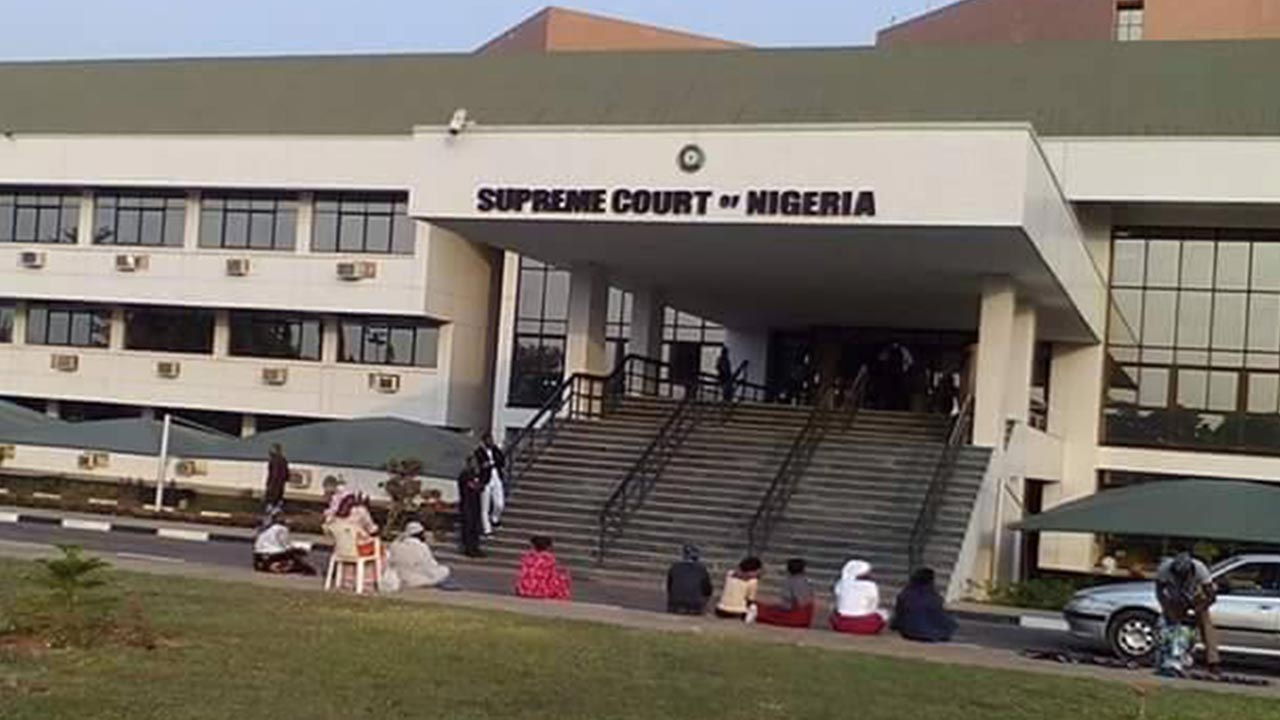
A party in a lawsuit must be notified that he or she has been summoned to the court and the process whereby the party is made aware of the matter is known as service.
When a party is not put on notice that he has been summoned to the court so that he can come to defend himself from accusations made against him, the party is denied his fundamental right to a fair hearing as constitutionally provided for in S. 36 of the Constitution of the federal republic of Nigeria thereby denying the party his constitutional provided fundamental human rights.
Parties must as a matter of law and practice provided in the rules of court ensure that the opposing party does not only receive the court process but acknowledges the receipt of the service of process on him thereby satisfying that he has been properly served.
When parties to the suit have not been properly served, it robs the court of its jurisdiction to entertain the matter.
The rules of procedures of various courts in Nigeria prescribe modes of service of court processes on a defendant/ respondent but the general rule is that parties to a suit must be served personally, ie Personal service which is to be effected by handing a copy of the summons to the defendant in person, but if personal service cannot be effected, substituted service can be effected on the defendant by pasting the process at the doorstep of the respondent or pasting it at his place of work or by pasting the summons in a conspicuous location that it will be presumed that the party will see it or by effecting the service on a third party who has a close relationship with the defendant or by electronically sending the process through the defendant’s email, WhatsApp or any other means.
Service of process of a civil suit originating from the federal high court is provided for by Order 6 of the Federal High Court (Civil Procedure) Rules 2019.
According to Order 6 rule 2 of the Federal High Court (Civil Procedure) Rule, 2019, originating processes are to be personally served on the Defendants. However, Rule 5 thereof provides that where personal service cannot be effected, substituted service of such Originating Processes shall be effected on the Defendant.
When a recipient of a process is a person who is in prison custody, the prisoner is to be served by sending the process to the superintendent or the head of the prison where the prisoner is detained.
When the person who is to be served is a person of unsound mind or mentally unstable person, the process is to be served on the superintendent or head of the asylum where the lunatic is kept.
When a person who is to be served the process is an infant or underaged, the process is served on the infant’s parents, his guardian, or the person on call for the infant.
Service of the originating process is carried out by the court Sheriff or Bailiff of the court but in some special circumstances, the judge may appoint a person to serve the court process and such person is called a process server.
Nigerian politics does not inspire. So the nation does not have a flood management strategy? People, how have they been spending the billions of Naira mapped for ecological funds? In a country with a rainforest region with erosion problems everywhere, one would have expected that as part of spending that money, the nation would have developed a flood management strategy as a component of a comprehensive playbook on managing erosion.
When I was in FUTO, there was a Center for Erosion Studies staffed by German experts. It was located at the back of the old SEET Building, sharing a building with Works & Maintenance. After one of those major strikes, upon return, the Center had been closed: the foreign experts had gone, possibly with their intervention funds and knowledge exchanges.
The minister has 90 days to do this; I hope that ASUU can work with him: “As Nigeria grapples with devastating floods that have ravaged homes and means of livelihood across the country, President Muhammadu Buhari has ordered the Minister of Water Resources, Suleiman Adamu, to develop a preventive plan within 90 days.”
As that happens, I call my alma mater, FUTO, to start an option under Environmental Engineering/Civil Engineering with Climate Change Management Engineering. This option will prepare young people with capabilities to design, develop and implement necessary climate change mitigation protocols in Nigeria and beyond. We’re at that moment now in the world – and FUTO can pioneer it.
And Mr Adamu can allocate funds to set up this type of program in selected schools as part of his plan. His plan must have a private sector incentivisation roadmap where building resilience to floods is designed to be good for business.
A statement issued by the presidential spokesperson, Garba Shehu, on Monday, said Adamu has been directed to lead and coordinate with the Ministries of Environment and Transportation as well as State Governments to develop a comprehensive plan of action for preventing flood disaster in the country.
Shehu in the statement said the President’s directive was conveyed to the Minister in a letter signed by his Chief of Staff, Prof Ibrahim Gambari. The statement said that Buhari regularly received updates on the flooding situation in the country, and has restated his commitment towards addressing the challenges caused by the disaster in the country.
As Nigeria grapples with devastating floods that have ravaged homes and means of livelihood across the country, President Muhammadu Buhari has ordered the Minister of Water Resources, Suleiman Adamu, to develop a preventive plan within 90 days.
A statement issued by the presidential spokesperson, Garba Shehu, on Monday, said Adamu has been directed to lead and coordinate with the Ministries of Environment and Transportation as well as State Governments to develop a comprehensive plan of action for preventing flood disaster in the country.
Shehu in the statement said the President’s directive was conveyed to the Minister in a letter signed by his Chief of Staff, Prof Ibrahim Gambari. The statement said that Buhari regularly received updates on the flooding situation in the country, and has restated his commitment towards addressing the challenges caused by the disaster in the country.
The flooding recorded in Nigeria in the past few weeks has been unprecedented, requiring an adequate pre-planned approach to mitigate it. So far, more than 600 people have lost their lives while about 1.4 million have been displaced across the country.
About 31 states are said to have been affected by flooding recently. The most affected states, where the deaths are recorded are: Anambra, Bayelsa, Delta, Kebbi, Kogi and Jigawa.
According to the Minister of Humanitarian Affairs, Disaster Management and Social Development, Sadiya Umar Farouq, about 82,053 houses had been totally decimated, 2,504,095,000 persons affected, while 332,327 hectares of land were completely damaged.
Besides death and displacement, the flooding is expected to unleash severe economic hardship on Nigerians in the near future. With major farms in the country submerged, food inflation is likely going to see further uptick even as the waters recede. Last week, Nigerian Liquefied Natural Gas (NLNG)declared force majeure due to issues emanating from the flooding that may impact its operation.
The floods have been attributed to the release of water from Lagdo dam in Cameroon. In September, Nigeria Hydrological Service Agency (NIHSA) had tasked the federal, state and local governments to step up efforts to avert the disaster that will result from the release of the dam’s water.
However, Nigeria was apparently not prepared for flood prevention despite trillions of naira the country has received in ecological funds. The National Emergency Management Agency (NEMA), the agency saddled with the responsibility of disaster management and prevention since 1999, has been insignificant in the face of the floods.
Thus, Buhari’s “90 days” directive to Adamu, who had last week said the flooding is from God, has been described as a display of the government’s unpreparedness in the face of disaster.