DD
MM
YYYY

PAGES

DD
MM
YYYY

spot_img

PAGES

Home Blog Page 4802

The Global Redesign and Implications for Nigerian Modular Refinery Investors

1

Most of the refineries that we procure from are actually shutting down their operations because of the clamour for green energy and COP26 compliance” – Chief Financial Officer of NNPC, Umar Ajia.

Yes, many refineries around the world are closing shops and Nigeria has to work harder to import petrol. This is consistent with my playbook that investing in modular refineries (not the multi-product type Dangote is building), which just refine crude oil, and give the core byproduct of petrol, may not be a good business decision if you are looking at an investment that would require more than a decade to break even. In other words, we’re in a transition phase on energy (Russia-Ukraine war or not) with many factors going to be programmed outside the capacity of Nigeria.

Many people are pushing for modular refineries in Nigeria. It is indeed a very exciting business, on the face of it: Nigeria needs fuel to run our generators and drive our cars. And with our refineries not producing the capacity the nation needs, we have been importing for years. Indeed, government will like to substitute the imports with locally refined products especially in this age of foreign exchange scarcity. It makes economic sense because Nigeria has the crude oil and we have no business importing refined products.

That is the optimistic exuberance why most people are getting into this. According to the Vanguard, Nigerian National Petroleum Corporation (NNPC) expects about 20 investors to pump in $20 billion in the business.

Indeed, if they decide not to make fossil-fueled cars in Japan, Europe and the US, there is nothing you can do since they will not run those factories to serve only Nigeria. Our new car import is insignificant to shape global car production strategy.

The implication will then become: once the old fossil cars have been shipped to Nigeria, and the world moves into green energy, some of those modular refineries may see low demand. Of course, you can argue that we have at least three decades for that redesign to become a full reality. 

The Nigerian National Petroleum Company (NNPC) Limited has raised an alarm over the decision of most of the refineries supplying Premium Motor Spirit (PMS), otherwise known as petrol, to Nigeria are shutting down their operations due to clamour for green energy.

This is as the state-owned oil company has put the volume of petrol consumed in Nigeria at 66.7 million litres per day as against the average of 98 million being reported in some quarters.

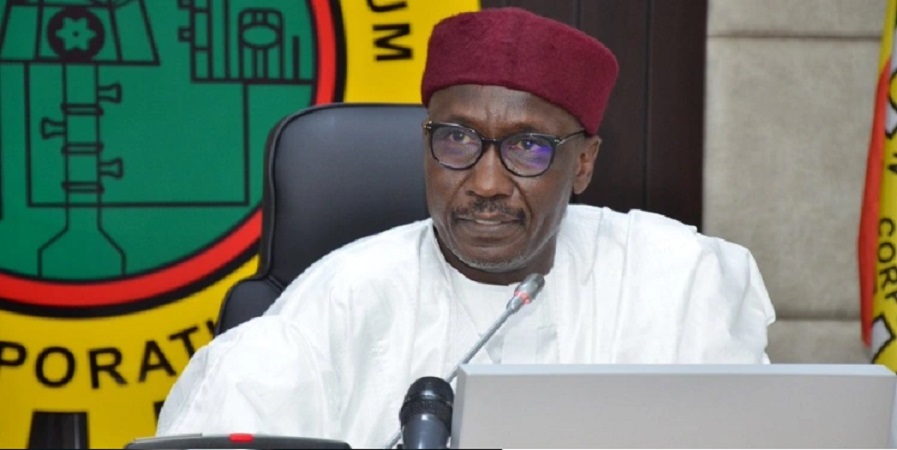
This was made known by the Group Managing Director of NNPC, Mele Kyari, during the continued investigative hearing of the House of Representatives Ad-hoc Committee to investigate the petrol products subsidy regime from 2013 to 2022, on Monday in Abuja.

Feedback on Feed

Comment: Well I know that you have been consistent with your position but my take remains that 200 million people have energy needs and their energy needs can be produced at a profit. We need refineries that can make aviation fuel available, we need refineries that will make diesel available for at least 2 decades. Lot’s of our companies that have embraced the green option try to make it hybrid. We can produce for ourselves and Africa. I believe that it will help if we had options within our country.

My Response: Actually, I have no position. I am just trying to analyze data.  NNPC is saying that it is finding it harder to buy petrol because the global refiners are closing shops.  My point is this: Nigeria cannot dictate the future on this and that we need to have a strategy. If Wall Street refuses to fund new refineries, even if you build one in Nigeria, you may not have the parts. Yet, this is not happening tomorrow. But it will come! Meanwhile, other use cases of crude oil are marginal and largely inconsequential to make a refinery profitable without petrol!
On the OIL REDISCOVERY in Nigeria

0

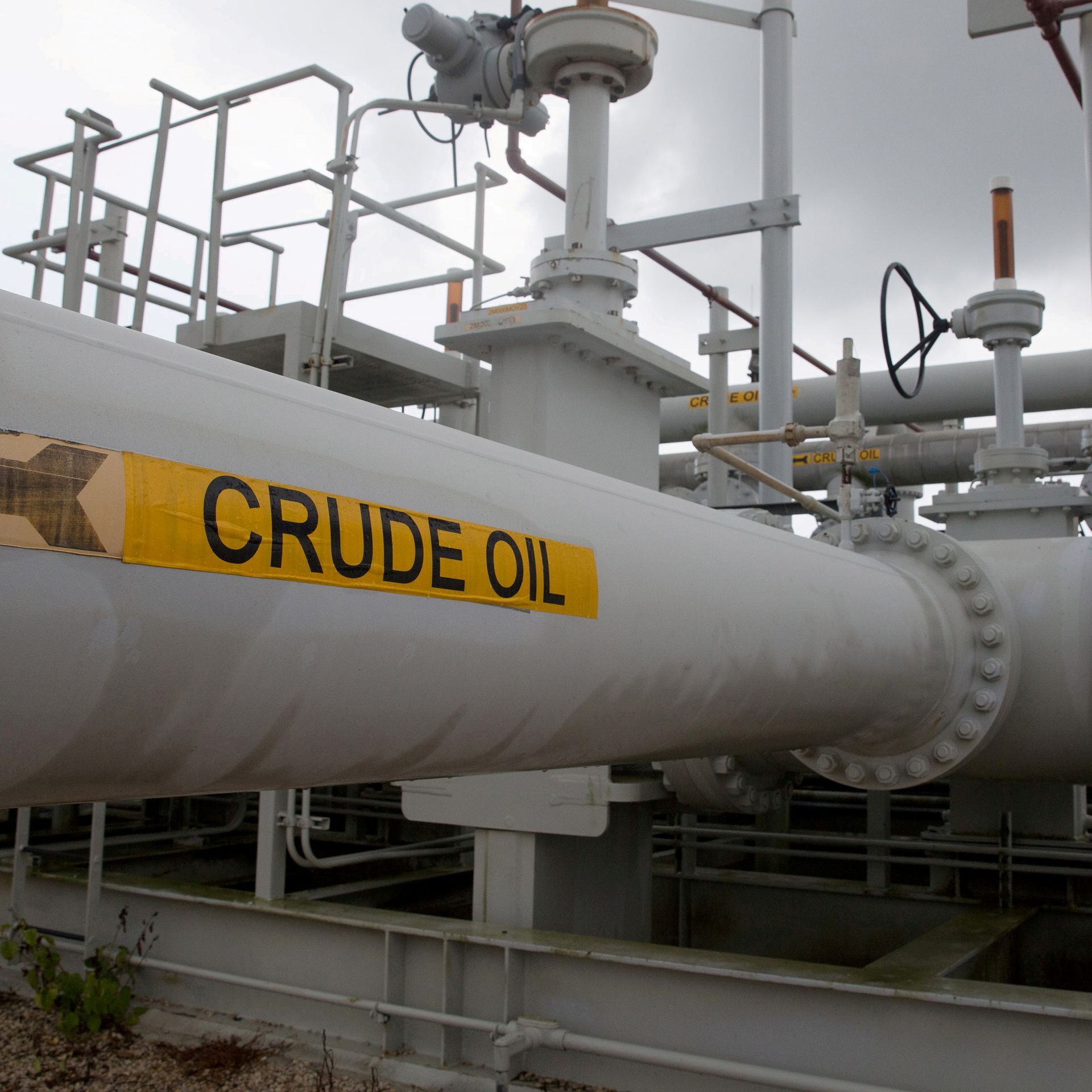
When Nigeria discovered crude oil in Oloibiri, Bayelsa, in 1956, political leaders and citizens believed that the resource would bring more abundance to everyone, regardless of gender, ethnicity, or religion. The early years of extracting oil and utilizing the revenue for socioeconomic advancement in all ramifications were not difficult, as expected. However, according to various sources, Nigeria began experiencing significant impediments that prevented her from generating expected revenue in line with daily production. Some people and groups felt that they were not receiving what was due to them from the national resource. The sources also establish how individuals and groups harmed and continue to disrupt resource production processes.

As previously stated, the disruption has resulted in a significant reduction in daily production. According to several reports, the Nigerian National Petroleum Corporation Limited reported a number of barrels stolen by criminals worth billions of dollars. Despite the formation of the Joint Task Force, which includes the army, navy, air force, and mobile police, the criminals are succeeding. After determining the extent to which the force could address the challenge, the Federal Government hired the services of a security firm owned by one of the Niger Delta development activists. Government Oweizide Ekpemupolo, also known by his nickname Tompolo, owns the company.

A few days after the contract was awarded, local gangs and young people protested it, according to national media. Some social commentators and public affairs analysts believed that the protest was the work of saboteurs who had made money from illegal bunkering over the years.

Meanwhile, our checks show that many potential solutions to the problem have been proposed in various studies conducted by academics and independent think tanks. For example, a study that examined the crime of crude oil theft between 2012 and 2014 produced a template that could be useful in reducing the problem. However, it appears that none of the stakeholders involved are prepared to find a long-term solution to the problem.

Public Concerns

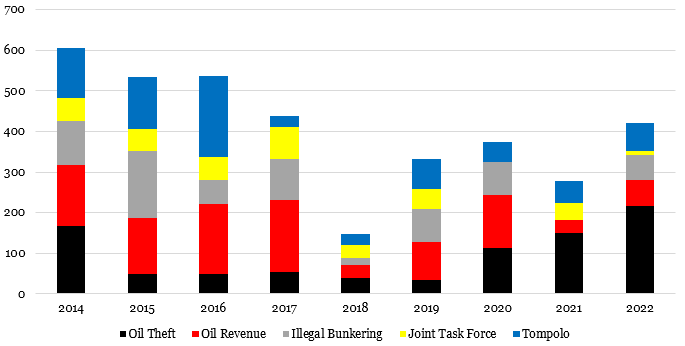
The examination of Nigerians who used the internet to learn about critical stakeholders and issues such as oil theft and illegal bunkering reveals some important insights for understanding the rediscovery of crude oil (oil theft) that was discovered 66 years ago. Nigerians, according to deep internet searches for information, are more concerned about oil theft in 2022 than they were in 2014 (see Exhibit 1). According to the analysis, they were more concerned about dwindling oil revenue in 2017 and 2016 than in other years during the government’s 9-year search for sources of oil theft.

In terms of whether the Joint Task Force, which includes the navy, army, police, and vigilantes, and Tompolo could stop the theft, our analysis shows that netizens (internet users) were more interested in seeing the security structure and Tompolo address illegal bunkering than the theft. However, our analysis shows that netizens were more interested in Tompolo’s abilities than in the security structure. According to our analyst, this outcome could be related to the recent contract awarded to Tompolo’s security firm, which has been widely reported in the news media. The Joint Task Force, on the other hand, appears to be appropriate for dealing with illegal bunkering, according to the analysis. Again, our analyst emphasizes that the outcome is consistent with existing facts establishing some positive results of the Force’s deployment of personnel to various locations in the Niger Delta Region over the years.

Exhibit 1: Nigeria’s Netizens Interest in Key Issues and Stakeholders between 2014 and 2022

Source: Google Trends, 2022; Infoprations Analysis, 2022

Figuring the Elites as Fall-Guys

Our analysis of netizens who searched for information about oil theft and illegal bunkering, as well as what they read as factors for dwindling oil revenue, reveals that illegal bunkering must have been considered as a key factor prior to the recent ‘rediscovery of crude oil.’ According to the analysis, one percent of those who expressed an interest in illegal bunkering were more than 60% more likely to be aware of and consider illegal bunkering to be a dominant factor. Nigerians on social media have accused political elites and some individuals in the Niger Delta Region of being perpetrators in the same way that the news media has.

In an interview granted a foreign newspaper, Alexander Sewell, a research specialist, notes the complexity of tracking oil theft and illegal bunkering. According to him, illegal crude oil trafficking involves the military, surveillance companies, politicians and local communities.

“There are two ways to steal oil. The first is to connect a pipe to a pipeline to convey the product to a barge. The barge can then supply artisanal refineries or go back and forth to a larger vessel anchored in an area where the river is deeper. This vessel will then head out to sea to refuel a tanker bound for South America, Europe or Asia. These tankers can also stay close to the West African coast and carry out transactions with other vessels on the high seas.

The second option is the so-called topping, which is the act of adding a quantity of undeclared crude oil to an official shipment. In this case, the documents are in order, the permits have been issued and traffickers can resell the extra oil as if nothing had happened. This second method is very difficult to investigate, especially since it often involves officials and members of the political élite. It is really a way to steal and move huge quantities of oil for minimal risk.”

The Atiku’s “Northern” Comment and Why He Must Move Away from That

2

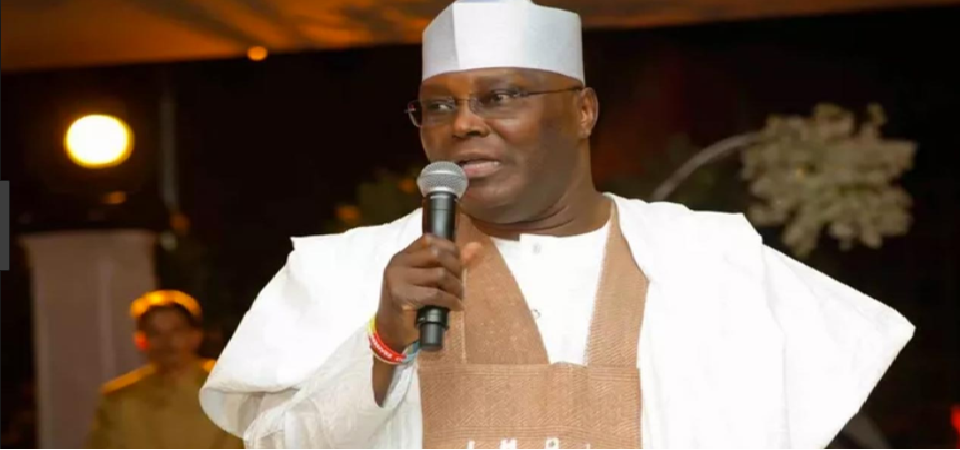
Former Vice President and presidential flagbearer of PDP scored a mindless own-goal on Saturday when he spoke at the interactive session of the Arewa townhall policy dialogue in Kaduna. It was his worst speech as a politician who many have seen to be detribalized. Many in Nigeria still believe that Atiku won the 2019 elections against Buhari.

But with Tinubu coming with a high voltage political force in his domain, Atiku is moving back to that dangerous “small mind” of look at my name, look at where I come from, and the associated demons. The former vice president has many things he can point to for the citizens to vote for him. With Obasanjo, they ran a really decent playbook. As the VP, he was the unofficial coordinator of the economy, well ahead of the ministers. There was peace under them and new sectors like telecoms blossomed.  They paid down debts or got them waived. I mean Waziri has many good records to prosecute this election.

What he does not need to say is that voters should vote for him because he is from the north. He is beyond that and he must move away for that. We need to preach competence. We need to canvas on readiness to read. We need to showcase vision. But NO to tribal politics.

Many northerners will vote for Atiku, Obi, and Tinubu. Many southerners will do the same. I do not expect Nigerians to use Atiku’s logic as they vote. Tinubu cannot tell SW “vote for me because I am Yoruba” or Obi to Igbos “you have never  since 1999 voted for any Igbo, please vote for me as I am an Igbo”.

I condemn Atiku’s logic and challenge him to move away from that.  My mathematics teacher in JSS3 was named Mr. Bukar. We all liked him because he was a really smart man. A teacher must have impacted your life to still remember his name decades after spending a semester in his class. Bukar for maths was a slogan and he booked many into mathematics (under him, no student failed Mathematics in JS3 external exam even though we had 3 who failed English. In other words, Mathematics was easier for all under him).

If they had sent an unprepared Igbo-man teacher from Umuahia who knew nothing, I am not sure that would have helped us. In other words, Nigeria can only rise on competence and not tribal sentiments. Let’s focus on that – and leave where we all came from!

“I have traversed the whole of this country,” he said.

“I know the whole of this country. I have built bridges across this country. I think what the average northerner needs is somebody who is from the north, and who also understands the other parts of Nigeria and who has been able to build bridges across the rest of the country.

“This is what the northerner needs. He (northerner) doesn’t need a Yoruba candidate, or an Igbo candidate. This is what the northerner needs.

“I stand before you as a pan-Nigerian of northern origin.

Indeed, I hope the southerners who had voted for Atiku in the past are not seen as fools from Atiku’s perspective. Most voted for him because they felt he was more competent than the available options.

https://twitter.com/OBIdient_FC/status/1581393443460616192?t=Jrr8dblrJ9mw-75riGnURA&s=08&fbclid=IwAR03SfxRI2YEJxE5bSFeEQje3xWS_FKLPRZ0mKQE6Wm6EEYZTZK9EVJ0Pl8

Nigerian Government Orders Reopening of Obajana Dangote Cement Plant

0

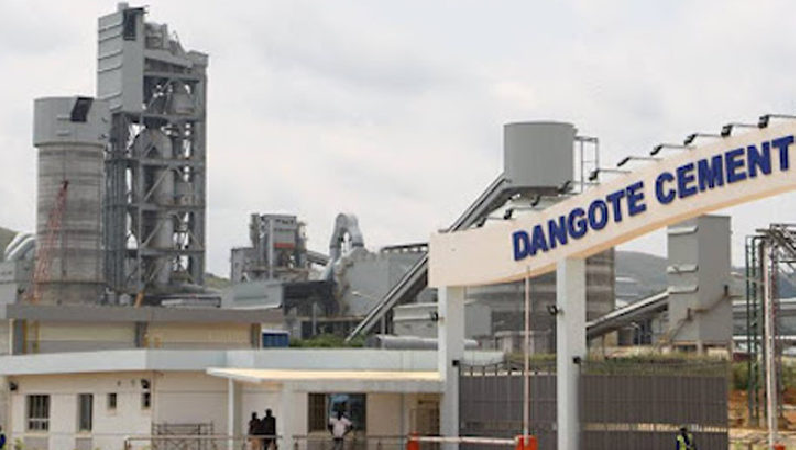
After intervening in the tussle between Kogi State Government and Dangote Cement Plc over the ownership of Obajana cement factory, the federal government has ordered the reopening of the plant.

The federal government’s order to reopen the cement plant, which was shut last week on the orders of the Kogi State Government, was disclosed by the Minister of Interior, Rauf Aregbesola, on Friday at the end of the National Security Council meeting.

The former governor of Osun State said that an agreement had been reached between Kogi State Government and Dangote Group on the necessity to reopen the cement factory, urging both parties to sheathe their swords and honor the deal.

“The council noted the development in Kogi and has ordered the reopening of the cement factory that is closed down and has advised that all issues related to that industry or factory should be resolved in accordance with the law, legally.

“Nobody must take the law into their own hands, either as a government or an individual. We are committed to guaranteeing and providing employment for Nigerians, whatever will hinder that or impede that must be discouraged.

“So, in that regard, the cement industry in Obajana must be reopened and all issues that are in dispute should be resolved legally,” Aregbesola said.

The lingering squabble between the Kogi State Government and Dangote Group over the ownership of the Obajana Cement Company escalated last week, following the inability of the duo to resolve it amicably. Dangote Cement claims 100% ownership of the plant while the Kogi State government said it is co-owned by the state, and that the company has been short-changing both the state and its indigenes by not giving the state its fair share.

Also, the Minister of Police Affairs, Maigari Dingyadi, who’s part of the federal government-led peace initiative, said an amicable solution has been reached to bring to an end this unfortunate development.

“An agreement has been reached between the Kogi State Government and the Dangote Cement in Kogi on the need to reopen the factory and ensure that peace is restored in the state,” he noted.

A picture shared on Friday after the NSC meeting, showed the governor of Kogi State, Yahaya Bello and the Chairman of Dangote Group, Aliko Dangote in what appeared like a reconciliatory pose. However, the picture does not indicate that an agreement has been reached by both parties.

The Kogi State Government is yet to acknowledge that the matter has been settled, suggesting that the fight over the cement plant has not ended.

Elon Musk Says Starlink Will Continue Providing Internet to Ukraine For Free

0

Tesla CEO Elon Musk via a recent tweet disclosed that Starlink satellite internet service will continue serving Ukraine even if the company doesn’t receive any subsidies from the Ukrainian government.

In the recent Tweet, he said “The hell with it, even though Starlink is still losing money & other companies are getting billions of taxpayer $, we’ll just keep funding Ukraine govt for free.”

A Silicon Valley investor David Sacks later responded by stating that “no good deed goes unpunished,” Musk tweeted in a reply; “Even so, we should still do good deeds.”

Musk’s tweet to keep supplying the Ukrainian government its Starlink satellite for free was a major reversal from a statement he made earlier, where he claimed that his Starlink company could not “fund the existing system indefinitely” without some U.S. funding.

He stated that roughly 20,000 Starlink satellite units have been donated to Ukraine, with Musk disclosing that the “operation has cost SpaceX $80 million and will exceed $100 million by the end of the year.”

Musk then stated that its charitable contributions to Ukraine could be coming to an end, as SpaceX warned the Pentagon that it may stop funding the service in Ukraine unless the US military kicks in tens of millions of dollars per month.

Musk then requested that the Pentagon take over funding for Ukraine’s government and military use of Starlink, which SpaceX claims would cost more than $120 million for the rest of the year and could cost close to $400 million for the next 12 months.

“We are not in a position to further donate terminals to Ukraine, or fund the existing terminals for an indefinite period of time,” SpaceX’s director of government sales wrote to the Pentagon.

Musk’s effort began in late February, just days after Russia invaded Ukraine. He said Starlink terminals were “on the way” but provided little detail about it. Many took this minimal and rather saw it as a promotional approach to mean what it implies that SpaceX was providing the terminals itself, either gratis or with some understanding as to their purchase.

In Ukraine, the satellite service offered by Starlink is now a primary mode of online communication in the country, a consequence of Russia’s sustained attack on Ukraine’s online infrastructure. A satellite cutoff could cripple Ukraine’s military and hand a major advantage to the Kremlin.

Starlink, which has a constellation of more than 3,000 small satellites in low Earth orbit, has been vital to Ukraine’s communications as it continually fights against Russia’s invasion.