DD
MM
YYYY

PAGES

DD
MM
YYYY

spot_img

PAGES

Home Blog Page 4847

Why A Diaspora Remittance Policy Will Remain Challenging for Nigeria

0

Really good news for Nigeria. Yes, the diasporas are opening their purses and wallets and funds are now going to the home country. In H1 2022, Nigeria received $10.11 billion (from the official quarters). When you add the non-border remittance (you have USD dollar in New York and someone has Naira in Lagos, both do deals without any money crossing the border), it could have hit $15 billion.

Now tell me: how much is Nigeria’s total annual revenue excluding crude oil sales? Way below $30 billion yearly using the 2022 budget numbers. Indeed, the diasporas are sending more money to Nigeria than its total non-oil revenue!

Of course, receiving $30billion is a marginal gain for Nigeria when you see the value these diasporas are creating in the countries they live in. But had they stayed in Nigeria, those values would have been impossible. This makes it extremely hard for a government policy. While it is a great thing to receive change, you cannot develop a nation on the policy of training and exporting your best talent.

According to Nigeria’s Ministry of Finance, budget, and national planning, it disclosed that diaspora remittances were among the top sources of non-oil foreign exchange for the nation.

Just recently, it was reported that in the first half (H1) of year 2022, Nigerians received the sum of $10.11 billion as diaspora remittances between January and June, which represents a 9.6% increase when compared to $9.23 billion received in the corresponding period of 2021.

In contrast to the second half of 2021, Nigeria’s diaspora remittance inflow increased marginally by 0.9% from $10.02 billion. This is according to data obtained from the Central Bank of Nigeria (CBN).

While it is a great thing to receive “change” or leftovers, you cannot develop a nation on the policy of training and exporting your best talent even as you struggle to know what to do with the talent if they stay back in the country!

Comment on LinkedIn Feed

Comment 1: The #japa economy is booming.
Nigeria is known to turn a blind eye to anything that benefits them short-term like we saw in the oil era. Don’t be surprised they can find this a justifiable reason to provide more scholarships to students so they can go abroad to bring in more diaspora wealth. At least not like the legalised slavery era where the money comes once when selling the individual as a commodity and never returns as dividend to the seller. The country should be thinking more longer term on how to grow talents on Nigerian soil by making the environment more favourable for them.

Many countries like UK, Australia, Canada, US have set up migration schemes to attract the best and brightest talents especially in their shortage occupation areas. Nigerian talents are shipped out en masse not out of adventure but a desperate need to survive.

That’s the reason it’s difficult to convince a graduate to stay back in the country or even return back after studies. They can bring back wealth and invest within a short time which could never have been possible with the peanuts in Nigeria.
Japa has become a huge investment any person can make in their career which the country is benefiting from, but of course, losing a lot from.

Comment 2: I believe that government can actually use good policies to not only increase the remittances but also increase them to investment. There are Nigerians who want to invest back home but government often inimical practices are a major challenge. By government I’m referring more to State governments’ not federal because the people in diaspora can afford to invest in backward integration strategy of the government if any such thing exists. For instance, if a State government legislates that anyone that has spare fund can go into agriculture, that will hang in the air but if you say bring N5M for cassava and you are entitled to 6 acres of land and a staff of the ministry of agriculture will oversee your farm and 2 youths interested in agriculture will be paid to work on the farm. If there’s transparency the second option can work. But then, the poison pill called monthly allocation will never allow government to think of how Nigeria can be made to work for her people. You have to give it to the people living in diaspora, they are doing well and yet they are completely disenfranchised when it comes to voting.

Comment 3: We are still losing so much, $10 billion remittance is nothing when compared to how far we have fallen. India has breached export earnings of $400 billion, and we are here talking about numbers that a single state in Nigeria should be bragging about.

When we have a proper government, we can attempt fixing all the broken parts. This idea of being beaten down mercilessly to the point that every small thing appears great, is something we must first do away with.

Our numbers never inspire, over 200 million people with a landmass of almost a million square kilometres. We should never allow poverty to violate and deconstruct our sense of worth and value.

Diaspora Remittance to Nigeria Hits $10.11 billion in H1 2022

Diaspora Remittance to Nigeria Hits $10.11 billion in H1 2022

0

The common act of sending money back home resonates greatly with Nigerians in the diaspora. Nigeria is reportedly the largest recipient of diaspora remittance in Sub-Saharan Africa, as remittance to Nigeria now constitutes a significant part of the country’s GDP.

According to Nigeria’s Ministry of Finance, budget, and national planning, it disclosed that diaspora remittances were among the top sources of non-oil foreign exchange for the nation.

Just recently, it was reported that in the first half (H1) of year 2022, Nigerians received the sum of $10.11 billion as diaspora remittances between January and June, which represents a 9.6% increase when compared to $9.23 billion received in the corresponding period of 2021. 

In contrast to the second half of 2021, Nigeria’s diaspora remittance inflow increased marginally by 0.9% from $10.02 billion. This is according to data obtained from the Central Bank of Nigeria (CBN). 

In the period under review, a sum of $23.3 million was recorded as remittance outflow from Nigeria, indicating a net inflow of $10.09 billion in H1 2022 as against a net value of $9.99 billion recorded in H2 2021 and $9.2 billion recorded in the corresponding period of 2021. 

In contrast to the second half of 2021, Nigeria’s diaspora remittance inflow increased marginally by 0.9% from $10.02 billion. This is according to data obtained from the Central Bank of Nigeria (CBN). 

In the period under review, a sum of $23.3 million was recorded as remittance outflow from Nigeria, indicating a net inflow of $10.09 billion in H1 2022 as against a net value of $9.99 billion recorded in H2 2021 and $9.2 billion recorded in the corresponding period of 2021. 

The World Bank had earlier projected that Nigeria’s Diaspora remittance inflow will increase by 7.1 percent in 2022, which is reflecting the gains of the continued adoption of official bank channels and the expectation that more Nigerians who have migrated will likely send more money home to support families in the face of an increase in the cost of living.

In a bid to forestall this trend, the Central Bank Of Nigeria CBN in December 2020 introduced measures to encourage Diaspora Nigerians to send their remittances through the banking system.

In one of its measures, the Central Bank introduced the Naira4Dollar scheme in February 2021 which offers beneficiaries of remittances N5 naira for every $1 of remittance sent through the bank.

Among other things, the measures allow beneficiaries to have unfettered access and utilization to foreign currency proceeds, either in foreign exchange cash and/or in their Domiciliary Accounts.

The number of Nigerians in diaspora has been increasing astronomically over the last five years due to the myriad of problems ravaging the country. Also, the high level of unemployment (33% and youth unemployment at almost 60%), the insecurity crisis, and the incessant ASUU strike which has crippled the educational system in the country, have all contributed to the surge in the migration of Nigerians to other parts of the world.

Nigerian Govt. Secures the Release of 23 Remaining Abducted Train Passengers

0

The 23 remaining persons among the 61 train passengers abducted during an attack on a passenger train in March have been released, according to a statement released by the Chief of Defense Staff Action Committee (CDSAC) on Wednesday.

The statement signed by the Secretary, Prof. Usman Yusuf, attributed the release of the abductees to a military operation conceived and executed under the leadership of the Chief of Defense Staff.

“I am pleased to announce to the nation and the world that at 1600Hrs. (4:00pm) today, Wednesday 5-10-2022, the seven-man Presidential Committee assembled by the Chief of Defense Staff (CDS), General L E O Irabor, secured the release and took custody of all the 23 remaining passengers held hostage by Boko Haram Terrorists following the attack on the Abuja to Kaduna train on 28-3-2022.

“The nation owes a debt of gratitude to the Nigerian Military under the leadership of the CDS who conceived and guided the operation from start to finish. All sister Security Agencies and the Federal Ministry of Transportation contributed immensely to this Operation.

“The unwavering support of the President and Commander in Chief of the Nigerian Armed Forces, President Muhammadu Buhari GCFR is what made it all possible. Members of this Committee are grateful for the rare honour and privilege to be part of this Humanitarian Operation,” the statement said.

Although it took more than six months before the government finally secured their release, the families of the kidnapped victims have expressed their gratitude.

However, questions about the government’s capability to prevent such a heinous crime from happening again remain. In the past seven years, the federal government of Nigeria has invested more than N10.02 trillion on the fight against insecurity, according to BudgIT, an NGO tracking governments’ expenditures. But it has failed to curtail rising cases of terrorists’ attacks and kidnappings.

Not quite long after Boko Haram terrorists attacked the Kaduna bound train and abducted several passengers, a medium prison was breached in Abuja, the nation’s capital, freeing hundreds of inmates. More than 400 escapees, who are said to be criminals, are still at large.

Most of the train attack victims paid millions of naira in ransom to the terrorists before they were freed. The government, which had been in negotiation with the terrorists since the abduction, is believed to have also paid ransom for the release of the remaining 23 victims.

The terrorists had earlier demanded that the government free their children and members in its custody as part of the negotiation to release the train passengers. The demand is said to be an integral part of the dialogue that led to the release of 11 of the abductees in June. The government did not admit or deny it.

With the highways still unsafe due to increase in abductions, Nigerians have been left to protect themselves against criminals. Apart from heeding security experts’ advice to embark on road trips only when it’s necessary, Nigerians have learnt to put ransom into consideration whenever they’re traveling.

The geo-political zones of the country have created their own security outfits as a sign that the government security agencies have become totally helpless as insecurity rages, but that has also failed to ameliorate the problem.

Words That Will Define Peter Obi’s Leadership If He Is Elected President in 2023

0

Martin Luther King (Jnr) delivered the “I Have a Dream” speech several years ago, calling for civil and economic rights as well as an end to racism in the United States of America. During campaigns, many social activists and politicians adopted his speech approach, particularly when they felt that political leaders had failed people in every aspect of socioeconomic and political life. Various promises have been made and are still being made before and during campaigns by political actors and their supporters while delivering speeches.

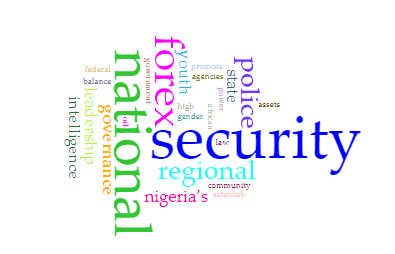
Though Mr Peter Obi, the Labour Party’s presidential candidate, did not title his recent speech at Harvard University, our analyst discovered that after subjecting the speech to granularity analysis, his speech is best titled “We Will.” This title is based on the phrase’s resonance with the key words in each paragraph of the speech. Aside from this outcome, the 914-word speech focuses on addressing national and regional security challenges through strategic positioning and the rejuvenation of the Nigeria Police Force. This is evident from his 11 references to security, compared to 9 and 5 references to national and regional security, respectively.

Key Words in Peter Obi's Harvard Speech
Source: Infoprations Analysis, 2022

Mr Peter Obi used his presence at Harvard University, like previous media appearances and speeches in Nigeria, to re-emphasize his leadership style if elected in 2023. According to our analyst, the first paragraph of his presentation, “We will offer a new brand of transformative and purposeful leadership. The overall goal of my administration shall be to streamline governance, make it more responsive, transformative, effective, less transactional, and therefore efficient and cost-effective,” indicated what Nigerians and the country’s global partners can expect from his administration.

Transformative. Having the power to change something or someone in a significant and long-lasting way

Purposeful Leadership. Making decisions as part of a larger strategy to encourage others to follow your lead

Streamline Governance. Redesigning skills and roles towards sustainable value creation and capturing for everyone.

Responsive. Quick and positive reaction

Effective. Successful in achieving the intended or desired outcome.

Less Transactional. Relationships in which one person does or gives something to another without expecting anything in return; the relationship itself is the reward for both parties and often bears long-term fruit.

Efficient. (of a machine or system) achieving maximum productivity with the least amount of wasted time or money.

Cost Effective. Effective or productive in relation to its cost.

Legalization and Authentication of Documents in Nigeria

0

Legalization of documents in this context simply means the process of certifying that a document is legit or authentic, i.e. it is the process of confirming the veracity or the authenticity or otherwise of a document. 

Because people tend to act funny or try to play smart sometimes and present fake or forged documents, the authorities they are presented to are being forced to confirm the genuineness or legitimacy of such documents presented before them. If they confirm that such a document is legit and not forged or faked, they will accept it  i.e. authenticate, or legalize it but if they see that it is fake or forged in any way they will discountenance such document.

Authentication comes before legalization. You can only legalize a document you have authenticated.

Authentication of documents simply means to check or confirm the authenticity, genuineness, or originality of the document presented before the authority. Authentication checks the authenticity or legitimacy of the document while legalization checks or confirms the legitimacy or genuineness of the authenticity carried out on the document. Legalization tries to confirm if the authenticity stamp on the document is real or forged.

Authentication of a document is done by Nigerian authorities while legalization of the document is done by the foreign embassy of the country where the document is presented before.

Legalization of documents in Nigeria, therefore, connotes the certification of a document, which has already been authenticated.  It is a process by which a foreign embassy in Nigeria certifies the genuineness of the signature or stamps and/or seal made by the authorized officials of the Ministry of Foreign Affairs in Nigeria.

The reason why every official document leaving Nigeria and is to be presented to a foreign authority is legalized by the foreign embassy even when it has already been authenticated by the Federal Ministry of foreign affairs in Nigeria is because Nigeria is not a signatory to the Hague Apostille Convention of 1961. The Hague Apostille Convention entered by some nations of the world on 5 October 1961 abolished the requirement of Legalisation for Foreign Public Documents moving from one member state to the other.

The most common documents individuals authenticate and legalize include but are not limited to the following;

-Educational documents; WASSCE, Bsc, Msc, Ph.D. certificate, and educational transcripts. 

-Professional licenses 

—Birth certificate or Attestation of Birth Certificate

-Marriage certificate ie legal proof of marriage 

-Divorce certificate ie legal proof of divorce 

-Single status affidavit/ Bachelorhood/ spinsterhood certificate. 

-Police character certificate or Criminal Record Check Certificates

-Nigerian International Passport Data Page

-CAC Incorporation documents

-Authorization letters

-Employment Letter certificate 

-Declaration of assets

-Bank statements/ proof of funds (POF).

-Sponsorship letters,

-Power of Attorney. 

-Change of Name Certificates

-Adoption Papers

-Citizenship and Immigration Documents

-Medical Reports

-Contract Papers or Agreement; etc

Please note that all documents issued by an authority in Nigeria, be it a government authority, or a private institution that is to be presented or submitted to a foreign authority need to go through the process of legalization whereby the foreign authority confirms the authenticity or legitimacy of such documents ensuring that is not forged or faked but documents required to be authenticated or legalized is peculiar to an individual country that is to be presented to.

You can either undertake to go through this process by yourself or you can engage the service of a legal practitioner or an agent. But for Nigerians residing abroad who need to authenticate or legalize their documents, it is advisable that instead of coming down to Nigeria for just that purpose, you should rather employ the services of a legal practitioner residing in Nigeria.