DD
MM
YYYY

PAGES

DD
MM
YYYY

spot_img

PAGES

Home Blog Page 486

Early BullZilla Buyers Secured 1275% ROI: Is This the Best Presale With 100x Potential Amid Cardano and Polkadot’s Slow Climb?

0

What happens when whales, progressive tokenomics, and meme coin firepower collide? Markets pay attention. In September 2025, BullZilla ($BZIL) hit a remarkable milestone, raising over $500,000 in its trending presale with 100x ROI, a number that’s been climbing faster than most analysts projected. Meanwhile, Polkadot (DOT) just capped its supply at 2.1 billion tokens to combat inflation, and Cardano (ADA) edges closer to its long-awaited scalability milestones. Together, they showcase how very different narratives are reshaping the crypto market this quarter.

Among them, BullZilla ($BZIL) is sparking the loudest conversation. Its presale isn’t just another funding round; it’s designed as a living saga where the price rises every 48 hours or when $100,000 is raised, whichever comes first. For financial students, crypto analysts, and blockchain developers, this makes the BullZilla 100x presale one of the most closely watched top early stage crypto investments right now.

BullZilla (BZIL) – Why This Presale Could Deliver Maximum Gains

Could a single presale mechanism rewrite meme coin history? That’s what BullZilla ($BZIL) aims to prove. The progressive price engine ensures that the token price never stalls; it climbs every 48 hours or instantly when $100,000 pours in. Early buyers secure cheaper tokens, while latecomers face higher entry costs. This is the momentum engineered for maximum gains in crypto investment potential.
The presale stages are already racing forward. With over $580,000 raised, 28 billion tokens sold, and 1,900+ holders, the momentum is undeniable. At the current Stage 3D price of $0.00007908, a $4,500 buy nets approximately 56,925,993 $BZIL tokens. At the projected listing price of $0.00527, that bag would be worth around $299,000, a jaw-dropping 6565.92% ROI. This is where meme coin whales are making decisive moves in the BullZilla presale 100x rewards, accelerating the timeline for everyone else.

BullZilla Presale Snapshot

Metric Current Value Future Value Target
Stage 3rd (404: Whale Signal Detected) Listing at $0.00527
Current Price $0.00007908 +8.42% in 4A ($0.00008574)
Tokens Sold 28B+
Presale Raised $580,000+
ROI Potential 6565.92%

The sheer affordability makes this round rare. $1,000 secures 12.64 million tokens, while larger positions are already locking in BullZilla’s explosive upside. With whales stepping in on the best 100x meme presales, these rounds don’t last.

How to Buy $BZIL – Claim Your Stake in the Beast

Joining the BullZilla presale means stepping into a meme coin presale built on Ethereum’s battle-tested chain. Here’s how investors can secure tokens before the next stage shift:

  1. Set Up Your Wallet

Compatible options: MetaMask, Trust Wallet, or Coinbase Wallet.

  1. Load Up With Crypto

Buyers can use ETH, USDT, USDC, or BNB. Always keep a little extra for gas fees.

  1. Connect to the Presale

On the presale site, click “Connect Wallet” and approve the link. You’re in.

  1. Join the Presale

Select your amount of $BZIL, confirm, and lock it in. Each second counts before the price ticks up again.

  1. Confirm the Hunt

Approve the transaction and watch your balance appear on the dashboard. From there, it’s just holding on until launch.

The beast is moving, and each stage grows more expensive. Secure your tokens today, don’t wait for whales to set the pace.

Polkadot (DOT) – A Supply Cap Changes the Game

Polkadot (DOT) has introduced a crucial change that could reshape its long-term value. The community approved a cap of 2.1 billion tokens, shifting DOT from inflationary uncertainty to controlled scarcity. Currently trading near $3.98, DOT is navigating heavy resistance between $4.35–$4.60. Analysts warn of a potential dip if resistance holds, but breakthroughs could carry DOT higher.

Polkadot 2.0 also continues to gain traction, with elastic scaling and JAM protocol upgrades on the horizon. While DOT’s growth may feel conservative compared to meme coin theatrics, its foundation and staking rewards continue to attract long-term holders. This positions DOT as a steady play in contrast to Bullzilla presale beast mechanics.

Cardano (ADA) – Scalability Dreams Edge Closer

Cardano (ADA) remains locked in its slow-and-steady approach, trading between $0.82–$0.90 with a market cap of around $30 billion. The next step for ADA is tied to Hydra layer-2 and Mithril improvements, aimed at scaling the network. For ADA holders, the key levels to watch are resistance at $0.94 and potential upside targets of $1.20–$1.25 if bulls gain traction.

Still, whale selling has recently delayed momentum, with reports of nearly 560 million ADA sold over four days. While ADA’s fundamentals remain intact, this selling pressure underlines how meme-driven projects like $BZIL can pull attention away from established giants.
Conclusion – Why BullZilla’s Presale Stands Apart

Based on market trends and presale data, BullZilla ($BZIL) emerges as the best presale with 100x potential, while Polkadot and Cardano focus on gradual, structural improvements. DOT’s capped supply and ADA’s upcoming scalability upgrades show strength, but they move at a measured pace. By contrast, BullZilla thrives on speed, progression, and whale-driven surges that demand immediate attention.

The narrative is clear: while ADA and DOT refine their ecosystems, investors chasing high-octane returns are already locking in Bull Zilla. The presale’s progressive engine ensures there’s no pause button; the beast climbs whether investors act or not. With stages ending every 48 hours or at each $100K mark, this presale is racing forward. Join now, or watch from the sidelines as others ride into the top early stage crypto investments history.

For More Information:

BZIL Official Website

Join BZIL Telegram Channel

Follow BZIL on X  (Formerly Twitter)

Frequently Asked Questions for the Best Presale with 100x Potential

What is BullZilla ($BZIL)?

BullZilla is a meme coin project built on Ethereum, designed with progressive pricing, staking, and burn mechanics to drive value.

How does the presale price mechanism work?

The $BZIL price rises every 48 hours or instantly when $100,000 is raised. This creates constant upward pressure.

What’s the ROI potential of $BZIL?

At the listing target of $0.00527, current investors could see up to 6565.92% ROI from today’s stage.

How does BullZilla compare to ADA and DOT?

While ADA and DOT focus on long-term infrastructure, $BZIL offers immediate upside through its meme coin presale mechanics.

Is investing in $BZIL risky?

Yes. Like all cryptocurrencies, $BZIL carries risk. This article is informational only and not financial advice.

Glossary

Progressive Price Engine – Mechanism where token price increases by time or capital raised.

Roar Burn – Token supply reduction tied to presale chapters.

HODL Furnace – Staking system offering up to 70% APY.

Hydra – Cardano’s layer-2 scalability solution.

Mithril – Cardano upgrade for faster node syncing.

Elastic Scaling – Polkadot scalability protocol in development.

JAM Protocol – Polkadot’s planned performance upgrade.

Whale Signal – On-chain data showing large buyers entering.

Listing Price – Target exchange price post-presale.

Chapter Presale – BullZilla’s 24 stages tied to lore and mechanics.

Summary

BullZilla ($BZIL) has raised over $500,000 in September 2025, racing through presale stages with a progressive price engine that lifts the token’s cost every 48 hours or after $100K in buys. At the current stage, a $4,500 buy could grow to nearly $300,000 by listing, promising a 6565.92% ROI. Meanwhile, Polkadot capped its supply at 2.1 billion tokens, while Cardano is advancing toward Hydra and Mithril upgrades. Both ADA and DOT signal stability and evolution, but BullZilla dominates the conversation as the best presale with 100x potential. With whales accelerating stage shifts, investors are urged to act now before this meme coin giant roars into its next phase.

Keywords Group

best presale with 100x potential, meme coin presale, BZIL presale early rounds, maximum gains crypto investment, Bullzilla presale beast, Bullzilla explosive, Bullzilla presale analysis, top early stage crypto investments, BullZilla ($BZIL), Polkadot (DOT), Cardano (ADA)

Disclaimer: This article is for informational purposes only and does not constitute financial advice. Cryptocurrency investments are highly volatile and risky. Always conduct independent research and consult with a licensed financial advisor before investing.

Patterns of Complying and Reporting Local Content in Nigeria’s Oil and Gas Industry

0

The Nigerian Oil and Gas Industry Content Development Act of 2010 has become a cornerstone for shaping how companies operate in the country’s most strategic sector. Its intent is simple but profound. The law compels international oil companies, indigenous firms and joint ventures to prioritize Nigerian participation across contracting, workforce, fabrication and technology transfer. Fifteen years on, patterns have emerged in how companies both comply with and report on local content. These patterns reveal much about corporate strategies, regulatory effectiveness and the evolving relationship between global operators and local communities.

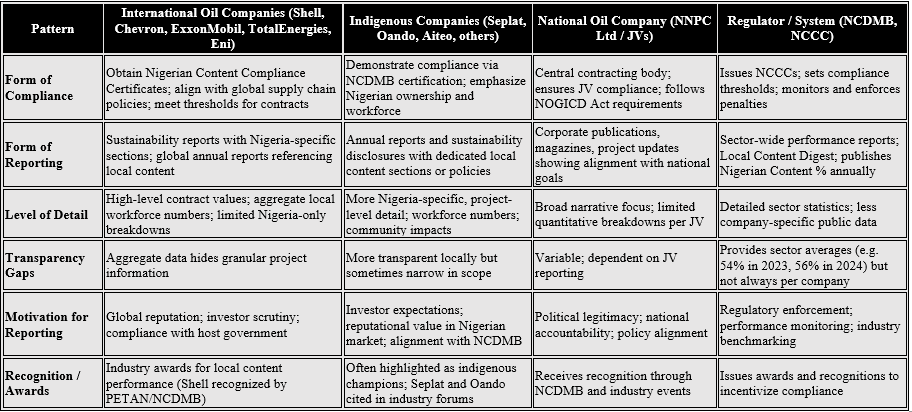
A first pattern is the divide between international oil companies and indigenous players. Multinationals such as Shell, Chevron, ExxonMobil, TotalEnergies and Eni have embedded local content reporting into their global sustainability frameworks. Their annual sustainability or corporate responsibility reports contain sections on Nigeria highlighting training programs, contract awards to Nigerian suppliers and percentages of Nigerian staff. Shell’s disclosures of billions of dollars awarded to local companies in 2023 is a case in point. These companies often report through polished global documents rather than Nigeria-only reports. This approach aligns with their international standards but sometimes limits the granularity of Nigerian data available to the public.

Indigenous companies present a second pattern. Firms like Seplat Energy, Oando and Aiteo include local content discussions in their annual or sustainability reports. Because these firms are listed in Nigerian and international markets they face pressure from regulators and investors to demonstrate compliance. Seplat is particularly explicit in linking its growth with Nigeria’s local content objectives. Oando has gone further by publishing a Local Content Policy alongside its sustainability materials. Indigenous players often highlight their advantage of being Nigerian-owned and operated while emphasizing workforce development and community engagement. Their disclosures are generally more Nigeria-specific and tailored to a local audience.

A third pattern lies with the national oil company. NNPC Limited is not only subject to local content rules but also acts as a joint venture partner and contracting entity for most projects in the country. Its publications and magazines showcase Nigerian Content Development and Monitoring Board awards and contract recognitions. Because NNPC sits at the center of the value chain its reporting is less about investor relations and more about demonstrating alignment with government policy and accountability to the Nigerian public.

Legal and regulatory engagement forms a fourth pattern. Court decisions such as the 2017 Addax case confirmed the authority of the regulator to impose penalties for non-compliance. This created a culture in which companies not only comply but also report in order to demonstrate transparency and avoid disputes. Compliance reporting therefore is not voluntary storytelling. It is closely tied to regulatory oversight through Nigerian Content Compliance Certificates issued by the Board. These certificates have become tangible evidence that a company has met prescribed thresholds on projects.

A fifth pattern is the gap between sector-level statistics and company-specific metrics. NCDMB reports regularly state that Nigerian Content stood at 54 percent in 2023 and rose to 56 percent in 2024. However only some companies disclose their own percentages. This creates uneven transparency. Sector averages look healthy but stakeholders often cannot trace the contributions of each operator. International oil companies prefer to emphasize aggregate impact while indigenous firms highlight project-level achievements. The result is a mosaic of compliance narratives rather than a uniform dataset.

Source: Nigeria’s oil and gas companies, 2010-2025; Infoprations Analysis, 2025

Another pattern worth noting is recognition through awards. Both multinationals and indigenous players have been celebrated by industry associations and NCDMB for local content performance. Shell was recognized as the best local content operator of the year. Such recognition reinforces reporting habits because companies see reputational value in publishing their achievements. Awards also create competitive pressure among peers to enhance compliance and reporting.

These patterns point to a gradual maturation of local content as both a compliance requirement and a reporting norm. Fifteen years ago few companies disclosed Nigerian Content in detail. Today many include it in their flagship reports. However gaps remain. Company-level disclosures are inconsistent and sometimes superficial. The regulator still carries the main responsibility for providing reliable sector-wide data. Stakeholders including investors, communities and policymakers increasingly call for harmonized reporting standards that would allow better benchmarking across operators.

Looking forward the challenge is to transform local content reporting from compliance to strategy. For companies this means moving beyond percentages of contracts awarded and instead demonstrating how Nigerian participation strengthens resilience, lowers costs and creates innovation. For regulators it means ensuring that data is transparent and comparable so that progress can be tracked across time and between companies. For communities it means holding companies accountable not just for contracts but also for skills transfer and sustainable opportunities.

US Economy Outlook and Reading the Market Signals, From Post-Pandemic Surge to 2025 Slowdown

0

A young professional asked me, “Sir, what is your outlook on the US economy, considering the changes we’re seeing, including the recent reforms on H-1B visas?” My response is anchored on a simple observation: policies are shifting because the architecture of the American economy is shifting.

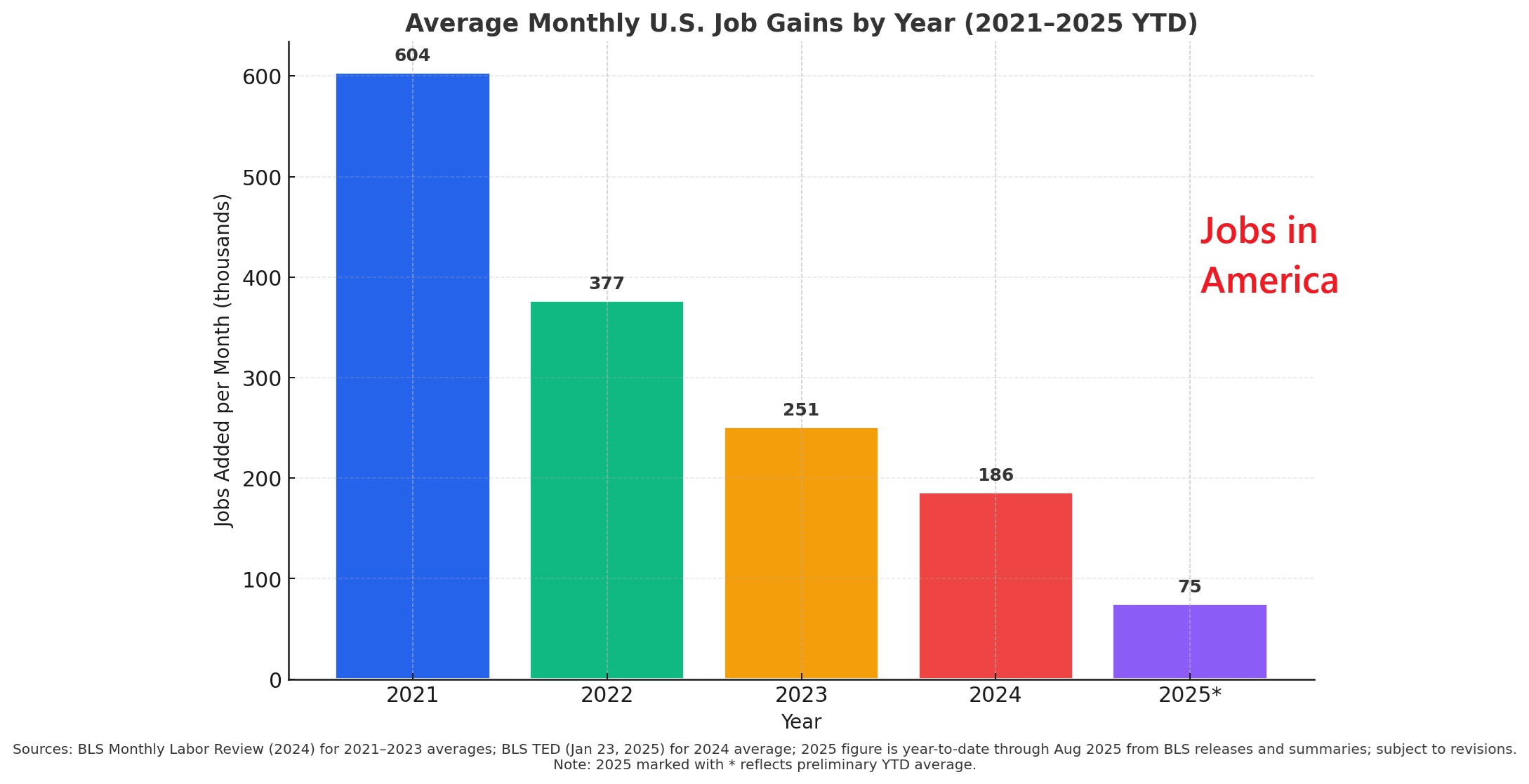
If you plot the average monthly jobs created in America since 2021, you will see a downward arc—from the exuberant highs of 600,000 jobs per month to fewer than 100,000. Yet, unemployment rates remain low, not because the economy is booming, but partly because immigration has slowed. Fewer entrants into the labor force have masked a profound redesign underway in the US economy. I shared this with Tekedia Capital members in our WhatsApp Group.

President Trump understands this reality. Tariffs were one lever to stimulate domestic production. But tariffs cannot close a chasm where a worker in Cambodia earns $10 a day—making relocation to Los Angeles less compelling even with a 100% tariff. The US Federal Reserve, holding its dual mandate to optimize employment and stabilize the dollar, watches this paradox unfold: low unemployment but slowing job creation.

Meanwhile, Wall Street is jubilant. Stocks climb, corporate profits soar, and capital markets hum. But for the fresh graduate seeking that first job, the melody sounds different. Somewhere between AI’s productivity surge, corporate efficiency, and changing demographics lies an unsolved equation.

The American economy remains resilient and promising for investors, but for workers, the path ahead demands vigilance and adaptability. In Igbo wisdom: “onye na-amaghi ebe mmiri bidoro mawa ya, agaghi ama ebe o kwusiri” [he who does not know where the rain began to beat him cannot know where things started to dry]. The rain is falling in America’s labor market, even as the sun shines on Wall Street. This plot below is what Trump wants to solve because this cannot be the new normal in the world’s finest economy.

China’s DeepSeek Says Bargain-Basement AI Training for R1 Model Costs $294,000

0

Chinese AI startup DeepSeek last week put a bold marker down, claiming it trained its R1 AI model for just $294,000 using a cluster of 512 Nvidia H800 chips. The figure — disclosed in a peer-reviewed Nature paper co-authored by founder Liang Wenfeng — is a fraction of what American AI giants have spent, and it is already raising eyebrows across the tech world.

The company said training took 80 hours on the China-specific H800s, designed by Nvidia to comply with U.S. export controls. In supplementary notes, DeepSeek also admitted to using Nvidia A100 GPUs in early experiments, before migrating its work to H800s.

That price tag, however, has immediately invited scrutiny. Analysts and U.S. rivals say the number is less a reflection of miraculous efficiency than a carefully chosen sliver of a much larger story.

A stark contrast with U.S. spending

The comparison with American AI firms underlines a huge gap. OpenAI CEO Sam Altman has previously said that training his company’s foundation models costs “much more” than $100 million, while industry peers such as Anthropic and Google DeepMind are also thought to have budgets in the hundreds of millions per model.

Research firm SemiAnalysis contends that DeepSeek’s operations are far from bargain-basement. It reported that the company has access to about 50,000 Nvidia Hopper GPUs — including 10,000 H800s and 10,000 H100s — and that its real investment includes $1.6 billion in servers, $944 million in operating costs, and more than $500 million spent directly on GPUs. By that estimate, the highly publicized sub-$300,000 training cost represents only a narrow portion of the overall effort.

Distillation versus proprietary data

The disparity between DeepSeek and U.S. firms extends beyond accounting. American companies like OpenAI, Google DeepMind, and Anthropic emphasize building models on massive proprietary datasets, relying on expensive scaling and dedicated supercomputing infrastructure. DeepSeek, by contrast, has leaned heavily on distillation, a technique in which one AI model learns by training on the outputs of another.

The practice, while cost-efficient, has stirred controversy. DeepSeek previously admitted to incorporating Meta’s open-source Llama into some of its distilled systems. In its new paper in Nature, the company went further, acknowledging that training data for its V3 model contained “a significant number” of responses generated by OpenAI systems — a byproduct, it said, of web-crawled data rather than deliberate replication.

U.S. rivals argue that their models’ competitive edge rests on painstakingly curated datasets and rigorous infrastructure. DeepSeek counters that its approach makes AI deployment cheaper and more scalable — a particularly powerful narrative in China, where state support favors affordability and accessibility.

Global implications

The company’s January debut jolted global markets, wiping billions off the valuations of Western AI leaders as investors recalibrated expectations about competitive dynamics. Evidence of DeepSeek’s alternative methods, whether genuinely revolutionary or not, underscores the broader divide between Beijing’s push for cost-efficient domestic champions and Washington’s focus on capital-intensive proprietary models.

For Washington, DeepSeek’s claims also carry geopolitical weight. U.S. export controls were designed to restrict China’s access to the most advanced GPUs, yet DeepSeek has managed to train frontier models on Nvidia’s restricted-market H800s. That success, even if partly overstated, suggests Beijing-backed firms are adapting faster than expected.

Since January, DeepSeek has kept a low public profile, rolling out incremental product updates while leaving rivals and regulators guessing about its true scale. But the combination of claimed low training costs, heavy reliance on distillation, and disputed financial disclosures ensures that its progress will remain a flashpoint in the broader contest between the United States and China for AI supremacy.

Robinhood Ventures and RVI Could Reshape Retail Investing By Opening Private Markets

0

Robinhood announced “Robinhood Ventures” introducing Robinhood Ventures Fund I (RVI)—a closed-end fund designed to give everyday retail investors exposure to private companies, traditionally reserved for wealthy individuals and venture capitalists.

This move builds on Robinhood’s earlier efforts, like tokenized private stocks in the EU, to open up opaque private markets, which now represent over $10 trillion in U.S. company value. RVI is structured as a publicly traded closed-end fund, with shares intended to list on the New York Stock Exchange under the ticker symbol “RVI” (pending SEC approval).

Investors can buy and sell shares through brokerages, including Robinhood itself. The fund will build a concentrated portfolio of private companies “at the frontiers of their industries,” holding investments long-term through IPOs and beyond. It will span multiple sectors, with Robinhood inviting startups to apply via email.

Operated by Robinhood Ventures DE, LLC—a new wholly owned subsidiary registered as an investment adviser with the SEC. Robinhood filed an initial registration statement (Form N-2) with the SEC on September 15, 2025, to begin the public offering process. The filing is not yet effective, and full details will come via prospectus.

Robinhood CEO Vlad Tenev emphasized the initiative’s goal: “For decades, wealthy people and institutions have invested in private companies while retail investors have been unfairly locked out. With Robinhood Ventures, everyday people will be able to invest in opportunities once reserved for the elite.”

This launch comes amid a trend where U.S. public companies have dropped from ~7,000 in 2000 to ~4,000 today, while private firms balloon in value—fueled by AI, fintech, and crypto. Similar funds exist (e.g., ARK Venture Fund), but RVI stands out for its NYSE listing and retail focus.

However, critics note risks: private investments are volatile, illiquid, and unregulated compared to public stocks, potentially exposing Main Street to venture capital’s high failure rates. On X, reactions range from excitement about “closing the fintech loop” (broker —bank —VC) to skepticism, like calling it “a casino dressed as financial literacy.”

Democratization of Private Markets

Historically, private company investments (e.g., venture capital, pre-IPO startups) have been limited to accredited investors (high-net-worth individuals or institutions). RVI, as a publicly traded closed-end fund listed on the NYSE, allows retail investors to gain exposure to private markets without needing millions in assets.

Private companies, especially in tech, AI, and fintech, have driven massive wealth creation (e.g., early investments in companies like SpaceX or Airbnb). RVI could enable everyday investors to capture some of this upside, narrowing the wealth gap historically widened by exclusive VC access.

Traders are eyeing $HOOD stock momentum, with targets around $122–$127. Robinhood’s branding as a platform for the “everyday investor” strengthens, aligning with its mission to disrupt traditional finance. This could attract a new wave of users to its ecosystem.

Private company investments are inherently riskier than public stocks. They lack transparency, face higher failure rates (e.g., ~70% of VC-backed startups fail), and are less liquid. RVI’s closed-end structure may mitigate some illiquidity, but share prices could still be volatile, especially if tied to speculative sectors like AI or crypto.

Private markets are less regulated than public ones, with fewer disclosure requirements. Retail investors may lack the expertise to assess these risks, potentially leading to losses if hyped investments underperform.

Robinhood’s gamified platform and marketing could draw inexperienced investors expecting quick gains, underestimating the long-term, high-risk nature of VC-style investing. RVI positions Robinhood as a competitor to traditional VC firms, wealth managers, and platforms like ARK Venture Fund or Destiny Tech100.

With retail investors gaining access, private companies may face increased scrutiny or pressure to deliver returns, especially if RVI’s portfolio becomes a public benchmark. Startups applying to RVI via Robinhood’s open call may also compete more fiercely for inclusion.

A successful RVI could boost $HOOD stock, as seen in X posts speculating on price targets ($122–$127). However, any missteps (e.g., poor fund performance or regulatory issues) could hurt Robinhood’s reputation and share price.

The SEC’s review of RVI’s Form N-2 filing will be critical. Any delays or rejections could stall the launch, while strict conditions might limit the fund’s appeal. Investors should monitor the prospectus for clarity on fees, holdings, and risks.

Regulators may scrutinize how Robinhood markets RVI to retail investors, ensuring it doesn’t oversimplify the risks of private investments. RVI could normalize VC-style investing for retail audiences, shifting cultural perceptions of wealth-building from traditional stocks to speculative, high-growth startups.

Robinhood may need to invest heavily in investor education to ensure users understand private market risks, or face backlash if losses mount. RVI expands Robinhood’s business beyond trading commissions and payment-for-order-flow, potentially stabilizing revenue through management fees.

With U.S. private company value exceeding $10 trillion (per Robinhood’s announcement), RVI taps into a growing trend of companies staying private longer. This could accelerate retail demand for private market exposure. RVI’s focus on “frontier” industries aligns with the AI and tech boom.

Overexposure to volatile sectors could amplify risks if market sentiment shifts. If RVI succeeds, other platforms may launch similar funds, potentially overcrowding private markets and inflating valuations, which could hurt returns.